The route
The Via Alpina Green Trail (Swiss National Route 1, formerly the Alpine Pass Route) runs 390 stages across the Alps from Vaduz to Montreux. Five of those stages — C8 through C12 — cross the Bernese Oberland from Meiringen to Kandersteg, traversing the core of the Eiger-Jungfrau massif.
This is a five-day section that can be hiked independently without committing to the full trans-Alpine route. It crosses four major passes, passes beneath the Eiger Nordwand, skirts the Blüemlisalp glacier, and ends at Oeschinensee — a UNESCO World Heritage lake. The terrain ranges from T2 (mountain hiking) to T3 (demanding mountain hiking) with one stage that may require crampons in early season.
| Stage | From → To | Key Pass | Distance | Ascent | Descent | Difficulty | Time |
|---|---|---|---|---|---|---|---|
| C9 | Meiringen → Grindelwald | Grosse Scheidegg (1,962 m) | ~22 km | ~1,400 m | ~1,300 m | T2 | 7-8 h |
| C10 | Grindelwald → Lauterbrunnen | Kleine Scheidegg (2,061 m) | ~17 km | ~1,100 m | ~1,300 m | T2 | 6-7 h |
| C11 | Lauterbrunnen → Griesalp | Sefinenfurgge (2,612 m) | ~18 km | ~1,800 m | ~1,600 m | T3 | 8-9 h |
| C12 | Griesalp → Kandersteg | Hohtürli (2,778 m) | ~19 km | ~1,700 m | ~1,700 m | T3 | 8-10 h |
Note: Stage C8 (Engelberg to Meiringen via Jochpass, 2,207 m) technically enters the region but starts outside it. Most Bernese Oberland hikers begin at Meiringen.
Sources: en.wikipedia.org/wiki/Via_Alpina, schweizmobil.ch Route 1.
Stage C9: Meiringen to Grindelwald via Grosse Scheidegg
The stage. From Meiringen (595 m), the trail climbs steadily through the Reichenbach valley — past the Reichenbach Falls where Arthur Conan Doyle killed Sherlock Holmes in 1893 — to the Rosenlaui Glacier Gorge and then up to the Grosse Scheidegg (1,962 m). The descent into Grindelwald follows a panoramic path with the Wetterhorn (3,692 m) dominating the view.
Terrain. T2 throughout. Good paths, well-signed. The ascent is long but never technically difficult. The Rosenlaui section passes through some of the finest alpine meadow scenery in the region. Above Schwarzwaldalp, the path steepens through forest before opening onto the broad saddle of the Grosse Scheidegg.
Shortcut. A PostBus runs from Meiringen to Schwarzwaldalp, cutting approximately 2 hours and 600 m of ascent from the stage. This is a legitimate option for those with limited time or fitness — the finest scenery is above Schwarzwaldalp.
Overnight. Grindelwald (1,034 m) has extensive accommodation from hostels to luxury hotels. No price band is quoted here because none is officially published — the federal tourism statistics carry no accommodation price indicator, and the official destination channels publish no nightly rates. Alternatively, the Berghotel Grosse Scheidegg at the pass offers dormitory and private rooms.
Meiringen note. The town claims to be the birthplace of the meringue — whether this is historically accurate is debated, but the local bakeries take the claim seriously.
Continue reading Day hikes in the Bernese Oberland — Bachalpsee, Faulhorn, Schynige Platte, and Oeschinensee →
Stage C10: Grindelwald to Lauterbrunnen via Kleine Scheidegg
The stage. The most accessible and most scenic of the five stages. From Grindelwald (1,034 m), the trail ascends through alpine pastures to Kleine Scheidegg (2,061 m), the railway junction directly beneath the Eiger North Face. The descent to Lauterbrunnen (802 m) follows the Wengernalp Railway corridor through Wengen.
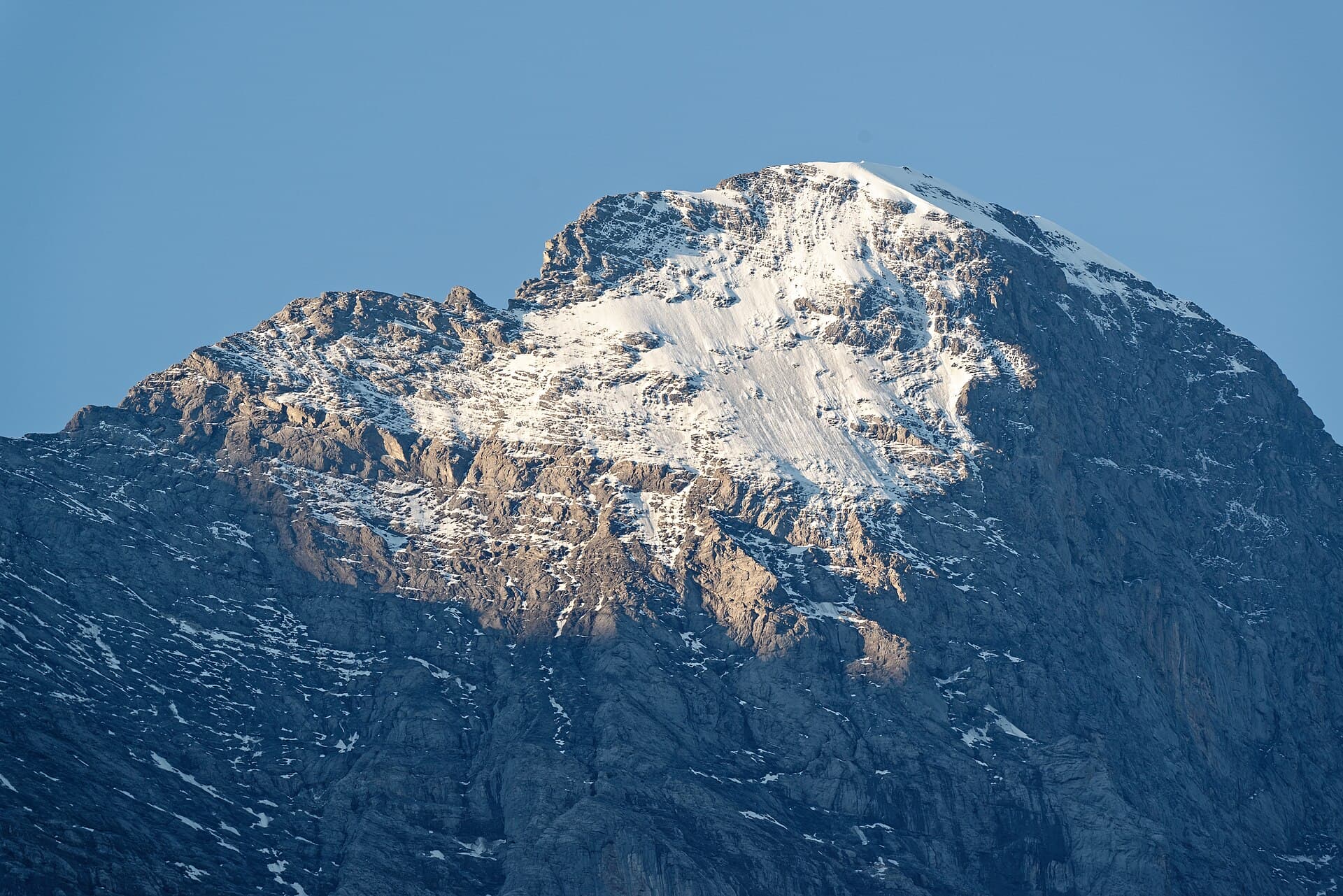
What you see. From Kleine Scheidegg, the Eiger Nordwand fills the southern sky — 1,800 m of vertical wall at close range. The Mönch (4,107 m) and Jungfrau (4,158 m) extend the skyline to the west. This is the viewpoint from which Toni Kurz's death was watched through telescopes in 1936. Hotels at Kleine Scheidegg still have the telescopes.
Terrain. T2 throughout. The ascent from Grindelwald is steady on wide, well-maintained paths. The descent from Kleine Scheidegg to Wengen and then Lauterbrunnen is gentler, following the railway line for much of the distance.
Railway options. This stage can be shortened extensively using the Wengernalp Railway. Grindelwald to Kleine Scheidegg by train: approximately 35 minutes. Kleine Scheidegg to Lauterbrunnen via Wengen: approximately 45 minutes. With a Berner Oberland Pass, both segments are free. This makes it possible to walk only the high section (Kleine Scheidegg area) and ride the rest — a half-day rather than a full day.
Connection to the Eiger Trail. From Kleine Scheidegg, a short train ride or walk reaches Eigergletscher station, the start of the Eiger Trail. Adding the Eiger Trail to this stage makes for a long but spectacular day.
Overnight. Lauterbrunnen (802 m) has hostels, guesthouses, and hotels. The Valley Hostel is a popular budget option. Camping is available at several sites in the valley.
Stage C11: Lauterbrunnen to Griesalp via Sefinenfurgge
The stage. This is where the Via Alpina becomes serious. From Lauterbrunnen (802 m), the trail climbs through the Sefinen valley to the Sefinenfurgge (2,612 m) — the most technically demanding pass on the Bernese Oberland section. The descent to Griesalp (1,407 m) is steep and sustained.
Terrain. T3 (demanding mountain hiking). The ascent to the Sefinenfurgge involves exposed sections with fixed chains on the final approach to the pass. In early season (June, sometimes early July), snow can cover the approach and the north side of the pass. An ice axe and microspikes are recommended before mid-July; in some years, crampons are warranted. By August, the route is typically snow-free.
The pass. The Sefinenfurgge at 2,612 m offers views south toward the Blüemlisalp group and north back toward the Jungfrau massif. It is a narrow gap between rock walls — atmospheric rather than panoramic.
Alternative start. Many hikers take the cable car from Lauterbrunnen to Grütschalp and walk to Mürren (1,638 m) before ascending into the Sefinen valley. This adds variety to the approach and avoids the initial road-walking out of Lauterbrunnen. From Mürren, the Sefinen valley is accessed via a well-marked descent to Gimmelwald and then up-valley.
Griesalp. A small settlement with limited accommodation. The Naturfreundehaus Griesalp and Berghaus Golderli provide dormitory and room options. Book ahead in July-August — there are not many beds.
Planning this route? We're forming a founding group for Via Alpina Bernese — 5-Day Cohort — registering interest is free, no commitment. See the expedition →
Stage C12: Griesalp to Kandersteg via Hohtürli
The stage. Often cited as one of the finest stages on the entire Via Alpina — all 390 of them. From Griesalp (1,407 m), the trail climbs relentlessly to the Hohtürli (2,778 m), the highest pass on the Bernese Oberland section. The descent passes the Blüemlisalphütte (SAC, 2,840 m), skirts the Blüemlisalp glacier, and drops to Oeschinensee (1,578 m) before the final descent to Kandersteg (1,176 m).
The Hohtürli. At 2,778 m, this is a proper high pass. The final 200 m of ascent from the north side are steep and can be loose. On the south side, the trail descends past the Blüemlisalp glacier — which is retreating but still impressive — with views across the Oeschinensee basin and the Kandertal beyond. In early season, the glacier approach may require crampons. By mid-July through September, the path is typically clear.
Blüemlisalphütte (SAC). The SAC hut at 2,840 m sits just below the Hohtürli on the south side. It is a logical overnight stop for those who want to break this long stage into two days, or for those arriving at the pass late in the day. Half-board: CHF 60-75 (SAC member), CHF 85-106 (non-member). Book via the SAC online reservation system. (sac-cas.ch)
Oeschinensee. The UNESCO World Heritage lake at 1,578 m is one of the most beautiful in the Alps — turquoise glacial water beneath 3,000 m cliffs. A gondola from Kandersteg covers most of the return elevation if legs are finished. Swimming is possible in summer (cold). The lake is also a standalone day-hike destination from Kandersteg.
Kandersteg. The trail terminus has full facilities: hotels, restaurants, supermarkets, and a train station with direct connections to Bern (1 hour), Interlaken (30 minutes), and the Lötschberg base tunnel to the Valais.
Logistics and planning
Direction. East to west (Meiringen to Kandersteg) is the standard direction, matching the Via Alpina Green Trail waymarking. The reverse is equally feasible but the signage is less intuitive.
Duration. Four to five days is standard. Fast hikers can compress the route into four days by combining C9 and C10 (long day) or by using transport shortcuts. Most hikers take five days, spending one night at each stage endpoint.
Accommodation summary:
| Night | Location | Options |
|---|---|---|
| 1 | Grindelwald | Hotels, hostels, Berghotel Grosse Scheidegg |
| 2 | Lauterbrunnen | Hotels, hostels, camping |
| 3 | Griesalp | Naturfreundehaus, Berghaus Golderli |
| 4 | Blüemlisalphütte or Kandersteg | SAC hut or town hotels |
The "Approx. CHF/night" column was removed on 14 August 2026: those bands could not be traced to any operator tariff or official statistic.
Transport pass. The Berner Oberland Pass covers PostBus shortcuts (Meiringen to Schwarzwaldalp), the Lauterbrunnen to Grütschalp cable car, and all trains between towns. The Kandersteg to Oeschinensee gondola was removed from the pass for 2026 and is no longer covered — budget for it separately. Six days cost CHF 350 full price or CHF 254 reduced, and the pass is valid all year with no seasonal pricing (as of 14 August 2026). It provides useful flexibility for shortening stages or recovering from weather delays. (berneseoberlandpass.ch prices, 2026 changes)
Maps. SwissTopo 1:25,000 sheets cover the route. The free SwissTopo app provides offline topographic maps at full resolution — download the Bernese Oberland tiles before departure. Trail markings follow the standard Swiss system: white-red-white for T2-T3 mountain trails. Via Alpina signage (green and red diamond markers) supplements the Swiss national markings.
Difficulty assessment. Stages C9 and C10 are straightforward T2 hiking — any reasonably fit walker can complete them. Stages C11 and C12 step up to T3: exposure, steep terrain, possible snow, and sustained effort (1,700-1,800 m of ascent per day). Previous mountain hiking experience is expected for these stages. A Via Alpina traverse through the Bernese Oberland is not a beginner route in its final two stages.
Weather contingency. The Sefinenfurgge and Hohtürli should not be crossed in thunderstorms, poor visibility, or fresh snow. Build at least one weather-contingency day into the schedule. Lauterbrunnen and Grindelwald both have excellent rail connections for rest days. Check MeteoSwiss daily and adjust the plan.
12 Sources
- en.wikipedia.orgVia Alpina — en.wikipedia.org/wiki/Via_Alpina
- schweizmobil.chSchweizMobil Route 1 — schweizmobil.ch
- sac-cas.chSwiss Alpine Club huts — sac-cas.ch
- jungfrau.chJungfrau Railways — jungfrau.ch
- en.wikipedia.orgBernese Oberland — en.wikipedia.org/wiki/Bernese_Oberland
- en.wikipedia.orgOeschinensee — en.wikipedia.org/wiki/Oeschinen_Lake
- en.wikipedia.orgEiger — en.wikipedia.org/wiki/Eiger
- en.wikipedia.orgKleine Scheidegg — en.wikipedia.org/wiki/Kleine_Scheidegg
- meteoswiss.admin.chMeteoSwiss — meteoswiss.admin.ch
- swisstopo.admin.chSwissTopo — swisstopo.admin.ch
- en.wikipedia.orgKandersteg — en.wikipedia.org/wiki/Kandersteg
- berneseoberlandpass.chBerner Oberland Pass 2026, official — prices and tickets, FAQ, 2026 changes
Correction, 14 August 2026: this article previously listed the Kandersteg to Oeschinensee gondola among the services covered by the Berner Oberland Pass — it was removed from the pass for 2026. The six-day price, previously given only as CHF 254 with a Half-Fare Card, is CHF 350 full or CHF 254 reduced, valid all year with no seasonal pricing. The unsourced lodging price bands (hostels CHF 40-60 and luxury hotels CHF 300+ in Stage C9, and the "Approx. CHF/night" column of the accommodation table) have been deleted rather than replaced, because no official Swiss source publishes lodging prices for this region. The SAC hut half-board rates are unchanged.