Alleghanian orogeny~300-250 Ma (Pennsylvanian-Permian; some syntheses ~325-260 Ma with multiple deformation pulses)Ancestral Africa (Gondwana) colliding with ancestral North America (Laurentia) — the final suture of the supercontinent Pangea🌋 none (Neoproterozoic rift lavas only, long extinct) — No active volcanism: the lavas seen in Shenandoah (Catoctin Formation greenstone) erupted about 570 million years ago during the rifting of Rodinia and are long extinct (NPS/USGS). The USGS lists no active volcanic centers in Virginia.
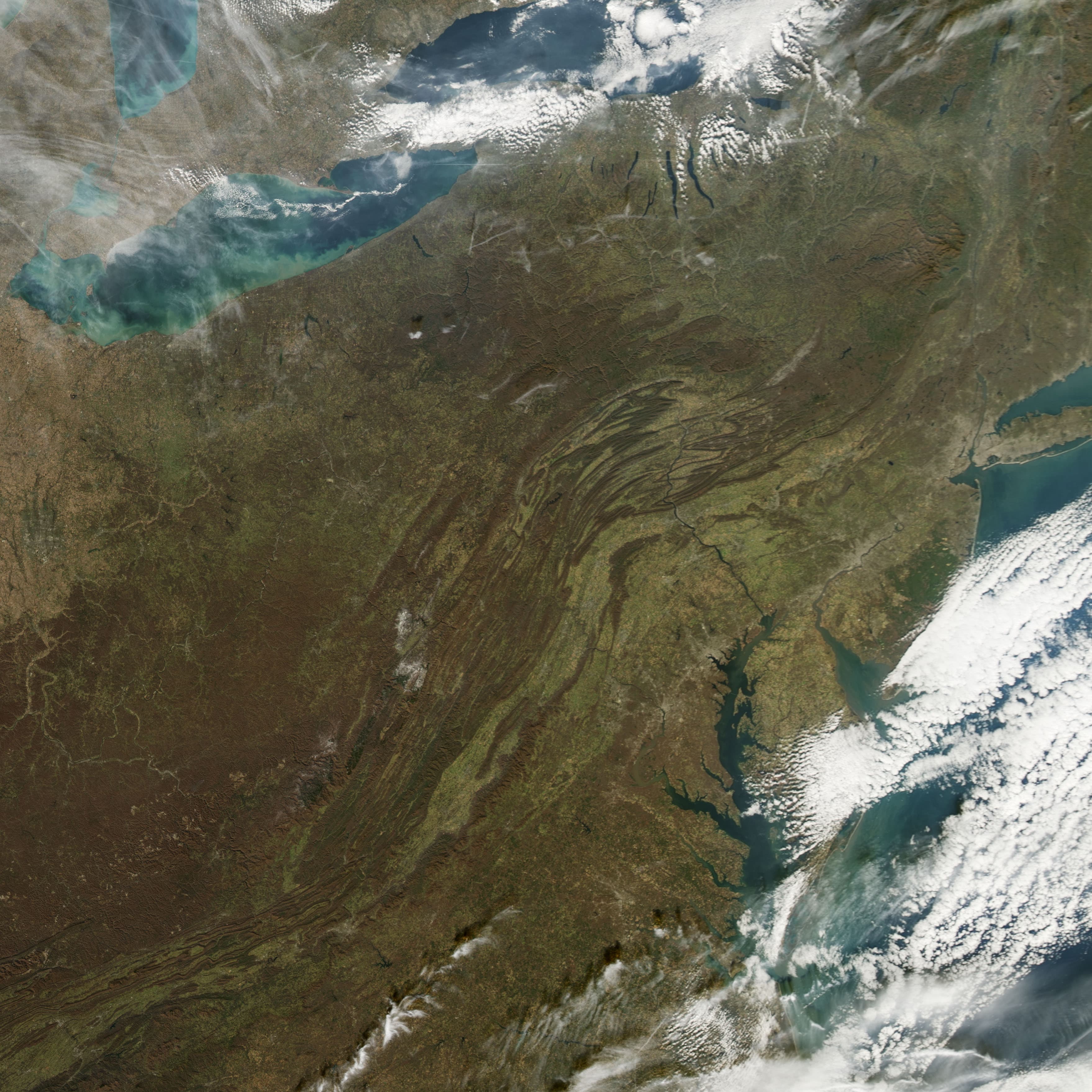
The Appalachian bend: folded and thrust Paleozoic rocks wrapping around the Pennsylvania salient.
NASA Earth Observatory image courtesy Jeff Schmaltz, LANCE MODIS Rapid Response Team at NASA GSFC. · NASA media use guidelines · source
The rocks of Virginia's Blue Ridge remember three worlds. The oldest — the Old Rag Granite and the gneisses of the Pedlar Formation — crystallized over one billion years ago during the Grenville orogeny, deep in the roots of a mountain chain raised when an earlier supercontinent, Rodinia, was assembled (USGS; NPS). Scrambling over Old Rag's bald summit, you are handling basement rock from a mountain range that vanished long before the first animals with shells existed.
When Rodinia tore apart, the second world arrived in fire. About 570 million years ago, floods of basaltic lava poured across the rifting landscape; metamorphosed to greenstone, these Catoctin Formation flows now form the sheer, jagged cliffs of Stony Man, Hawksbill and many other summits in Shenandoah National Park (NPS). The rift became the Iapetus Ocean, and beach and shallow-marine sands along its new shore hardened into the tough Chilhowee Group quartzites that litter the southern district's summits as talus.
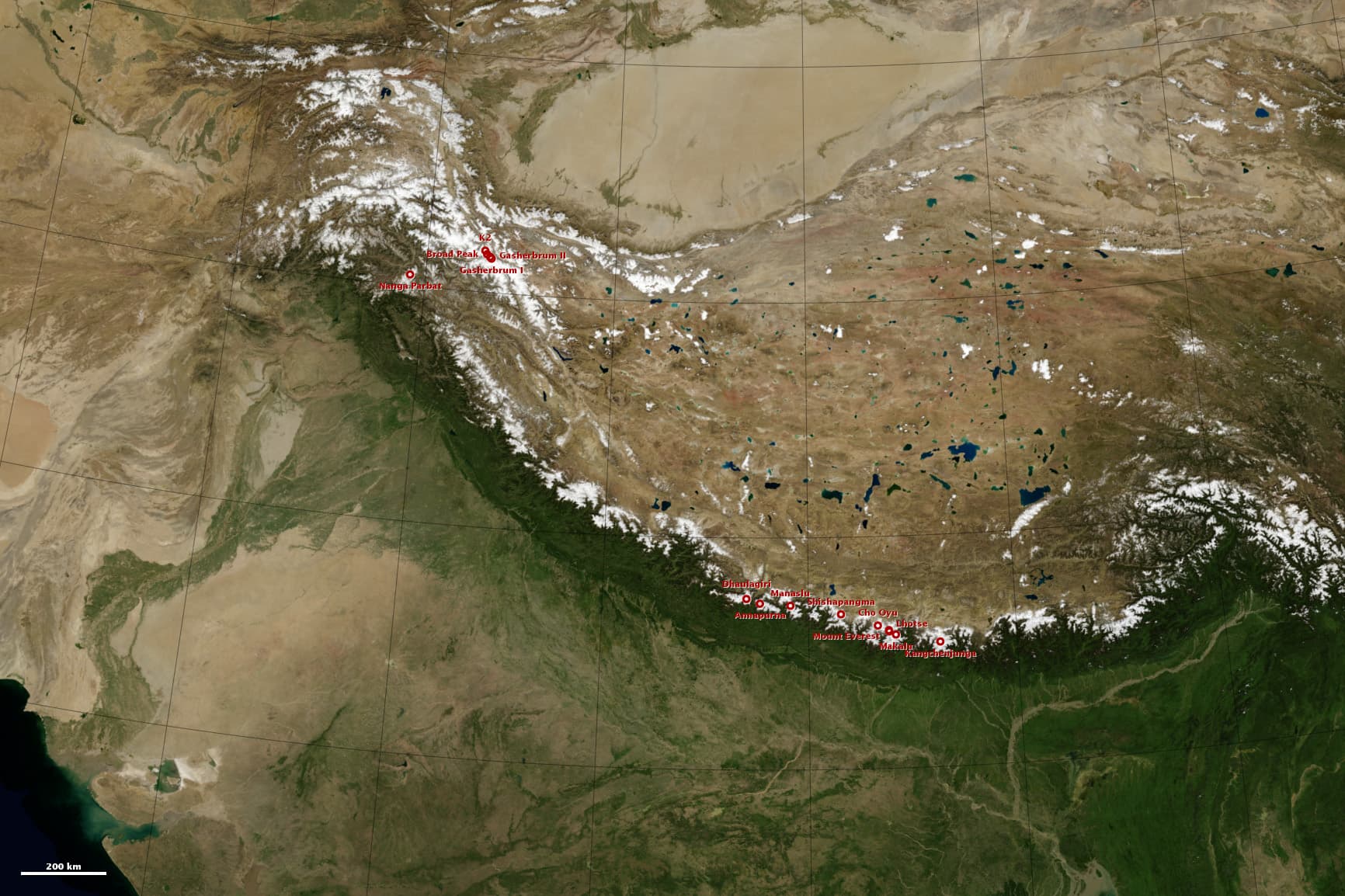
The third world is the one the brief is about: the Alleghanian orogeny. Between roughly 300 and 250 million years ago (Pennsylvanian to Permian; some syntheses count deformation pulses back to ~325 Ma), ancestral Africa collided with ancestral North America, closing the proto-Atlantic oceans and welding the supercontinent Pangea together. The collision drove thrust sheets east-over-west: the Blue Ridge basement itself — Old Rag included — was uplifted and shoved bodily to the northwest, while the sedimentary layers beyond crumpled into the long parallel ridges of the Valley and Ridge province (Historical Geology / opengeology.org; USGS). The NPS states plainly that rugged mountain ranges 'similar to the Himalayas' rose along these collision zones — the ancestral Appalachians among them — 'now much lower thanks to 250 million years of erosion.'
Here is the detail that reorders your sense of time on the trail: when these mountains stood at their full height, there was no Atlantic Ocean. Pangea only began to split at the very end of the Triassic, about 201 million years ago, when vast lava fields erupted along the future seaboard and the North Atlantic started to open (NPS). The ocean that now defines 'the East Coast' is tens of millions of years younger than the mountains that overlook it. Everything you hike in Virginia today — greenstone cliffs, granite domes, quartzite scree — is the deep, erosion-resistant root of that Himalayan-scale range, still standing after a quarter of a billion years of being worn down.
What you can see on the trail
Billion-year-old Old Rag Granite, sliced by dark eroded dikes
📍 Old Rag Ridge Trail rock scramble, Shenandoah National Park
The bare summit domes are Grenville-age granite over one billion years old (USGS hiker's guide, OFR 00-263). The narrow slots the trail squeezes through follow dark basalt feeder dikes — softer rock that fed the Catoctin lava flows and now erodes faster than the granite around it.
Columnar jointing — hexagonal lava columns in the Catoctin greenstone
📍 Compton Peak, via the Appalachian Trail from Compton Gap parking (Skyline Drive mile 10.4); follow the blue blazes below the east viewpoint
As the 570-million-year-old Catoctin lavas cooled, they shrank into hexagonal columns — the same physics as Giant's Causeway. The NPS trail page marks this as one of the park's finest geologic sights.
Sheer greenstone cliffs — stacked rift lava flows
📍 Stony Man and Little Stony Man cliffs, via the Appalachian Trail from Little Stony Man parking (Skyline Drive mile 39.1)
These jagged cliff bands are Catoctin Formation lava flows, erupted ~570 million years ago as the supercontinent Rodinia ripped apart (NPS) — ocean-birth recorded in rock, now standing a kilometer above sea level.
Quartzite talus field — the shattered beach of a vanished ocean
The jumbled block field is Chilhowee Group quartzite — originally sand laid down along the young Iapetus Ocean's shore in the Cambrian, hardened, uplifted in the Alleghanian collision, and shattered by ice-age freeze-thaw (NPS/USGS).
Fun fact
These mountains are older than the ocean beside them. The Alleghanian Appalachians were already Himalayan-scale peaks when there was no Atlantic at all — the ocean only began opening about 201 million years ago as Pangea split (NPS). The range has been eroding for 250 million years and still tops 1,200 meters.
Rocks: Old Rag Granite (~1 Ga, Grenville basement) · Pedlar Formation granodiorite and gneiss (~1 Ga) · Catoctin Formation greenstone (metabasalt, 570 Ma) · Chilhowee Group quartzite (Cambrian)