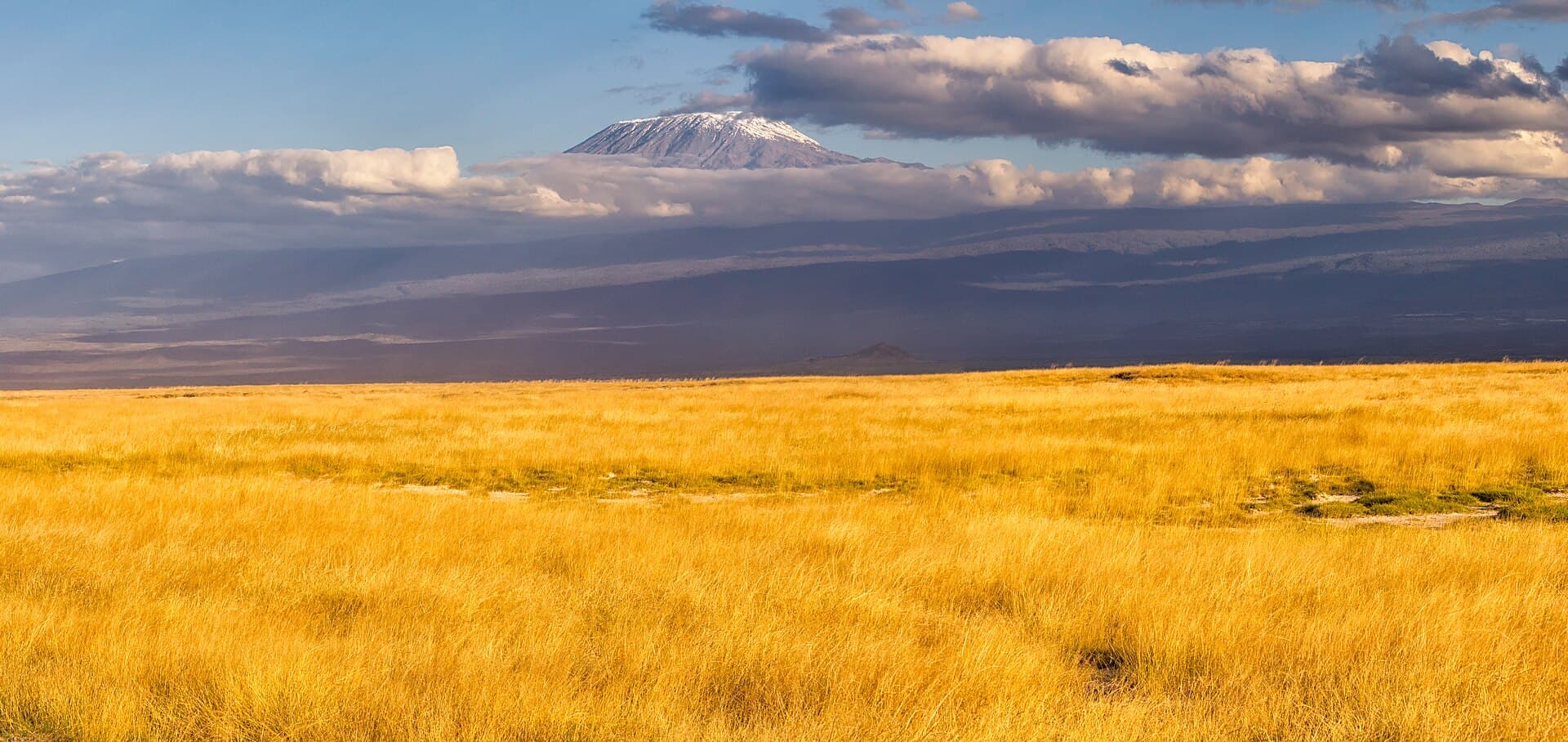
Kilimanjaro has three histories stacked on top of each other. The geological one spans millions of years. The human one spans centuries. The climate one is collapsing into decades. They converge at the summit crater, where the glaciers that survived 12,000 years of climate variation are now disappearing fast enough to measure year over year.
This is the story of who climbed it first, who named it, who renamed it, and what is being lost while the naming arguments continue.
Three cones, three names
Kilimanjaro is not a single peak. It is three volcanic cones on a shared massif, aligned roughly east-west along the East African Rift:
| Cone | Elevation | Status | Chagga meaning |
|---|---|---|---|
| Kibo | 5,895m | Dormant (last erupted ~360,000 years ago) | "Spotted" — the snow patches |
| Mawenzi | 5,149m | Extinct | "Broken top" — the jagged, eroded summit |
| Shira | 3,962m | Extinct (collapsed) | "Collapsed" or "spread out" |
Kibo is the one you climb. Its crater rim holds Uhuru Peak at 5,895m. Mawenzi is a technical rock climb and rarely attempted. Shira collapsed into a caldera roughly 500,000 years ago and is now the broad plateau that forms the western approach.
All three names are Chagga. The Chagga people — Bantu-speaking agriculturalists who have farmed the mountain's southern slopes for at least 500 years — named the peaks long before any European saw them.
Continue reading Getting to Kilimanjaro: Flights, Transfers, Visas, and What to Sort Before You Fly →
The name nobody can explain
The word "Kilimanjaro" has no settled etymology. At least five competing theories exist, none conclusive:
| Theory | Language | Meaning | Source |
|---|---|---|---|
| Kilima Njaro | Swahili | "Mountain of Whiteness" (snow) | Most popular, but njaro doesn't mean white in standard Swahili |
| Kilima Njaro | Swahili | "Mountain of Caravans" (njaro as a trade route term) | Krapf, 1860 |
| Kilema Kyaro | Chagga | "That which defeats the bird" (too high to fly over) | Dundas, 1924 |
| Kileman Ngaro | Maasai (proposed) | "Mountain of the evil spirit" | Johnston, 1886 |
| Kilema Njare | Maasai (proposed) | "Water source" (spring/river origin) | Hutchinson, 1932 |
Source: Hutchinson, "The Meaning of Kilimanjaro," The Geographical Journal, 1932
The reality: nobody knows. The mountain predates the written records of every language group that has tried to name it. The Swahili "Mountain of Whiteness" theory dominates travel brochures but has the weakest linguistic evidence. Hutchinson's 1932 survey remains the most rigorous treatment and leaves the question open.
Thread 1: The first ascent and who gets erased
The European who was called a liar
In 1848, Johannes Rebmann — a German missionary working out of Mombasa — became the first European to see Kilimanjaro. He reported a snow-capped mountain on the equator in the Church Missionary Intelligencer. The response from the British geographical establishment was ridicule. William Desborough Cooley, an armchair geographer who had never been to Africa, published a paper arguing Rebmann was suffering from optical illusions or outright fabrication. Snow on the equator was physically impossible, Cooley claimed.
It took twelve years for the Royal Geographical Society to accept Rebmann's observation. Cooley never retracted.
Source: Rebmann, Church Missionary Intelligencer, 1849
Three attempts, one summit, one erasure
Hans Meyer, a German geologist, and Ludwig Purtscheller, an Austrian mountaineer, reached the summit on October 6, 1889. It was Meyer's third attempt.
The first attempt (1887) turned back at the snow line — Meyer lacked the equipment and local knowledge to navigate the glaciers. The second attempt (1888) was interrupted when Meyer was captured during the Abushiri Revolt — an armed uprising against German colonial rule on the East African coast. Meyer was held for ransom and eventually released after payment by the German East Africa Company.
For the third attempt, Meyer hired Yohani Kinyala Lauwo, an 18-year-old Chagga man from Marangu, as head guide. Lauwo led the party up what is now the Marangu Route — the path the Chagga had used for generations to reach the upper slopes for honey collection and ritual purposes.
Meyer planted a German flag on the summit and named it Kaiser-Wilhelm-Spitze, after the German Emperor. He published his account as Across East African Glaciers (1891). Lauwo's name does not appear in the book.
Source: Meyer, Ostafrikanische Gletscherfahrten (Across East African Glaciers), 1891 — Internet Archive
The guide history forgot — and then remembered
Yohani Kinyala Lauwo continued guiding on Kilimanjaro for more than 70 years after the Meyer expedition. When Tanzanian researchers and journalists tracked him down in the 1980s and 1990s, he was living in Marangu, still sharp enough to recount the 1889 climb in detail. He died in 1996 at an estimated age of 125 — birth records did not exist in 1870s Chaggaland, so the exact figure is uncertain, but multiple independent estimates converge on the 1870-1871 range.
His erasure from Meyer's account was not unusual for the period. European expedition literature systematically omitted or anonymized indigenous guides, porters, and route-finders. Meyer's book credits Purtscheller extensively but treats the Chagga support team as interchangeable labor, not named individuals with navigational expertise.
Lauwo's descendants still guide on Kilimanjaro today. The Tanzanian government erected a plaque in his honor at Marangu Gate. His story surfaced not through academic historiography but through oral tradition — Chagga families preserving what the expedition book discarded.
Sources: Tanzania Tourist Board — Yohani Kinyala Lauwo, BBC — "The forgotten hero of Kilimanjaro," 2016
Thread 2: The renaming
Independence night on the summit
On December 9, 1961, Tanganyika gained independence from Britain. At midnight — the exact moment the Union Jack came down in Dar es Salaam — Lieutenant Alexander Nyirenda of the Tanganyika Rifles stood on the summit of Kilimanjaro and planted the national flag alongside the Uhuru Torch, a lit beacon symbolizing freedom and hope.
The summit was renamed Uhuru Peak. Uhuru is Swahili for freedom.
The renaming was not incidental. It was a deliberate act of geographic decolonization — replacing Kaiser-Wilhelm-Spitze, a name imposed by a colonial power that had seized the territory in the 1880s, with a word that embodied the new nation's founding principle. Julius Nyerere, Tanganyika's first president, had called the mountain "a symbol of our freedom" in his independence speech.
Source: Nyerere, Independence Day Address, December 9, 1961 — Julius Nyerere Foundation
From Tanganyika to Tanzania
In 1964, Tanganyika merged with Zanzibar to form the United Republic of Tanzania. Uhuru Peak — already renamed — became a permanent national symbol, appearing on currency, official seals, and the national imagination. The mountain had been a German possession (1885-1919), then a British League of Nations mandate (1919-1961). Its summit name now carried the weight of that entire arc.
The old name survives only in historical texts and on Meyer's original survey maps. No serious proposal to restore it has ever been made.
Thread 3: The disappearing archive
11,700 years of climate data, drilled from the summit
In 2000, Lonnie Thompson and a team from Ohio State University's Byrd Polar Research Center drilled six ice cores from the Northern Ice Field and Furtwangler Glacier on Kibo's summit plateau. The results, published in Science in 2002, revealed a continuous climate record stretching back 11,700 years — nearly the entire Holocene epoch.
The cores documented droughts, wet periods, volcanic dust layers, and atmospheric composition changes spanning the rise and fall of multiple civilizations. A catastrophic drought ~4,200 years ago — coinciding with the collapse of the Old Kingdom of Egypt and the Akkadian Empire — left a distinct dust layer in the ice.
The glaciers survived that drought. They survived the Medieval Warm Period. They survived the Little Ice Age. They did not survive the twentieth century intact.
The retreat by the numbers
When Hans Meyer reached the summit in 1889, the ice fields covered approximately 12 km². By 1912 — the first year of systematic measurement — the coverage was already declining. The trajectory since then:
| Year | Approximate ice coverage | Source |
|---|---|---|
| 1912 | 12.1 km² | Hastenrath & Greischar, 1997 |
| 1953 | 6.7 km² | Hastenrath & Greischar, 1997 |
| 1989 | 3.3 km² | Thompson et al., 2009 |
| 2000 | 2.5 km² | Thompson et al., 2002 |
| 2007 | 1.8 km² | Thompson et al., 2009 |
| 2022 | ~1.0 km² (estimated) | Bohleber et al., 2023 |
That is an 85% loss between 1912 and 2009. The rate of loss has accelerated: the glaciers lost more ice between 1989 and 2007 (18 years) than between 1912 and 1953 (41 years).
The prediction that didn't happen — and the one that will
In 2006, Al Gore's An Inconvenient Truth projected that Kilimanjaro's glaciers would disappear by 2025. The claim was based on extrapolations from Thompson's data but oversimplified the dynamics. The glaciers did not vanish by 2025. Small remnants persist.
This does not mean the trajectory has reversed. Current peer-reviewed estimates place total glacier loss between 2040 and 2060, with the most commonly cited figure being approximately 2050. The Furtwangler Glacier — the most studied remnant on the summit plateau — shrank by roughly 70% between 2000 and 2023. It is now a thin, fragmented ice body that no longer behaves as a coherent glacier.
The contested claim: TANAPA's glacier numbers
In 2024, TANAPA (Tanzania National Parks Authority) released a statement claiming that glacier coverage on Kilimanjaro had increased from 2.2 km² to 5.92 km² — an apparent tripling. The claim was widely reported in Tanzanian media.
This figure contradicts every independent glaciological study published in peer-reviewed journals. Thompson's team, the European Space Agency's satellite monitoring, and multiple university research groups all document continuous retreat. No mechanism has been proposed that would explain a tripling of ice coverage during a period of rising global temperatures and documented retreat at every other tropical glacier on Earth.
The TANAPA figure appears to use a different measurement methodology — potentially including seasonal snow cover or redefining glacier boundaries — but no peer-reviewed paper supports the claim. It should be treated as contested until independent verification is published.
The physical consequences: Western Breach, 2006
On January 4, 2006, a rockfall on the Western Breach route killed three American climbers — Michael Martino, Douglas Mantle, and Mark Leon. The rocks that struck them had been cemented in place by glacial ice that had retreated, exposing unstable volcanic breccia to freeze-thaw cycles.
TANAPA temporarily closed the Western Breach route, then reopened it with warnings. The route remains the most direct path to the crater but carries objective rockfall hazard that is worsening as ice continues to retreat. The 2006 deaths were not an accident of weather or bad luck. They were a direct physical consequence of glacier loss — the ice that had stabilized the rock for centuries was gone, and the mountain began to come apart.
Source: National Park Service — Kilimanjaro Western Breach Incident Report, 2006, Reuters — "Three Americans killed by rockfall on Kilimanjaro," January 2006
The irreducible insight
Every trekker who reaches the crater rim of Kibo stands at the intersection of deep geological time and acute contemporary crisis.
The three volcanic cones are 750,000 to 2.5 million years old. The Chagga have farmed the slopes for at least five centuries. The summit has carried a European colonial name and an African independence name within the span of a single human lifetime. The glaciers contain an 11,700-year climate archive — the entire Holocene, readable in ice layers — and that archive is melting in real time.
The summit of Kilimanjaro is not a bucket-list checkbox. It is a time-limited encounter with planetary change. The ice that Rebmann saw in 1848, that Meyer walked across in 1889, that Thompson drilled in 2000, will not exist for the next generation of climbers. What took 12,000 years to accumulate is disappearing in roughly 130 years of industrial civilization.
Yohani Kinyala Lauwo guided climbers up this mountain for seven decades. His name was erased from the expedition record and recovered through oral tradition. The glaciers are being erased by atmospheric chemistry, and there is no oral tradition that can recover ice.
The mountain will remain. The record it carries will not.
Sources used in this article:
- Rebmann, J. Church Missionary Intelligencer, 1849
- Meyer, H. Ostafrikanische Gletscherfahrten (Across East African Glaciers), 1891 — Internet Archive
- Hutchinson, H.N. "The Meaning of Kilimanjaro," The Geographical Journal, Vol. 79, No. 3, 1932
- Dundas, C. Kilimanjaro and Its People, 1924
- Hastenrath, S. & Greischar, L. "Glacier recession on Kilimanjaro," Journal of Glaciology, 1997
- Thompson, L.G. et al. "Kilimanjaro Ice Core Records: Evidence of Holocene Climate Change in Tropical Africa," Science, Vol. 298, 2002
- Thompson, L.G. et al. "Glacier Loss on Kilimanjaro Continues Unabated," PNAS, Vol. 106, 2009
- Bohleber, P. et al. "Kilimanjaro's ice fields," Earth-Science Reviews, 2023
- Nyerere, J. Independence Day Address, December 9, 1961
- Tanzania Tourist Board — Yohani Kinyala Lauwo biographical record
- KPAP/KRTO — Kilimanjaro Porters Assistance Project
- TANAPA glacier coverage statement, 2024
- National Park Service — Western Breach Incident Report, 2006
- Reuters — Kilimanjaro rockfall report, January 2006
- Gore, A. An Inconvenient Truth, 2006
- BBC — "The forgotten hero of Kilimanjaro," 2016
6 Sources
- cambridge.orgHastenrath & Greischar, "Glacier recession on Kilimanjaro, East Africa, 1912-89," Journal of Glaciology 43 (1997)
- tc.copernicus.orgStadelmann, Furst, Molg & Braun, "Brief communication: Glacier thickness reconstruction on Mt. Kilimanjaro," The Cryosphere 14 (2020)
- archive.orgHans Meyer, Ostafrikanische Gletscherfahrten (Across East African Glaciers), 1890 - Internet Archive
- nationalgeographic.comNational Geographic, "Tragedy on Kilimanjaro"
- thecitizen.co.tzThe Citizen (Tanzania), "The hero who placed Uhuru Torch on Kilimanjaro"
- education.nationalgeographic.orgNational Geographic Education, "Kilimanjaro"