
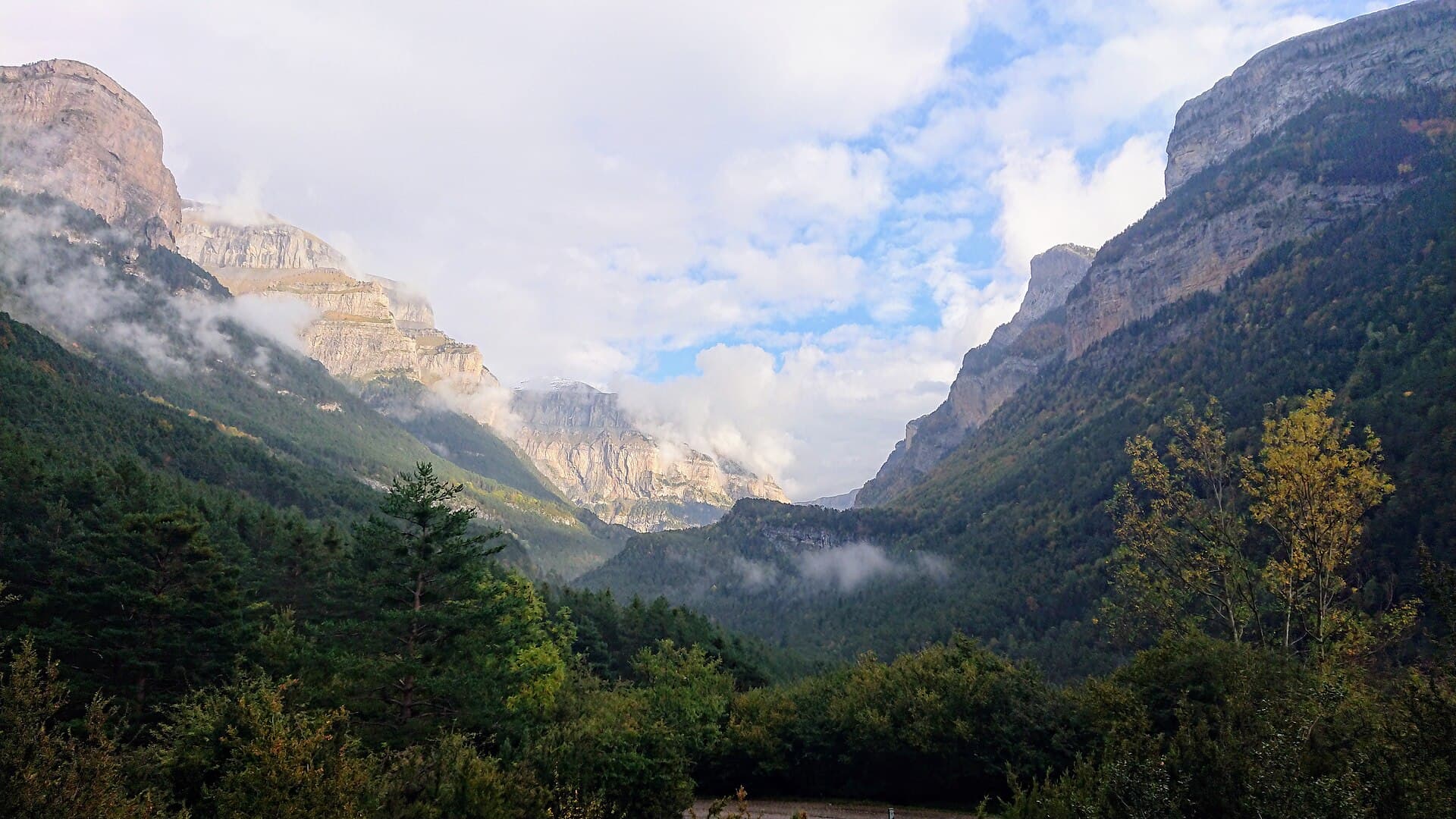
The circuit
Carros de Foc ("Chariots of Fire" in Catalan) is a circular route connecting nine staffed refugis inside Aiguestortes i Estany de Sant Maurici National Park — Catalonia's only national park, established in 1955. The circuit covers approximately 55 km with 9,200 m of cumulative elevation gain. The highest point is Coll de Contraix at 2,745 m. Most parties complete it in 5-7 days. Source: carrosdefoc.com.
The concept is simple: walk between all nine refugis, getting your forfait card stamped at each one. There is no fixed direction or itinerary — you choose your own route and order. This flexibility is the circuit's defining feature. Some hikers add peaks and lakes as side trips; others connect the refugis by the shortest paths.
The park itself sits at the northwestern end of the Catalan Pyrenees. It covers 141 km2 of core area plus a 267 km2 buffer zone. Over 200 glacial lakes dot the landscape. Private vehicles are banned entirely within park boundaries — access is by 4x4 taxi from the villages of Boi (west side) or Espot (east side). Source: parcsnaturals.gencat.cat.
The nine refugis
The circuit connects the following refugis, listed here alphabetically. They can be visited in any order.
Amitges (2,380 m): Overlooking the twin Amitges needles. One of the most photographed settings on the circuit.
Colomers (2,135 m): At the foot of the Colomers lake basin — a cluster of glacial lakes in a granite amphitheater.
Colomina (2,395 m): The highest refugi on the circuit. Views over the Vall Fosca.
Ernest Mallafre (1,885 m): Near Estany de Sant Maurici, the park's most accessible lake. Closest refugi to the Espot entrance.
Estany Llong (2,000 m): In the main valley of Aiguestortes, surrounded by the park's signature twisted-river meadows.
Joan Ventosa i Calvell (2,220 m): In the upper Besiberri valley. Named after a Catalan mountaineer.
Josep Maria Blanc (2,350 m): At the Sallente reservoir, above the Vall Fosca.
Restanca (2,010 m): Near the large Restanca lake. Access point from the Val d'Aran side.
Saboredo (2,310 m): In the Saboredo lake cirque. The most remote refugi on the circuit.
Source: carrosdefoc.com — the refugis.
Continue reading Aneto (3,404m) — the glacier crossing on borrowed time →
The forfait system
The Carros de Foc forfait is the booking mechanism for the circuit. It costs EUR 35-40 (2025/2026 pricing) and includes a 1:50,000 Editorial Alpina map and small gifts. The forfait card gets stamped at each refugi as proof of completion. Source: carrosdefoc.com — reservations.
What the forfait does: It reserves your beds at all nine refugis in a single transaction. You choose your dates and direction when booking. Advance reservation is mandatory — you cannot walk up and expect beds without a forfait booking in July-August.
What the forfait does not cover: Accommodation costs. The forfait is a booking fee and registration, not a pass. You pay for half-board at each refugi individually, on arrival.
Half-board pricing (2025/2026): Approximately EUR 50-65 per person per night. The exact tariffs are published in PDF format at carrosdefoc.com. A deposit is required at the time of booking; the balance is paid at each refugi.
Booking: Through the centralized platform at carrosdefoc.refusonline.com. This is one of the few centralized refugi booking systems in the Pyrenees — most Spanish and French mountain huts require individual contact. The booking office phone is +34 973 641 681, open 9:00-14:00 (October-May), 9:00-17:00 (June-September).
Cancellation: 15+ days before departure: 25% retained. 7-15 days: 50%. Less than 7 days: 100% forfeit. Source: carrosdefoc.com — reservations.
The economics, compared with the Dolomites Alta Via
This is where the Carros de Foc becomes interesting for anyone who has priced out a Dolomites hut-to-hut trek.
Carros de Foc (5 nights, 9 refugis):
- Forfait: EUR 35-40
- Half-board (5 nights x EUR 55 average): EUR 275
- 4x4 taxi access (Boi or Espot): EUR 5-10 per person each way
- Total on-trek cost: approximately EUR 320-330
Dolomites Alta Via 1 (10 nights):
- No booking fee
- Half-board (10 nights x EUR 75-95 non-member): EUR 750-950
- Total on-trek cost: approximately EUR 750-950
Source for Dolomites pricing: rifugioagostini.com; The Hiking Club.
The Carros de Foc delivers a comparable hut-to-hut mountain experience — staffed refugis, cooked meals, mountain scenery — at roughly 35-45% of the Dolomites cost per night. The per-night saving of EUR 20-40 compounds over a multi-day trek. For a party of two on a 5-night circuit, the total saving versus a 5-night Dolomites equivalent is EUR 200-400.
The trade-off: the Dolomites have more dramatic vertical rock architecture and more luxurious rifugi (some serve wine lists). Aiguestortes has granite, glacial lakes, and a wilder character. The Carros de Foc refugis are functional mountain shelters — clean, well-run, but not the restaurant-at-altitude experience that some Dolomites rifugi offer.
Guided departures
Carros de Foc offers guided group departures on fixed dates. For 2026, the confirmed dates are July 20 and August 10. These are organized through the Carros de Foc office and include a mountain guide, pre-planned itinerary, and guaranteed bookings at all nine refugis. Source: carrosdefoc.com.
The guided departures fill early — typically by March for the July date and April for the August date. The self-guided option remains available throughout the season, subject to individual refugi availability.
Access
From Barcelona (BCN): The most common international approach. Drive via C-16 and C-13 to Boi (west entrance) or Espot (east entrance). Approximately 4-5 hours. No practical direct public transport to either village — a rental car or pre-arranged transfer is necessary.
From Toulouse (TLS): Drive via the Val d'Aran (A64 to Vielha through the Bielsa tunnel or via Port de la Bonaigua). Approximately 3-4 hours to Boi.
Inside the park: Private vehicles are prohibited at all times. From Boi, 4x4 taxis run from Plaza del Treio. From Espot, 4x4 taxis operate from the village taxi stand. No reservation needed for taxis — hire directly at the stands. Taxi hours vary by season: April-June 9:00-18:00, July-August 9:00-19:00, November-March 10:00-17:00. Vehicles wider than 2 m cannot access park roads. Source: parcsnaturals.gencat.cat; vallboi.cat.
Park Bus: Operates June to September, connecting Boi and Espot via Val d'Aran, twice daily. Useful for point-to-point logistics if starting and finishing at different park entrances.
When to go
The refugis are open approximately mid-June to late September, with some variation by individual hut. The circuit is snow-free at all passes by early July in a normal year. Late June is possible but may require crossing snow on the higher cols (Coll de Contraix at 2,745 m, Coll de Sendrosa at 2,491 m).
July: Full operations, longest days, warmest temperatures. Afternoon thunderstorm risk builds — the Pyrenean convective pattern (clear mornings, storms from 14:00-17:00) applies here as everywhere in the range. Guided departures are available. Source: hikepyrenees.co.uk.
August: Peak crowds. The forfait sells out for prime weeks. Hot days at valley level (30 C+) but comfortable at refugi altitude (2,000-2,400 m). Thunderstorm risk at its highest.
September: The recommended window. Crowds drop 60-70% after mid-September. Thunderstorm frequency decreases versus August. Temperatures cool (3-15 C at 2,000 m). Most refugis remain open through September 20-30. Shorter days are the trade-off. Source: adventurecreators.com.
Difficulty and fitness
The Carros de Foc is a moderate mountain trek with one qualification: the cumulative elevation gain (9,200 m over 55 km) is substantial. The daily average on a 5-day circuit is approximately 1,840 m of gain — comparable to the harder stages of the Dolomites Alta Via 1 but sustained over every day.
No technical climbing or scrambling is required. The trails are marked and well-maintained. The paths between refugis involve rocky terrain, some scree crossings, and short steep sections, but nothing requiring hands or equipment beyond hiking boots and poles.
The fitness requirement is cardiovascular endurance for sustained uphill walking with a pack, day after day. Anyone who can comfortably hike 10-12 km with 1,500 m of gain in a single day is fit enough. The short inter-refugi distances (averaging 6-7 km per stage) make individual days manageable — but the cumulative effect across five consecutive days is the real challenge.
Permits
No trekking permit is required beyond the forfait reservation. Park entry is free. The only access restriction is the vehicle ban — 4x4 taxis are required to enter and exit the park, but no reservation or permit is needed for the taxis themselves.
Wild camping
Bivouac rules inside Aiguestortes follow the French-style pattern: tolerated more than one hour's walk from roads or park boundaries, between 19:00 and 09:00 only. Tent up after 19:00, down before 09:00. No fires. However, the Carros de Foc is designed as a hut-to-hut circuit — the inter-refugi distances are short enough that wild camping is unnecessary, and the forfait system assumes nightly refugi stays.
Route planning and itinerary options
The Carros de Foc has no fixed itinerary — that is part of the design. But most parties follow one of two common patterns.
The clockwise loop from Boi (5 days): Start with the 4x4 taxi to Estany Llong. Day 1: Estany Llong to Joan Ventosa i Calvell (via Estany Negre). Day 2: Ventosa to Restanca (via Coll de Crabioles). Day 3: Restanca to Colomers to Saboredo. Day 4: Saboredo to Amitges (via the Ratera lakes). Day 5: Amitges to Ernest Mallafre to Colomina to Josep Maria Blanc, then taxi out from the Vall Fosca side. This sequence moves roughly clockwise around the park and distributes the elevation gain evenly across days.
The fast circuit (4 days): Combine two short stages on one of the middle days — typically linking Colomers and Saboredo, or Amitges and Ernest Mallafre. This produces one longer day of 15-18 km with 2,500+ m cumulative gain. Fit hikers with fast-packing setups use this approach. It is not comfortable, but it is efficient.
Direction: Neither clockwise nor counterclockwise has a clear advantage. Clockwise from Boi puts the Restanca-Colomers lake district in the middle of the circuit, which some consider the scenic highlight. Counterclockwise from Espot starts with the Sant Maurici lake and the Amitges needles — a strong opening.
Side trips worth the detour: The Besiberri massif above Joan Ventosa i Calvell offers non-technical peaks above 3,000 m. The Saboredo lake cirque rewards an extra hour of exploration beyond the refugi. The Estanys de Colomers basin — over 30 glacial lakes in a single granite amphitheater — is the densest lake district in the Pyrenees and arguably the circuit's visual centerpiece.
The park's history and character
Aiguestortes i Estany de Sant Maurici was established on 21 October 1955 as Spain's fifth national park. In 1988, the Catalan government assumed ownership, bringing expanded budgets, more staff, and stricter access rules — including the vehicle ban that defines the visitor experience today. A 1997 court ruling resolved litigation between regional and national authorities over park management, establishing a precedent for autonomous community participation in Spain's national park system. Source: Wikipedia — Aiguestortes.
The park's name translates to "twisted waters and Lake of Sant Maurici" — a reference to the sinuous streams that meander through the Aiguestortes meadows. The landscape is granite and slate, shaped by Quaternary glaciation. Over 200 lakes fill the glacially carved basins. The vegetation transitions from montane forest (Scots pine, silver fir) at lower elevations to alpine meadow and bare rock above the treeline at approximately 2,300 m.
The character of the Carros de Foc is fundamentally different from the Dolomites Alta Via. The Dolomites are about vertical rock architecture — towers, walls, and ledge trails. Aiguestortes is about water: lakes, tarns, cascades, and the rivers that connect them. The granite is softer in profile, rounded by ice rather than fractured by weathering. The visual language is horizontal, not vertical. For trekkers who have done the Dolomites, the Carros de Foc offers a complementary rather than competing experience.
Common misconceptions
1. "The Carros de Foc is a trail." It is not a single marked trail. It is a circuit concept — walk between nine refugis by whatever route you choose. There are multiple path options between most refugis. The forfait card and the Editorial Alpina map define the circuit; the exact route is your decision.
2. "55 km is easy in 5 days." The distance is modest. The 9,200 m of cumulative gain is not. This averages nearly 1,900 m of climbing per day. Do not confuse short distance with low difficulty.
3. "You can just show up." In July-August, no. The forfait system exists precisely because demand exceeds refugi capacity. Book the forfait in advance. The guided departures sell out months ahead.
10 Sources
- carrosdefoc.comcarrosdefoc.com — circuit overview
- carrosdefoc.comcarrosdefoc.com — reservations
- carrosdefoc.comcarrosdefoc.com — tariffs PDF
- carrosdefoc.refusonline.comcarrosdefoc.refusonline.com — booking platform
- parcsnaturals.gencat.catparcsnaturals.gencat.cat — Aiguestortes access
- vallboi.catvallboi.cat — Aiguestortes area
- rifugioagostini.comrifugioagostini.com — Dolomites pricing comparison
- thehiking.clubThe Hiking Club — Alta Via 1 cost
- hikepyrenees.co.ukhikepyrenees.co.uk — weather
- adventurecreators.comadventurecreators.com — Pyrenees climate