The Most Important Thing to Know Before You Go
Bariloche gets marketed as "the gateway to Argentine Patagonia." It's in Patagonia the way Chamonix is "in France" — technically correct, but the framing hides what makes the place different from everything else with the same label.
Bariloche is a European-style alpine hut system transplanted to 41°S Valdivian temperate forest. It's closer to the Dolomites than to Torres del Paine. Travelers who understand this get exactly what the place was designed to deliver. Travelers who expect "Torres del Paine with fewer crowds" get confused, disappointed, and write angry Reddit posts.

The latitude tells you everything
| Destination | Latitude | Ecosystem | Hut culture |
|---|---|---|---|
| Bariloche | 41°S | Valdivian temperate forest, lakes, granite spires | European alpine club huts (CAB, est. 1931) |
| El Chalten | 49°S | Patagonian steppe, big glaciers | Minimal infrastructure, mostly camping |
| Torres del Paine (Chile) | 51°S | Sub-Antarctic steppe/forest | Commercial refugios, Chilean wilderness lodge model |
| Tierra del Fuego | 54°S | Sub-polar | Almost nothing |
Bariloche at 41°S and Torres del Paine at 51°S are 1,100 km apart — a difference comparable to the distance between Barcelona and Copenhagen. The forests change, the wind changes, the light changes, the trekking culture changes. The fact that they share a tourism word means nothing ecologically.
Source: Climates to Travel — Bariloche climate, Wikipedia — Valdivian temperate forests.
Continue reading Bariloche vs El Chalten vs Torres del Paine: The Real Comparison →
The hut system is the thesis
Club Andino Bariloche was founded in 1931 — among the oldest alpine clubs in Latin America, explicitly modeled on the German and Austrian alpine clubs. The refugio network predates Nahuel Huapi National Park's formal trail system. The huts are not commercial wilderness lodges like Torres del Paine's EcoCamp. They are mountain-club huts, built and owned by a member cooperative, run by contract hut keepers (refugieros) who pay CAB for operating rights.
This is European mountain culture, not Chilean wilderness tourism. The implications:
- You walk between refugios (huts with beds, blankets, shared dining, bathrooms down the hall) — not campsites
- The huts are crowded by alpine-club standards — Refugio Frey gets ~500 visitors a day in peak season, with three people per two mattresses
- The booking systems, discounts, and social rules are designed for CAB members first and foreigners second
- "Wilderness" is not the product. "Hut hiking in a granite amphitheater" is the product.
If you've hiked the Dolomites Alta Via, the Tour du Mont Blanc, or the Haute Route, you already know the template. If you've only done Torres del Paine or the Inca Trail, this is a different culture — you need to mentally rewire before arrival.
Source: Club Andino Bariloche, Bricepollock — Refugio Frey logistics.
The granite tells you what to actually come for
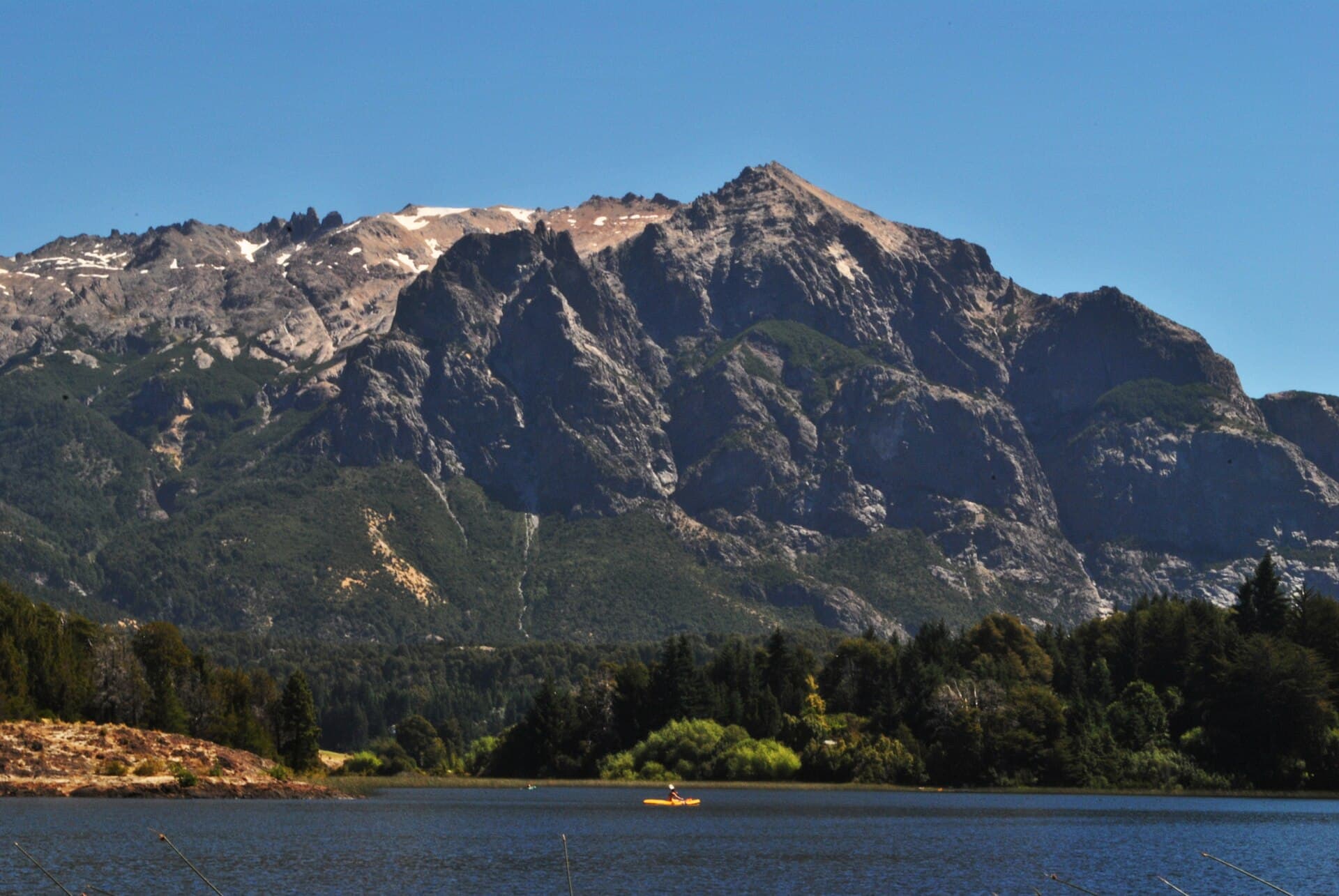
Bariloche's signature scenery is Cerro Catedral's granite spires — a compact alpine amphitheater of needle-like towers visible from Refugio Frey, reached by a 4-5 hour walk from the Villa Catedral ski base. It's one of the best sport-climbing areas in South America, and the trekking access is the side benefit of a climbing town.
- Refugio Frey sits at 1,700m below a cluster of 2,200-2,400m granite needles
- Refugio Jakob and Refugio Italia/Laguna Negra anchor the multi-day traverse at similar elevations
- The Jakob → Laguna Negra leg is the hardest section — unmarked, scrambly, rockfall-exposed, and arguably more technical than anything on the W-trek or Laguna de los Tres
- The high passes (Paso Schmoll, Brecha Negra) cap at ~2,200m
You are hiking in an alpine zone at mid-latitudes, not a subpolar one. Zero altitude sickness risk. Different mental model entirely from Himalayan or even Colorado trekking.
Source: Bariloche Trekking — Sendero 204, AllTrails — 4 Refugios Trek, Sol Salute — Bariloche Refugios.
Planning this route? We're forming a founding group for Bariloche — Frey–Jakob Traverse — registering interest is free, no commitment. See the expedition →
The reframes, summarized
Every consensus statement about Bariloche has a better version:
| What the Instagram-Patagonia narrative says | What the research actually says |
|---|---|
| "Bariloche is Patagonia" | It's the northernmost Lakes District. Torres del Paine is 1,100 km south in a different ecosystem. |
| "Book refugios months ahead" | You cannot book Refugio Frey more than 7 days ahead unless you have a group of 8+. Everyone else walks up or refreshes the site. |
| "Bring USD cash for the blue-dollar arbitrage" | Rates converged in 2025 to within 2%. The arbitrage is dead. A foreign Visa is now rational. |
| "It's a wilderness experience" | Refugio Frey sees ~500 visitors/day. You're "hut hiking in a busy European national park," not Alaska. |
| "It's a starter Patagonia trek" | The Jakob → Laguna Negra leg is more technical than most of the W or Fitz Roy day hikes. Unmarked, scrambly, you can die from a fall. |
| "Bariloche is overpriced for what you get" | Cost-adjusted it's the best value in Patagonia: ~$60/day vs $106/day Torres del Paine. |
| "December-February is the window" | The real non-expert window is mid-December to early March — snow lingers in high passes until mid-Dec, fire/wind risk climbs in late Feb. |
Sources: Refugio Frey reservations, Wanderwallet — Argentina exchange rates, Buenos Aires Herald — Argentina dollar rates, Budget Your Trip — El Chalten vs TdP, Shoulder Season — March in Bariloche.
Who told you this: A 6-lens research analysis of primary sources (Club Andino Bariloche, Parque Nacional Nahuel Huapi, Argentine economics press, climbing blogs, and peer-reviewed catastrophe records). What they gain: nothing. CAB is a non-profit; APN is a federal agency; the climbing blogs are mostly unmonetized. The "Patagonia lite" narrative benefits tour operators selling multi-city packages, not trekkers.
What this changes about your planning
If you absorb this reframe, your plan changes in concrete ways:
- Stop comparing Bariloche to Torres del Paine. They're different products. Do both if you have time — don't substitute one for the other.
- Plan for hut-hiking logistics, not expedition logistics. You'll walk between beds in a restaurant, not set up tents in the wild.
- Assume the CAB booking system is designed for members who speak Spanish and own an 8-digit DNI. Read our refugio system guide to navigate it as a foreigner.
- Skip the USD cash stacks. Bring $150-250 for mountain kiosks and taxis. Use your card for everything else. Read the dollar convergence article for why.
- Don't over-pack for cold. January nights at 1,700m sit at 7°C. Pack for wind and rain, not for Nepal-style down. Read the gear reality article.
- If you're doing the Frey-Jakob-Laguna Negra traverse, respect the hard middle section. It's not a walk. Read the traverse guide before committing.
Summary
Bariloche is not a worse Torres del Paine. It's a different activity entirely — a busy, forested, European-style hut hike through a world-class granite amphitheater, at a latitude where the wind matters more than the cold and the booking UI matters more than the weather forecast. If you come expecting what it is, you'll love it. If you come expecting Chilean Patagonia with fewer tourists, you won't.
The editorial thesis for everything else on this site: use a member-first European alpine club system as a non-member foreigner, without falling into the Instagram-Patagonia expectation trap.
14 Sources
- clubandino.orgClub Andino Bariloche (official) (Tier 1)
- refugiofreybariloche.comRefugio Frey — Reservations (Tier 1)
- bricepollock.comBricepollock — Refugio Frey logistics (Tier 3)
- alltrails.comAllTrails — 4 Refugios Trek (Tier 3)
- solsalute.comSol Salute — Bariloche Refugios (Tier 3)
- barilochetrekking.comBariloche Trekking — Sendero 204 (Tier 3)
- barilochetrekking.comBariloche Trekking — Sendero 205 (Tier 3)
- climatestotravel.comClimates to Travel — Bariloche (Tier 3)
- wanderwallet.ioWanderwallet — Argentina exchange rates (Tier 3)
- buenosairesherald.comBuenos Aires Herald — Argentina dollar (Tier 2)
- budgetyourtrip.comBudget Your Trip — El Chalten vs TdP (Tier 3)
- en.wikipedia.orgWikipedia — Valdivian temperate forests (Tier 4)
- shoulderseason.netShoulder Season — March in Bariloche (Tier 4)
- barilocheturismo.gob.arBarilocheturismo — Italia-Manfredo Segre (Tier 1)