The Annapurna Circuit: Everything a Solo Trekker Needs to Know
The Annapurna Circuit was once the greatest teahouse trek on Earth — a 230 km loop around the Annapurna massif crossing a 5,416m pass through landscapes that shift from subtropical rice paddies to Tibetan plateau. It still is, arguably, but with caveats. Roads have eaten 75% of the original trail. Jeeps enable fatal rapid ascent. And a 2023 mandatory guide rule means "solo" no longer means "alone."
This guide covers the route as it exists in 2026-2027, not as it existed in the guidebooks you read from 2010.
1. Day-by-Day Itinerary: The Standard 14-18 Day Route
The full Annapurna Circuit covers 160-230 km depending on start/end points and side trips. Most trekkers complete it in 12-18 days of walking. Here is the classic counterclockwise itinerary with current (2026) road-bypass options.
| Day | Segment | Altitude (m) | Distance (km) | Walking Time | Notes |
|---|---|---|---|---|---|
| 0 | Kathmandu/Pokhara to Besisahar | 760 | — | 6-7h drive | Bus or jeep. Many now jeep to Jagat or Chame to skip road sections |
| 1 | Besisahar to Bahundanda | 1,310 | ~12 | 5-6h | Subtropical. Hot and humid. NATT trail available to bypass road |
| 2 | Bahundanda to Tal | 1,700 | ~14 | 5-6h | Waterfall at Chamje. Enter Manang District at Tal |
| 3 | Tal to Dharapani | 1,860 | ~12 | 5-6h | Follow Marsyangdi River. Option to detour via Bagarchap |
| 4 | Dharapani to Chame | 2,670 | ~17 | 5-6h | District HQ. First views of Annapurna II. Pine forest begins |
| 5 | Chame to Upper Pisang | 3,300 | ~14 | 5-6h | Apple orchards at Bratang. Choose Upper Pisang (quieter, better views) over Lower |
| 6 | Upper Pisang to Manang (via Ghyaru/Ngawal) | 3,540 | ~20 | 7-8h | Critical bypass: Ghyaru-Ngawal high route avoids road. Stunning Annapurna views |
| 7 | Manang — acclimatization day | 3,540 | varies | varies | Do not skip. Hike to Ice Lake (4,620m) or Gangapurna Lake. Attend HRA altitude briefing |
| 8 | Manang to Yak Kharka | 4,050 | ~10 | 4-5h | Gradual ascent. Vegetation thins. Last proper tea houses |
| 9 | Yak Kharka to Thorong Phedi | 4,525 | ~8 | 3-4h | Or continue to High Camp (4,850m) — shorter pass day but harder acclimatization |
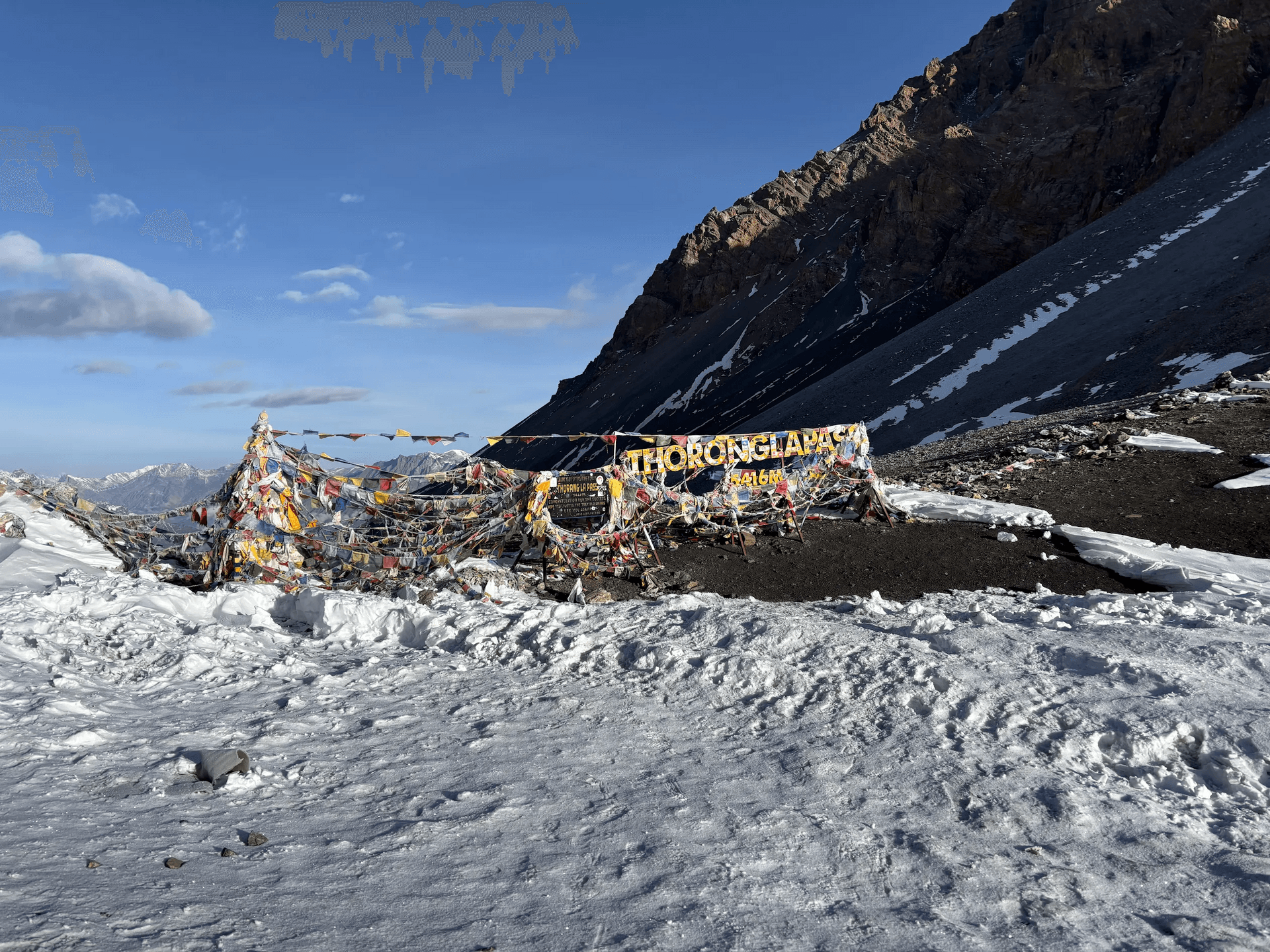
| 10 | Thorong La Pass (5,416m) to Muktinath | 3,800 | ~18 | 9-12h | THE day. Leave 3-5 AM. Details in Section 3 |
| 11 | Muktinath to Kagbeni | 2,800 | ~11 | 3-4h | Descend into Kali Gandaki valley. Muktinath temple worth visiting |
| 12 | Kagbeni to Jomsom | 2,720 | ~10 | 3h | Windy afternoon. Walk early. Road section begins |
| 13 | Jomsom to Tatopani (or bus/jeep) | 1,190 | ~40 | 7-8h or 3h by jeep | Most trekkers take transport. Tatopani has hot springs |
| 14 | Tatopani to Ghorepani | 2,860 | ~13 | 6-7h | Steep climb. Rhododendron forest in spring |
| 15 | Ghorepani — Poon Hill sunrise (3,210m) — Nayapul | 1,070 | ~18 | 7-8h | 4:30 AM start for Poon Hill. Descend to Nayapul, bus to Pokhara |
Total walking days: 13-15 (plus 1-2 rest days). Total elevation gain: ~4,656m net from Besisahar to Thorong La.
Sources: Himalayan Trekkers — altitude and days guide, Discover Altitude — distance and altitude profile, Travel Lexx — day-by-day itinerary, Magical Nepal — detailed itinerary.
Continue reading Everest Base Camp: The Complete Solo Trekker's Guide for 2026-2027 →
2. The Road Problem
This is the single biggest issue facing the Annapurna Circuit in 2026 and the reason some trekkers now skip it entirely.
How much is road?
Up to 75% of the original Annapurna Circuit route has been impacted by road construction. A maintained road now runs from Besisahar to Manang on the east side, and from Pokhara through the Kali Gandaki valley to Muktinath on the west side. Only two sections of 2-3 walking days are entirely road-free: the Thorong La crossing and the Ghorepani/Poon Hill section.
Sources: Nepal Eco Adventure — road construction impact, MountainIQ — road construction guide, Wikipedia — Annapurna Circuit.
Has it ruined the trek?
Not if you use the bypass trails. In 2024-2025, you can walk 95% of the Annapurna Circuit on natural trails using the NATT (Natural Annapurna Trekking Trails), created by Nepalese guide Prem Rai and Dutch trekker Andrees de Ruiter. These trails are waymarked blue and white (the main circuit uses red and white).
Key NATT bypasses:
- Besisahar to Chame: NATT side trail from Karte over the suspension bridge at Nache, through Odar village, rejoining at Bagarchap
- Pisang to Manang: Take the Upper Pisang — Ghyaru — Ngawal high route instead of the valley road through Lower Pisang. This is the single best bypass on the circuit — stunning views of the Annapurna massif from a quiet trail
- Kali Gandaki (west side): Road from Jomsom to Tatopani is heavy with jeep traffic. Most trekkers take a vehicle here or walk the road reluctantly
A free NATT guidebook PDF is available, or pick up a paper copy in Thamel, Kathmandu.
Sources: Horizon Guides — road-free itinerary, Der Eskapist — solo on new trails, Amazon — NATT guidebook.
The verdict
The Annapurna Circuit is not the wilderness experience it was in 2005. On the road sections, you will walk alongside (or on) dusty jeep tracks with occasional vehicles passing. But with NATT trails, route knowledge, and a willingness to take the upper paths, the core experience — subtropical forest transitioning to alpine desert, crossing a 5,416m pass, descending into a different cultural world — remains intact and is still one of the world's great treks.
3. Thorong La Pass (5,416m) — The Crux
The day
This is the hardest day of the entire circuit and one of the highest trekking passes in the world.
| Detail | Data |
|---|---|
| Elevation | 5,416m / 17,769 ft |
| Start point | Thorong Phedi (4,525m) or High Camp (4,850m) |
| End point | Muktinath (3,800m) |
| Total walking time | 9-12 hours |
| Ascent | 570-890m (from High Camp or Phedi) |
| Descent | 1,616m to Muktinath |
| Departure time | 3:00-5:00 AM — non-negotiable |
Why the early start matters
Strong winds develop a few hours after sunrise and intensify through the afternoon. By noon, the pass can be dangerously windy with wind chill plummeting temperatures well below what your gear can handle. Trekkers who depart at 6 AM or later face significantly worse conditions than those who leave at 4 AM.
Temperature
Expect -5C to -15C at the pass in the pre-dawn hours, with wind chill making it feel much colder. Even in peak season (October), you need a serious down jacket, wind-proof layers, insulated gloves, and a balaclava. See our gear guide for specific recommendations.
Thorong Phedi vs. High Camp
| Thorong Phedi | High Camp | |
|---|---|---|
| Altitude | 4,525m | 4,850m |
| Pros | More tea house options, lower sleep altitude | Shorter pass day (2-3h less), higher success rate |
| Cons | Longer pass day, 890m ascent | Higher sleep = worse night, limited lodges |
Most experienced trekkers recommend sleeping at High Camp to shorten the pass day, provided you are acclimatizing well.
What happens if the pass closes
Thorong La can close due to heavy snowfall, blizzards, or avalanche risk. This happens most often December-February but can occur anytime. If closed:
- Wait it out. Thorong Phedi has limited supplies for 1-3 days
- Turn back to Manang and take a jeep from Manang to Besisahar
- Nar Phu Valley alternative: If you planned ahead with the required restricted-area permit ($100/person), you can cross Kang La (5,320m) instead — though this is a harder, more technical pass
- There is no safe way to "push through" a closed pass. The 2014 disaster killed 43 people who were caught in exactly this situation
Sources: Access Nepal Tour — Thorong La complete guide, Responsible Travel — crossing guide, Backpackers Wanderlust — Phedi to High Camp, Wikipedia — Thorong La.
4. Altitude Profile and Acclimatization Schedule
Sleeping altitudes night by night
| Night | Location | Sleeping Altitude | Gain from Previous Night |
|---|---|---|---|
| 1 | Bahundanda | 1,310m | — |
| 2 | Tal | 1,700m | +390m |
| 3 | Dharapani | 1,860m | +160m |
| 4 | Chame | 2,670m | +810m |
| 5 | Upper Pisang | 3,300m | +630m |
| 6 | Manang | 3,540m | +240m |
| 7 | Manang (rest day) | 3,540m | 0 — mandatory |
| 8 | Yak Kharka | 4,050m | +510m |
| 9 | Thorong Phedi/High Camp | 4,525-4,850m | +475-800m |
| 10 | Muktinath | 3,800m | -725 to -1,050m |
| 11 | Kagbeni | 2,800m | -1,000m |
The critical acclimatization stop: Manang (3,540m)
Manang is the unofficial acclimatization capital of the Annapurna Circuit. Do not skip your rest day here. This is the last safe plateau before you enter the extreme altitude zone.
What to do on rest day:
- Hike to Ice Lake (Kicho Tal, 4,620m): The single best acclimatization day hike on the circuit. 7 hours round trip, ~1,080m elevation gain. Textbook "climb high, sleep low"
- Hike to Gangapurna Lake: Shorter, easier option (1-2 hours)
- Attend the HRA (Himalayan Rescue Association) altitude briefing: Free daily talk on altitude sickness symptoms and prevention
- Do NOT just sit in your tea house. Active rest with altitude exposure is far more effective than passive rest
When to add a second rest day
Add an extra rest day at Manang if you have any AMS symptoms (headache, nausea, poor appetite, dizziness). Also consider adding a rest day at Yak Kharka (4,050m) if you're feeling the altitude.
The golden rule above 3,000m: Never increase sleeping altitude by more than 500m per day. For the full science behind this, read what altitude actually does to your body. The itinerary above mostly follows this, but the jump from Chame (2,670m) to Upper Pisang (3,300m) at +630m is aggressive — monitor yourself carefully that night.
Sources: Magical Nepal — altitude sickness guide, Nepal Hiking Team — acclimatization in Manang, Laidback Trip — Manang day trips, Travel Lexx — Ice Lake hike.
5. Tea Houses: What to Expect
Quality gradient
Tea house quality drops dramatically with altitude:
| Zone | Altitude | What You Get |
|---|---|---|
| Lowland (Besisahar-Dharapani) | 760-1,860m | Multi-story concrete buildings, private rooms, attached western bathrooms, hot water, Wi-Fi |
| Mid-altitude (Chame-Manang) | 2,670-3,540m | Basic rooms, shared bathrooms, intermittent hot water, charging available ($1-3) |
| High altitude (Yak Kharka-Thorong Phedi) | 4,050-4,850m | Bare minimum: thin walls, shared dorms, no showers, freezing at night, limited menu |
| West side (Muktinath-Jomsom) | 2,720-3,800m | Better quality again — road access means supplies are easier |
NTNC-regulated pricing
The Annapurna Conservation Area is managed by the National Trust for Nature Conservation (NTNC). Tea houses are monitored and must follow fixed pricing, standard menus, and building limits (caps on how many tea houses can operate on each route section).
Current approximate prices (2025-2026):
| Item | Lowland | High Altitude |
|---|---|---|
| Room per night | NPR 500-1,000 ($4-8) | NPR 1,000-2,000 ($8-17) |
| Dal bhat | NPR 500-700 ($4-6) | NPR 700-1,000 ($6-10) |
| Noodles/pasta | NPR 400-600 | NPR 600-900 |
| Tea/coffee | NPR 100-200 | NPR 200-400 |
| Charging devices | Free | NPR 100-300 ($1-3) |
| Hot shower | Free or NPR 100 | NPR 300-500 ($3-5) |
| Wi-Fi | Free or NPR 100 | NPR 200-500 ($2-5) |
Important: Many tea houses offer free or cheap rooms if you eat all meals there. This is the norm — asking for a room without eating there will cost significantly more.
Budget estimate: $25-35 per day for food + accommodation on the trail.
Sources: OneSeed Expeditions — tea house guide, Nepal Eco Adventure — tea house prices, Follow Alice — accommodation guide, The Himalayan Odyssey — accommodation guide.
6. Direction Debate: Counterclockwise vs. Clockwise
The overwhelming consensus: counterclockwise (east to west)
99% of trekkers walk the Annapurna Circuit counterclockwise — from Besisahar up the Marsyangdi valley, over Thorong La, and down the Kali Gandaki.
| Factor | Counterclockwise (standard) | Clockwise |
|---|---|---|
| Acclimatization | Gradual ascent over 7-8 days to Thorong La. Manang provides perfect rest stop | West side offers no equivalent acclimatization village. Rapid altitude gain |
| Thorong La approach | ~570m ascent from High Camp. Manageable | ~1,200m ascent from Muktinath side. Steep, relentless, and dangerous |
| Road problem | Road sections come first (east side) when you're fresh, trail sections come later | Trail sections first, road sections last — ends with a whimper |
| Social | You'll meet other trekkers going the same direction. Safety in numbers for pass day | Nearly alone. Very few tea houses expect clockwise trekkers |
| Scenery | Walking "into" the mountains as landscape transforms. Dramatic reveal at Thorong La | Mountains behind you. Less dramatic progression |
When clockwise might make sense
Almost never for the standard circuit. The only argument is avoiding crowds, but the risks of poor acclimatization and the 1,200m brutal ascent from the west side make it a poor trade-off for all but very experienced high-altitude trekkers.
Sources: Wikipedia — Annapurna Circuit, Backpack Adventures — ultimate guide, TripAdvisor — clockwise discussion.
7. Permits and Costs
Required permits (2026)
| Permit | Cost (Foreigners) | Cost (SAARC) | Where to Get |
|---|---|---|---|
| ACAP (Annapurna Conservation Area Permit) | NPR 3,000 + 13% VAT (~$30) | NPR 1,000 | NTNC offices in Kathmandu (Bhrikutimandap) or Pokhara (Lakeside), or at Besisahar gate. Also available via NTNC e-permit portal |
| TIMS (Trekkers' Information Management System) | Not required as of 2023 | — | Checkpoints verify ACAP only |
The mandatory guide rule (2026)
Since April 1, 2023, all foreign trekkers must employ a licensed, TAAN-certified guide through a registered trekking agency. As of March 2026, Nepal eased rules for restricted areas to allow solo travelers to apply for permits without a second person — but a guide is still mandatory.
Enforcement reality: The Kathmandu Post reported in February 2025 that the "solo ban fails to deter trekkers from Annapurna Circuit," and multiple 2024-2025 trip reports indicate inconsistent enforcement. However, digital permit scanners at checkpoints are being rolled out, and enforcement is tightening for 2026-2027. Plan to have a guide.
Guide cost: $25-35/day. For a 15-day trek: $375-525. Our agency guide covers how to find a reputable agency and what to pay.
Total budget
| Category | Budget | Standard |
|---|---|---|
| ACAP permit | $30 | $30 |
| Guide (15 days) | $375 | $525 |
| Porter (optional, 15 days) | $300 | $375 |
| Food + lodging on trail | $375-525 | $450-600 |
| Transport (Kathmandu-Besisahar + Jomsom-Pokhara) | $30-40 | $175-200 |
| Tips (guide + porter) | $75-150 | $100-200 |
| Gear rental (if needed) | $50-100 | — |
| Total (in-Nepal) | $1,235-1,670 | $1,655-1,930 |
Use the budget calculator to plan your spend, or read the real cost of trekking Nepal for a full breakdown.
Sources: Shikha Adventure — 2026 permits update, Himalayan Adventure Treks — permit fees 2026, Kathmandu Post — solo ban enforcement, Best Heritage Tour — mandatory guide rule, Himalayan Masters — cost breakdown.
8. Getting There and Back
To the trailhead: Kathmandu/Pokhara to Besisahar
| Option | Duration | Cost | Notes |
|---|---|---|---|
| Bus: Kathmandu to Besisahar | 6-7 hours | ~$15 | From Gongabu (New) Bus Park. Daily departures |
| Private jeep: Kathmandu to Besisahar | 5-6 hours | ~$175 total | Faster, more comfortable |
| Flight + bus: Kathmandu to Pokhara (25 min flight) + bus to Besisahar | 3-4 hours total | ~$100-130 | Fastest option |
| Jeep: Besisahar to Chame/Dharapani | 3-5 hours | $15-30 | Common shortcut. Skips road sections. Recommended |
From the end: Jomsom/Muktinath to Pokhara
| Option | Duration | Cost | Notes |
|---|---|---|---|
| Flight: Jomsom to Pokhara | 20-25 min | ~$160 one-way | Morning flights only (6:15-10:00 AM). Frequently cancelled by wind/weather. Book but don't count on it |
| Local bus: Jomsom to Pokhara | 10-12 hours | ~$20 | Rough road. Dusty. Long |
| Shared jeep: Jomsom to Pokhara | 8-10 hours | ~$40-50/person | Most common option |
| Private jeep: Jomsom to Pokhara | 8-10 hours | ~$280 total | Worth splitting with other trekkers |
Warning about Jomsom flights: They operate only in early morning before Kali Gandaki winds pick up. Cancellations of 2-5 consecutive days are common. Do not book an international flight home for the day after your planned Jomsom flight. Build 2-3 buffer days.
Sources: Namaste Nepal Trekking — Kathmandu to Besisahar, Nepal Flight Ticket — Jomsom flights, HoneyGuide — getting to Jomsom.
9. The Jomsom-Muktinath Jeep Death Trap
This is one of the most under-reported dangers on the Annapurna Circuit, and it kills people every year.
The problem
The road from Pokhara (822m) to Muktinath (3,800m) enables motorized ascent of 3,000m in a single day. Pilgrims — particularly Indian religious tourists visiting Muktinath temple — routinely drive from Pokhara to Muktinath in one long jeep ride without any acclimatization.
The death toll
- 2024-2025 (Nepali fiscal year): 11 tourists died from altitude sickness in Mustang district alone. Five died in Muktinath, five in Jomsom, one in Thasang. Victims included Nepalis, Indians, and others. Source: The Annapurna Express
- 2023-2024: The Annapurna Conservation Area reported 21 deaths from altitude sickness across the entire conservation area. Most were in the Muktinath/Mustang corridor. Source: Annapurna Express
- Hospital data: Provincial Hospital Jomsom treated 14 altitude sickness patients in one month (mid-July to mid-August), 43 in the next month, and 78 in a single month (mid-September to mid-October) during peak season. Source: Rising Nepal Daily
Who is at risk
Primarily non-trekkers arriving by vehicle: religious pilgrims, tourists on jeep tours, and anyone who drives directly to Muktinath or Jomsom without spending nights at intermediate altitudes. Trekkers walking the circuit counterclockwise are at far lower risk because they acclimatize over 7-10 days before reaching this altitude.
What this means for circuit trekkers
If you are walking the circuit in the standard counterclockwise direction, you arrive at Muktinath on the descent from 5,416m — you are already well-acclimatized. The risk is minimal.
The danger is if you skip ahead by jeep — for example, taking a jeep from Besisahar directly to Manang (3,540m) to save time. This replicates exactly the rapid-ascent pattern that kills the jeep pilgrims. Do not do this.
Sources: Nepal York — 18 deaths in Annapurna region, Himalayan Times — 7 deaths in Mustang, Nepal Khabar — 11 deaths.
10. Side Trips Worth Taking
Tilicho Lake (4,919m) — Highly Recommended
The world's highest large lake. A 2-3 day detour from the main circuit, branching off between Manang and Yak Kharka.
| Detail | Data |
|---|---|
| Altitude | 4,919m (16,138 ft) |
| Days added | 2-3 |
| Route | Manang → Khangsar → Tilicho Base Camp → Tilicho Lake → return to main trail |
| Difficulty | Challenging — narrow paths, exposed terrain, limited lodges |
| Best for | Experienced trekkers who want the most spectacular high-altitude lake in the Himalayas |
The approach through the Khangsar valley is demanding but the reward — a turquoise lake ringed by ice-covered peaks including Tilicho Peak, Annapurna II, and Gangapurna — is extraordinary. Not many trekkers take this detour, which is part of its appeal.
Sources: Laidback Trip — Tilicho side trip, Full Time Explorer — Tilicho itinerary.
Ice Lake / Kicho Tal (4,620m) — Essential
Not really a "side trip" — this should be your mandatory acclimatization day hike from Manang.
| Detail | Data |
|---|---|
| Altitude | 4,620m (15,157 ft) |
| Time | 7 hours round trip from Manang |
| Elevation gain | ~1,080m |
| Trail start | Clearly signed from Braga village |
Pushing to 4,620m and returning to sleep at 3,540m is textbook altitude training. The lake itself is stunning — frozen in winter, crystal blue in summer — with panoramic views of Tilicho Peak, Annapurna I and II, Gangapurna, Chulu East, and Pisang Peak.
Sources: Travel Lexx — Ice Lake hike, Magical Nepal — Ice Lake guide, The Outbound — Kicho Tal.
Pisang Peak (6,091m) — Expedition, Not a Day Trip
This is a proper mountaineering peak, not a trekking side trip.
| Detail | Data |
|---|---|
| Altitude | 6,091m (19,984 ft) |
| Permit cost | $125 (autumn) / $250 (spring) + $500 refundable garbage deposit |
| Total cost with agency | $2,000-3,500 |
| Duration added | 4-6 days |
| Skills required | Basic crampons, ice axe, rope work |
Only consider this if you have mountaineering experience and want to bag a 6,000m peak. It combines well with the circuit but is a fundamentally different undertaking.
Sources: Nepal Adventure Trail — Pisang Peak guide, Peace Nepal Treks — permit costs.
11. Annapurna Circuit vs. Annapurna Base Camp (ABC)
For trekkers with limited time, this is the core decision.
| Factor | Annapurna Circuit | Annapurna Base Camp |
|---|---|---|
| Duration | 14-21 days | 7-12 days |
| Max altitude | 5,416m (Thorong La) | 4,130m (ABC) |
| Difficulty | Hard. Extended high altitude, long days, 5,000m+ pass | Moderate. Steep but shorter |
| Landscape variety | Enormous. Subtropical → alpine → Tibetan plateau → Kali Gandaki valley | Limited. Forest → glacier → mountain amphitheater |
| Cultural variety | Hindu lowlands → Tibetan Buddhist Manang → Mustang | Gurung villages throughout |
| Road problem | Severe on parts of the circuit | Less affected — trail is foot-only above Chhomrong |
| AMS risk | Significant. 1,300m higher max altitude | Lower but still present above 3,500m |
| The "wow" moment | Crossing Thorong La at dawn. The sheer scale of completing a circuit around an 8,000m massif | Standing in the Annapurna Sanctuary — a natural amphitheater of 7,000-8,000m peaks surrounding you |
| Best for | 3+ weeks in Nepal, wants the classic long trek, comfortable at high altitude | 10-14 days total, wants dramatic mountain views without extreme altitude |
Honest recommendation
If you have 2 weeks or less in Nepal total: do ABC. It's a more concentrated experience, less impacted by roads, and the Sanctuary amphitheater is genuinely one of the most dramatic mountain landscapes on Earth.
If you have 3+ weeks and want the defining Nepal trek: do the Circuit with Tilicho Lake and Ice Lake side trips. Despite the roads, the full experience of circumnavigating an 8,000m peak through multiple climate zones and cultural regions is unmatched.
Sources: The Mountain Company — ABC vs Circuit, Magical Nepal — comparison, Earth's Edge — comparison.
12. Weather and Best Months
Season breakdown
| Season | Months | Conditions | Verdict |
|---|---|---|---|
| Autumn (post-monsoon) | Oct-Nov | Clear skies, stable weather, cool nights, best visibility | Peak season. Best overall conditions |
| Spring (pre-monsoon) | Mar-May | Warming, rhododendrons blooming, some haze, snow melt improves trails | Second best. Fewer crowds than autumn |
| Winter | Dec-Feb | Cold, Thorong La often blocked with snow, many tea houses closed | Not recommended unless experienced |
| Monsoon | Jun-Sep | Heavy rain on east side. Kali Gandaki (west) is in rain shadow and passable | Possible but challenging. Leeches below 3,000m |
October: The best and most dangerous month
October offers the most stable weather and clearest mountain views, making it the most popular month. But October also carries a specific risk: late-monsoon cyclones.
The 2014 disaster
On October 14, 2014, Cyclone Hudhud — a tropical cyclone in the Bay of Bengal — merged with an upper atmospheric trough and drove a catastrophic snowstorm into the Annapurna and Dhaulagiri ranges. 1.8 meters of snow fell in 12 hours. Over 200 trekkers were on or near Thorong La.
43 people died, including 21 trekkers of various nationalities, plus guides, porters, and yak herders. 407 people were rescued, including 226 foreigners. Bodies were found frozen on the trail. It was Nepal's worst trekking disaster.
What changed:
- Weather monitoring and early warning systems improved (though still imperfect)
- More tea houses at high altitude serve as emergency shelters
- ACAP checkpoints now track trekker locations more closely
- But the fundamental risk remains: October is cyclone season in the Indian Ocean, and storms can reach the Himalayas
Recommendation: If trekking in October, check weather forecasts obsessively (especially Bay of Bengal cyclone tracking). If a storm is predicted, descend immediately. Do not attempt Thorong La in deteriorating weather.
Sources: Wikipedia — 2014 Nepal snowstorm disaster, National Geographic — deadly blizzard, Backpacker — inside Nepal's deadly blizzard, NASA Earth Observatory — blizzard in Nepal.
13. Crowds
The numbers
The Annapurna region set a record in 2024: 244,045 foreign trekkers, a 27% increase over 2023 and exceeding the pre-COVID peak by a significant margin. This number covers all Annapurna treks (Circuit, ABC, Poon Hill, Mardi Himal), not just the circuit.
When it's worst
October and November account for nearly half the annual total. In 2024, 8,853 trekkers entered in October and 6,902 in November. The second peak is March-May (spring season).
Where it's worst
| Location | Crowd Level | Why |
|---|---|---|
| Poon Hill | Extremely crowded | Short trek from Pokhara. Day-trippers and Poon Hill-only trekkers |
| Manang | Crowded in peak season | Everyone stops to acclimatize. Limited tea houses |
| Thorong La pass day | Moderate-high | Bottleneck — everyone crosses the same day/time window |
| Muktinath | Crowded | Religious pilgrims arrive by jeep year-round |
| Besisahar-Chame (road section) | Low trekker density | Most trekkers now jeep through this section |
| Upper Pisang-Ghyaru-Ngawal | Low | The high bypass route is quieter than the road |
| Tilicho Lake detour | Low | Extra days deter most trekkers |
How to avoid crowds
- Trek in late November or early March — shoulder season with decent weather but far fewer trekkers
- Take the NATT bypass trails — the high routes are always quieter
- Add the Tilicho Lake detour — filters out the majority of trekkers
- Start from Besisahar on foot instead of jeeping to Chame — you'll have the lower trail nearly to yourself (though it's on/near the road)
Sources: Mission Himalaya Treks — record-breaking 2024 tourism, Kathmandu Post — solo ban and trekker numbers, Annapurna Encounter — trekking stats.
Summary: Is the Annapurna Circuit Still Worth It?
Yes, with caveats. The road problem is real but solvable with NATT trails. The mandatory guide rule adds cost but provides safety. The altitude is serious — 21 deaths from AMS in the conservation area in a single year — but manageable with proper acclimatization. The 2014 disaster proved that even "safe" trekking seasons carry catastrophic risk.
The Annapurna Circuit in 2026 is not the wilderness trek it was 20 years ago. It is a well-established, tea-house-supported, road-adjacent, guide-mandatory, permit-regulated trek through some of the most dramatic landscape on Earth. If you walk it with realistic expectations — not nostalgia for the 2005 version — it remains one of the greatest multi-day treks in the world.
Walk counterclockwise. Take the NATT bypass trails. Do not skip your Manang rest day. Leave for Thorong La before dawn. And never, ever take a jeep to altitude without acclimatizing first.