The mountain is 4,808 metres. The system around it is 280 years old.
Mont Blanc is not visually exceptional. It is a massive snow dome — tall for the Alps, but not a spire. Dozens of Himalayan peaks are more dramatic. What made Mont Blanc the most famous mountain in the world was not geology. It was a specific sequence of human interventions, all originating from one valley.
Each intervention was institutional — driven by scientists, cooperatives, engineering projects, and national trail organizations. Chamonix provided the organizational architecture. Mont Blanc provided the raw material.
Understanding this inverts the way most trekking content frames the region. Chamonix is not the town where you sleep before the walk starts. It is the story.
1760: The bounty that invented mountaineering
In 1760, Genevan naturalist Horace-Benedict de Saussure visited the Chamonix valley — then called "Chamouny," part of the Duchy of Savoy, not yet France — and offered a cash reward to anyone who could find a route to the summit of Mont Blanc or demonstrate it could be climbed. The bounty stood uncollected for 26 years. Multiple attempts failed. (Royal Society, Notes and Records; AAC Publications)
What Saussure wanted was not sport. He wanted data: barometric readings, temperature measurements, geological observations from the highest point in the Alps. The concept of climbing a peak for its own sake did not yet exist as a cultural practice. The bounty turned a mountain into a problem to be solved rather than a hazard to be avoided.
On 8 August 1786, Dr. Michel-Gabriel Paccard (physician of Chamonix) and Jacques Balmat (crystal hunter and chamois tracker from the valley) reached the summit at 6:23 PM. Their packs contained blankets, food, and Paccard's scientific instruments. This is the founding event of mountaineering as a human activity. (AAC Publications; Explorersweb)
The narrative was immediately hijacked. Marc-Theodore Bourrit, a Genevan writer and failed Mont Blanc aspirant, publicly credited Balmat alone — likely out of personal rivalry with Paccard. For nearly two centuries, Balmat was the celebrated figure. The Balmat statue (depicting him pointing to the summit, with Saussure at its base) stood in the Chamonix town square from 1887. A Paccard statue was not erected until the 200th anniversary in 1986. (AAC Publications, "Memorial to Dr. Paccard"; SummitPost)
On 3 August 1787, Saussure himself reached the summit with a party of 18 guides. He carried two three-foot glass barometers filled with mercury, a cyanometer (his own invention, measuring the blueness of the sky at altitude), a eudiometer (measuring oxygen content), and conducted experiments on the boiling point of water at altitude. His four-volume Voyages dans les Alpes (1779-1796) established the Alps as a scientific laboratory, not merely scenery. He is considered the father of modern Alpine research and a founding figure of geology and glaciology. (SciHi Blog; Linda Hall Library)
The first ascent of Mont Blanc was a scientific expedition funded by an Enlightenment naturalist. Alpinism was born from curiosity, not conquest. No other mountain destination can claim this origin story.
Continue reading Goûter vs Trois Monts: an honest comparison of the two normal routes →
1821: The oldest mountain guide company on Earth
On 20 August 1820, an avalanche on the route to Mont Blanc killed three guides: Auguste Tairraz, Pierre Balmat, and Pierre Carrier. The disaster exposed a structural problem: guides worked as independent freelancers with no mutual aid, no insurance, and no equitable distribution of clients. The bereaved families had no safety net. (Compagnie des Guides official history; Chamonix.com, 200th anniversary)
In 1821, the Chamonix municipal council organized the guides into a formal company with 34 founding members — including Jacques Balmat, then aged 59, who had made the first ascent 35 years earlier. Two institutions were created:
Caisse de Secours (Relief Fund): A solidarity fund to support families of guides killed or injured in the mountains. This was, in effect, one of the world's first occupational insurance schemes for mountain workers.
Tour de Role: A rotation system ensuring equitable distribution of clients among all guides. Every guide received the same opportunity to lead high-paying expeditions. This prevented a winner-take-all market where famous guides monopolized work while others starved.
The Compagnie des Guides de Chamonix predates the Alpine Club (London, 1857) by 36 years. Every mountain guide association in the world — from Nepal to Patagonia — descends from this organizational model. (Connexion France, "200 years of guiding")
Key milestones in the company's history:
- 1855-1865: Golden Age of Alpinism. The Compagnie's guides led first ascents across the entire Mont Blanc massif and beyond.
- 1930: Roger Frison-Roche became the first non-Chamoniard guide admitted. He later wrote First on the Rope (Premier de cordee, 1941), the canonical novel of mountain guiding.
- 1950: Company member Louis Lachenal summited Annapurna (8,091 m) — the first eight-thousander ever climbed. He lost all his toes to frostbite. His diary, published posthumously, contested Maurice Herzog's heroic narrative — another mountaineering controversy rooted in Chamonix.
- 2021: Bicentennial celebrated. The Compagnie now counts approximately 220 guides across 8 operational departments.
Chamonix is not just where people first climbed mountains. It is where the profession of mountain guiding was formalized.
1741: The first alpine tourists
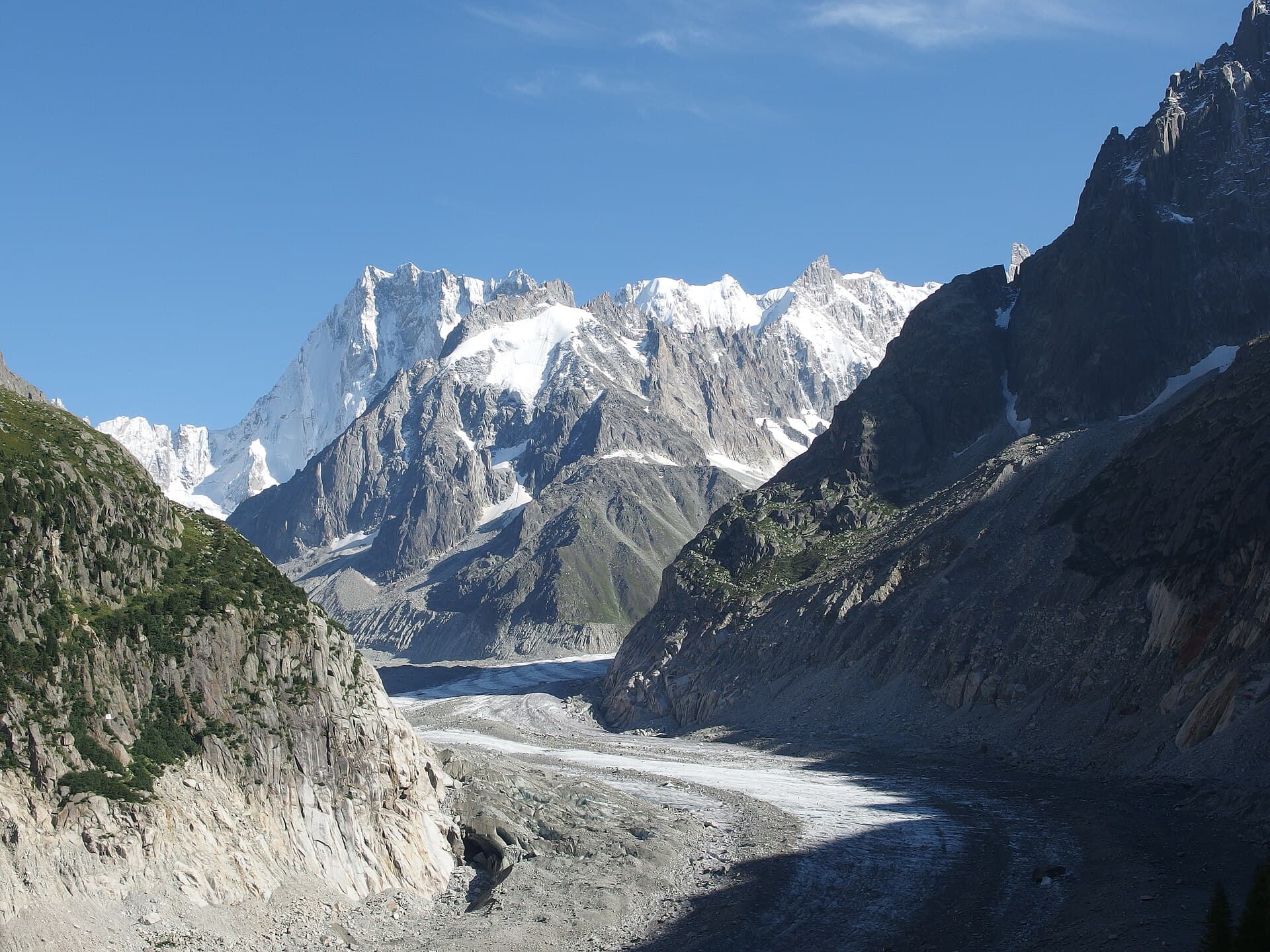
In June 1741, two Englishmen on their Grand Tour — William Windham and Richard Pococke — led a small party (with armed servants, expecting bandits) from Geneva into the Chamonix valley. They reached a glacier and were stunned. Windham described it as: "You must imagine your lake put in agitation by a strong wind, and frozen all at once." They named it Mer de Glace — Sea of Ice. (Haute-Savoie Tourism; ResearchGate, "A history of tourism at the Mer de Glace")
Windham and Pococke published an account in London in 1744. The publication ignited European fascination with Alpine glaciers. The Mer de Glace became one of the first natural tourist attractions in the Alps — inspiring Shelley, Byron, and J.M.W. Turner for the next two centuries.
This is where European tourism to the natural world began.
Planning this route? We're forming a founding group for Mont Blanc — Goûter Route — registering interest is free, no commitment. See the expedition →
1908: The railway that killed a mule economy
In August 1908, the first steam train departed Chamonix for the Montenvers viewpoint above the Mer de Glace — a 5.1 km rack railway climbing 871 metres of elevation. Construction began in May 1906, employing 200-250 workers, mostly Italian labourers from Valle d'Aosta. (Wikipedia, Chemin de fer du Montenvers; Chamonix.com, Montenvers history)
The railway was fiercely opposed. The Chamonix municipal council had rejected the project 15 years earlier because accompanying tourists to Montenvers by mule was a thriving livelihood for 650 families. The railway destroyed that economy — an early case of mechanized tourism infrastructure displacing traditional mountain livelihoods.
In its first ten weeks of partial operation, it transported 24,000 passengers. The line was electrified in 1953.
The Mer de Glace staircase: 3 steps to 580
When a cable car from the Montenvers viewpoint (1,913 m) to the glacier surface was installed in 1988, visitors descended 3 steps to reach the ice. By 2024-2025, they descended over 580 steps. The staircase is lengthened every year as the glacier surface drops. (Chamonix.net; Haute-Savoie Tourism)
Plaques along the staircase mark the glacier level in previous decades. Each plaque is higher than the last. Visitors descend through a geological timeline of loss.
The numbers:
| Metric | Value | Source |
|---|---|---|
| Current length | 7.5 km | Wikipedia, Mer de Glace |
| Thickness loss | ~6 metres per year | recency.md, cross-referenced |
| Length lost since 1850 | ~2 km | recency.md |
| Recent acceleration | 400 m retreat in the last 20 years | recency.md |
| Surface lowering (1939-2001) | Average 30 cm/year, equivalent to 700 million m3 water | Wikipedia |
| Projection by 2040 | Another 1.2 km withdrawal | recency.md |
| Projection by 2100 | Could vanish entirely | recency.md |
A new panoramic cable car replaced the old installation (commissioned late 2023/2024) to maintain visitor access despite the retreat. The Glaciorium — a climate and glacier interpretation centre at Montenvers — is scheduled to open in 2026. The old gondola path to the glacier is permanently closed. (recency.md; La Chamoniarde)
The Mer de Glace is not just a glacier. It is where European tourism to the natural world began (1741), where mechanized mountain tourism began (1908), and where climate change is most legibly inscribed into a visitor experience. No other site in the Alps condenses the entire arc — Enlightenment curiosity, industrial tourism, ecological grief — into a single staircase.
The summit no one owns
The border between France and Italy in the Mont Blanc area was established by the Treaty of Turin (24 March 1860), when the Kingdom of Sardinia ceded the Duchy of Savoy (including Chamonix) to France — the price Napoleon III extracted for supporting Italian unification. (Wikipedia, Treaty of Turin); Italy's Practice on International Law)
Italy alleges that in 1865, French army cartographer Captain J.J. Mieulet produced maps that shifted the border away from the watershed line at Mont Blanc's summit, placing the entire summit within French territory. The French maps have been treated as canonical ever since. Italy maintains the border should bisect the summit.
The disagreement covers approximately 82 hectares across three areas:
- Mont Blanc summit (~65 hectares) — Italy says the border bisects the summit; France says the summit is entirely French
- Dome du Gouter (~10 hectares) — same pattern
- Col du Geant — where Italian infrastructure (the Torino Hut) sits in territory France claims
This is not academic. In September 2015, the mayor of Chamonix deployed fencing on territory Italy considers its own. In 2019, French municipalities banned paragliding over the summit — including airspace Italy considers partially sovereign. In October 2020, the Haute-Savoie Prefecture created a 3,000+ hectare natural protection zone that Italy protested to the European Parliament. (Euronews; European Parliament Questions E-005668/2020 and E-005844/2020)
The highest point in the Alps has no settled nationality. A mountain that symbolizes European unity — three-country trek, EU borderless hiking — is simultaneously a live sovereignty dispute.
Three countries, one circuit
The Tour du Mont Blanc — ~170 km, 10,000 m of cumulative ascent, 7-11 days — crosses from France to Italy at the Col de la Seigne (2,516 m), from Italy to Switzerland at the Grand Col Ferret (2,537 m), and from Switzerland back to France at the Col de Balme (2,191 m). No other major long-distance trek crosses three sovereign nations in a single loop. (autourdumontblanc.com; Wikipedia, Tour du Mont Blanc)
The Schengen Agreement makes these crossings frictionless — no passport stamps, no border posts. What changes is everything else: the trail markings (French GR red-and-white blazes give way to Swiss yellow diamond signs), the food (French refuge cuisine to Italian rifugio cooking to Swiss hut fare), the prices (Italy is cheapest, Switzerland is most expensive by a factor of 1.5-2x), and the language (French, Italian, Arpitan patois, Swiss-French).
The trails that compose the modern TMB predate tourism by centuries. Many date to pre-Roman times as pastoral transhumance routes. The path from Les Contamines over the Col du Bonhomme was an established trade route when the Romans arrived — the Ceutrone tribe used it to transport salt from Moutiers for cheesemaking. The path crosses a surviving Roman bridge below the Nant Borant refuge. (White Marmotte, "History of the TMB"; Alpenwild)
The first recorded circuit of the massif was completed in 1767 by Saussure himself — 19 years before the first ascent. The formal trail system with standardized GR markings, official refuges, and published itineraries was a 20th-century creation by the Club Alpin Francais and sister organizations, built on top of millennia-old infrastructure. (White Marmotte; Speed Cap, "History of TMB")
For the practical stage-by-stage breakdown: Tour du Mont Blanc guide.
What this adds up to
The conventional framing: "Europe's greatest trek circles Europe's highest mountain." The structural framing:
- Saussure's bounty (1760) created the financial incentive for the first ascent — turning a mountain into a problem to be solved.
- The Compagnie des Guides (1821) professionalized access — making the mountain climbable by clients, not just locals.
- The Montenvers Railway (1908) industrialized glacier tourism — making the spectacle accessible to anyone who could buy a ticket.
- The Aiguille du Midi cable car (1955) placed technical alpine terrain within reach of day-trippers — 3,842 m in 20 minutes from the valley floor.
- The TMB trail system (1920s-1950s) formalized a multi-day circuit that packages the massif as a single experience.
Each intervention was institutionally driven. Chamonix's dominance is organizational, not natural.
The TMB is not a nature walk that happens to pass through three countries. It is a walking tour of the 280-year-old system that invented mountain tourism, mountain guiding, mountain science, and mountain infrastructure. The glacier is retreating. The border is disputed. The guides have been organizing since 1821. The Roman bridge is still there.
The trekker who understands this history walks a fundamentally different trail than the one who does not.
Practical links
- Tour du Mont Blanc — stage-by-stage guide
- Haute Route — Chamonix to Zermatt
- Day hikes from Chamonix
- The real cost of trekking from Chamonix
- When to trek from Chamonix
- Getting to Chamonix
- Budget calculator