
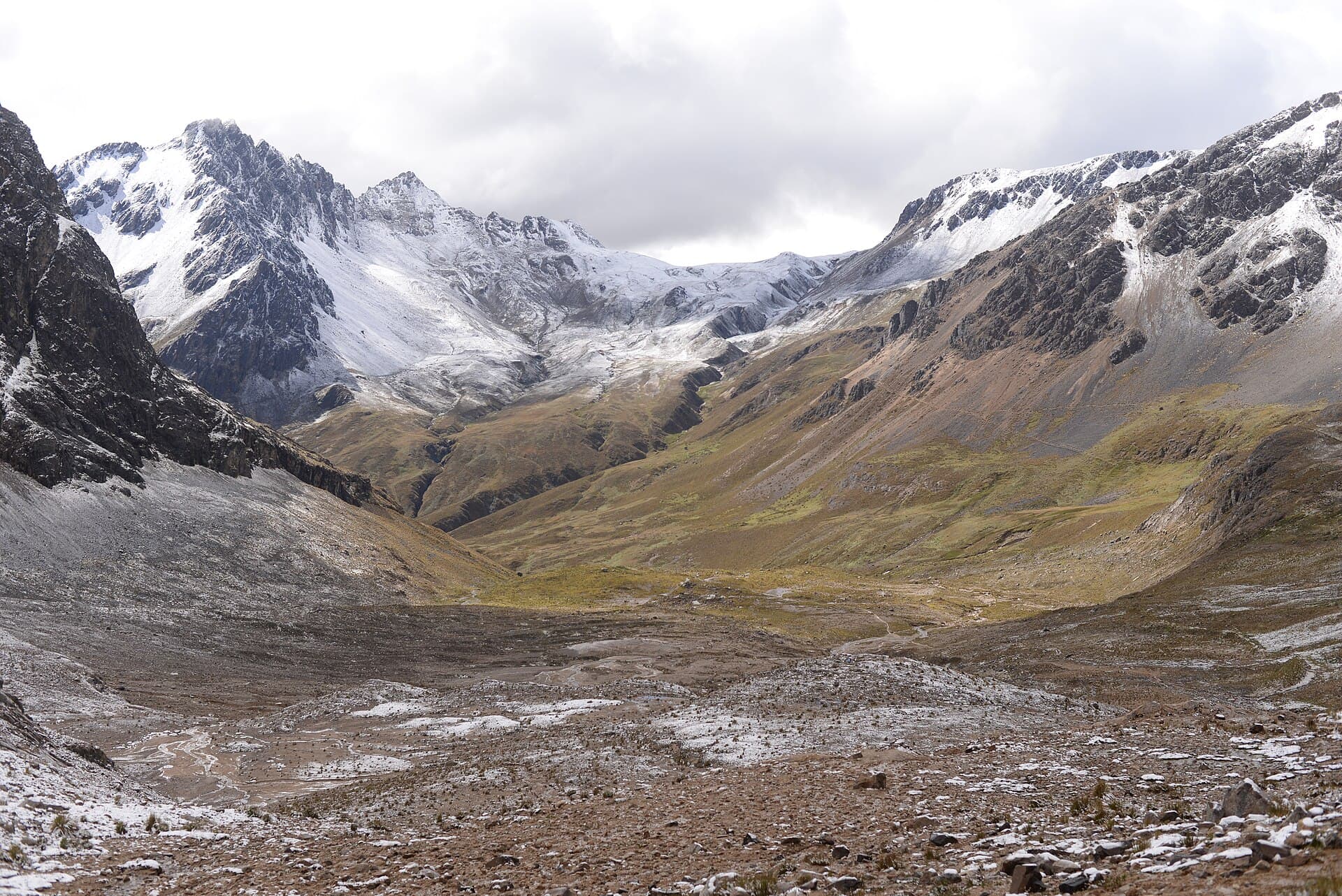
The two seasons
Cusco and the Machu Picchu corridor operate on two seasons: dry (May-September) and wet (October-April). There is no European-style four-season gradient. The transition between dry and wet is relatively abrupt, with April and October serving as shoulder months.
Month-by-month
| Month | Temp range (C) | Rain | Season | Trek status |
|---|---|---|---|---|
| January | 12-24 | Heavy | Wet | Open but muddy. Avoid for trekking. |
| February | 12-14 | Heaviest | Wet | Inca Trail CLOSED. Machu Picchu open via train. |
| March | 11-23 | Moderate-Heavy | Wet → Transition | Reopens. Trail muddy. Leeches in cloud forest. |
| April | 10-21 | Light-Moderate | Transition | Good. ~9 rainy days avg. Fewer crowds. |
| May | 12-20 | Light | Dry (peak begins) | Excellent. ~3 rainy days. |
| June | 8-21 | Minimal | Dry (peak) | Excellent. Cold nights at altitude. |
| July | 6-19 | Minimal | Dry (peak) | Excellent. Coldest month. |
| August | 5-20 | Minimal | Dry (peak) | Excellent. Driest month. |
| September | 8-21 | Light | Dry | Excellent. Warming. |
| October | 7-20 | Light-Moderate | Transition | Good. Rains begin. |
| November | 7-20 | Moderate | Wet | Manageable. Fewer crowds. |
| December | 6-19 | Heavy | Wet | Open but unpredictable. |
Temperatures in the table are for the Machu Picchu / Inca Trail corridor (2,400-4,200m). Higher passes are significantly colder — expect near-freezing or below at Dead Woman's Pass (4,215m) and Salkantay Pass (4,630m) in June-August.
The February closure
The Inca Trail closes every February for maintenance, enforced since 2002. Conservation crews repair trail sections, maintain terraces, clear vegetation, and restore camping areas.
Machu Picchu itself remains open year-round. During February, visitors access the citadel via train from Ollantaytambo. The Salkantay and Choquequirao routes do not officially close in February, but conditions at altitude passes can be dangerous — most operators suspend departures December through March.
Continue reading Four routes to Machu Picchu, four different realities — and the altitude trap that ruins 30% of first days →
Best months by route
| Route | Optimal | Acceptable | Avoid |
|---|---|---|---|
| Classic Inca Trail | Jun-Aug | May, Sep-Oct | Feb (closed), Dec-Jan |
| Salkantay Trek | Jun-Aug | May, Sep | Dec-Mar (pass snow risk) |
| Choquequirao | May-Sep | Apr, Oct | Dec-Feb (trail washouts) |
| Day visit (train) | May-Sep | Apr, Oct-Nov | None — open year-round |
The shoulder month advantage
Late April / early May and late September / early October offer the best balance across all variables:
Weather: Mostly dry. April averages 9 rainy days; October is similar. Showers tend to be afternoon — mornings are often clear.
Crowds: Significantly fewer than June-August peak. Inca Trail permits are easier to secure. Train and hotel prices drop.
Permit availability: Inca Trail permits for September-October are typically available 1-2 months ahead. For April, often available 2-4 weeks ahead. Compare this to May-June, which sells out within days of release.
Pricing: Operator packages, accommodation, and train tickets are all 10-30% cheaper in shoulder months. The Salkantay and Choquequirao routes, which have no permit caps, are also less crowded.
The trade-off: a higher chance of rain, particularly in the afternoons. Cloud cover can obscure mountain views. But clouds also create the dramatic mist effects that make Machu Picchu photographs atmospheric rather than flat.
The altitude acclimatization window
The timing decision is not just about weather. It is about the 2-3 days your body needs to adjust to altitude before attempting any pass above 4,000m.
The numbers
| Location | Elevation | Context |
|---|---|---|
| Lima (departure) | 0m | Sea level |
| Cusco (arrival) | 3,399m | Immediate altitude exposure |
| Sacred Valley | 2,792-2,850m | 500-600m lower than Cusco |
| KM 82 (Inca Trail start) | 2,600m | Below AMS threshold |
| Dead Woman's Pass | 4,215m | Significant AMS risk |
| Salkantay Pass | 4,630m | Highest standard route |
| Machu Picchu | 2,430m | Below AMS threshold |
AMS incidence
40-50% of travelers arriving directly in Cusco from low elevation experience some degree of acute mountain sickness. Symptoms: headache, nausea, fatigue, insomnia. Onset typically 6-12 hours after arrival.
The risk is amplified by the common flight route: Lima (0m) to Cusco (3,399m) in 1 hour 15 minutes. This is one of the most aggressive altitude gains in commercial aviation tourism.
The Sacred Valley strategy
Fly into Cusco, transfer immediately to the Sacred Valley (1-1.5 hours by road). Spend 2-3 nights at 2,800-2,900m. Return to Cusco on day 3, already partially adapted.
Recommended timeline:
- Day 1: Arrive Cusco. Descend immediately to Sacred Valley (Urubamba/Ollantaytambo). Rest. Drink coca tea. No strenuous activity.
- Day 2: Gentle Sacred Valley activities — Pisac ruins (2,972m), Moray terraces (3,500m), Chinchero textiles (3,762m). These sites provide graded altitude exposure. Hydrate aggressively — 3+ liters per day.
- Day 3: Return to Cusco (3,399m). Explore at slow pace. Body should be adapting.
- Day 4+: Begin trek or more demanding activities.
Minimum acclimatization before trekking: 48-72 hours at altitude. Ideally 2-3 full days before any trek exceeding 4,000m.
Pharmacological options
Acetazolamide (Diamox) 125-250mg twice daily, started 24 hours before arrival. Available over-the-counter in Cusco pharmacies for ~S/5 (~$1.50). Side effects: tingling in extremities, increased urination, altered taste of carbonated drinks. Effective for prevention, not treatment of established symptoms.
Coca leaf tea (mate de coca) — the traditional Andean remedy. Widely available in hotels, restaurants, and markets throughout Cusco. Culturally important, modest clinical evidence for mild symptom relief. Legal in Peru; coca leaves cannot be taken out of the country.
Avoid alcohol for the first 48 hours. Alcohol dehydrates and impairs acclimatization.
Planning by priority
"I want the Inca Trail in peak season"
Book permits 6-8 months ahead for June-August. Arrive 3-4 days before trek start for acclimatization. Total trip: 8-10 days minimum. Expect maximum crowds at Machu Picchu and peak pricing everywhere.
"I want good weather with fewer people"
Target late April / early May or late September / early October. Book Inca Trail permits 1-3 months ahead. The Salkantay and Choquequirao require no advance booking. 10-20% cheaper across all categories.
"I want the cheapest possible trip"
Target March or November. Wet season tail end or start. Inca Trail permits often available weeks ahead. Accommodation and transport at yearly lows. Trade-off: afternoon rain likely, trail conditions muddier, some mountain views obscured by cloud.
"I want Choquequirao before the cable car"
Go in May-September when trail conditions are dry. The Apurimac canyon is exposed and hot regardless of month — but dry season avoids the washouts that can close the trail in wet months. No permit timing concerns.
"I only have 3-4 days"
Train to Aguas Calientes, bus to Machu Picchu, return same day or next. Available year-round including February (when the Inca Trail is closed). Allow 1-2 acclimatization days in Sacred Valley / Cusco before the visit.
The cold reality at altitude
Night temperatures at high camps and passes:
| Location | Elevation | Night temp (Jun-Aug) |
|---|---|---|
| Cusco | 3,399m | 2-6 C |
| Wayllabamba Camp | 3,000m | 5-10 C |
| Dead Woman's Pass | 4,215m | -5 to 0 C |
| Salkantay Pass | 4,630m | -10 to -5 C |
| Machu Picchu | 2,430m | 10-15 C |
June through August have the best daytime weather but the coldest nights. A 4-season sleeping bag (rated to -10 C) is standard equipment for any trek crossing passes above 4,000m. Operators provide sleeping bags, but quality varies — bringing a liner adds meaningful warmth.
What "wet season" actually means
The wet season (November-April) does not mean continuous rain. It means afternoon storms — often dramatic, brief, and followed by clearing. Mornings in wet season are frequently clear and sunny. The rain typically starts between 12:00-14:00 and lasts 1-3 hours.
This pattern has implications for planning:
Machu Picchu day visits in wet season can work well if you take the earliest entry slot (06:00). You may get 4-6 hours of clear weather before afternoon clouds arrive. The citadel in morning mist, before rain and before crowds, is arguably more atmospheric than the flat light of peak dry season.
Trekking in wet season is genuinely harder. Trails become muddy and slippery. Stone steps on the Inca Trail are treacherous when wet. River crossings on the Salkantay and Choquequirao routes can become dangerous. Cloud forest sections have leeches (not harmful, but unpleasant). The pass days on any trek carry increased risk — visibility drops to meters at times, and snow at 4,000m+ is more likely.
November and March are the mildest wet season months — transitional periods with moderate rain and manageable trail conditions. December through February are the heaviest months and should be avoided for multi-day trekking.
Festivals and cultural timing
Cusco's festival calendar can affect both logistics and experience:
Inti Raymi (June 24): The Festival of the Sun, Cusco's largest celebration. A massive reenactment of the Inca solstice ceremony at Sacsayhuaman. The city is packed — accommodation and transport prices spike. Book everything 3-4 months ahead if visiting around this date.
Corpus Christi (June, date varies): Religious procession through Plaza de Armas with saints from surrounding churches. A fascinating blend of Catholic and Andean traditions.
Fiestas Patrias (July 28-29): Peru's Independence Day. National holiday. Domestic tourism spikes. Machu Picchu and the Inca Trail are at maximum capacity. Book everything well ahead.
Q'oyllur Rit'i (May/June, date varies): An Andean pilgrimage to a glacier in the Sinakara valley at 4,700m. Thousands of Quechua people trek to the glacier for a syncretic festival blending Catholic and pre-Colombian traditions. Not a tourist event — but if you happen to be in the Cusco region during Q'oyllur Rit'i, it offers a perspective on Andean culture that no guided tour provides.
Planning around these dates means either embracing the energy and booking early, or avoiding the peak entirely for a quieter experience.
10 Sources
- incatrailmachu.comInca Trail Machu — Weather Month by Month
- ticketmachupicchu.comTicket Machu Picchu — February Closure
- inkatrail.com.peInka Trail — Best Time
- inkatrail.com.peInka Trail — Availability
- voyagers.travelVoyagers Travel — Altitude Sickness
- tripcusco.comTripCusco — Altitude Guide 2026
- riverexplorers.comRiver Explorers — Sacred Valley Tips
- salkantaytrekmachu.comSalkantay Trek Machu — Altitude
- salkantaytrekking.comSalkantay Trekking — Acclimatization
- sightdoing.netSightdoing — Sacred Valley Acclimatization
10 sources consulted. Prices verified May 2026.