Alpine orogeny (uplifting Middle–Upper Triassic carbonate platforms)Platforms: Middle–Late Triassic (~247–201 Ma); Alpine hard continental collision: Eocene (~50 Ma)–present, ongoing; main Dolomites shortening/uplift: Neogene (Valsugana phase, ~12–8 Ma)Adria (African promontory) – Eurasia🌋 extinct Middle Triassic volcanic centres (no Cenozoic or active volcanism) — No active volcanism. INGV (Istituto Nazionale di Geofisica e Vulcanologia), Italy's volcano-monitoring agency, monitors no volcanoes in the Dolomites or anywhere in the Alps — all active Italian volcanoes lie far to the south. Volcanic activity here ended in the Middle Triassic.
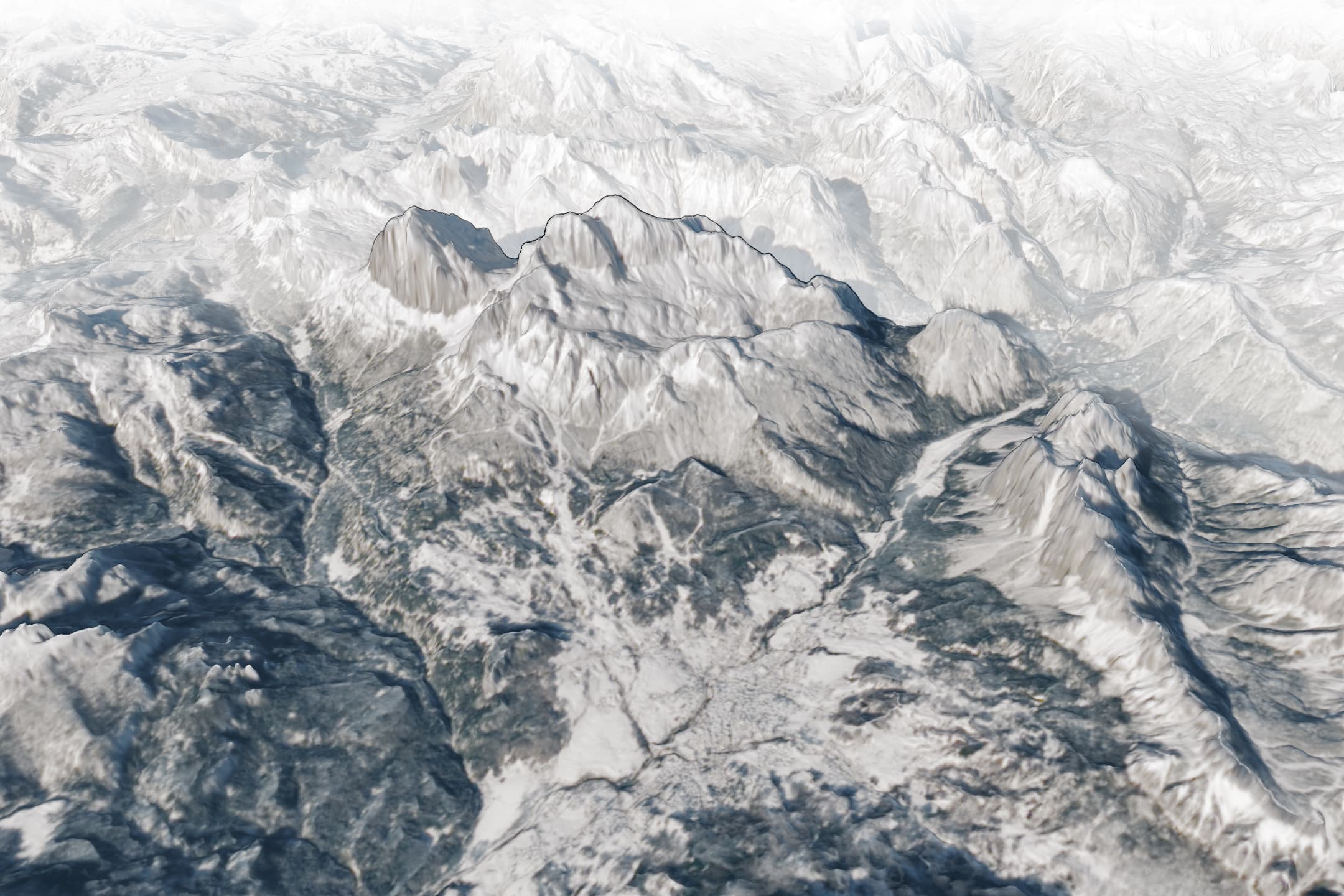
Tofana di Mezzo above Cortina: steep Dolomite relief in a landscape of limestone cliffs, faults, and glacial valleys.
NASA Earth Observatory image by Michala Garrison, using Landsat and TINITALY elevation data. · NASA media use guidelines · source
Stand under the pale walls of the Tre Cime and you are looking at a tropical seafloor. Around 252 million years ago the end-Permian mass extinction — the worst in Earth's history — emptied the oceans; in the Triassic that followed, this corner of the Tethys Ocean became the stage on which reef-building life reinvented itself. That is precisely why UNESCO inscribed the Dolomites in 2009 (141,903 hectares across nine separate mountain systems): the World Heritage evaluation singles out its 'Mesozoic carbonate platforms, or fossilized atolls', and the evidence they preserve of how reef-building organisms recovered after the Permian/Triassic boundary.
In the Middle Triassic (Ladinian–Carnian, roughly 242–227 million years ago on the international chronostratigraphic timescale) this was an archipelago: flat-topped carbonate platforms built by microbes, calcareous algae, sponges and early corals rose hundreds of metres from deep seaways, exactly like modern atolls rising from lagoon-blue water. The deep basins between them filled with the marls of the San Cassiano Formation, whose exquisitely preserved fauna makes it one of the richest windows on Triassic marine life anywhere. Uniquely, the whole geometry survived: geologists — and observant trekkers — can still trace the original reef slopes (clinoforms) plunging from platform rim to basin floor in today's cliff faces. Mid-Triassic eruptions then buried part of this seascape: dark lavas, tuffs and ash, still visible as the sombre volcanic rocks of the Padon and Monzoni areas, in stark contrast with the pale reefs.
The rock itself carries a famous puzzle. In 1791 the French mineralogist Déodat de Dolomieu described a carbonate that, unlike ordinary limestone, barely fizzed in acid; within a year the mineral — calcium magnesium carbonate — bore his name, and eventually so did an entire mountain range. How magnesium came to replace part of the calcium in these rocks after deposition ('dolomitization') is still an active research question, the classic 'dolomite problem'. The reef insight came later: in 1860 the geologist Ferdinand von Richthofen, studying the Schlern/Sciliar massif, recognized that these isolated dolomite peaks ringed by fossil-bearing volcanic sediments were ancient reefs — applying Darwin's then-new theory of atoll growth to rocks standing two kilometres above sea level.
What lifted a seafloor into the sky was the Alpine orogeny: the Adriatic microplate, a promontory of Africa, pressed into Europe, with hard continental collision beginning in the Eocene, around 50 million years ago; most of the shortening and uplift that raised the Dolomites came later still, in the Neogene (the Valsugana phase, roughly 12–8 million years ago). The Dolomites were caught up in the collision but escaped the intense internal deformation that mangled most of the Alps — which is why the platform-and-basin anatomy is preserved so legibly here. Ice-age glaciers and frost shattering then did the sculpting, quarrying the jointed dolomite into the towers, spires and vertical walls of today. One massif tells a different story: the Marmolada, at 3,343 m the highest of the Dolomites, is built of Marmolada Limestone that escaped dolomitization — original reef limestone, which is why climbers find its rock so different from its neighbours'.
What you can see on the trail
Layered pale walls of the Tre Cime — a sliced-open Triassic carbonate platform
📍 Tre Cime di Lavaredo loop, best from Rifugio Locatelli (Dreizinnenhütte) facing the north walls
The horizontal banding running across the north faces is original bedding of the Upper Triassic Dolomia Principale: each layer records tidal flats and shallow lagoons on a carbonate platform, now standing nearly 3,000 m above sea level.
The Sciliar/Schlern cliff — the original 'fossil reef' of 1860
📍 Alpe di Siusi (Seiser Alm) trails, looking up at the flat-topped Sciliar massif
This is the exact cliff where Ferdinand von Richthofen first recognized a Dolomite peak as an ancient reef in 1860. The flat-topped pale massif is the platform; the gentle meadows you walk on cover the softer basin sediments that once surrounded it.
Dark volcanic rocks underfoot on the Padon ridge — the eruptions that buried the reefs
📍 Viel del Pan trail (Passo Pordoi to Lago Fedaia), on the Padon ridge
The crumbly dark rock under your boots is Middle Triassic volcanic material — lava, tuff and ash that buried parts of the reef archipelago. The contrast with the pale carbonate massifs all around you is the whole story of the Dolomites in one glance.
The Marmolada — un-dolomitized limestone 'Queen of the Dolomites' (3,343 m)
📍 Across the valley from the Viel del Pan trail, or from Lago Fedaia
The highest massif in the Dolomites is, ironically, not dolomite: the Marmolada Limestone escaped the magnesium alteration that transformed its neighbours, preserving original reef limestone — one reason its rock and its glacier look so different.
Fun fact
Ferdinand von Richthofen, the geologist who in 1860 first recognized the Sciliar massif as a fossil coral reef, went on to coin the term 'Silk Road' — and was an uncle of Manfred von Richthofen, the 'Red Baron' of World War I.
Rocks: dolomite (dolostone) — Sciliar/Schlern Dolomite, Dolomia Principale · limestone — Marmolada Limestone (never dolomitized) · marls, sandstones and volcaniclastics — San Cassiano Formation basin fills · Middle Triassic volcanic rocks — dark lavas, tuffs and ash of the Padon and Monzoni areas