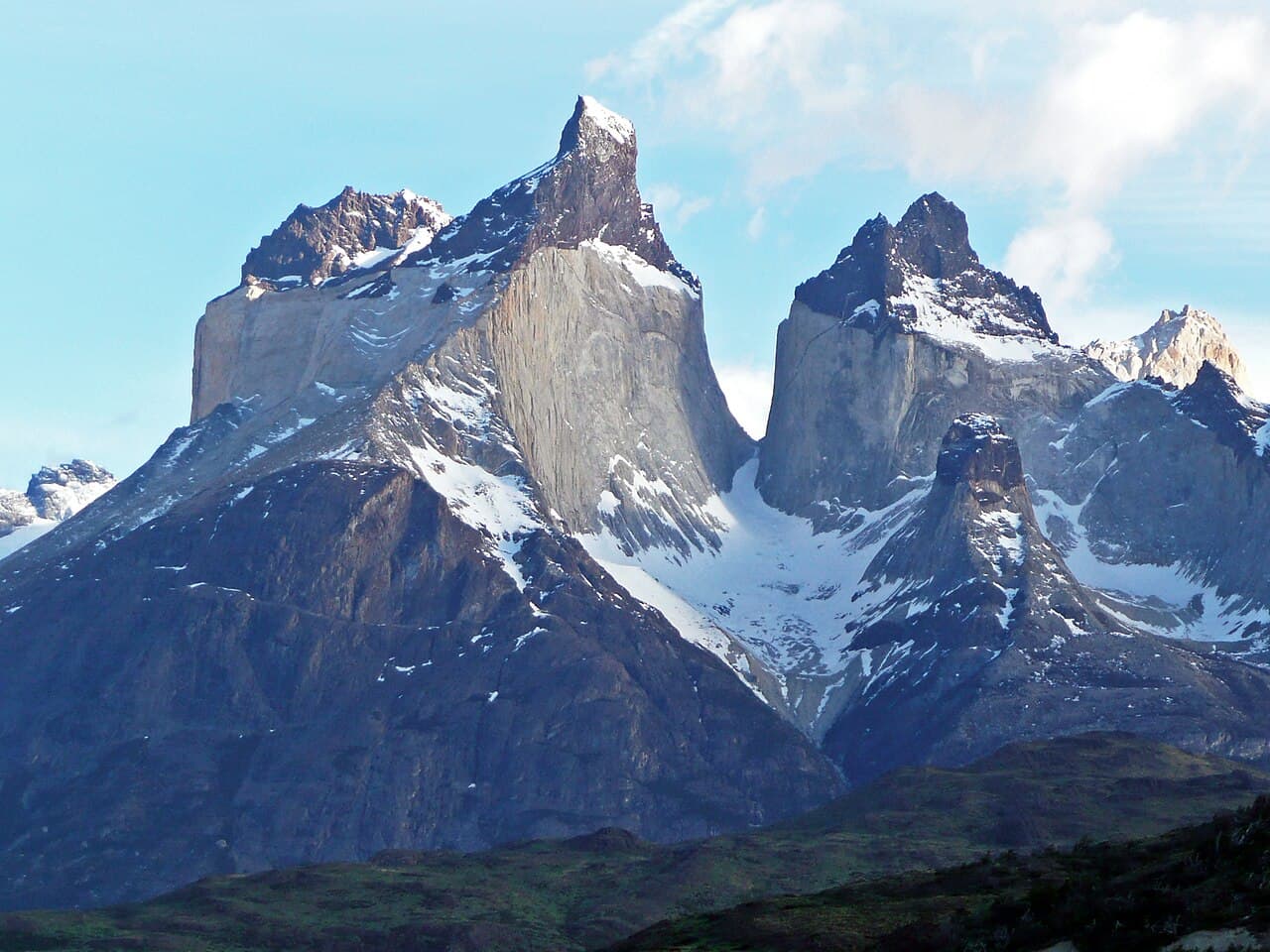
A magma blister under old seafloor — the towers wear dark caps of baked rock
Andean orogeny — Miocene Torres del Paine laccolith, exhumed by glacial erosionIntrusion 12.593 ± 0.009 to 12.431 ± 0.006 Ma (granite laccolith built in 90 ± 30 kyr; whole bimodal complex in 162 ± 11 kyr); rapid glacial exhumation from ~6.5 Ma, final exhumation late QuaternaryEmplaced inboard of the Nazca/Antarctic–South America subduction margin; today the Antarctic plate subducts at this latitude (south of the Chile Triple Junction)🌋 None — the Paine Intrusive Complex is an extinct Miocene intrusive system; the magma never reached the surface — None — the Paine Intrusive Complex solidified ~12.4 Ma and its magmatic system is extinct; the magma never erupted at the surface. Chile's SERNAGEOMIN national volcano monitoring network (RNVV) monitors no volcanic center in the Torres del Paine area; the nearest historically active volcanoes lie far outside the park, in the Austral Volcanic Zone. Monte Burney, ~200 km south of the park, was instrumented in December 2025 and is being incorporated into the RNVV during 2026 as the first monitored volcano in Magallanes.
Cuernos del Paine: a light granite laccolith injected between dark Cretaceous sedimentary rocks.
Torres del Paine is one of the best-exposed laccoliths on Earth — a blister of magma that inflated between layers of sedimentary rock instead of erupting. High-precision U-Pb dating shows the Paine intrusion was assembled between 12.593 ± 0.009 and 12.431 ± 0.006 million years ago. The granite laccolith itself — three great sheets, each injected beneath the previous one — was built in just 90 ± 30 thousand years (Michel et al., 2008); after a brief pause, mafic sills of gabbro and diorite were emplaced beneath it, the whole bimodal complex taking 162 ± 11 thousand years to assemble (Leuthold et al., 2012). The finished intrusion extends more than 12 km with a maximum thickness of about 2.5 km — roughly 88 cubic kilometers of granite and mafic rock in all, the pale granite sitting atop the darker gabbros and diorites that arrived with it. For the completeness of this exposed magma-chamber anatomy, the IUGS lists the Paine Intrusive Complex among its First 100 geological heritage sites of the world.
The magma rose to within about 3 km of the surface — pressures of roughly 750 ± 250 bars recorded in its contact minerals — and pushed into Cretaceous marine sedimentary rocks of the Cerro Toro and Punta Barrosa formations: mudstones, sandstones and conglomerates laid down on a deep seafloor around 98–86 million years ago. The granite's heat cooked a rim of these sediments, 200 to 400 m wide, into a dense, dark contact rock: hornfels. That baked skin is the park's signature. The intrusion's roof was never fully eroded away, so the pale granite still carries patches of its dark ceiling.
Nowhere is this clearer than on the Cuernos del Paine — the 'Horns' — which are a geological sandwich you can read from the trail: dark hornfels on top, a massive band of pale granite in the middle, dark country rock at the base. The famous silhouette is simply the granite/hornfels contact, drawn in two colors at the scale of a mountain. The Torres themselves are the deeper story: three clean granite monoliths where erosion has removed the roof entirely, leaving joint-bounded blades of pure intrusion.
The demolition was glacial. Thermochronology records a short, rapid cooling episode at about 6.5 million years ago — interpreted, together with a matching signal at Fitz Roy, as the onset of the late-Cenozoic Patagonian glaciations — followed by final exhumation in the late Quaternary (Muller et al., 2024). Ice-cap outlet glaciers stripped the 2–3 km of cover, quarried the granite along its vertical joints, and overdeepened the basins now holding lakes Nordenskjöld, Pehoé and Grey. Glacier Grey, an arm of the Southern Patagonian Icefield, still calves into its lake at the park's western edge: the sculptor, mid-stroke. There is no volcano in the park — the Paine magmatic system froze solid 12.4 million years ago and never reached the surface at all.
What you can see on the trail
The bicolor Cuernos — dark hornfels caps over white granite, the laccolith's roof contact
📍 Mirador Cuernos on the Lake Pehoé shore, and the W-trek stretch between Paine Grande and Refugio Los Cuernos
The Horns' dark summits and dark bases are Cretaceous seafloor rocks baked to hornfels by the intrusion; the pale band between them is the granite itself. You are looking at the top of a magma chamber, contact and all, left in place.
The three granite Torres and their moraine-dammed tarn
📍 Mirador Base de las Torres, at the top of the Valle Ascencio boulder field
Here erosion removed the intrusion's roof completely: the three monoliths are pure Paine granite, sliced free along vertical joints by ice and frost. The milky lake at their feet is held in a rock basin behind rubble the glacier left as it withdrew.
The contact wrapping around the French Valley cirque
📍 Valle del Francés, from Mirador Francés up to Mirador Británico
The cirque walls show the granite/hornfels contact tracing around peaks like La Espada and the back of the Cuernos — pale intrusion below, dark baked roof above. Hanging glaciers on Paine Grande still calve and avalanche here, glacial erosion running loudly in real time.
Glacier Grey — the sculptor still at work
📍 Mirador Grey and the W-trek section from Paine Grande to Refugio Grey
Grey is an outlet of the Southern Patagonian Icefield, the modern remnant of the ice that stripped 2–3 km of rock off the Paine intrusion. Its calving front and the polished, striated bedrock along the trail show exactly how the towers were freed.
Fun fact
The three stacked granite sheets of the Paine laccolith were emplaced in just 90 ± 30 thousand years — a geological eye-blink — each slipped beneath the last, and the full ~88 cubic-kilometer bimodal complex was assembled in only 162 ± 11 thousand. That exceptionally well-recorded construction is why the IUGS named it one of the world's First 100 geological heritage sites.
Rocks: granite (Paine Granite, three stacked sheets) · gabbro and diorite (Paine Mafic Complex) · hornfels (contact-metamorphosed mudstone and sandstone) · Cretaceous mudstone, sandstone and conglomerate (Cerro Toro and Punta Barrosa formations) · glacial till and moraines