
Anchorage (ANC)
All roads to Denali start in Anchorage. Ted Stevens Anchorage International Airport (ANC) is Alaska's primary hub, with direct flights from Seattle, Minneapolis, Denver, Dallas, Chicago, Los Angeles, and several other US cities. International connections typically route through Seattle (SEA).
ANC is a midsized airport with rental car counters, a few hotels within shuttle distance, and standard US airport services. It is not a gateway where you need a buffer day to recover — if your flight lands by early afternoon, you can drive to Talkeetna the same day.
What to do in Anchorage: Most climbers pass through quickly, but if you arrive the day before driving to Talkeetna, the city has what you need:
- REI Anchorage — the largest outdoor retailer in Alaska. Last-minute gear, white gas, and batteries.
- Alaska Mountaineering & Hiking (AMH) — local mountaineering shop in midtown Anchorage. Knows Denali-specific gear requirements and carries items REI may not stock.
- Grocery stores — Fred Meyer and Carrs/Safeway for expedition food resupply. Repackage and weigh your food here, not at the trailhead.
- Lodging — hotels near the airport run $150-250/night. Downtown options exist but offer no advantage for a climber passing through.
Anchorage is at sea level. Do not expect acclimatization here.
Anchorage to Talkeetna
Talkeetna is the staging point for Denali climbs. It sits 115 miles north of Anchorage on the Parks Highway (AK-3), at an elevation of 348 feet. The drive takes approximately 2.5 hours.
Driving
The route is straightforward: take the Glenn Highway north from Anchorage to the Parks Highway junction, then continue north on AK-3 to the Talkeetna Spur Road turnoff at Mile 98.7. Turn left (north) onto the spur road and drive 14 miles into Talkeetna.
The road is paved, two-lane for much of the stretch, and well-maintained. In May and June (climbing season), conditions are clear — snow is gone at highway elevation by then. Rental cars work fine; no 4WD necessary.
Gas stations are available in Wasilla (Mile 42) and at the Parks Highway junction. Fill up before the spur road — Talkeetna has limited services.
Alaska Railroad
The Denali Star route runs between Anchorage and Fairbanks, with a stop in Talkeetna. The train operates mid-May through mid-September. Travel time from Anchorage to Talkeetna is approximately 3 hours. One-way fares run $100-175 depending on class and booking date.
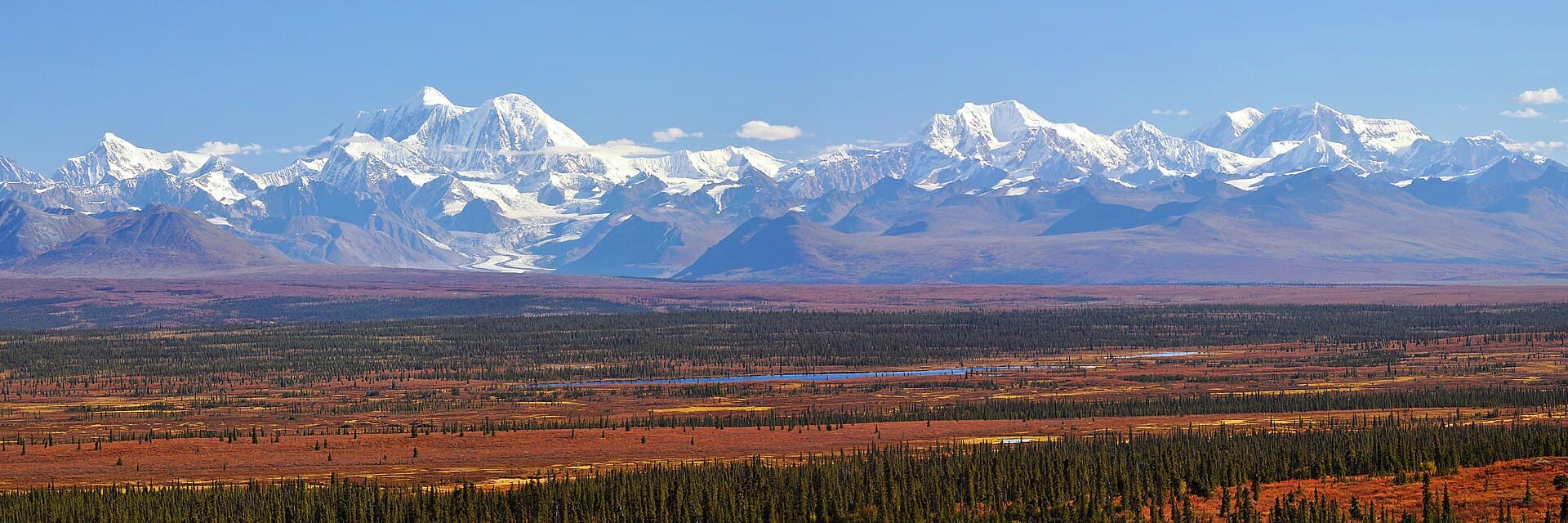
The railroad is scenic — it crosses the Susitna River and passes through boreal forest with views of the Alaska Range. But it is less practical than driving if you have expedition gear. The train limits luggage, and you lose the flexibility of a vehicle in Talkeetna.
If your guided expedition includes an Anchorage-Talkeetna shuttle (RMI does; Alpine Ascents may), that is the simplest option. Check with your operator.
Shuttle services
Several Talkeetna-area shuttle services run the Anchorage-Talkeetna route. These are typically booked through your guide company or air taxi operator. Prices vary. If you are going independent and do not want to rent a car, contact your air taxi operator — they often coordinate ground transport or can recommend a shuttle.
Continue reading Denali costs $15,000–$21,500 in 2026 — the full breakdown →
Talkeetna
Talkeetna is a town of approximately 900 year-round residents at the confluence of the Susitna, Chulitna, and Talkeetna rivers. During climbing season (May-July), it swells with mountaineers, bush pilots, and tourists.
It is a small town. Adjust your expectations accordingly.
What's in Talkeetna
Lodging: Limited and fills quickly during climbing season. Options include:
- Talkeetna Roadhouse — the town's most well-known lodge and bakery. Basic rooms, excellent breakfasts. Book well in advance.
- Talkeetna Alaskan Lodge — the upscale option, on a bluff south of town with views of Denali. $200-400/night in season.
- Latitude 62 Lodge — mid-range, on the main road into town.
- Hostels and B&Bs — a handful exist; availability is limited and variable. Search early.
- Camping — the Talkeetna area has campground options (River Park Campground, private sites). Camping is the budget default for climbers waiting for weather.
Food: The Talkeetna Roadhouse (bakery and diner, cash only), Denali Brewing Company, Wildflower Cafe, and a few seasonal restaurants. Do not expect variety. Do expect to eat well enough.
Gear: Alaska Mountaineering School (AMS) has a Talkeetna base that rents sleds, Clean Mountain Cans, and some climbing gear. If you forgot something, AMS is your best bet. Anchorage is the fallback — do not count on finding specialized mountaineering equipment in Talkeetna beyond what AMS stocks.
Groceries: Nagley's Store is the only general store in town. It has basics but is not where you want to do expedition food shopping. Buy and pack your food in Anchorage.
Cell service: Limited and unreliable. AT&T and GCI have some coverage. Do not depend on making calls or downloading maps in Talkeetna — handle that in Anchorage.
Source: Local operator websites; NPS Talkeetna Ranger Station information.
The Walter Harper Talkeetna Ranger Station
This is the NPS mountaineering headquarters for Denali. It is located on B Street in Talkeetna, a short walk from the town center and the air taxi offices.
Every climber — guided or independent — must check in here before departing for the mountain. The station handles:
- Registration verification — confirming your permit is in order
- In-person orientation briefing — four sessions daily (9:00 AM, 11:00 AM, 1:30 PM, 3:30 PM)
- Clean Mountain Can checkout — CMCs are issued here and returned here
- Current conditions briefing — route status, weather, and any active hazards
- Gear review — informal assessment of your equipment
Bring your government-issued photo ID. Without it, you cannot complete the check-in.
The station is named for Walter Harper, the first person confirmed to stand on Denali's summit, on June 7, 1913. Harper was 20 years old, the son of an Irish immigrant father and a Koyukon Athabascan mother. He reached the top before the expedition leader, Hudson Stuck, and the other members of the party. Alaska designated June 7 as Walter Harper Day in 2020.
Source: NPS Mountaineering.
The air taxi
All West Buttress expeditions fly from Talkeetna to Kahiltna Base Camp at 7,200 feet. There is no road, no trail, and no overland approach to the standard climbing route. You fly or you do not go.
The operators
Three NPS-authorized air taxi services operate Denali mountaineering flights from Talkeetna:
| Operator | Base Rate (approx.) | Contact |
|---|---|---|
| K2 Aviation | $650-750 | Talkeetna; k2aviation.com |
| Talkeetna Air Taxi | $650-750 | talkeetnaair.com |
| Sheldon Air Service | From $660 | (907) 733-2321; sheldonairservice.com |
Pricing is per person, round trip (Talkeetna to Kahiltna Base Camp and return). If your guided expedition includes air taxi — most do — this is bundled into the guide fee and you deal with the operator through your guide company. Independent climbers book directly.
Note on pricing: K2 Aviation's current mountaineering rates are not publicly listed on their website. The $650-750 range is an industry estimate. Sheldon Air Service confirms $660 as a base rate. Call operators directly for 2026 quotes.
Source: Sheldon Air Service; RMI.
The aircraft
Flights use ski-equipped bush planes: typically de Havilland Beavers, Cessna 185s, or de Havilland Otters. These are single- or twin-engine propeller aircraft fitted with retractable wheel-skis that allow them to take off from the Talkeetna gravel strip and land on glacier snow.
The planes carry 3-6 passengers plus gear, depending on the aircraft type. Weight limits apply. If your expedition's gear exceeds the aircraft's load capacity, you may need a second flight — at additional cost. Weigh your gear before arriving.
The flight
Duration: approximately 45 minutes one way.
The flight crosses the Alaska Range from the lowland forest around Talkeetna (348 feet) to the southeast fork of the Kahiltna Glacier (7,200 feet). You fly through mountain passes, over crevasse fields, and land on a maintained snow strip on the glacier. The landing zone is a flat section of glacier that the NPS and air taxi operators assess and maintain each season.
The flight itself is extraordinary — a transition from boreal forest to high-altitude glacial terrain in under an hour. It is also the point of no return. Once the plane leaves, you are on the glacier, and your only way out is to climb and descend the route, or fly out when weather permits.
Weather delays
This is the single most important logistical fact about getting to Denali's base camp: the bush plane flies only in clear weather.
Cloud cover, high winds, rain, or poor visibility at either end (Talkeetna or the glacier) will ground all flights. Delays of 1-3 days are common. Delays of 5+ days have occurred. This applies to both the flight in and the flight out.
Plan buffer days. If your guided expedition starts on May 20, the operator has already built weather days into the itinerary. If you are independent, budget at least 2-3 extra days in Talkeetna before your planned mountain departure, and the same at the end. You will spend these days in town, watching the sky.
Your air taxi operator will call you when conditions are flyable. Keep your gear packed and be ready to move within an hour of the call. The weather window may be short.
What to do in Talkeetna while waiting
Weather delays are not unusual. Here is how climbers typically spend waiting days in Talkeetna:
Eat. The Talkeetna Roadhouse serves breakfast starting at 7 AM — large portions, locally sourced. Denali Brewing Company has food and beer. These are the two anchors of the social scene during climbing season.
Check gear. Use the time to recheck pack weight, repackage food, test stove function, and organize sled loads. If something is wrong, AMS (Alaska Mountaineering School) is in town and may have what you need.
Walk. Talkeetna sits at the confluence of three rivers. The riverfront trails are short but pleasant. The town itself can be walked end to end in 20 minutes.
Talk to other climbers. Talkeetna during climbing season is a concentrated gathering of people about to attempt the same thing you are. The restaurants, the air taxi offices, and the ranger station waiting area are where expedition intel gets exchanged. Recent conditions, gear recommendations, and weather patterns — other climbers who just came off the mountain are your best real-time source.
Do laundry. The Talkeetna laundromat exists. You will appreciate this fact more on the way out than the way in.
Glacier landing logistics
When the weather clears and your pilot calls, here is what happens:
- Report to the air taxi office with all your gear, packed and weighed
- Load the plane — the pilot manages weight distribution; follow their instructions
- Fly — 45 minutes across the Alaska Range
- Land on the Kahiltna Glacier — the plane touches down on the snow strip at approximately 7,200 feet on the southeast fork of the glacier
- Unload — you and your gear come out; the plane leaves
There is nothing at Kahiltna Base Camp except snow, other expedition teams, and an NPS base camp manager during peak season. No structures, no huts, no facilities. You set up your tent on the glacier and begin organizing for the climb.
The altitude at base camp (7,200 feet) is modest, but you have just moved from sea level (Anchorage) to a glacier in less than a day. Some climbers feel the transition immediately. The first night on the glacier is often cold, disorienting, and a sharp reminder that the expedition has started.
For non-climbers: getting to Denali National Park (different from Talkeetna)
This is a common point of confusion. Talkeetna and Denali National Park entrance are different places serving different purposes.
- Talkeetna is the staging point for mountaineering expeditions. It is 115 miles north of Anchorage, at Mile 98.7 of the Parks Highway. Climbers go here.
- Denali National Park entrance is the gateway for non-climbing visitors — bus tours, backcountry hiking, camping, wildlife viewing. It is at Mile 237 of the Parks Highway, approximately 240 miles north of Anchorage and 125 miles south of Fairbanks. Non-climbers go here.
The two are separated by approximately 150 miles of highway. If you are visiting the national park — riding the bus to Mile 43, hiking the Savage River Loop, watching for grizzlies — you go to the park entrance, not Talkeetna. If you are climbing the mountain, you go to Talkeetna, not the park entrance.
Getting to Denali National Park entrance
| From | Distance | Drive time | Notes |
|---|---|---|---|
| Anchorage | 240 miles | 4.5 hours | Parks Highway (AK-3) north |
| Fairbanks | 125 miles | 2.5 hours | Parks Highway (AK-3) south |
| Talkeetna | 150 miles | 2.5 hours | Parks Highway north from Talkeetna Spur |
The Alaska Railroad Denali Star route stops at the park entrance. Mid-May through mid-September, one train daily in each direction. Scenic but time-constrained — check schedules at alaskarailroad.com.
The park entrance area has more services than Talkeetna: a cluster of hotels, restaurants, and tour operators along the "Glitter Gulch" strip on the Parks Highway near Mile 238. These are tourist-oriented and priced accordingly. The NPS visitor center is at Mile 1.5 of the park road, just inside the entrance.
Source: NPS Getting Here.
The complete transit chain for climbers
Here is the full sequence from your front door to Kahiltna Base Camp:
| Step | Segment | Duration | Cost (approx.) |
|---|---|---|---|
| 1 | Home → Anchorage (ANC) | Varies | $300-800 RT (domestic US) |
| 2 | Anchorage → Talkeetna (drive) | 2.5 hours | Rental car + fuel |
| 2 alt | Anchorage → Talkeetna (railroad) | 3 hours | $100-175 one-way |
| 2 alt | Anchorage → Talkeetna (shuttle) | 2.5-3 hours | Varies (often included in guided trip) |
| 3 | Talkeetna: NPS check-in | 2-4 hours | Free |
| 4 | Talkeetna: wait for weather | 0-5+ days | Lodging/camping costs |
| 5 | Talkeetna → Kahiltna Base Camp (bush plane) | 45 min | $660-750 RT (independent) |
Total elapsed time from Anchorage to standing on the glacier: 1-7 days, depending on weather. The flight itself is 45 minutes. Everything else is logistics and waiting.
What guides handle vs. what you handle
If you book with one of the seven NPS-authorized guide companies, most of the transit chain is managed for you:
Typically included in guided expedition fee:
- Anchorage → Talkeetna transport (RMI includes shuttle; others vary)
- Air taxi (Talkeetna → Kahiltna Base Camp → Talkeetna)
- NPS check-in coordination
- All group food and fuel for the expedition
- Group climbing equipment (ropes, anchors, rescue gear)
Typically NOT included:
- Flights to/from Anchorage
- NPS permit fee ($450)
- Personal mountaineering gear (boots, pack, sleeping bag, sled)
- Lodging in Talkeetna (pre-departure and post-climb)
- Travel/evacuation insurance
- Tips for guides ($200-500 per guide, industry standard)
If you are going independent, you handle everything. Book your air taxi directly, coordinate NPS check-in on your own schedule, and pack all food, fuel, and group gear yourself.
Source: Alpine Ascents; RMI.
The return trip
The descent from the mountain typically takes 1-2 days in good weather (High Camp to Base Camp). Then you wait for the bush plane.
The same weather dependency applies on the way out. Your air taxi operator knows you are at base camp and will fly when conditions allow. You may wait 1-3 days. You may fly out the same day you arrive at base camp. There is no schedule.
Once you land in Talkeetna, you return your Clean Mountain Cans to the Walter Harper Ranger Station, check in with NPS staff, and head back to Anchorage. Most climbers drive or shuttle back the same day, spend one night in Anchorage, and fly home.
The full expedition — Anchorage departure to Anchorage return — typically runs 21-28 days for a guided West Buttress attempt, accounting for weather delays at both ends and rest days on the mountain. Independent expeditions can be shorter or longer depending on pace and conditions.
Timing
The Denali climbing season runs April 1 through August 1. Within that window:
| Period | Conditions | Notes |
|---|---|---|
| Late April - early May | Coldest (-35F to 20F at altitude) | Often the clearest weather windows; fewer teams |
| Late May - mid June | Best balance (-20F to 40F at altitude) | Peak season; most guided departures; highest traffic |
| Late June - July | Warmer but cloudier | More precipitation; longer days; "t-shirt summit" possible on rare warm days |
Most guided expeditions depart between May 7 and July 6. The late May through mid-June window sees the highest concentration of teams on the mountain. If you prefer fewer people, early May or late June offer less crowding at the cost of more extreme cold (early) or worse weather (late).
The bush plane flights operate throughout the season. Talkeetna weather tends to be more flyable in May and early June than in late June and July, when cloud cover increases.
Source: NPS Weather; Alpine Ascents Schedule.
8 Sources
- home.nps.govNPS — Walter Harper Talkeetna Ranger Station
- nps.govNPS — Denali Mountaineering (registration and permits)
- talkeetnaair.comTalkeetna Air Taxi — Climbing Support / Logistics
- flyk2.comK2 Aviation — Denali Climbing Air Service
- sheldonairservice.comSheldon Air Service — Kahiltna Glacier Denali Base Camp
- alaskarailroad.comAlaska Railroad — Denali Star Train
- dot.alaska.govTed Stevens Anchorage International Airport (official)
- nps.govNPS — Directions to Denali National Park