
The numbers, corrected
The Alta Via 2 (AV2) is the second of the Dolomites' numbered high routes and, by most measures, the hardest of the classic pair. It runs from Bressanone (Brixen) in the north to Feltre in the south, traversing the Sella Group, Marmolada massif, and Pale di San Martino — three of the most geologically dramatic mountain groups in the range.
The numbers that matter, as of 2026:
- Distance: ~174 km on the standard marked route. Some sources cite 160 km; the discrepancy depends on whether the approach stages from Bressanone and the descent stages into Feltre are counted or truncated.
- Elevation gain: ~11,000 m cumulative ascent. This is roughly 50% more vertical than AV1's ~7,300 m over a route that is also ~45% longer.
- Duration: 13-16 days at a moderate pace. Guided itineraries that compress this into 10-12 days produce multiple 9-11 hour stages and eliminate weather-hold flexibility.
- Highest point: The route passes through terrain above 3,000 m in the Marmolada area. The exact high point depends on variant chosen — the standard route reaches approximately 3,000 m near Passo di Ombretta.
- Season: Mid-June to late September. Rifugi open approximately June 20 to September 25-30, varying by individual hut.
- Via ferrata gear required: Yes. On the standard route. This is the single most important distinction between AV2 and AV1.
The distinction that matters more than any other
Alta Via 1 does not require via ferrata gear on its standard route. Every via ferrata section on AV1 — Ra Gusela (K1), Averau (K2-K3), the Schiara finish — is an optional side trip or variant. A trekker can walk the full AV1 from Lago di Braies to Belluno province with nothing but hiking boots. Source: The Hiking Club — via ferrata on AV1.
Alta Via 2 does not offer this option. The standard marked route passes through at least three sections where via ferrata equipment — harness, energy-absorbing via ferrata lanyard, and helmet — is mandatory (full grading context in via ferrata truth):
- Val Setus (K2): A cable-protected descent through a rocky couloir below the Sella Group. Steel cables, iron stemples, and short vertical sections. Not a walk.
- Forcella della Roa (K2): A cable-aided traverse with genuine exposure on the approach to Rifugio Puez. Wet conditions make this significantly harder than its grade suggests.
- Passo delle Farangole (K2-K3): The crux of the entire AV2. A sustained cable-protected traverse through the Pale di San Martino with sections of vertical rock, iron stemples, and exposure that would be graded as rock climbing without the fixed infrastructure. This is the section that filters trekkers from mountaineers.
The grading systems deserve a note. The Italian/German scales (K1-K6 / A-F) and the French scale (F through ED) describe different things with overlapping numbers. K2-K3 means: steel cables throughout, vertical sections requiring arm strength, genuine exposure (100-300 m drops), and conditions where wet rock or afternoon thunderstorms convert a manageable via ferrata into a survival situation. Source: Guide Dolomiti — via ferrata grades.
The English-language internet frequently describes AV2 as "the harder AV1" — as though the difference is merely one of fitness. It is not. The difference is categorical. AV1 is a trek. AV2 is a trek that includes mountaineering sections requiring specific equipment, specific skills, and a specific risk tolerance. Treating the two as points on the same continuum is how people end up at the base of Val Setus in hiking poles and trail runners, staring at a vertical cable section they have no gear for.
Can you do Alta Via 2 without via ferrata?
No — not the route this article describes. The three sections above sit on the standard marked route, not on side trips, so there is no gear-free line from Bressanone to Feltre that can still be called AV2. If searching for "alta via 2 without via ferrata" brought you here, the honest options are:
- Walk Alta Via 1 instead. Every via ferrata on AV1 is an optional variant; the standard route needs nothing but boots. This is the answer for most people asking the question.
- Walk AV2's ends and skip its middle. The opening stages as far as Rifugio Genova stop before the first mandatory cables at Forcella della Roa, and the southern stages from Rifugio Treviso to Feltre carry no mandatory via ferrata. Both make strong multi-day treks on their own — but stitching them together means leaving the route by road, not walking through.
- Do not improvise a bypass. The cabled sections cross terrain that is graded climbing without the fixed infrastructure; there is no marked walking alternative around Val Setus, Forcella della Roa, or Passo delle Farangole.
Continue reading Alta Via 2 gear and packing list — what hut-to-hut in the Dolomites actually requires →
Stage breakdown — Bressanone to Feltre
The following is a representative 14-stage itinerary. Stages can be split or combined depending on fitness, weather, and rifugio availability. All elevation figures are approximate and vary by source.
Northern stages — Plose to Sella Group
| Stage | From | To | Distance | Ascent | Descent | Key features |
|---|---|---|---|---|---|---|
| 1 | Bressanone (559 m) | Rifugio Plose (2,446 m) | ~12 km | +1,900 m | -50 m | Cable car option from Bressanone to Sant'Andrea |
| 2 | Rif. Plose | Rifugio Genova (2,306 m) | ~14 km | +800 m | -950 m | Odle/Geisler Group views |
| 3 | Rif. Genova | Rifugio Puez (2,475 m) | ~12 km | +750 m | -600 m | Forcella della Roa (K2) — via ferrata gear required |
| 4 | Rif. Puez | Rifugio Boè (2,873 m) | ~10 km | +700 m | -300 m | Sella Group high plateau, lunar landscape |
| 5 | Rif. Boè | Rifugio Viel dal Pan (2,432 m) | ~13 km | +400 m | -850 m | Val Setus descent (K2) — via ferrata gear required |
Central stages — Marmolada and transition
| Stage | From | To | Distance | Ascent | Descent | Key features |
|---|---|---|---|---|---|---|
| 6 | Rif. Viel dal Pan | Rifugio Falier (2,074 m) | ~14 km | +700 m | -1,050 m | Marmolada south face, Ombretta valley |
| 7 | Rif. Falier | Rifugio Mulaz (2,571 m) | ~12 km | +900 m | -400 m | Passo di Ombretta, approach to Pale di San Martino |
| 8 | Rif. Mulaz | Rifugio Rosetta (2,581 m) | ~10 km | +500 m | -500 m | Pale di San Martino high plateau — otherworldly karst desert |
Southern stages — Pale di San Martino to Feltre
| Stage | From | To | Distance | Ascent | Descent | Key features |
|---|---|---|---|---|---|---|
| 9 | Rif. Rosetta | Rifugio Pradidali (2,278 m) | ~8 km | +300 m | -600 m | Passo delle Farangole (K2-K3) — crux, via ferrata gear required |
| 10 | Rif. Pradidali | Rifugio Treviso (1,631 m) | ~12 km | +400 m | -1,050 m | Val Canali descent |
| 11 | Rif. Treviso | Rifugio Boz (1,718 m) | ~14 km | +800 m | -700 m | Transition to southern Dolomites |
| 12 | Rif. Boz | Rifugio Dal Piaz (1,993 m) | ~13 km | +700 m | -400 m | Quieter terrain, fewer trekkers |
| 13 | Rif. Dal Piaz | Rifugio Bòz (1,850 m) | ~12 km | +600 m | -750 m | Approaching Vette Feltrine |
| 14 | Rif. Bòz | Feltre (325 m) | ~18 km | +200 m | -1,700 m | Long descent to finish |
The three mountain groups that define the route
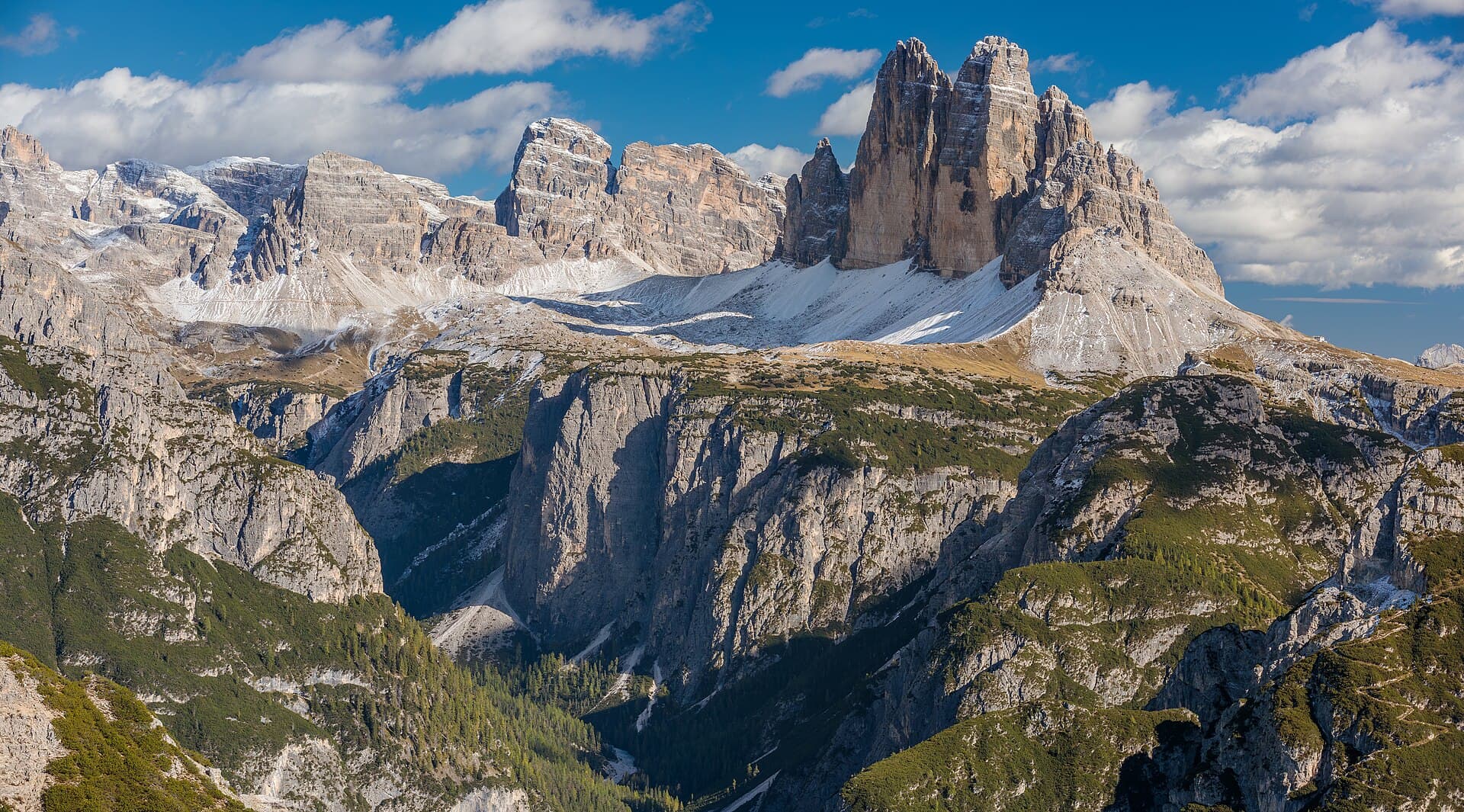
AV1's character is defined by the pale towers of the Tofane, Cinque Torri, and Civetta — dramatic from a distance, walked around rather than through. AV2's character is different. It walks through the mountain groups, not around them, and this is why via ferrata gear is required.
The Sella Group (2,873 m, Piz Boè). A massive tabletop fortress of dolomite, ringed by vertical walls on every side. The AV2 route crosses the summit plateau — a flat, moonscape expanse at 2,800+ m that looks nothing like what most trekkers imagine when they hear "Dolomites." The descent off the Sella via Val Setus is the route's first mandatory via ferrata section: a steep couloir with fixed cables, stemples, and short drops that feed directly onto the rock face. The Sella is also the geographic heart of the Ladin-speaking valleys — Val Badia, Val Gardena, Livinallongo, and Val di Fassa surround it on four sides, and the language, food culture, and woodcarving traditions of this Rhaeto-Romanic community are distinct from both the German-speaking north and the Italian-speaking south. Source: Cicerone — Alta Via 2.
The Marmolada massif (3,343 m, Punta Penia). The highest peak in the Dolomites and the only one that carries a glacier — though "carries" is an increasingly generous verb. The Marmolada glacier has lost more than 80% of its area and more than 94% of its volume since 1888. Maximum ice thickness measured in 2024: 34 meters. Scientists project complete disappearance by 2040 at current rates. On July 3, 2022, a serac collapse killed 11 people — a 70,400 m3 mass of ice detached from the northern slope. Full context on the 2022 collapse, climate attribution, and what it means for AV2 routing: Marmolada glacier collapse. Source: NHESS 2025 — Marmolada collapse climate attribution.
The AV2 standard route does not summit Marmolada. It traverses the southern flank via the Ombretta valley, passing Rifugio Falier with the south face of Marmolada dominating the skyline. The guided via ferrata to Punta Penia via the West Ridge is available as a side trip (June-October, guide mandatory). The cable car from Malga Ciapela to Punta Rocca (3,265 m) operates summer and winter. Source: Funivie Marmolada.
The Pale di San Martino (3,192 m, Cima della Vezzana). The largest mountain group in the Dolomites by area and, by consensus among those who have seen it, the most alien. The high plateau between Rifugio Mulaz and Rifugio Rosetta is a karst desert — a flat expanse of bare, pale rock at 2,500-2,700 m with virtually no vegetation, no water, and no visual reference points in poor visibility. It resembles a lunar surface more than anything in the Alps. The crossing of this plateau in cloud or storm is a genuine navigation challenge; cairns can be difficult to follow and GPS is strongly recommended.
Passo delle Farangole, the crux of the entire AV2, is the exit from this plateau into the Val Canali. It is a sustained K2-K3 via ferrata involving vertical cable sections, iron stemples, and exposure that is categorically more committing than anything on the AV1 standard route. This is the section that determines who should and should not attempt AV2.
Planning this route? We're forming a founding group for Alta Via 2 — Dolomites — registering interest is free, no commitment. See the expedition →
Who should do AV2 versus AV1
This is not a question of fitness alone.
AV1 is appropriate for: experienced multi-day hikers who are comfortable with sustained mountain terrain, rocky trails, and 6-8 hour days at altitude. No technical climbing skills are required. No via ferrata gear is required. A fit hill-walker with multi-day backpacking experience and no alpine-specific training can complete AV1.
AV2 is appropriate for: trekkers who have prior via ferrata experience at K2 grade or above, are comfortable with exposure (100-300 m drops), can manage fixed-cable technique (clipping and unclipping on vertical terrain under load), and have the endurance for a route that is 50% longer and 50% more vertical than AV1. AV2 is not a first via ferrata. It is not a first Dolomites trek. It is a route for people who have done AV1 or equivalent and are looking for the next level.
The practical filter: if the idea of descending a vertical couloir on steel cables and iron stemples with a 15 kg pack, 200 m of air below, and an afternoon thunderstorm building behind the ridge does not sound manageable, AV2 is not the right route. AV1 is excellent. There is no shame in the classic.
Gear requirements — the non-negotiable additions
Everything required for AV1 is required for AV2, plus:
- Via ferrata harness: A climbing harness rated for via ferrata use. A standard sport climbing harness works, but a dedicated via ferrata harness with wider leg loops and padding is more comfortable for long days.
- Via ferrata lanyard (energy absorber): A Y-shaped lanyard with two carabiners and an integrated energy absorber (shock pack). This is NOT a pair of slings with carabiners. The energy absorber is a legal and practical requirement — it reduces the impact force of a fall on a fixed cable from potentially lethal to survivable. Standard slings will not do this. Source: In A Faraway Land — beginner via ferrata guide.
- Helmet: Mandatory. Rockfall on via ferrata routes is not hypothetical — it is a regular occurrence, especially when other parties are above.
- Gloves: Not mandatory but strongly recommended. Gripping wet steel cable for hours will shred unprotected hands.
The rental option: via ferrata sets (harness + lanyard + helmet) are available for rent at gear shops in Bressanone, Corvara, Canazei, and other valley towns along the route at approximately 13-15 EUR/day. For a 14-16 day route, buying is likely more economical than renting. A basic set (harness + certified lanyard + helmet) runs 120-180 EUR new.
Rifugio booking — the southern advantage
One of the lesser-known advantages of AV2 over AV1 is rifugio booking pressure. The AV1 northern stages (Lagazuoi, Nuvolau, Biella, Fanes) are among the most popular rifugi in the entire Dolomites — groups of 2+ attempting July-August without 3-6 months advance booking will likely be turned away. Source: Brooke Beyond — rifugio guide.
AV2's southern stages — from Rifugio Treviso through to Feltre — see significantly less traffic. The via ferrata requirement filters a large percentage of AV1's audience. The Pale di San Martino stages and everything south of them are quieter, and rifugio availability is substantially easier to secure, even in peak season. The northern stages of AV2 (Plose, Genova, Puez, Boè) do attract day-hikers and short-route trekkers, but the multi-day pressure is lower than AV1's famous northern huts.
The booking system remains the same: no centralized platform. Each rifugio is contacted individually — typically by phone, email, or WhatsApp. Half-board rates: 50-75 EUR/night. CAI/AVS membership saves 10-18 EUR/night. Hüttenschlafsack (silk or cotton liner) mandatory; full sleeping bags are not welcome. Source: Brooke Beyond — rifugio guide. The channel-by-channel process — who answers email, who only answers the phone, what the CAI card changes — is in the rifugio booking guide.
The "two AV1s" confusion — and the same applies to AV2
There are two routes called "Alta Via 1" in Italy. One is the Dolomites AV1 (Lago di Braies to Belluno). The other is the Liguria Alta Via dei Monti Liguri — a completely different route on the Italian Riviera, often abbreviated AV1. English-language search engines conflate them routinely. Source: Cicerone — What's the Alta Via and why are there two AV1 routes?.
The same naming collision applies to AV2. The Dolomites Alta Via 2 (Bressanone to Feltre) shares its designation with other "Alta Via 2" routes in different Italian regions. The distinction matters most when searching for GPS tracks, guidebooks, and trip reports — a search for "Alta Via 2 Italy" will return results from multiple mountain ranges. Always specify "Dolomites" or "Dolomiti" in search queries. Always verify that the route described starts in Bressanone/Brixen and ends in Feltre. If it does not, it is a different AV2.
Weather and timing
The same afternoon thunderstorm pattern that governs AV1 governs AV2, but with a critical amplifier: AV2 puts trekkers on via ferrata sections — steel cables attached to exposed rock — during the hours when lightning is most likely.
The protocol: start every stage at first light. Be off via ferrata sections by noon. Be at the rifugio by 1-2 PM. The morning weather window (clear sky, stable air, dry rock) is the only window in which to commit to via ferrata terrain. An afternoon thunderstorm on the Pale di San Martino plateau, with no shelter and no escape route, is a genuine emergency. Source: Guide Dolomiti — Dolomites weather.
September remains the statistically driest trekking month, not July. After September 15, crowds drop 60-70% and rifugi maintain schedules through month-end. Trade-offs: 3-8 degrees C nights at 2,500 m, shorter days, possible early snow on the high plateau sections. For AV2, the September window is particularly attractive because the via ferrata sections benefit most from dry, stable conditions.
Rescue and insurance — the same math, higher stakes
The rescue infrastructure (CNSAS, BRD, Aiut Alpin Dolomites helicopter) and the billing structure (accident rescue covered by CAI membership; non-injury evacuation billed at 90-120 EUR/minute in Veneto/Trentino/South Tyrol) apply identically to AV2 as to AV1. Source: Guide Dolomiti — mountain rescue.
The difference is probability. Via ferrata terrain increases the likelihood of both injury (falls, rockfall, cable burns) and non-injury evacuation scenarios (stranded in storm, exhaustion on exposed terrain, gear failure). The CAI + Aiut Alpin combination (~85 EUR total) that is strongly recommended for AV1 is closer to mandatory for AV2. CAI covers accident rescue and saves 10-18 EUR/night on rifugio half-board. Aiut Alpin covers comprehensive helicopter evacuation including non-injury scenarios. Over a 14-night AV2, the rifugio savings alone (140-252 EUR) pay for both memberships several times over. Neither membership is medical insurance — they cover the rescue, not the treatment after it. Non-EU visitors should add travel medical cover: SafetyWing covers trekking to 4,500 m, but read its via ferrata clause before relying on it for the cable sections. Source: Aiut Alpin Dolomites — membership.
What to do with this
- Do AV1 first. Unless prior via ferrata experience at K2+ is already established, AV1 is the correct first Dolomites high route. It is not a lesser route. It is the classic for a reason.
- Via ferrata skills before AV2. If AV1 is done and AV2 is the goal, spend a day or two on standalone via ferrata routes in the Cortina or Sella area (Brigata Tridentina, Piz da Lech) before committing to the full route. The via ferrata sections on AV2 are not places to learn technique.
- Buy the gear, do not rent. For a 14-16 day route, rental costs exceed purchase price. A harness, certified via ferrata lanyard, and helmet for 120-180 EUR will be cheaper than renting at 13-15 EUR/day and will fit better.
- Join CAI + Aiut Alpin before departure. ~85 EUR total. Accident rescue, helicopter evacuation, and rifugio discounts that pay for themselves by stage 3.
- Book northern stages early, relax on southern stages. Rifugi Puez, Boè, and Viel dal Pan need 3-4 months advance booking for July-August. From Rifugio Treviso south, availability is substantially easier.
- Target September. Driest month, emptiest trails, best conditions for via ferrata rock. Accept the trade-off of colder nights and shorter days.
- Carry GPS and know how to use it. The Pale di San Martino high plateau in cloud has no visual navigation references. Cairns disappear in mist. This is not optional equipment on AV2.
Book the huts
Booking these huts means juggling separate operators, emails, and portals — exactly what this guide walks through. jtreks can do it for you: tell us your route and dates, we send the request to each hut and confirm back, at no extra cost to you.
→ Request your huts on /refugios
12 Sources
- thehiking.clubThe Hiking Club — via ferrata routes along Alta Via 1
- guidedolomiti.comGuide Dolomiti — via ferrata grades
- inafarawayland.comIn A Faraway Land — beginner via ferrata guide
- cicerone.co.ukCicerone — Alta Via 2
- cicerone.co.ukCicerone — What's the Alta Via and why are there two AV1 routes?
- nhess.copernicus.orgNHESS 2025 — Marmolada collapse climate attribution
- funiviemarmolada.comFunivie Marmolada — opening and prices
- brookebeyond.comBrooke Beyond — mountain huts rifugi in the Dolomites
- guidedolomiti.comGuide Dolomiti — Dolomites weather
- guidedolomiti.comGuide Dolomiti — mountain rescue
- aiut-alpin-dolomites.comAiut Alpin Dolomites — membership
- caibardonecchia.itCAI Bardonecchia — 2026 membership fees