The mountains that require a reservation
In 2026, the Dolomites crossed a line that most English-language trekking guides have not yet noticed.
To drive to Tre Cime di Lavaredo — the most iconic formation in the range — you now need a mandatory online reservation and €40 per car. The toll road accepts 7,000–8,000 visitors per day. Without a reservation, you are turned away at the gate.
To ride the cable car to Seceda — the ridgeline viewpoint that has become one of the most photographed landscapes in Europe — you now need a pre-booked time slot. A €5 turnstile fee has been added to the trail itself. Rangers enforce stay-on-trail rules; the meadow access that every Instagram photo was taken from is prohibited.
To drive to Lago di Braies — the starting point of Alta Via 1 — you are banned from driving between 9AM and 4PM from July 1 to September 15. A paid shuttle from the valley entrance is mandatory.
To drive to the Santa Maddalena church viewpoint in Val di Funes — the postcard that launched a thousand blog posts — driving is banned from May to November. You park in the village and walk 30 minutes.
Wild camping: zero tolerance in all nature parks. Fines €100–500+. Drones: illegal without a professional ENAC permit. Fines up to €3,000+.
Every one of these restrictions is new or tightened since 2024. Most English-language Dolomites guides were written before them. If the guide you're reading describes open-access trailheads with free parking, it is describing a Dolomites that no longer exists.
The infrastructure IS the product
The conventional way to frame this story is as an overtourism problem — too many people, not enough mountain. That framing is not wrong, but it misses the deeper structural point.
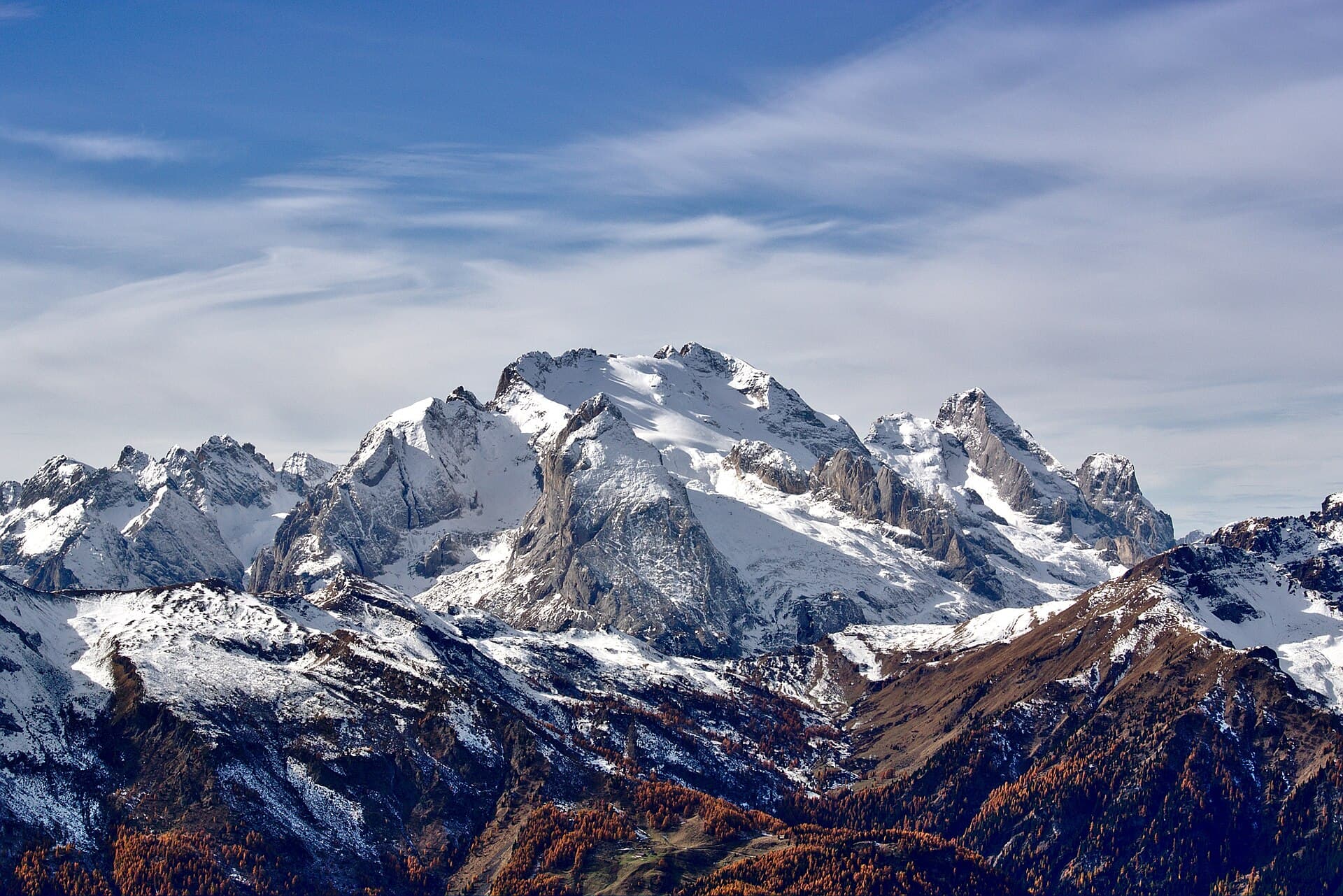
The Dolomites have never been a wilderness. They are the most densely infrastructured alpine landscape on Earth, and that infrastructure is not an intrusion on the experience — it is the experience itself. Understanding this is the single most useful thing this article can give you.
Layer 1 — 900 years of pastoral agriculture. The alpine meadows (Alm in German, malga in Italian) that make the Dolomites visually distinctive — the bright green pastures below pale vertical walls — are not natural grasslands. They are the product of nearly a millennium of managed cattle and dairy farming at altitude. Many of the rifugi that trekkers sleep in today are built on or adjacent to working alpine dairies. The food culture at a Dolomites rifugio — the speck, the Knödel, the kaiserschmarrn, the local cheese — is not tourist-menu marketing. It is the pastoral economy of the Alm, served at altitude because that is where the cows and the cheesemakers have been for centuries.
Layer 2 — 150 years of alpine club hut-building. The rifugio system began in the 1870s with the founding of the Società degli Alpinisti Tridentini (SAT, 1872) and the Deutsche und Österreichische Alpenverein (DOAV) sections. These were, at the time, acts of Italian irredentist and Austrian imperial nation-building respectively — huts planted in the mountains as territorial markers. After 1919, when South Tyrol was transferred from Austria to Italy, the South Tyrolean alpine club sections were dissolved and expropriated under Italian rule (Club Arc Alpin — AVS history). The Alpenverein Südtirol (AVS) was refounded in 1946 as the South Tyrolean successor.
The rifugio system today — over 1,000 huts across the Dolomites, operated by CAI sections, AVS sections, and private families — is the densest mountain hut network in the world. On popular routes, you pass a rifugio every 3–5 km. This is not comparable to any other trekking destination: Nepal's teahouses are more spread out, Patagonia's refugios are fewer, the Swiss hut system is sparser at altitude. The Dolomites rifugio density is unique, and it is the product of 150 years of competitive hut-building by rival alpine clubs in a politically contested landscape. Practical how-to: rifugio booking guide and rifugio food culture.
Layer 3 — 100 years of military infrastructure. The Dolomites were the frontline of the Italian-Austro-Hungarian alpine war from 1915 to 1918. The via ferrata system — the fixed steel cables, iron stemples, ladders, and tunnels that today allow non-climbers to traverse vertical rock — was built to move soldiers and supplies through terrain that would otherwise require technical climbing.
The Lagazuoi tunnels, which are now one of the most popular day hikes in the Cortina area, were Italian and Austrian mine galleries — each side tunnelling into the mountain to place explosives under the other's positions. The Cinque Torri open-air museum preserves trenches and gun emplacements among the rock towers. Col di Lana was called "Col di Sangue" (Hill of Blood) after a 1916 Italian mine killed an entire Austrian garrison. The Marmolada "Ice City" was a system of tunnels and barracks carved into the glacier by Austrian troops at 3,000+ meters.
When you clip into a via ferrata cable in the Dolomites, you are clipping into infrastructure that was built to kill people. The cables have been maintained, rerouted, and supplemented for a century since, but the origin layer — the reason the metal is in the rock at all — is war. No other trekking destination on Earth has this archaeological layer. It is the single most distinctive thing about Dolomites trekking, and few English-language guides lead with it.
Layer 4 — 2026: the reservation layer. The toll roads, turnstiles, plate scanners, time-slotted cable cars, and shuttle mandates that appeared in 2024–2026 are not an aberration. They are the fourth layer of infrastructure in a landscape that has been continuously managed for nine centuries. The difference is that the first three layers (pastoral, alpine club, military) were built to bring people into the mountains. The fourth layer is built to manage how many people can be there at once.
Continue reading Alta Via 2 gear and packing list — what hut-to-hut in the Dolomites actually requires →
Common errors in English-language guides
- "You need via ferrata gear for Alta Via 1." Wrong on the standard route. All via ferrata sections on AV1 are optional side trips (Ra Gusela K1, Averau K2–K3). The standard finish at La Pissa deliberately avoids the Schiara via ferrata. You can walk the full AV1 with nothing but hiking boots. Alta Via 2 is the one where gear is mandatory — full comparison in via ferrata truth. Source: The Hiking Club — via ferrata on AV1.
- "Alta Via 1 is 150 km." The standard marked route is approximately 120 km with ~7,300 m total elevation gain. The 150 km figure includes optional variants and side trips. No two English guides agree on the distance because they count different things. Source: Hut to Hut Hiking Dolomites.
- "K1–K2 via ferrata are safe for complete beginners." K1–K2 routes still have genuine exposure — sometimes 300 m drops on a 30 cm ledge. Memorial plaques with names of fatalities exist on nearly every via ferrata, including "easy" ones. A K1 route with wet cables or an afternoon thunderstorm is a survival situation, not a tourist experience. Source: In A Faraway Land — beginner via ferrata guide.
- "Helicopter rescue is free in Italy." In Veneto, Trentino, and South Tyrol — the three provinces where the Dolomites sit — helicopter rescue of uninjured persons (stranded, exhausted, lost) is billed at €90–120 per minute of flight time. A real August 2025 case cost €14,225. CAI membership covers accident rescue only, NOT non-injury evacuations. Source: Guide Dolomiti — mountain rescue.
- "The Mobilcard covers cable cars." The Südtirol Mobilcard covers public transport and a handful of urban/village cable cars (Ritten, Jenesien, Mendel). It does NOT cover the major hiking cable cars — Seceda (~€60 return), Lagazuoi (~€27 return), Sass Pordoi, or Marmolada. The free Südtirol Guest Pass from participating hotels covers the same public transport the Mobilcard does. Source: suedtirol.info — Mobilcard.
- "Tre Cime toll road is €30." Increased to €40/car in 2025. Now requires mandatory online pre-booking via pass.auronzo.info. Up to 8,000 daily visitors in peak. Without a reservation: turned away. Source: Mountain Maps — Tre Cime 2025 rules.
- "You can walk up to rifugi." Solo hikers can often walk up even in peak season. Groups of 2+ attempting July–August on AV1 stages 1–4 (Lagazuoi, Nuvolau) without booking 3–6 months ahead will likely be turned away. Source: Brooke Beyond — rifugio guide.
The rescue math — the €85 that changes everything
The Dolomites have one of the highest helicopter rescue rates in Europe. Multiple daily missions in peak season. The rescue infrastructure — CNSAS (national mountain rescue), BRD (Bergrettungsdienst, South Tyrol), and Aiut Alpin Dolomites (dedicated helicopter service with an Airbus H135 T3) — is world-class.
The billing, however, is the detail most English guides miss.
CAI membership (~€45/year ordinary rate, 2026 fees) covers CNSAS rescue intervention for accidents in Italy. It also saves €10–18 per night on rifugio half-board pricing through the reciprocal alpine club system. Over a 10-night AV1, the savings are €100–180 — the membership pays for itself in 2–3 nights.
But CAI membership does not cover helicopter evacuation of uninjured persons. In the Dolomites provinces, that costs €90–120 per minute of flight time. A typical helicopter extraction is 15–20 minutes of flight time. The August 2025 bill: €14,225.
Aiut Alpin Dolomites membership (€40/individual, €60/family, aiut-alpin-dolomites.com) covers comprehensive rescue and helicopter transport costs across Europe, including non-injury evacuations.
The combination — CAI + Aiut Alpin, ~€85 total — gives you accident rescue coverage, comprehensive helicopter coverage, and rifugio pricing discounts that more than pay for both memberships. This is the highest-ROI insurance decision in alpine trekking. Few English guides surface it because few do the math.
Planning this route? We're forming a founding group for Alta Via 2 — Dolomites — registering interest is free, no commitment. See the expedition →
The "Eighth Wonder" it actually is
The Dolomites were inscribed as a UNESCO World Heritage Site in 2009 — a serial property of nine component systems. The inscription is geological, not cultural: it recognizes the Triassic reef-origin dolomite rock as "among the most beautiful mountain landscapes anywhere" and as an outstanding example of Mesozoic carbonate platform development.
The name itself comes from Déodat de Dolomieu, the French geologist who identified dolomite rock (calcium magnesium carbonate) in 1791. The pale color of the towers — unique in the Alps — is the color of ancient reef limestone. The enrosadira phenomenon (alpenglow, Alpenglühen) — when the towers turn pink, then orange, then deep red at sunset — is a property of the rock's mineral composition refracting low-angle light. It is not a photographic filter. It is physics.
The geological uniqueness shapes the trekking experience in distinctive ways: dolomite rock creates vertical towers and buttresses that rise abruptly from gentle alpine meadows. This is not the smooth-ridge profile of granite ranges (Mont Blanc, Fitz Roy) or the rounded forms of sandstone. The Dolomites are architecturally sharp — every horizon looks like a skyline. This verticality is what made the via ferrata system possible: the rock is steep enough to need cables but solid enough to hold them.
The three cultures you walk through
The Dolomites are politically Italian but culturally trilingual. A trekker on Alta Via 1 walks through three distinct cultural zones:
German-speaking South Tyrol (Südtirol / Alto Adige): ~70% German-speaking, Austrian until 1919, subject to forced Italianization under Fascism, autonomous since the 1972 Second Autonomy Statute. The rifugi here are Schutzhütten. The food is Knödel and speck. The signage is bilingual (German first, Italian second). The 1961 Feuernacht (Night of Fire) — when South Tyrolean separatists blew up 37 electrical pylons and Italy deployed 24,000 troops — is within living memory.
Ladin-speaking valleys: ~30,000–35,000 speakers of a Rhaeto-Romanic language older than both Italian and German, concentrated in five valleys around the Sella massif: Val Badia, Val Gardena, Livinallongo, Ampezzo, Val di Fassa. 90% still spoken at home in Val Gardena. The place names on the trail are Ladin. The woodcarving in the rifugi is Ladin. The food culture blends Italian and Tyrolean with its own distinct character.
Italian-speaking Veneto (Belluno province): The southern stages of AV1 cross into Veneto. The shift is noticeable: different signage standards, different trail maintenance funding, different rifugio pricing structures. South Tyrol's autonomy means it controls its own tourism and infrastructure budgets independently of Rome. Veneto does not have this autonomy. The "two Dolomites" quality gap is real, if subtle.
You don't need to speak any of the three languages to trek. But knowing that you are walking through a politically trilingual, historically contested landscape — not just "Italy" — changes what you notice.
The Marmolada question
On July 3, 2022, a serac collapse on Marmolada — the highest peak in the Dolomites at 3,343 m — killed 11 people. A 70,400 m³ mass of ice detached from the glacier and slid 2.3 km down the northern slope. The cause, per a 2025 peer-reviewed study in Natural Hazards and Earth System Sciences, was attributed to record temperatures and absence of insulating snow cover.
The Marmolada glacier has lost more than 80% of its area and more than 94% of its volume since 1888. Maximum ice thickness measured in 2024: 34 meters. Scientists project complete disappearance by 2040 at current rates. Twelve glaciers remain in the Dolomites.
As of 2026, the West Ridge via ferrata to Punta Penia is accessible for guided excursions (June–October). The cable car from Malga Ciapela to Punta Rocca (3,265 m) operates in both summer and winter seasons. Source: Funivie Marmolada.
The balanced view: Marmolada is still a reasonable destination for a trekker who wants to see one of Europe's last low-altitude glaciers before it is gone. It is also a landscape in terminal collapse. Both things are true. A guide that pushes Marmolada without mentioning the 2022 deaths, the glacial retreat, or the ongoing risk assessment is incomplete.
What to do with this
If you are planning a Dolomites trek in 2026:
- Book the access before the trails. Tre Cime toll road, Seceda cable car, Lago di Braies shuttle — pre-book all of these before you book rifugi. The access infrastructure is now the first bottleneck, not the accommodation.
- Join CAI + Aiut Alpin before you fly. ~€85 total. Covers accident rescue, comprehensive helicopter evacuation (including non-injury), and saves €100–180 on rifugio half-board over 10 nights. The membership pays for itself by night 3.
- AV1 does not require via ferrata gear on the standard route. If you want to do the optional via ferrata side trips (and you should — Lagazuoi tunnels alone are worth the gear), rent a set at Passo Falzarego (harness + via ferrata lanyard + helmet, ~€13–15/day).
- September, not July. Driest month. After September 15, crowds drop 60–70%. Rifugi and cable cars maintain full schedules through month-end. Trade-off: 3°C nights at 2,500 m, shorter days, possible early snow. Carry layers and a headlamp.
- Start early every day. The afternoon thunderstorm pattern is the defining Dolomites weather hazard. Clear sky morning → clouds after noon → storms 2–5 PM. Be at the rifugio by 1–2 PM. Do not be on an exposed ridge or via ferrata after 1 PM in July–August.
- The Mobilcard is not the smart buy. It doesn't cover the cable cars you actually use. The free Südtirol Guest Pass from participating accommodations covers the same public transport. Don't pay for the Mobilcard unless you're not staying in Guest Pass accommodation.
- The "two Dolomites" is real. South Tyrol's autonomous budget means better trail signage, maintenance, and digital booking infrastructure than the Belluno/Veneto side. If you're doing AV1 southbound, expect the quality to shift around stage 6–7.
18 Sources
- wildconnectionsphotography.comWild Connections Photography — 2026 access restrictions in the Dolomites
- mountainmaps.itMountain Maps — Tre Cime di Lavaredo new rules summer 2025
- thehiking.clubThe Hiking Club — via ferrata routes along Alta Via 1
- huttohuthikingdolomites.comHut to Hut Hiking Dolomites — Alta Via 1 ultimate guide
- brookebeyond.comBrooke Beyond — mountain huts rifugi in the Dolomites
- guidedolomiti.comGuide Dolomiti — Dolomites mountain rescue
- guidedolomiti.comGuide Dolomiti — via ferrata grades
- guidedolomiti.comGuide Dolomiti — Dolomites weather
- caibardonecchia.itCAI Bardonecchia — 2026 membership fees
- aiut-alpin-dolomites.comAiut Alpin Dolomites — membership
- aiut-alpin-dolomites.comAiut Alpin Dolomites — helicopter
- suedtirol.infosuedtirol.info — Mobilcard
- inafarawayland.comIn A Faraway Land — beginner via ferrata guide
- whc.unesco.orgUNESCO World Heritage — The Dolomites
- en.wikipedia.orgWikipedia — 2022 Marmolada serac collapse
- nhess.copernicus.orgNHESS 2025 — Marmolada collapse climate attribution
- funiviemarmolada.comFunivie Marmolada — opening and prices
- cicerone.co.ukCicerone — What's the Alta Via and why are there two AV1 routes?