
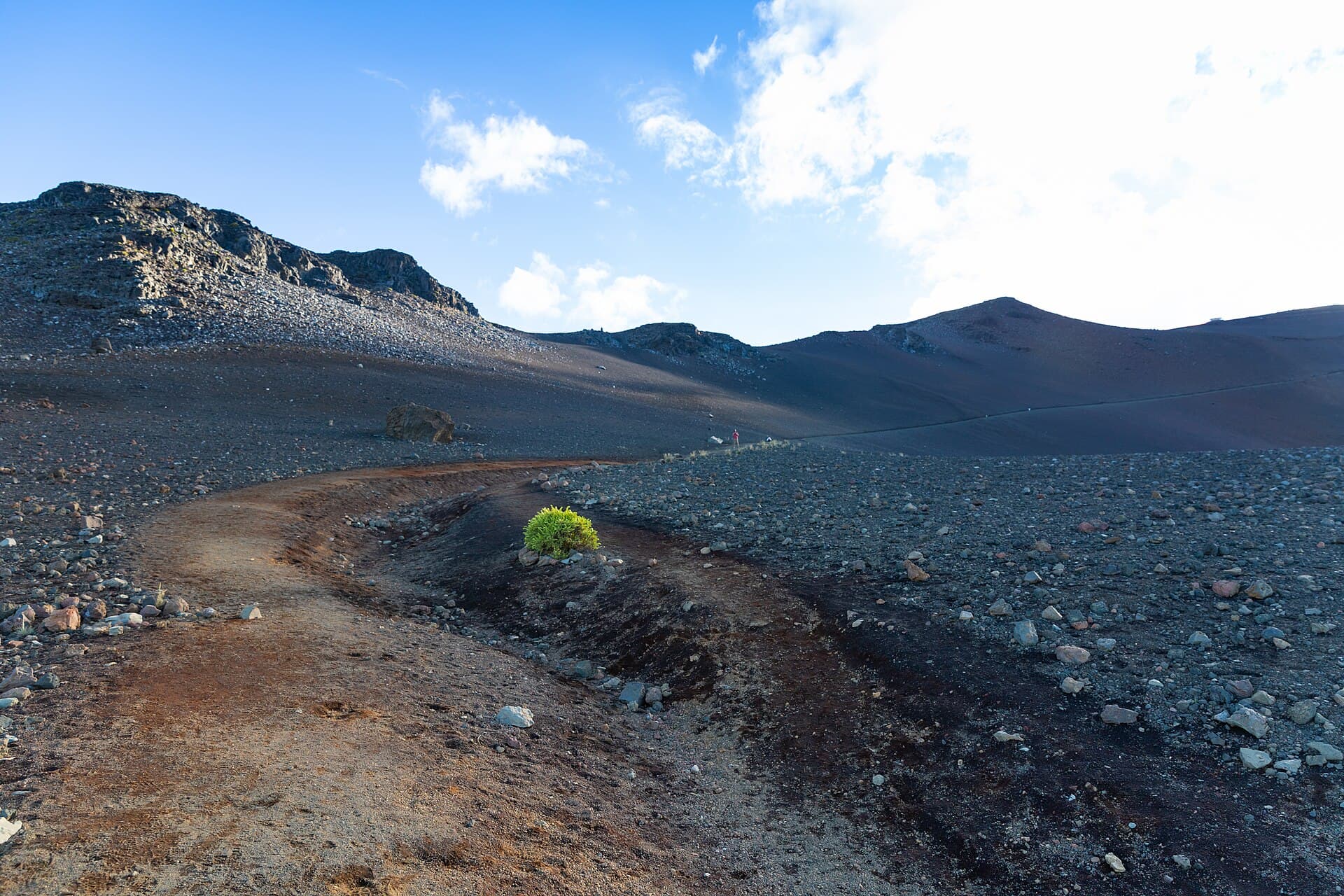
Current eruption status
Kīlauea is erupting. Episode 46 of the ongoing Halemaʻumaʻu eruption began with precursory activity at 1:38 AM HST on May 4, 2026, escalating to full lava fountaining at 8:17 AM on May 5. Fountains from the north vent peaked at approximately 200 m (650 ft). The episode lasted roughly 9 hours before ending around 5:30 PM on May 5.
The USGS Hawaiian Volcano Observatory (HVO) raised the alert level from ADVISORY to WATCH and the Aviation Color Code from YELLOW to ORANGE. An ashfall advisory was issued for the Volcano and Mountain View communities downwind of the summit.
All eruptive vents and lava flows remain confined to Halemaʻumaʻu crater. There is no lava flow threat to populated areas, roads, or the broader trail network.
This is not unusual. Kīlauea has been in a state of near-continuous eruption since 1983. The current Halemaʻumaʻu eruption sequence has produced 46 episodes since December 2020. The park operates around a volcano that could erupt again tomorrow or go quiet for months. Trail access changes accordingly.
Source: USGS/HVO Kīlauea Updates; Honolulu Star-Advertiser; Big Island Now.
What is open (spring 2026)
The park covers 335,000 acres with over 150 miles of trails. Most of it is open. The closures are concentrated around the Halemaʻumaʻu crater rim and the old Crater Rim Drive loop.
Kīlauea Iki Trail
The park's most popular hike. A 4-mile (6.4 km) loop that descends from the rim through ʻōhiʻa forest, crosses the floor of Kīlauea Iki crater, and climbs back out. The crater floor is the solidified lava lake from the 1959 eruption — you walk across it. Steam vents still hiss through cracks. The surface is uneven and rough on footwear.
The 1959 eruption was the most spectacular in Kīlauea's modern history. Lava fountains reached 580 m (1,900 ft) — still the highest ever recorded in Hawaiʻi. The lava lake filled the crater to a depth of 134 m. The trail crosses this lake, which took over 35 years to fully solidify.
Allow 2–3 hours. The descent into the crater and return climb are moderate. Footing on the crater floor requires attention — the lava surface is rough and cracked.
Source: NPS Hiking.
Nāhuku (Thurston Lava Tube)
A 0.4-mile (0.6 km) loop through a 500-year-old lava tube. The tube is lit from 8 AM to 8 PM; bring a flashlight outside those hours. Discovered in 1913 by Lorrin Thurston, a newspaper publisher who was also central to the overthrow of the Hawaiian monarchy — a history the NPS interpretive signs do not emphasize.
Access note (spring 2026): The entrance bridge is being replaced. The tube is accessible only from the back entrance during construction. Parking at the Thurston lot is extremely limited. The NPS recommends arriving before 9 AM or after 4 PM, or parking at the Kīlauea Iki Overlook (0.5-mile walk).
Source: NPS Nāhuku.
Devastation Trail
A 1-mile (1.6 km) round-trip paved trail through the blast zone of the 1959 Kīlauea Iki eruption. The landscape is a field of cinder and scattered dead tree trunks — ʻōhiʻa forest killed by tephra fallout. New ʻōhiʻa seedlings are now growing back through the cinder, 67 years later.
This is an easy, accessible trail. Wheelchair-navigable for most of its length. It offers two overlook points with panoramic views of both Halemaʻumaʻu and Mauna Loa.
Source: NPS Hiking.
Chain of Craters Road
An 18.8-mile (30.3 km) one-way drive from the summit area to the coast, descending 1,128 m (3,700 ft) through increasingly barren lava fields. The road passes multiple pit craters, lava flow overlooks, and petroglyphs.
This road is not a loop. Crater Rim Drive — which once connected Chain of Craters Road back to the summit — has been partially closed since the 2018 collapse event, when the Halemaʻumaʻu caldera floor dropped over 500 m. Multiple guides still describe "the full Crater Rim Drive loop." That loop has not existed since 2018 and will not be restored.
The road ends where a 2003 lava flow crossed it. You drive down and drive back up the same way.
Pu'uloa Petroglyphs: At mile 16.5, a 1.4-mile (2.3 km) round-trip trail leads to one of Hawaiʻi's largest petroglyph fields — over 23,000 images carved into pāhoehoe lava. These are cultural sites. Walk only on the boardwalk. The petroglyphs include circular holes (puka) where Hawaiians placed their children's umbilical cords to ensure long life.
Source: NPS Chain of Craters.
Continue reading The trails are not the danger — the water is. Hawai'i hiking in 2026. →
What is closed (spring 2026)
Crater Rim Trail (western section)
The section from Kīlauea Military Camp to Uēkahuna is closed while park staff clear volcanic cinders deposited during Episode 46. Sections of Crater Rim Drive west and south of Halemaʻumaʻu have been closed since the 2018 caldera collapse and have no reopening date.
A 0.7-mile section of the Crater Rim Trail near the Devastation Trail parking lot remains open, with two overlook points.
Kīlauea Visitor Center
Closed since February 2025. A two-year construction project is repairing or removing buildings damaged during the 2018 collapse. The NPS projects a late 2026 reopening. In the meantime, a temporary information station operates from the Kahuku Unit.
Jaggar Museum site
Demolished after the 2018 collapse rendered it structurally unsound. The overlook that once offered the closest view of the lava lake is gone. The current best summit viewpoint is the Devastation Trail overlooks and the open section of Crater Rim Trail.
Source: NPS March 2026 Reopening; Big Island Video News.
Vog
Vog — volcanic smog — is a haze of sulfur dioxide (SO₂) gas and sulfuric acid aerosols emitted by Kīlauea. During eruption episodes, SO₂ emissions increase sharply. The gas sinks into the lungs during physical exertion, causing throat irritation, headache, and respiratory distress. Asthmatics are most at risk.
Vog is worst on the leeward (Kona) side of the Big Island, where trade winds carry the emissions. Ironically, the park itself — on the windward side near the source — often has better air quality than towns 100 km downwind.
Before hiking: Check real-time air quality at vog.ivhhn.org. On high-vog days, consider limiting strenuous activity, especially if you have respiratory conditions.
Tephra from Episode 46: Volcanic debris (tephra) remains on roads and trails following the May 2026 eruption. Fine cinder particles can irritate eyes and skin. The NPS recommends long sleeves and eye protection when conditions are dusty.
Source: USGS HVO Vog FAQ.
Backcountry camping
The park has seven backcountry campsites and three backcountry shelters across its 150+ miles of trails. This is some of the most remote and least-visited backcountry in Hawaiʻi.
Backcountry campsites
| Site | Location | Notes |
|---|---|---|
| Ka'aha | South coast | Coastal; 5.6 mi from Hilina Pali Road |
| Halape | South coast | Beach campsite; shelter rebuilt after 1975 tsunami |
| Keauhou | South coast | Remote; between Halape and 'Āpua Point |
| 'Āpua Point | South coast | Coastal lava shelf; hot and exposed |
| Nāpau | East rift zone | Near Pu'u 'Ō'ō; check eruption status before going |
| Pepeiao Cabin | Mauna Loa trail | Shelter at 2,606 m (8,550 ft) on the Mauna Loa Trail |
| Red Hill (Pu'u 'Ula'ula) Cabin | Mauna Loa summit | Shelter at 3,048 m (10,000 ft); staging point for summit |
Permits: Required from the Backcountry Office (808-985-6178) or through Recreation.gov. First-come, first-served plus reservable sites. Maximum 12 people per site, 3 nights maximum per site.
Coastal backcountry reality: The south coast sites (Ka'aha, Halape, Keauhou, 'Āpua Point) are hot, exposed, and remote. Water must be carried or collected from rainfall catchments (unreliable). The hike to Halape descends 671 m (2,200 ft) over 7.2 miles on the Hilina Pali Trail — a brutal return climb in tropical heat. These are genuine wilderness campsites, not developed campgrounds.
Source: NPS Backcountry; Recreation.gov.
Mauna Loa trail access
Mauna Loa — the world's largest active volcano by volume — is also in the park. Its summit caldera, Moku'āweoweo, sits at 4,169 m (13,681 ft). The most recent eruption was November–December 2022, the first in 38 years.
Mauna Loa Trail:
- Distance: 18.3 mi (29.5 km) one way from Mauna Loa Lookout (2,030 m) to the summit
- Elevation gain: 2,139 m (7,014 ft)
- Duration: 3–4 days round trip
- Two shelters en route: Red Hill Cabin (3,048 m) and Mauna Loa Summit Cabin (4,038 m)
This is a serious high-altitude trek on barren lava flows above the cloud line. There is no water, no shade, and no trail markers beyond rock cairns. Weather can turn from clear to white-out in minutes. Altitude sickness is a real concern — the summit is higher than most European Alps peaks.
Current status: Check with the backcountry office before attempting. The trail and summit area may be closed during elevated volcanic activity or after eruptions that reshape the terrain.
Source: NPS Mauna Loa.
Campgrounds
Nāmakanipaio Campground
Located near the park entrance at approximately 1,219 m (4,000 ft) in a eucalyptus and ʻōhiʻa forest. As of April 2026, tent camping is closed. A-frame cabins remain open and can be booked through Hawaiʻi Volcanoes Lodge Company. The cabins are basic — wood frames, bunks, shared bathhouse — but they are warm and dry, which matters at this elevation.
Kulanaokuaiki Campground
A drive-in campground on Hilina Pali Road, about 5 miles off Chain of Craters Road. Nine sites, no water, pit toilets. This is the quieter option and serves as a staging point for south coast backcountry hikes. First-come, first-served.
Kahuku Unit
The Kahuku Unit is a separate section of the park, about 45 minutes south of the main entrance off Highway 11. It covers former ranch land on the slopes of Mauna Loa. The upper trails require 4WD past the Upper Palm Trailhead (mile marker 3). This unit sees a fraction of the main park's visitors and offers grassland and forest hiking with Mauna Loa views.
Source: NPS Campgrounds.
Entry fees
| Type | Cost | Validity |
|---|---|---|
| Per vehicle | $30 | 7 consecutive days |
| Per motorcycle | $25 | 7 consecutive days |
| Per individual (walk/bike) | $15 | 7 consecutive days |
| Hawaiʻi Tri-Park Annual Pass | $55 | 12 months (Volcanoes + Haleakalā + Puʻuhonua o Hōnaunau) |
Cash is no longer accepted at the entrance gate as of January 1, 2026. Credit or debit card only.
No reservation is required to enter the park. Drive up and pay at the gate.
Source: NPS Fees.
HVO and monitoring
The USGS Hawaiian Volcano Observatory has monitored Kīlauea and Mauna Loa continuously since 1912. Their real-time data feeds are public and are the only authoritative source for eruption status:
- Volcano updates: usgs.gov/volcanoes/kilauea/volcano-updates
- Webcams: usgs.gov/volcanoes/kilauea/webcams
- Alert levels: NORMAL → ADVISORY → WATCH → WARNING (most severe)
- Aviation color codes: GREEN → YELLOW → ORANGE → RED
If you are planning a visit, check the HVO page the morning of your trip. Trail access can change overnight — literally. An eruption can start at 2 AM and close trails by dawn. Conversely, an episode can end and trails reopen within 24–48 hours.
Source: USGS HVO.
Getting there
The park entrance is approximately 45 minutes from Hilo and 2.5 hours from Kailua-Kona, both via Highway 11.
From Hilo: Drive southwest on Highway 11 through Kea'au, Pāhoa junction, and Volcano village. The park entrance is at mile marker 28.
From Kona: Drive south on Highway 11 through Captain Cook, Nā'ālehu (southernmost town in the US), and Ocean View. The route passes through dry lava desert before climbing back into rainforest near the park.
Volcano village: A small community just outside the park entrance with restaurants, a general store, and accommodations. This is the nearest supply point. There is no food or fuel inside the park.
Cell service: Spotty at the summit, nonexistent in the backcountry and along Chain of Craters Road. Download offline maps before arriving.
Source: NPS Directions.
The 2018 collapse — what reshaped the park
From May to August 2018, Kīlauea's summit caldera collapsed. Over 62 collapse events dropped the Halemaʻumaʻu crater floor more than 500 m (1,600 ft). The lava lake that had been visible from the old Jaggar Museum overlook drained entirely. Simultaneously, lava erupted from fissures in the lower East Rift Zone (Leilani Estates), destroying 716 structures and covering 36 km² with lava.
This event fundamentally changed the park. Crater Rim Drive — once an 11-mile scenic loop — was partially destroyed. The Jaggar Museum was demolished. The visitor center was damaged. Much of the summit infrastructure that existed in guidebooks published before 2019 no longer exists.
Any guide that describes the "full Crater Rim Drive loop," the Jaggar Museum overlook, or the Halemaʻumaʻu lava lake viewpoint is referencing a park that no longer exists in that form. The park is rebuilding, but the 2018 collapse was the most significant landscape change at Kīlauea in over 200 years.
Source: USGS 2018 Eruption Summary; NPS 2018 Eruption.
Planning notes
Check before you go: USGS Kīlauea Updates for eruption status; NPS Conditions for trail closures.
Best time for the park: Year-round. The park sits at 1,200 m, above the coast heat but below the summit cold. Rain is frequent — the Kīlauea summit area receives approximately 250 cm (100 inches) of rain per year. Bring rain gear regardless of season.
Combining with Mauna Loa: The Mauna Loa summit trail starts within the park. A Kīlauea day hike plus a 3-day Mauna Loa backcountry trip is a legitimate expedition-grade itinerary on a single park entry fee.
Combining with Mauna Kea: Mauna Kea is approximately 90 minutes north of the park via Saddle Road (Highway 200). It is feasible to hike Kīlauea Iki in the morning and drive to the Mauna Kea Visitor Information Station for sunset stargazing the same day.
9 Sources
- usgs.govUSGS HVO — Kīlauea Volcano Updates (daily status)
- bigislandnow.comBig Island Now — Episode 46 lava fountaining ends at Kīlauea summit (May 5, 2026)
- nps.govNPS — Hawaiʻi Volcanoes National Park Fees & Passes
- nps.govNPS — Kīlauea Iki Trail Day Hike
- nps.govNPS — Backcountry Hiking, Hawaiʻi Volcanoes National Park
- recreation.govRecreation.gov — Hawaiʻi Volcanoes NP Backcountry Permits
- usgs.govUSGS — 2018 Kīlauea Lower East Rift Zone Eruption and Summit Collapse
- vog.ivhhn.orgIVHHN Vog / Current Air Quality — Hawaiʻi
- usgs.govUSGS Hawaiian Volcano Observatory (HVO)