
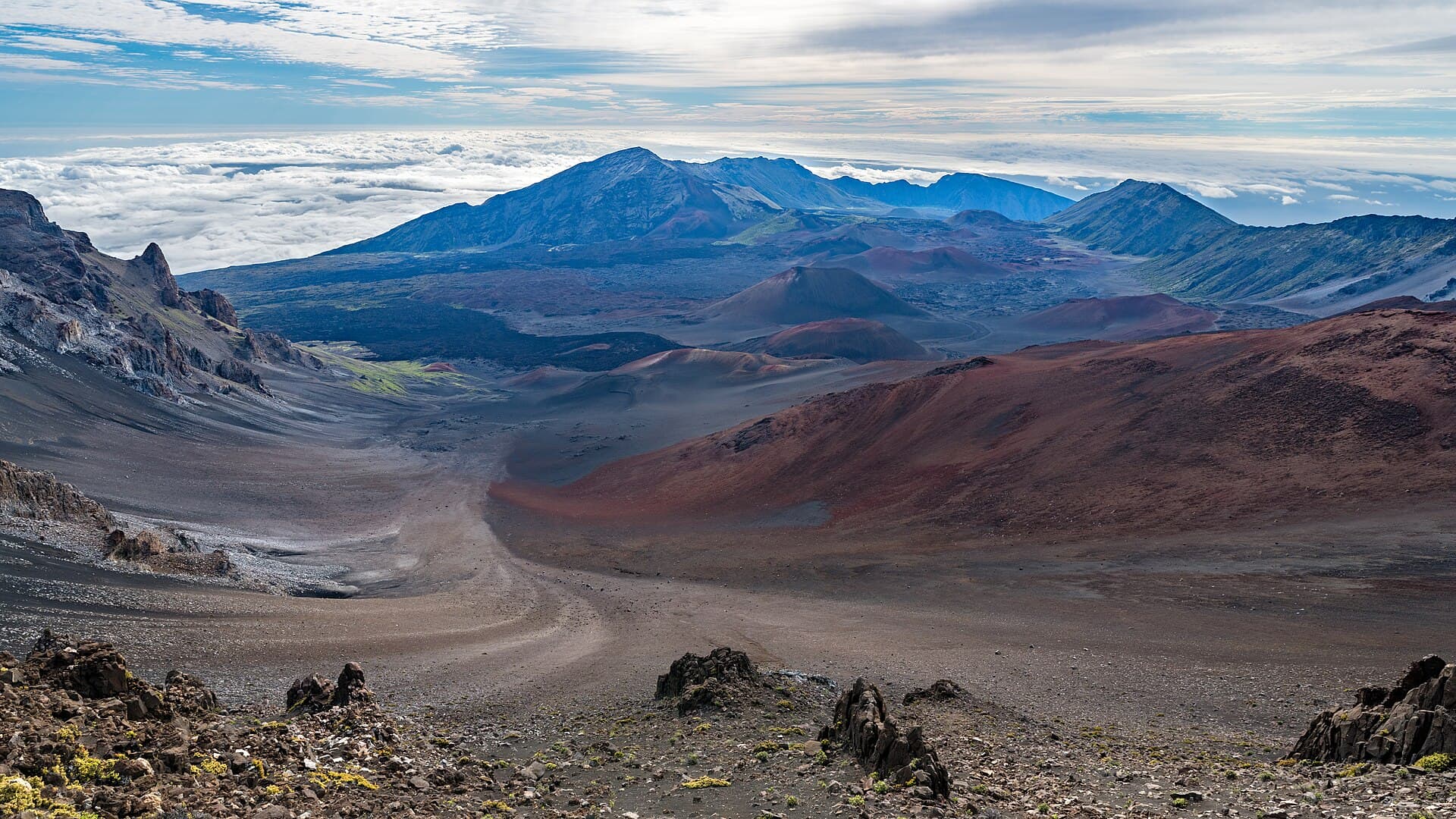
The "crater" that is not a crater
Haleakalā means "House of the Sun" in Hawaiian. The summit stands at 3,055 m (10,023 ft) on eastern Maui, and the massive depression below the rim looks like a volcanic crater. It is not one. Geologists classify it as an erosional depression — two stream valleys that carved into the volcano from opposite sides and eventually merged, creating a basin 11.2 km long, 3.2 km wide, and 800 m deep. Later volcanic activity deposited cinder cones across the floor, but the shape itself is erosion, not explosion.
This distinction matters for hikers because the "crater" floor is not a flat caldera. It is a landscape of cinder cones, lava flows, and sandy desert connected by trails that undulate across the basin at elevations between 1,945 m and 2,969 m.
Source: Wikipedia — Haleakalā; NPS Haleakalā.
Keoneheʻeheʻe (Sliding Sands) Trail
This is the primary descent into the depression. It begins at the summit visitor center parking lot at 2,969 m (9,740 ft) and drops 762 m (2,500 ft) over 3.9 miles to the crater floor. The full traverse to the Paliku cabin is 9.3 miles one way.
Trail specs:
| Segment | Distance | Elevation change |
|---|---|---|
| Trailhead to crater floor | 3.9 mi (6.3 km) | -762 m (2,500 ft) |
| Trailhead to Ka Lu'u o ka O'o cinder cone | 2.5 mi (4 km) | -457 m (1,500 ft) |
| Trailhead to Pele's Paint Pot | 5.7 mi (9.2 km) | -762 m (2,500 ft) |
| Trailhead to Kapalaoa cabin | 5.5 mi (8.9 km) | -759 m (2,490 ft) |
| Trailhead to Paliku cabin | 9.3 mi (15 km) | -1,024 m (3,360 ft) |
The descent is deceptively easy. Loose cinder acts like ball bearings underfoot, and you walk downhill in thin air at nearly 3,000 m. The return climb is where the trail earns its "extremely strenuous" rating. Plan on the ascent taking twice as long as the descent. At this altitude, the air contains roughly 30% less oxygen than at sea level.
Half-day option: The 5-mile round trip to Ka Lu'u o ka O'o cinder cone and back is the most popular day hike. It gives a taste of the crater floor without committing to the full traverse.
Conditions: No water on the trail. Temperatures range 0–18°C (30–65°F) at the summit year-round. Carry 2–3 liters minimum. Sun exposure is intense at this altitude — UV radiation increases approximately 10% per 1,000 m of elevation.
Source: NPS Hiking; Maui Hikes; TrailForks.
Continue reading Getting around Hawai'i for hiking — inter-island flights, rental cars, and the new permit platform →
Halemau'u Trail
The second major trail into the depression starts from its own trailhead at 2,438 m (8,000 ft), roughly 6 miles down the road from the summit visitor center.
Trail specs:
- Round trip to first viewpoint: 2.2 mi (3.5 km), with 122 m (400 ft) of elevation change
- Features the "Rainbow Bridge" natural land bridge, approximately 0.25 miles past the first viewpoint
- The switchback descent from the rim is the classic route out of the crater for hikers doing the full traverse
The Halemau'u trail is shorter and lower than Sliding Sands, which makes it the preferred exit for the traverse. Most hikers descend via Sliding Sands and climb out via Halemau'u because the return elevation gain is roughly 300 m less than climbing back up Sliding Sands.
Native Hawaiian trees and shrubs line the upper sections — including the silversword plant (ʻāhinahina), which grows only at Haleakalā and Mauna Kea and takes 15–50 years to bloom once before dying.
Source: NPS Hiking.
The crater floor traverse
Connecting Sliding Sands and Halemau'u creates an 11.2-mile point-to-point traverse across the crater floor. This is the signature Haleakalā hike. It can be done as a very long day hike (8–12 hours) or as an overnight with a cabin or tent campsite reservation.
The car shuttle problem: The two trailheads are approximately 6 miles apart by road. You need either two vehicles, a willing driver, or a hitchhike. There are no shuttle services. Some hikers leave a bicycle locked at the Halemau'u trailhead and coast downhill back to their car at the summit after the hike. Others arrange with their accommodation to be dropped off and picked up.
Route direction: Descend via Sliding Sands, cross the crater floor, and exit via Halemau'u. This direction puts the steeper descent on the cinder-soft Sliding Sands trail and the shorter climb on Halemau'u. Going the other way — entering at Halemau'u and exiting at the summit — means a brutal 762 m climb on loose cinder at the end of your day.
Source: Earth Trekkers.
Wilderness cabins
Three cabins sit on the crater floor, accessible only by trail. They are primitive — wood bunks, no electricity, no running water. Each cabin has 18 lockers with 3 fire logs per locker per night. The NPS does not regularly clean them. Bring your own cleaning supplies.
| Cabin | Elevation | From Sliding Sands trailhead | From Halemau'u trailhead |
|---|---|---|---|
| Holua | 2,115 m (6,940 ft) | 7.4 mi | 3.7 mi |
| Kapalaoa | 2,210 m (7,250 ft) | 5.5 mi | 7.2 mi |
| Paliku | 1,945 m (6,380 ft) | 9.3 mi | 10.4 mi |
Reservations: Through Recreation.gov, up to 6 months in advance on a rolling basis. Cannot be made in person. These are competitive — particularly Holua and Kapalaoa, which sit along the main traverse route.
Wilderness tent camping is also available via Recreation.gov with the same advance window. Tent sites are near the cabin areas.
For an overnight traverse, the most common itinerary is: Day 1 — descend Sliding Sands to Kapalaoa or Paliku cabin (5.5–9.3 miles); Day 2 — cross the crater floor and exit via Halemau'u (7.2–10.4 miles).
Source: NPS Wilderness Cabins; Recreation.gov.
Sunrise reservations
Haleakalā sunrise is the most popular activity on Maui. The summit sits above the trade wind inversion layer, which means on clear mornings you watch the sun rise over a sea of clouds from 3,000 m. On overcast mornings, you see fog. There are no refunds for weather.
The reservation system:
- Required for any vehicle in the 4 highest-elevation parking lots between 3:00 AM and 7:00 AM
- Cost: $1.00 per vehicle (non-refundable), separate from the $30 park entrance fee
- Booking: Recreation.gov, released at 7:00 AM HST both 60 days and 2 days before the date
- Limit: One reservation per individual every 3 days
- Demand: Popular summer weekends sell out in under 5 minutes at the 60-day window. The 2-day window catches cancellations and is worth checking
The reservation system exists because vehicles were overflowing the summit parking lots at 3 AM, creating safety hazards on the narrow, winding, unlit road at 3,000 m. A January 2026 water infrastructure construction project further reduced already-insufficient parking. The NPS warns visitors to arrive early and acknowledges vehicles are turned away at capacity even with reservations.
The drive: Haleakalā Highway (Highway 378) from Kahului takes approximately 1.5 hours. The road climbs from sea level through agricultural land, cloud forest, and then above the clouds. For a sunrise reservation, expect to leave Kahului around 3:00–3:30 AM.
Sunset is free. No reservation needed after 7:00 AM. The sunset from the summit is equally dramatic and far less crowded. The main risk is the drive down after dark on a narrow mountain road.
Source: NPS Sunrise; Recreation.gov; Beat of Hawaii.
Hosmer Grove
A 0.54-mile (0.87 km) loop trail near the park entrance at the summit district. Elevation change is approximately 15 m (50 ft). The trail passes through a planted grove of non-native trees (Douglas fir, eucalyptus, cypress) alongside native Hawaiian species, offering a side-by-side comparison of the two ecosystems.
This is the best spot in the park for birdwatching. Hawaiian honeycreepers — including the critically endangered ʻākohekohe and the kiwikiu (Maui parrotbill) — are found in the native forest sections. Early morning is best.
The adjacent Hosmer Grove campground is first-come, first-served, free, and requires no reservation. It sits at approximately 2,073 m (6,800 ft), making it a useful staging point for early-morning sunrise drives or dawn hike starts.
Source: NPS Haleakalā.
Pipiwai Trail to Waimoku Falls (Kīpahulu side)
Haleakalā National Park has two districts separated by 33 miles of road with no direct trail connection between them. The summit district contains the crater. The Kīpahulu district, on the southeast coast past Hāna, contains the Pipiwai Trail.
Trail specs:
- Distance: 4 mi (6.4 km) round trip
- Elevation gain: 244 m (800 ft)
- Rating: Moderately strenuous
- Time: 2–3 hours round trip
The sequence:
- 'Ohe'o Gulch (sometimes called "Seven Sacred Pools" — a marketing name, not a Hawaiian one). The pools cascade down the hillside to the ocean. The NPS does not recommend swimming here due to flash flood risk and leptospirosis in freshwater pools.
- Makahiku Falls at 0.5 miles — a 61 m (200 ft) waterfall visible from an overlook.
- Bamboo forest from approximately 1.0–1.5 miles — a dense canopy of Polynesian-introduced bamboo with a boardwalk section. The bamboo creaks and clacks in the wind.
- Waimoku Falls at 2.0 miles — a 122 m (400 ft) waterfall at the trail's end. You cannot swim at the base; the NPS has roped off the area due to rockfall hazard.
Flash flood risk: The Kīpahulu streams drain the wettest part of Maui. Rain in the upland forest — invisible from the trail — can turn the streams into torrents. If water is rising, muddy, or carrying debris, do not cross. Wait.
Getting there: The Kīpahulu district is accessed via the Road to Hāna (Highway 360/31), approximately 3 hours from Kahului. Most visitors combine the Pipiwai Trail with a Road to Hāna day trip. The same $30 park entrance fee covers both the summit and Kīpahulu districts, valid for 3 days.
Source: NPS Hiking; AllTrails.
Park entry and passes
| Type | Cost | Validity |
|---|---|---|
| Per vehicle | $30 | 3 consecutive days |
| Per motorcycle | $25 | 3 consecutive days |
| Per individual (walk/bike) | $15 | 3 consecutive days |
| Hawai'i Tri-Park Annual Pass | $55 | 12 months (Haleakalā + Hawai'i Volcanoes + Pu'uhonua o Hōnaunau) |
The Tri-Park pass pays for itself if you visit both Haleakalā and Hawai'i Volcanoes National Park on the same trip — those two entries alone total $60 at per-vehicle rates.
Haleakalā sunrise reservations ($1) are separate from park entry and must be booked independently on Recreation.gov.
Source: NPS Fees.
Weather at the summit
The summit of Haleakalā sits above the trade wind inversion layer most of the year, giving it a climate more similar to a high desert than a tropical island. The temperature swing from sea level to summit can be 25–30°C (45–55°F) in a single day.
What to expect:
- Temperature: 0–18°C (30–65°F) year-round. Below freezing is possible, especially before dawn during sunrise visits.
- Wind: Sustained 30–50 km/h winds are common. Wind chill can make it feel well below freezing.
- Precipitation: The summit is relatively dry (less than 130 cm/year), but fog, clouds, and occasional ice occur.
- UV exposure: At 3,055 m, UV intensity is approximately 30% higher than at sea level. Sunburn happens fast.
The standard advice is to dress in layers. Visitors routinely arrive in shorts and t-shirts from the beach and discover they are in a near-freezing, wind-exposed environment at 3,000 m. Bring a fleece, a windbreaker, and gloves if you're going for sunrise.
The crater floor is partially sheltered from wind but can be extremely hot during midday — particularly the shadeless Sliding Sands trail, where reflected heat from dark cinder adds to direct sun.
Source: NPS Haleakalā; NWS Honolulu.
Planning notes
For the full traverse: Book a wilderness cabin on Recreation.gov 6 months out. Arrange the car shuttle before you commit to the route. Carry 3 liters of water per person — there is no water source on the trail until Paliku cabin, which has a catchment tank.
For sunrise only: Book the $1 reservation at Recreation.gov exactly 60 days ahead at 7:00 AM HST. Set an alarm. Check again at the 2-day window for cancellations. Leave your accommodation by 3:00 AM.
For Pipiwai Trail: Check flash flood advisories before driving to Kīpahulu. The Road to Hāna can itself be closed after heavy rain. The NPS does not always update closures promptly — call (808) 572-4400 for current conditions.
Combined itinerary: It is possible to do sunrise at the summit, descend to the coast, drive the Road to Hāna, and hike Pipiwai Trail in one long day. This is a 14–16 hour day and requires the drive back to your accommodation afterward. Most hikers split it over two days.
Source: NPS Haleakalā — Plan Your Visit.
9 Sources
- usgs.govUSGS — Haleakalā volcano
- nps.govNPS Haleakalā — Hiking (Summit District trails)
- nps.govNPS Haleakalā — Wilderness Cabins
- nps.govNPS Haleakalā — Sunrise Reservations
- recreation.govRecreation.gov — Haleakalā Summit Sunrise Reservations
- nps.govNPS Haleakalā — Fees & Passes
- nps.govNPS Haleakalā — Kīpahulu District
- nps.govNPS Haleakalā — Hosmer Grove Campground
- nps.govNPS Haleakalā — Weather