
Five airports
Hawaiʻi has five commercial airports that matter for a hiking trip. Which ones you use depends on which islands and trailheads you are targeting.
| Code | Airport | Island | Serves |
|---|---|---|---|
| HNL | Daniel K. Inouye International | Oʻahu | Diamond Head, Kaʻena Point, Wiliwilinui Ridge, Mānoa Falls |
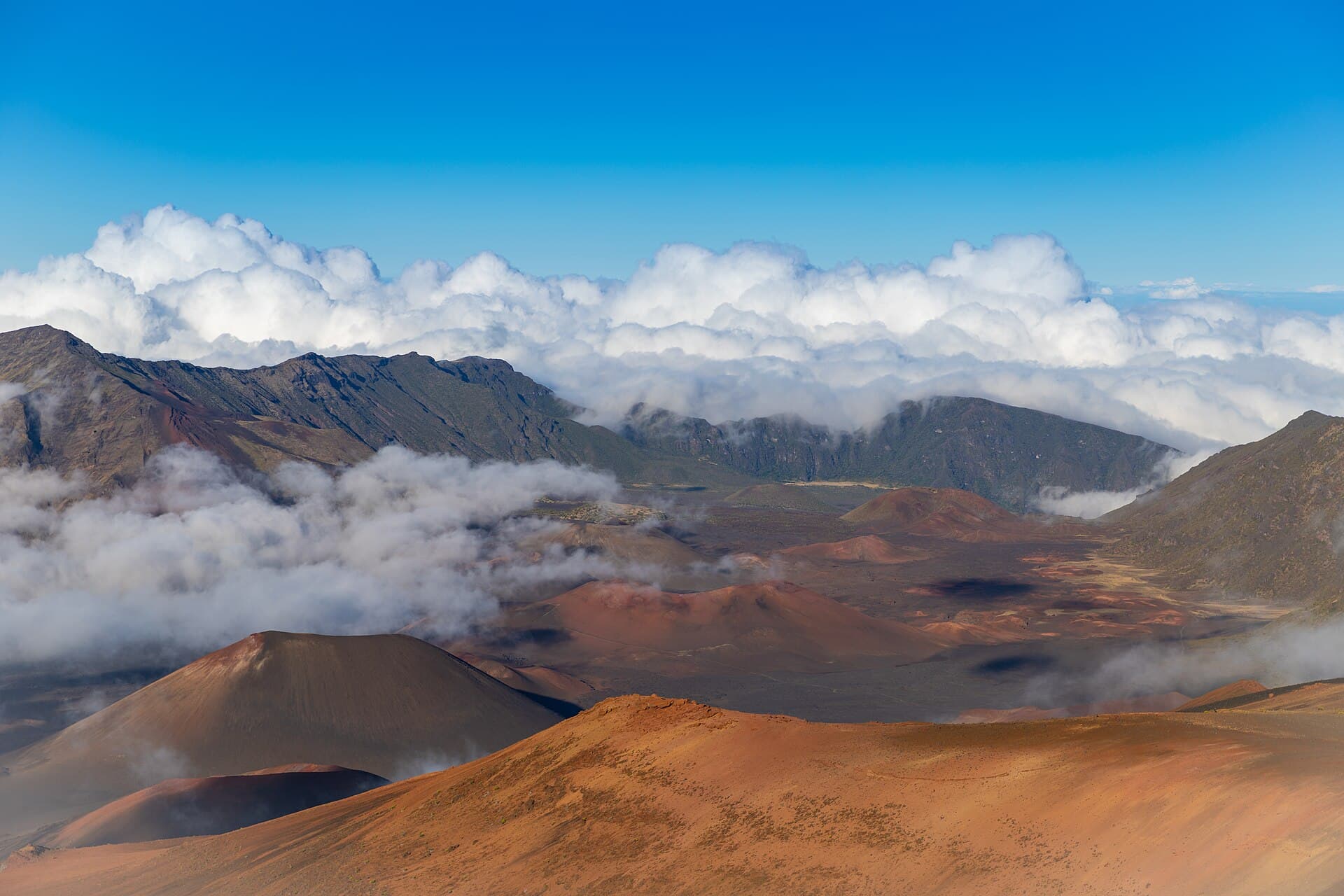
| OGG | Kahului Airport | Maui | Haleakalā (summit and Kīpahulu/Pipiwai via Road to Hāna) |
| KOA | Ellison Onizuka Kona International | Big Island (west) | Mauna Kea (1.5 hr drive), Pololu Valley, Kohala trails |
| ITO | Hilo International | Big Island (east) | Hawaiʻi Volcanoes NP (45 min), Mauna Kea (45 min) |
| LIH | Lihue Airport | Kauaʻi | Kalalau Trail, Waimea Canyon, Na Pali Coast |
For a Big Island hiking trip, fly into Hilo (ITO) if your priority is Volcanoes NP and Mauna Kea. Fly into Kona (KOA) if you want the dry coast as a base. The two airports are 90 minutes apart by car on Saddle Road.
For Maui, Kahului (OGG) is the only viable airport. The small Kapalua Airport (JHM) and Hāna Airport (HNM) are served only by Mokulele's 9-seat Cessna Grand Caravans.
Source: Hawaii Guide — Inter-Island Flights.
Three inter-island carriers
Hawaiian Airlines
The dominant carrier. Approximately 170 daily inter-island flights on Boeing 717 jets. Serves all five major airports (HNL, OGG, LIH, KOA, ITO). Flight times range from 25 to 50 minutes.
Southwest Airlines
Serves HNL, OGG, LIH, KOA — not all routes daily. Two free checked bags and no change fees make them attractive for hikers carrying backpacking gear. Not every island pair has a direct route — some connections require a stop at HNL.
Mokulele Airlines
A small carrier operating 9-passenger Cessna Grand Caravans to Molokaʻi, Lānaʻi, Kapalua (West Maui), and Hāna (East Maui). These are the only scheduled flights to Molokaʻi and Lānaʻi. Weight limits are strict — 25 lbs per checked bag.
Pricing (May 2026)
| Tier | One-way fare | Notes |
|---|---|---|
| Budget/promo | $39–$69 | Booked 6–8 weeks out; Tuesday/Wednesday departures |
| Typical | $80–$150 | Booked 2–4 weeks out |
| Peak/last-minute | $150–$250+ | Weekends, holidays, or within 7 days of departure |
Fares spiked in late April and May 2026 due to global fuel price increases. Some round-trip routes are exceeding $600. The cheapest days to fly inter-island are Tuesday and Wednesday — savings of 30–40% compared to weekends.
Booking tip: Book inter-island legs as soon as you know your itinerary. Unlike mainland flights, inter-island routes have limited seats per departure. There may be only 3–4 flights per day on some routes.
Source: Hawaii Guide; Hawaii News Now; Beat of Hawaii.
Continue reading The trails are not the danger — the water is. Hawai'i hiking in 2026. →
Rental cars
A rental car is effectively mandatory on every island except central Oʻahu. Public transit does not reach most trailheads. Kauaʻi, Maui, and the Big Island have no viable alternative for hikers.
Pricing reality (2026)
| Island | Daily rate (economy) | All-in daily cost | Notes |
|---|---|---|---|
| Oʻahu | $35–$55 | $55–$80 | Best availability; TheBus covers some trailheads |
| Maui | $50–$80 | $70–$110 | Worst availability; airport-only pickup; periodic shortage spikes |
| Big Island | $40–$60 | $60–$85 | Two airports — can pick up at one, drop at other (usually extra fee) |
| Kauaʻi | $45–$65 | $65–$90 | Limited fleet; book early for North Shore access |
All-in daily cost includes the rental rate, state surcharge ($7.50/day), taxes, and insurance.
The surcharges
A $7.50/day state rental car surcharge took effect January 1, 2026 (up from $7.00 in 2025). Additional county surcharges of $3–$5/day are pending in the legislature — Maui and Kauaʻi at $3/day, Oʻahu and Big Island at $5/day. If passed, a 10-day multi-island rental would add $30–$50 in surcharges alone.
The Mauna Kea insurance problem
Most standard rental car agreements explicitly prohibit driving on the Mauna Kea summit road above the Visitor Information Station. If you drive a rental car to the summit and damage it (or yourself), your collision damage waiver (CDW) is void. This is not a technicality — the road is unpaved, steep, and rough. The financial exposure for a wrecked rental on the summit road is real.
Options:
1. Book a guided summit tour ($250–$280/person) — vehicles are insured for the road
2. Rent from Turo, where some private owners explicitly allow Mauna Kea access
3. Accept the insurance risk (not recommended)
Dynamic pricing
Rental companies use airline-style dynamic pricing. Rates change multiple times per day. Booking 2–3 months ahead typically locks in the best price. Some travelers book early, then rebook if rates drop — most companies allow free cancellation before pickup.
Maui shortages: February 2026 saw rates spike to $2,015/week before dropping to $1,154 as fleets adjusted. These spikes coincide with high tourist arrivals and limited fleet size — rental companies deliberately keep smaller fleets post-COVID because it is more profitable to rent fewer cars at higher prices.
Source: Discount Hawaii Car Rental; Maui Car Rental; Beat of Hawaii.
The new permit platform: Explore Outdoor Hawaiʻi
In February 2026, the Hawaiʻi DLNR switched all camping, cabin, and pavilion permits to a new platform called Explore Outdoor Hawaiʻi (explore.ehawaii.gov). This replaced the old camping.ehawaii.gov portal.
What changed:
- Old login credentials do not carry over — you must create a new account
- The URL is different: explore.ehawaii.gov
- The interface is different
- Release cadences for permits remain the same (90 days for Kalalau, etc.)
What did not change:
- Permit prices
- Daily caps
- Release times (12:01 AM HST for Kalalau, etc.)
- The fundamental scarcity
Any guide referencing "ehawaii.gov" or "camping.ehawaii.gov" for Kalalau permits is pointing to a system that no longer works. The migration happened February 1, 2026.
Source: Explore Outdoor Hawaii; Kalalau Trail Guide.
Permit summary table
| Permit | Platform | Cost | Advance window | Difficulty | Key detail |
|---|---|---|---|---|---|
| Kalalau Trail camping | Explore Outdoor Hawaiʻi | $35/night + $5 fee (non-res) | 90 days at 12:01 AM HST | Genuinely hard | 60 spots/day; summer sells out in <30 seconds |
| Hāʻena State Park day-use | GoHaena.com | $10/vehicle + $5/person | 30 days at 12:00 AM HST | Hard in peak season | 900 visitors/day; 100 parking spaces |
| Haleakalā sunrise | Recreation.gov | $1/vehicle | 60 days + 2 days at 7:00 AM HST | Moderate | Sells out <5 min on summer weekends |
| Haleakalā wilderness cabins | Recreation.gov | Varies | 6 months rolling | Moderate-Hard | 3 cabins; online only |
| Diamond Head | gostateparks.hawaii.gov | $5/person + $10/vehicle | 30 days | Easy | Residents exempt; rarely sells out |
| Hawaiʻi Volcanoes NP entry | Pay at gate (card only) | $30/vehicle | None | No permit needed | 7-day pass; cash no longer accepted |
| Volcanoes NP backcountry | Backcountry Office / Recreation.gov | Fee applies | FCFS + reservable | Easy-Moderate | Max 12 people/site, 3 nights |
| Mauna Kea summit | No permit required | Free | None | None | 4WD mandatory; road hours enforced |
Three platforms, three accounts
A multi-island hiking trip requires accounts on three separate platforms:
- Explore Outdoor Hawaiʻi — for Kalalau permits and state park camping
- Recreation.gov — for Haleakalā sunrise, wilderness cabins, and Volcanoes NP backcountry
- GoHaena.com — for Hāʻena State Park day-use access (Kalalau trailhead)
There is no single unified system. Create all three accounts before your booking windows open.
The Maui accommodation problem
Maui County passed Bill 9 (Ordinance 5306) — the most aggressive short-term rental regulation in the United States. Approximately 7,000 STRs in apartment-zoned areas are being phased out on a rolling basis through 2029–2031. Permits expire and are not renewed.
What this means for hikers:
- Airbnb and VRBO inventory on Maui is shrinking
- Remaining legal STRs are concentrating in resort zones (Wailea, Kāʻanapali, Kapalua) — not near trailheads
- Hotel prices are rising as STR supply contracts
- Hostels on Maui are few — the Northshore Hostel in Wailuku and Banana Bungalow are the primary budget options
Big Island is the opposite. STR regulation is the most permissive in the state. Airbnb options near Volcanoes NP (Volcano village) and Hilo are abundant and relatively affordable. A new registration requirement (Bill 47) takes effect July 2026 but is not expected to reduce inventory significantly.
Kauaʻi: Moderate regulation with existing permits generally grandfathered. North Shore inventory near the Kalalau trailhead is limited regardless — the area is rural with a small accommodation base.
Oʻahu: A 90-day minimum rental period for non-resort areas (Ordinance 22-7) took effect September 2025. Waikīkī and Ko Olina remain legal for short-term stays. Budget travelers: hostels in Waikīkī run $40–$70/night for dorm beds.
Source: Minut — Hawaiʻi STR Laws; Beat of Hawaii.
Gas
May 2026 average: $5.64/gallon — second highest in the US behind California. Up 25.2% from $4.40 in April 2025.
Driving between trailheads is unavoidable. A typical hiking-focused day involves 50–80 miles of driving. Budget $10–$15/day for gas.
On the Big Island, the distance between Kona and Hilo (via Saddle Road) is 87 miles. Kona to Volcanoes NP is 96 miles. Fill up before heading to remote trailheads — gas stations are sparse on Saddle Road and nonexistent on the summit roads.
On Maui, the drive from Kahului to Haleakalā summit is 37 miles (1.5 hours). Kahului to Kīpahulu (Pipiwai Trail) via the Road to Hāna is approximately 52 miles (3 hours). There is one gas station past Pāʻia on the Road to Hāna — do not count on it being open.
Source: AAA Gas Prices — Hawaiʻi.
The Green Fee
Hawaiʻi became the first US state to implement a visitor-impact "green fee" — a 0.75% increase to the Transient Accommodations Tax (TAT), effective January 1, 2026. The total TAT state portion is now 11%.
On a $300/night hotel room, the green fee adds approximately $2.25/night. It is not a separate line item on your bill — it is embedded in the TAT.
The fee is projected to generate approximately $100 million per year, dedicated to wildfire prevention, native reforestation, and trail maintenance. It was enacted after the August 2023 Lahaina wildfire, which killed 101 people and destroyed a historic Hawaiian town.
Source: Aloha Hawaiian — Green Fee.
Getting to trailheads
Kalalau Trail (Kauaʻi)
The trailhead is at Hāʻena State Park, at the end of Highway 560 on Kauaʻi's North Shore.
Day hikers: Drive with a GoHaena reservation ($10/vehicle + $5/person). Parking is limited to 100 spaces (30 reserved for residents). Arrive early.
Overnight hikers: As of 2026, overnight hikers can no longer leave vehicles at Hāʻena State Park. You must take the GoHaena shuttle ($40/adult round trip, $25/child) or arrange a private ride. This is a new rule and eliminates the previous strategy of leaving a car at the trailhead for multi-day trips.
Haleakalā (Maui)
Summit district: Drive Haleakalā Highway (Highway 378) from Kahului. Approximately 1.5 hours to the summit. The road is paved, two lanes, with switchbacks above 2,000 m. No gas stations on the road — fill up in Pukalani or Kahului.
Kīpahulu district (Pipiwai Trail): Drive the Road to Hāna (Highway 360/31) from Kahului. Approximately 3 hours, 620 curves, 59 bridges. No direct road connects the summit and Kīpahulu districts.
Hawaiʻi Volcanoes NP (Big Island)
Drive Highway 11 from Hilo (45 minutes) or Kailua-Kona (2.5 hours). The park entrance is at mile marker 28 on Highway 11.
Mauna Kea (Big Island)
From either coast, drive Saddle Road (Highway 200) to mile marker 28, then turn onto Maunakea Access Road. Any vehicle can reach the Visitor Information Station at 2,804 m. Beyond the VIS: 4WD mandatory, insurance-voiding for most rentals.
Diamond Head (Oʻahu)
TheBus Route 23 stops at Diamond Head from Waikīkī. This avoids the $10 parking fee. By car, take Diamond Head Road from Kapiʻolani Park. Parking inside the crater is limited; the reservation system helps but does not guarantee a spot.
Source: NPS — Plan Your Visit; Lonely Planet — Getting Around Hawaiʻi.
Trip cost: 10-day multi-island hiking trip
A realistic budget for a solo trekker from the US mainland, covering 3 islands (Kauaʻi + Big Island + Maui), mixing hostels/Airbnb, self-catering most meals, and hitting the major trails:
| Line item | Budget | Mid-range | Comfortable |
|---|---|---|---|
| Mainland RT flight (West Coast) | $350 | $550 | $900 |
| Inter-island flights (2 hops) | $160 | $280 | $400 |
| Rental car (10 days, 3 islands) | $530 | $775 | $1,210 |
| Car surcharges + gas | $155 | $215 | $280 |
| Accommodation (10 nights) | $500 | $1,150 | $2,200 |
| Park fees + permits | $160 | $170 | $170 |
| Food (10 days, grocery-heavy) | $300 | $600 | $1,000 |
| Total | ~$2,155 | ~$3,740 | ~$6,160 |
The mid-range figure — approximately $3,700–$4,200 — is comparable to a 14-day Everest Base Camp trek from the US including flights. The difference: in Nepal, that budget buys a guided expedition with lodges, meals, and porters. In Hawaiʻi, it buys a rental car, gas, and a hostel bed.
The premium is not trail fees. Kalalau camping ($75 for 2 nights), Haleakalā sunrise ($1), and Volcanoes NP entry ($30) total $106 combined. The cost is in everything around the trails: accommodation, car, gas, and groceries priced 33–69% above the national average because 85–90% of Hawaiʻi's food arrives by ship.
Costco membership: If you are buying groceries for 10 days, a $65 Costco membership pays for itself. Costco locations on Oʻahu (Iwilei, Hawaiʻi Kai), Maui (Kahului), Big Island (Kailua-Kona), and Kauaʻi (Līhuʻe) stock prices 20–30% below Safeway and Foodland.
Source: Beat of Hawaii; BLS Honolulu CPI; permit sources cited in table above.
The Kalalau overnight parking change
This is the single most important logistics change for 2026 and it is worth repeating: overnight hikers can no longer leave vehicles at Hāʻena State Park. The parking lot is under construction with reduced capacity even for day-users.
If you are backpacking the Kalalau Trail, your options are:
- GoHaena shuttle — $40/adult round trip, $25/child. Schedule and operator details are available at GoHaena.com.
- Private drop-off — have a friend, accommodation host, or taxi drop you at the trailhead and pick you up on your return date.
- Hitch from Princeville/Hanalei — possible but unreliable, especially for early-morning starts.
This change was not widely publicized. Many hikers are arriving with multi-day packs and discovering they cannot park. Plan transportation before you book your permit.
Source: GoHaena.com; Reserve Nature.
Cell service and navigation
Cell coverage is unreliable at most trailheads and nonexistent in the backcountry. Specific dead zones:
- Kalalau Trail: No service beyond Hāʻena State Park
- Haleakalā crater: Intermittent at the summit; none on the crater floor
- Chain of Craters Road: Drops off after the first few miles
- Mauna Kea summit road: Intermittent above VIS
- Road to Hāna: Spotty through most of the drive; extended dead zones between Keʻanae and Hāna
Download offline maps (Google Maps, Gaia GPS, or AllTrails) before leaving your accommodation. If you are doing backcountry camping, carry a physical map and compass or a GPS device that does not rely on cell service.
For emergencies on trails, a personal locator beacon (PLB) or satellite communicator (Garmin inReach, SPOT) is the only reliable way to call for help. Helicopter rescues run $1,500–$2,700/hour. The state legislature is debating bills (SB 2358, SB 2937) to recover SAR costs from hikers who ignore posted warnings.
Source: The Garden Island — Rescue Cost Bills.
8 Sources
- outdoor.hawaii.govExplore Outdoor Hawaiʻi — Camping Permits (Hawaiʻi DLNR)
- gohaena.comGo Hāʻena — Overnight Camping Parking & Park Entry
- nps.govNPS — Haleakalā Sunrise Viewing Reservations
- home.nps.govNPS — Hawaiʻi Volcanoes National Park Fees & Passes
- recreation.govRecreation.gov — Haleakalā Summit Sunrise Reservations
- mauicounty.govMaui County — Mayor Bissen Signs Bill 9 Into Law
- mauinow.comMaui Now — Hawaiʻi's Green Fee Takes Effect Jan. 1
- gasprices.aaa.comAAA Fuel Prices — Hawaiʻi State & Metro Averages