
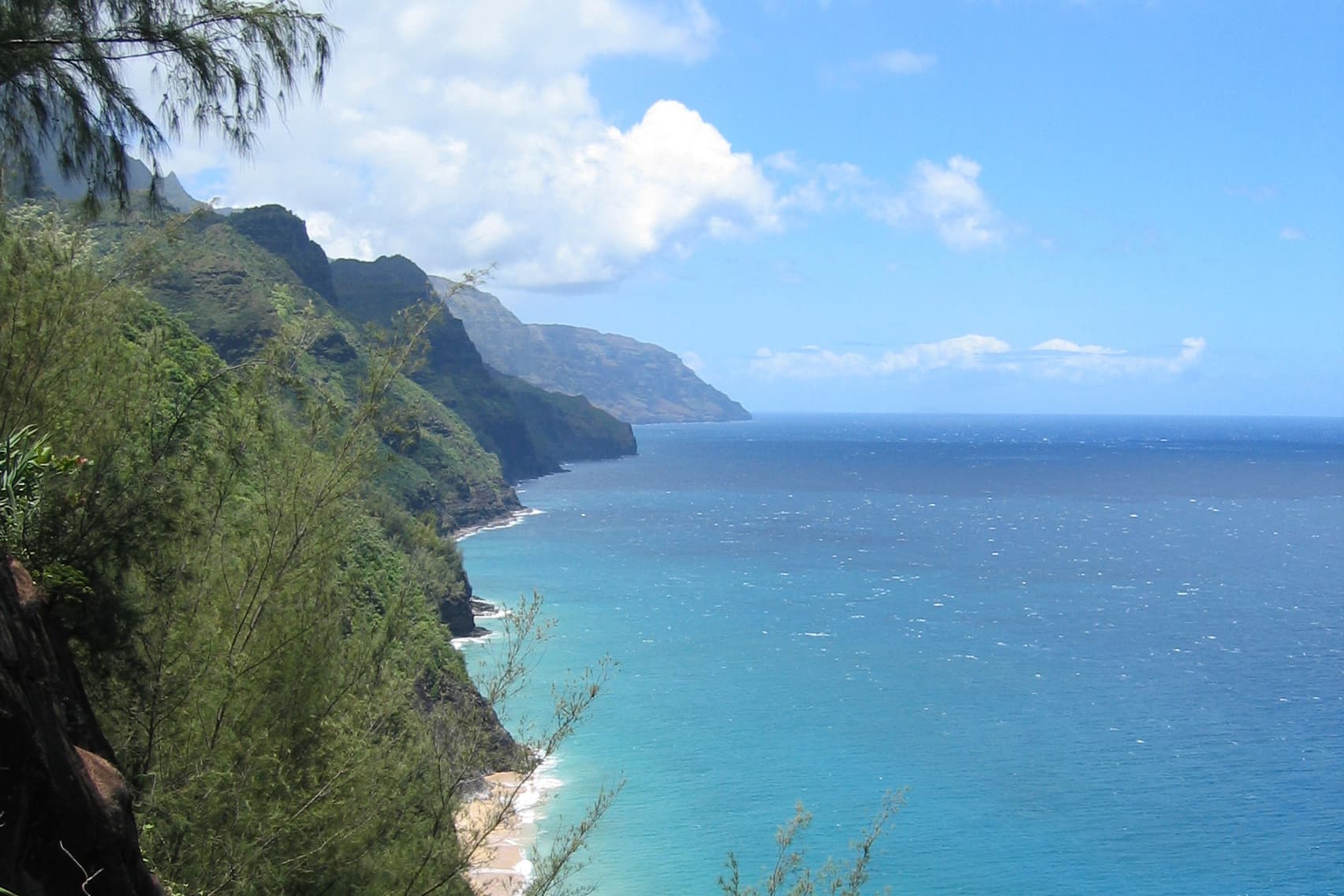
The trail
The Kalalau Trail runs 11 miles (17.7 km) one way along the Nā Pali Coast of Kaua'i, from Ke'e Beach to Kalalau Beach. It traverses five valleys. Round trip is 22 miles. The Sierra Club rates it 9 out of 10 for difficulty. Total cumulative elevation gain and loss, one way, is approximately 1,524 meters (5,000 feet), with constant climbs and descents through each valley rather than a single sustained ascent.
The trail divides into three segments with distinct character.
Segment 1: Ke'e Beach to Hanakapi'ai Beach (2 miles / 3.2 km)
The popular day hike. No camping permit needed — only a Hā'ena State Park day-use reservation. The trail climbs from sea level to approximately 200 meters through dense tropical forest, then drops back to sea level at Hanakapi'ai Beach.
Allow 3–4 hours round trip. The trail is muddy, root-tangled, and slippery in all conditions. Rain or shine, the Na Pali Coast is wet.
Hanakapi'ai stream must be crossed to reach the beach. When running low, the crossing is ankle-to-knee deep. When running high — after upstream rain that may not be visible from the crossing point — it becomes impassable or lethal. The DLNR trail page states: "Drownings occur here regularly."
Side trip — Hanakapi'ai Falls (additional 4 miles round trip): A spur trail climbs approximately 244 meters (800 feet) through the valley to Hanakapi'ai Falls. This technically goes beyond the 2-mile day-hike zone and requires a camping permit, though enforcement varies. The falls pool is subject to flash flooding and rockfall. The trail is rough, with multiple stream crossings.
Hanakapi'ai Beach — do not swim here. The warning sign at the beach tallied 83 drowning deaths as of 2008. That number is a running count maintained on the sign itself. Independently verified records show at least 29 confirmed drownings at the beach between 1970 and 2012. The beach has no reef protection. Waves slam directly onto the shore. Rip currents are powerful enough that at least 15 bodies have never been recovered — the nearest safe shore is approximately six miles away.
This is the endpoint for most hikers. For those continuing, everything changes beyond this point.
Continue reading The trails are not the danger — the water is. Hawai'i hiking in 2026. →
Segment 2: Hanakapi'ai to Hanakoa (4 miles / 6.4 km)
The most strenuous section. The trail climbs from sea level via steep switchbacks to approximately 244 meters (800 feet), traverses the Hono O Nā Pali Natural Area Reserve, and reaches the Hanakoa Valley campsite.
A valid overnight camping permit is required beyond Hanakapi'ai regardless of whether you intend to camp. There is no exception for "just passing through."
Hanakoa has composting toilets and shelters. Maximum stay is 2 consecutive nights. Water must be purified from the Hanakoa stream — filter or tablets, not boiling alone (leptospirosis is a documented risk in Hawaiian streams). The stream crossing at Hanakoa is the second of three major flash-flood-risk crossings on the trail.
The vegetation is dense and the trail is narrow. Allow 3–4 hours for this segment when carrying an overnight pack.
Segment 3: Hanakoa to Kalalau Beach (5 miles / 8 km)
The terrain changes. The lush forest of the first two segments gives way to drier, more exposed terrain with minimal shade. The final valley — Kalalau — is arid by Kaua'i standards.
Miles 7 through 9 are the crux. The trail narrows to a ledge clinging to bare cliff faces with sheer drops to the ocean. The exposure is genuine — falls from this section have resulted in fatalities. The trail surface is loose dirt and rock. In rain, it becomes a mudslide with a 1,000-foot consequence.
The third major stream crossing — Kalalau Stream — is subject to the same flash-flood mechanism as the first two. After the exposed traverse, the trail descends into Kalalau Valley and reaches the beach.
Camping at Kalalau Beach
Kalalau Beach is a half-mile crescent of sand backed by 4,000-foot cliffs. In summer, the beach is wide and the surf is manageable (though never safe for inexperienced swimmers). In winter, North Pacific swells remove the sand entirely — the beach can disappear, and the sea caves that provide shelter in summer become inaccessible.
Facilities at Kalalau:
- Composting toilets
- No tables
- No drinking water — purify from Kalalau Stream
- No fires allowed
- No trash service — pack everything out
Swimming at Kalalau Beach is not recommended for anyone unfamiliar with Hawaiian ocean conditions. There are no lifeguards, no reef protection, and limited escape options if caught in a current.
The permit system (2026)
Platform
Permits are booked through Explore Outdoor Hawai'i (formerly ehawaii.gov camping system). DLNR switched to this platform in February 2026. The old camping.ehawaii.gov links that appear in most existing guides are dead ends. Old login credentials do not carry over — new account creation is required.
Release window
Permits drop exactly 90 days before the hiking start date at 12:01 AM HST. Not 90 days before arrival on Kaua'i. Not 90 days before the trip. Ninety days before the specific date you begin hiking.
Cost
- Non-residents: $35 per person per night + $5 non-refundable reservation fee
- Hawai'i residents: $25 per person per night + $5 fee
Daily cap
60 camping permits per day. During summer months (May through September), all 60 spots sell out in under 30 seconds. Weekend dates are the most competitive.
Maximum stay
5 nights total. Maximum 2 consecutive nights at Hanakoa.
This is NOT a lottery
Despite multiple top-ranking guides describing a "DLNR lottery," the system is first-come, first-served. There is no randomized allocation. You are competing in a click-race against everyone else who set an alarm for 12:01 AM Hawaiian time.
Practical booking strategy:
1. Create your Explore Outdoor Hawai'i account well before the 90-day window opens.
2. Log in before midnight HST. Have the Kalalau Trail page loaded and ready.
3. At 12:01 AM HST — exactly — select your dates, number of people, and submit. The entire transaction needs to complete in under 30 seconds.
4. If you miss the window, check for cancellations. Refunds are available if canceled at least 15 days before the trip, so spots occasionally reopen.
5. Permit concierge services like GoKalalau.com (~$49+) exist because the booking window is that brutal. They will attempt to book on your behalf.
Walk-in permits
Available exclusively for Kaua'i residents, Tuesdays through Thursdays, 8 AM to 11 AM at the Kaua'i State Parks Office in Līhu'e (mid-May through early September).
Refunds
Available if canceled at least 15 days before the trip. The $5 reservation fee is non-refundable. No weather refunds unless the trail is officially closed by the state.
Transfer/resale
Not permitted. Name must match ID at check-in.
Hā'ena State Park access (2026)
Day hikers
A separate Hā'ena State Park day-use reservation is required to enter the park and reach the Ke'e Beach trailhead. This is not the same as the Kalalau camping permit — it controls access to the park itself.
- Daily cap: 900 visitors
- Cost: Included in park entry
- Parking: 100 spaces available, 30 reserved for residents. $10 per vehicle.
- Booking window: Rolling 30 days in advance, released at midnight HST
- Peak season: Sells out within minutes during May through September
- No same-day tickets. If you miss the release window, check 7:00–8:00 AM daily for cancellation openings.
Overnight hikers — the 2026 no-parking rule
Overnight Kalalau hikers can no longer leave vehicles at Hā'ena State Park. This is new for 2026. The previous multi-day strategy of parking at the trailhead is eliminated.
You must use the GoHaena shuttle:
- Cost: $40 round trip per adult, $25 per child
- Pickup: Princeville / Hanalei area
- Drop-off: Hā'ena State Park trailhead
Alternative: arrange a private ride to the trailhead and pickup after the hike. Some North Shore accommodations offer trailhead drop-off.
The drowning problem
The Kalalau corridor — trail, streams, and beaches combined — has documented 45+ drowning deaths: 3 in flash-flooding streams and 42+ at the beaches (Hanakapi'ai, Kalalau, Honopū).
How flash floods kill hikers
The mechanism is specific and poorly understood by mainland hikers:
- Rain falls in the mountains above the trail — potentially miles upstream, invisible from the crossing point.
- Water channels through steep, narrow valleys and arrives at the stream crossing as a wall of brown water, debris, and force.
- A stream that was ankle-deep at 9 AM becomes chest-deep or higher by 11 AM.
- Hikers attempt to cross because they crossed safely hours earlier and assume conditions are the same.
- The current sweeps them downstream. In the case of Hanakapi'ai stream, "downstream" means into the ocean, where rip currents take over.
The critical cognitive error: "If it's sunny where I am, the stream is safe." On a steep tropical island where annual rainfall varies from 50 cm on one side to 1,100 cm on the other, weather at the crossing point tells you nothing about weather in the watershed above.
What to do at a flooding stream
Wait. Do not attempt to cross. Hawaiian streams typically recede within hours once upstream rain stops. The inconvenience of waiting is not comparable to the risk of being swept into the Pacific.
Warning signs: rising water, discoloration (brown or muddy), debris in the current. If you see any of these, stop.
In 2014, 121 hikers were stranded by flash floods at Hanakapi'ai and required helicopter rescue. They waited — and lived.
March 2026 storm closure and reopening
Two Kona low-pressure systems in March 2026 dumped heavy rain across the Nā Pali Coast. Landslides blocked portions of the trail between Hanakoa Valley and Kalalau Beach. Hā'ena State Park and the entire Nā Pali Coast State Wilderness Park closed.
State crews hiked in to assess the damage and found it was surface-level debris rather than structural trail failures. The Kalalau Trail reopened March 19, 2026 for permitted overnight hikers. Full reopening with shuttle service occurred April 14, 2026.
Kona Lows are a recurring weather pattern. They form when the normally dominant northeast trade winds weaken — typically October through April — and storms approach from the southwest. For winter and spring hikers: build buffer days into the itinerary. A two-day closure is normal. A week-long closure is possible.
Day hike vs. overnight
Day hike to Hanakapi'ai (4 miles round trip)
- Permit needed: Hā'ena State Park day-use reservation only (GoHaena.com, $5/person + $10/vehicle parking). No camping permit.
- Duration: 3–4 hours round trip.
- What you see: Dense tropical forest, coastal views, Hanakapi'ai Beach.
- Difficulty: Moderate. Muddy, rooty, slippery. Not technically difficult but physically demanding if not accustomed to tropical trail conditions.
- Best for: Hikers with limited time, those who could not secure camping permits, anyone not comfortable with multi-day backcountry.
Day hike to Hanakapi'ai Falls (8 miles round trip)
- Permit needed: Technically requires a camping permit since it extends beyond the 2-mile day-hike zone. Enforcement is inconsistent — some rangers check, others do not. The conservative approach: get the permit.
- Duration: 6–8 hours round trip.
- What you see: Everything above plus a 300-foot waterfall in a lush valley.
- Difficulty: Strenuous. Multiple stream crossings on the spur trail.
Overnight to Kalalau Beach (22 miles round trip)
- Permit needed: Kalalau camping permit (Explore Outdoor Hawai'i) + Hā'ena day-use reservation (or shuttle).
- Duration: Most hikers take 2–3 days each way. Minimum is a grueling 1 day each way for very fit backpackers.
- What you see: The full Nā Pali Coast — five valleys, 4,000-foot cliffs, the exposed cliff traverse at miles 7–9, and Kalalau Beach.
- Difficulty: Very strenuous. The exposure, stream crossings, and weight of an overnight pack make this a genuine backcountry experience.
The boat alternative
For those who cannot hike the Kalalau Trail — whether due to permit scarcity, fitness, or time — boat tours from Hanalei Bay or Port Allen offer Nā Pali Coast access.
Options range from luxury catamarans to rigid-hull inflatable rafts that enter sea caves:
| Operator | Type | Price (2026) |
|---|---|---|
| Capt Andy's (est. 1983) | Catamaran + snorkel, 5–6 hrs | $189–$274/adult |
| Holo Holo Charters | Catamaran sunset/snorkel | $170–$220/adult |
| Na Pali Riders | Zodiac raft | $189–$249/adult |
| Blue Ocean Adventures | Raft tour | $170–$210/adult |
Summer (May through September) offers calmer water and more reliable departures. Winter swells regularly cancel tours.
Critical distinction: Commercial boat drop-off or pickup at Kalalau Beach or Miloli'i is prohibited by DLNR. There is no legal shortcut to Kalalau Beach by sea. You hike in, or you see the coast from a boat without landing.
Weather and timing
Best months
May through June. Dry season has started. Hurricane season has not peaked. Trade winds are reliable. Stream crossings are at their lowest and safest. This is also peak permit competition.
Acceptable months
July through September. Dry, but hurricane season peaks (hurricanes are extremely rare in Hawai'i, but when they hit — Hurricane Iniki, Kaua'i, 1992 — the damage is catastrophic).
Risky months
October through April. Trade winds weaken. Kona storms bring rain from the southwest. Flash flood risk increases significantly. The March 2026 closures are a typical example, not an anomaly.
Day-to-day reality
Expect rain on at least part of the trail every day, year-round. The Na Pali Coast is the wet side of one of the wettest islands on Earth. Waterproof your pack. Bring a synthetic sleeping bag — down does not perform when wet. Dry-bag electronics. Accept that you will be muddy.
Rescue
Kaua'i Fire Department is the primary rescue agency for the Kalalau Trail. Air support comes from the county helicopter (Air 1) and the US Coast Guard for ocean rescues along the Na Pali Coast.
Helicopter rescue costs the county $1,000–$2,500 per operation. Hawai'i does not currently bill rescued hikers for costs. The 2026 legislature debated bills (SB 2358, SB 2937) to recover costs from trespassers or to create a prepaid "hike card" fund. The State Fire Council opposes these bills.
Cell service on the Kalalau Trail is nonexistent for most of the route. Satellite communicators (Garmin inReach, SPOT, or phone-based satellite SOS) are the only reliable emergency communication option. There is no cell tower coverage between Ke'e Beach and Kalalau Beach.
Gear notes
This is not a comprehensive gear list. These are the items that matter specifically for the Kalalau Trail and that generic packing lists often miss:
- Water purification: No potable water on the trail. All water comes from streams and must be filtered or treated. Leptospirosis is present in Hawaiian freshwater.
- Synthetic sleeping bag: Down bags are a liability on the wettest coast in the state.
- Dry bags: For electronics, sleeping bag, and anything that cannot get wet. Assume your pack will be soaked.
- Water shoes or trekking sandals: For stream crossings. Do not cross barefoot — rocks are slippery and currents are stronger than they appear.
- Reef-safe sunscreen: Hawai'i law (Act 104, effective 2021) prohibits sunscreens containing oxybenzone and octinoxate.
- 30+ feet of cord: For hanging food. Kalalau Beach has feral goats and rodents.
- Headlamp with fresh batteries: No trail markers or reflectors. Night hiking on exposed cliff sections is extremely dangerous.
Sources: Hawai'i DLNR, Explore Outdoor Hawai'i, GoHaena.com, NPS, Wikipedia (Kalalau Trail, Hanakapi'ai Beach), Civil Beat, Star-Advertiser, Kauai Now, The Mountaineers, Gaia GPS, Reserve Nature, Hawaii Guide, Islands.com, USCG. All URLs verified May 2026.