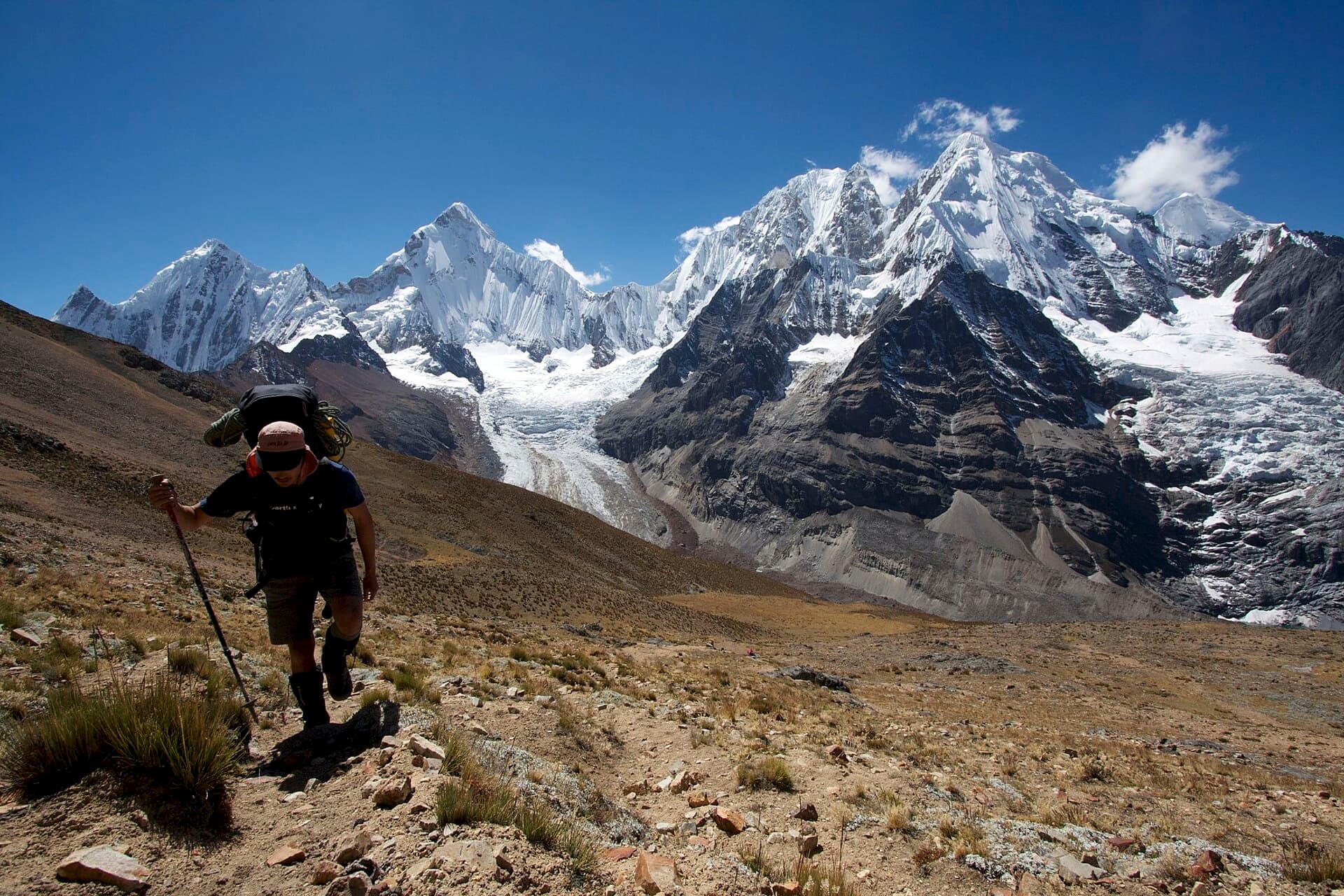
The Cordillera Huayhuash is a compact chain of ice peaks in northern Peru — Yerupajá at 6,635 m, Siula Grande at 6,344 m, Jirishanca at 6,094 m — ringed by a circuit that crosses passes to around 5,010 m and sleeps eight to twelve consecutive nights above 4,000 m. It has a decades-old reputation as the connoisseur's alternative to the Inca Trail: harder, emptier, and walkable independently with a couple of burros.
That last part is now out of date, and most of the internet has not caught up.
The rule that changed
On 14 May 2026 the Municipalidad Provincial de Lauricocha published Ordenanza Municipal N.º 005-2026-MPL/CM, approving the Protocolo de Uso Turístico Sostenible de la Cordillera Huayhuash for the Huánuco sector, co-branded by DIRCETUR Huánuco. Article 12.4 is explicit: "Queda prohibido el ingreso de visitantes de manera independiente o no organizada (mochileros)" — entry by independent or unorganised visitors is prohibited, with access permitted only under the stated conditions, to guarantee visitor safety and control of entries. Source: Ordenanza Municipal N.º 005-2026-MPL/CM; the protocol itself (PDF).
This binds the whole classic route, because every classic itinerary crosses the Huánuco sector: Cacanampunta, Mitucocha, Carhuacocha, Campamento Huayhuash and both exit passes — Trapecio and Arag — sit inside it.
What the protocol requires in practice (Arts. 12.4, 15.1–15.3):
- An official tourism guide registered with the competent Dirección Regional de Comercio Exterior y Turismo, who must present his guide carnet at the control post.
- A travel agency listed in the Directorio Nacional de Prestadores de Servicios Turísticos, which identifies itself at the post with the group's details.
- Group ratios: ten people per guide recommended; above ten, one additional guide per ten participants is obligatory, plus accredited guide assistants.
- Registration with an identity document (original DNI for Peruvians; passport, carné de extranjería or cédula diplomática for foreigners), your declared route and your estimated duration. The registration is valid only for that route and period, and does not permit re-entry.
Enforcement has teeth. Article 21 permits an on-the-spot acta, immediate removal of the visitor or group, and a temporary or permanent ban from the cordillera.
One caveat we will not paper over: no equivalent protocol has been published for the Ancash sector (Bolognesi, Pacllón, Llamac, Pocpa) or the Lima sector (Cajatambo, Huayllapa, Uramasa). We searched gob.pe and found only the Lauricocha instrument. Treat the guide requirement as applying to the whole circuit anyway — both because the route crosses Huánuco and because that is the conservative reading.
Who actually governs this range
The layers confuse people, so here they are plainly.
It is not a national park, but it is not purely private land either. It is the Zona Reservada Cordillera Huayhuash, created by Resolución Ministerial N.º 1173-2002-AG on 20 December 2002, covering 67,589.76 ha across Bolognesi (Ancash), Lauricocha (Huánuco) and Cajatambo (Lima). SERNANP still lists it among Peru's Zonas Reservadas — a provisional protected-area category awaiting definitive categorisation. Source: SERNANP — Zona Reservada Cordillera Huayhuash.
In practice: SERNANP holds the conservation status but does not staff or charge at the trail. The province and DIRCETUR write the rules. The comunidades campesinas administer entry, run the control posts and take the money (Protocolo Art. 5).
The fees, and why you carry a lot of small cash
There is no single park ticket. Each community charges its own fee, in cash soles, at its own post, and issues a receipt that is personal, non-transferable, and must be produced at every subsequent control post (Protocolo Arts. 11.1–11.4).
Fees recorded in MINCETUR's tourist-resource inventory: Llamac/Pocpa S/20; Pacllón for Laguna Jahuacocha S/20; Queropalca S/40 foreigners (S/30 nationals) plus Quishuarcancha campground S/30 (S/25); Huayllapa for Mirador San Antonio S/50 (S/25); Uramasa for Laguna Viconga and Baños de Gunoc S/30 (S/15), under-10s free. One MINCETUR record additionally notes communities charging S/10–S/30 per foreign trekker per campsite. Source: MINCETUR ficha 2166; ficha 25; ficha 10689; ficha 9745.
Carry substantially more than the sum of those figures. The inventory is not a complete list of posts, and the amounts are set community by community.
Control-post hours matter too, because they close before dark: Huánuco sector 06:00–18:00; Llamac/Pocpa and Pacllón 08:00–14:00; Queropalca 05:00–17:00; Mirador San Antonio and Laguna Viconga 07:00–17:00. Late arrivals in the Huánuco sector are regularised the following day (Art. 13.1).
The circuits the authorities recognise
Peru's state news agency published a guide on 30 July 2026 naming four official circuits: the Clásico (12 days, ~120 km, Cuartel Wain to Llamac, 3,300–5,010 m, moderate to difficult), Achalau Huayhuash (8 days, 103 km, using Paso Trapecio as a shortcut), Huayhuash–Raura (9 days, ~70 km) and Shumaq Huayhuash (10 days, 105 km). It also states a minimum of two acclimatization days before starting. Source: Agencia Andina.
SERNANP frames the full circumnavigation differently — 165–180 km over 12 to 18 days, crossing five high passes averaging 4,300 m — with shorter routes of 2 to 12 days, all walked above 4,000 m.
On the "Alpine Circuit": no Peruvian authority documents it. It is not among Andina's four official circuits, and the Huánuco protocol authorises named tramos and variants and requires visitors to travel only on them (Art. 14.1). Every description of the Alpine variant we could find is operator or blog material. Treat it as unpermitted off-route travel until an authority publishes otherwise.
What actually kills people here
Altitude, first and foremost. The circuit sleeps eight to twelve consecutive nights above 4,000 m and crosses to about 5,010 m, so HAPE and HACE are the realistic causes of death. The protocol names altitude first among the risks that make guides mandatory (Art. 12.5). The single most consequential decision is night one: the road drops you at Quartelhuain at roughly 4,150 m, which is a hard first sleep for anyone who flew into Lima a few days earlier. Andina's two-day minimum is a floor, not a plan — acclimatize in Huaraz first.
Cold. SERNANP records night temperatures below 0 °C above 4,000 m in every season. Every camp on the circuit is above that line.
Isolation. No road touches the circuit between Cuartel Wain and the exit passes; the protocol cites aislamiento geográfico explicitly. Evacuation means foot or horseback to a track head, then hours of unpaved road — a stable patient can be a day or more from a clinic.
The access roads in the wet season. On 1 March 2026 the Municipalidad Distrital de Pacllón reported landslides, collapses and rain erosion on the Pacllón–Chiquián (AN-1271) and Llamac (AN-1263) roads and on the Pacllón–Cura Pampán track, and D.S. N.º 025-2026-PCM placed the district under a state of emergency for imminent danger from intense rainfall. The same municipality rehabilitated the Pacllón–Cruz Pampa track in April and maintained it again in July 2026. Assume the access track is damaged by default at the end of each wet season. Source: Municipalidad Distrital de Pacllón — comunicado oficial.
The season
May to September. MINCETUR gives "mayo a septiembre" as the recommended season on every Huayhuash record it holds. October to April is not safe: SERNANP records precipitation from September to mid-April, and as above, the wet season closes the road in, not only the trail. An October–April arrival can find both the road cut and the gate shut.
What this means for your trip
The Huayhuash is still one of the great mountain walks on earth, and the traverse above the Tres Lagunas below Siula Grande's east face deserves every word written about it. But the way you go changed in 2026. Budget for a registered guide and agency, carry a thick wad of small soles for the community posts, keep every receipt, acclimatize properly in Huaraz before you drive in, and go between May and September. Anyone selling you an unguided Huayhuash for 2026 is selling you a trip that the ordinance says can be stopped and turned around at the first control post.
10 Sources
- gob.peOrdenanza Municipal N.º 005-2026-MPL/CM — Municipalidad Provincial de Lauricocha (14 May 2026)
- cdn.www.gob.peProtocolo de Uso Turístico Sostenible de la Cordillera Huayhuash — ámbito Huánuco (PDF)
- gob.peSERNANP — Zona Reservada Cordillera Huayhuash
- gob.peSERNANP — Compendio: Zonas Reservadas
- andina.peAgencia Andina — Cordillera Huayhuash: guía para el trekking de montaña más espectacular del mundo (30 July 2026)
- consultasenlinea.mincetur.gob.peMINCETUR — ficha de inventario turístico 2166 (Pacllón, Bolognesi, Ancash)
- consultasenlinea.mincetur.gob.peMINCETUR — ficha 25 (Queropalca, Lauricocha, Huánuco)
- consultasenlinea.mincetur.gob.peMINCETUR — ficha 10689 (Mirador San Antonio)
- consultasenlinea.mincetur.gob.peMINCETUR — ficha 9745 (Laguna Viconga)
- gob.peMunicipalidad Distrital de Pacllón — comunicado oficial (1 March 2026)