The Basics
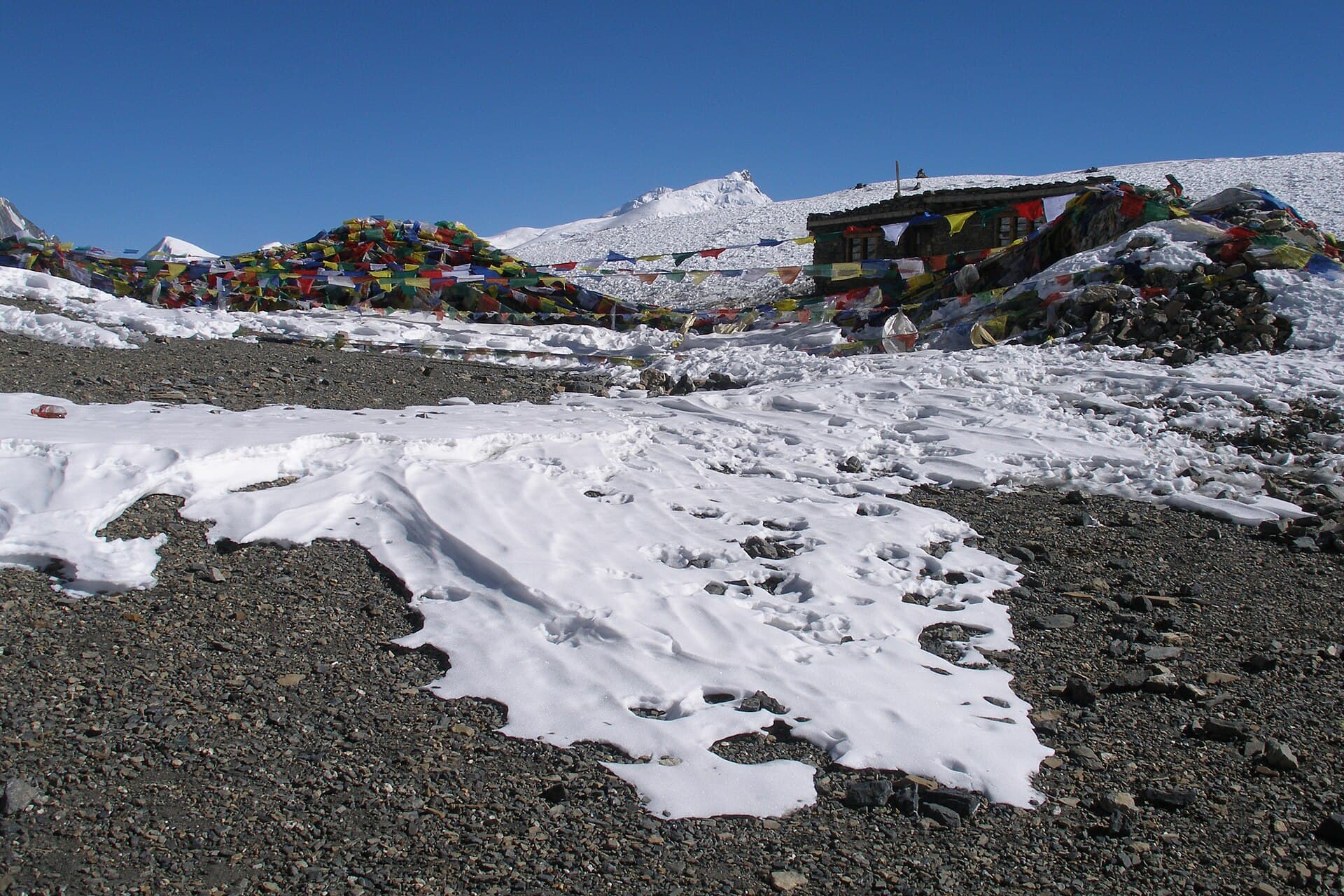
Cho Oyu stands at 8,188 meters (26,864 feet), making it the sixth-highest mountain on Earth and the fifth-highest in Nepal. It sits on the Nepal-Tibet border in the Khumbu section of the Mahalangur Himal, approximately 20 kilometers west of Mount Everest. The name means "Turquoise Goddess" in Tibetan, and the mountain's broad, snow-covered flanks give it a gentler appearance than its sharper neighbors.
Cho Oyu is the second most climbed 8,000-meter peak after Everest. As of December 2024, over 4,027 climbers had reached its summit. Its proximity to the Nangpa La — a glaciated pass at 5,716 meters that has served as a trade route between Nepal and Tibet for centuries — gives the mountain an accessible character that sets it apart from the other high peaks.
First Ascent
Austrian climbers Herbert Tichy and Joseph Jochler, along with Nepali-Sherpa Pasang Dawa Lama, reached the summit on October 19, 1954. The expedition was notably small and lightweight for the era — Tichy had organized it on a minimal budget, in deliberate contrast to the large national expeditions that characterized 1950s Himalayan climbing.
The ascent came just one year after Everest and months after K2. Tichy's approach was ahead of its time: small team, minimal fixed rope, fast movement. The route followed the Northwest Ridge from the Tibetan side, which remains the standard route today.
An earlier British reconnaissance in 1952, which included Edmund Hillary, had judged the mountain unclimbable from the Nepal side due to the icefall guarding the approach — an assessment that pushed subsequent expeditions to the Tibetan side.
Continue reading Ama Dablam — The Matterhorn of the Himalayas →
Routes and Difficulty
The standard Northwest Ridge route from Tibet is why Cho Oyu earned its reputation as the easiest 8,000-meter peak. The route is technically straightforward: moderate snow slopes, no sustained steep sections, and a well-established trail broken by hundreds of climbers each season. The crux is a rock band at approximately 7,200 meters that requires a short section of fixed-rope climbing, but it is brief and well-protected.
From the Tibetan side, climbers typically establish base camp at approximately 5,700 meters near the Nangpa La. Advanced Base Camp sits at around 6,400 meters, Camp 1 at 7,100 meters, and Camp 2 at 7,500 meters. Summit day involves roughly 700 meters of vertical gain — long, but not technically extreme.
The Nepal side is a different proposition entirely. The southwest face is steeper and more prone to avalanche, and sees very few ascents. A route from the southeast was climbed in 1978, but the Tibetan approach dominates.
Cho Oyu serves as a training peak for climbers preparing for Everest or K2. Many guide services offer it as a stepping stone, and a successful Cho Oyu ascent is often listed as a prerequisite for attempting harder peaks.
Death Rate
Cho Oyu has the lowest fatality rate among the 8,000-meter peaks. Approximately 52 climbers have died against over 4,000 successful summits, producing a death rate of roughly 0.6-1.4% depending on the calculation method. By comparison, Annapurna I has a fatality rate above 25%, and even Everest sits around 1%.
The deaths that do occur are typically caused by avalanches, crevasse falls on the approach, or altitude sickness in climbers who ascend too quickly. The 2014 season saw a notable tragedy when an avalanche killed several climbers near Camp 2.
The low death rate is not an indication that the mountain is safe in absolute terms. It is still above 8,000 meters. Hypoxia, pulmonary edema, and cerebral edema can strike anyone. But the moderate terrain means that a climber who turns back when conditions deteriorate has a reasonable chance of descending safely — a luxury that steeper peaks do not offer.
From the Trail
Cho Oyu is visible from much of the upper Khumbu region. From Gokyo Ri (5,357 m), one of the premier viewpoints on the Everest Base Camp / Three Passes trek, the mountain fills the northwestern horizon. Its broad, snow-laden flanks contrast sharply with the darker, more angular profiles of Everest and Lhotse to the east.
From the Renjo La pass (5,360 m), Cho Oyu's full west face is on display — a massive wall of snow and ice that appears deceptively gentle from a distance. The mountain's scale only becomes apparent when you spot climbers' tents on its lower slopes, reduced to specks against the white expanse.
Why It Matters
Cho Oyu occupies a unique position in high-altitude mountaineering. It is the gateway peak — the mountain where climbers learn whether they can function above 8,000 meters. Its moderate difficulty makes it accessible, but it is still high enough to expose every weakness in a climber's acclimatization, fitness, and mental resilience.
The mountain also raises questions about what "easy" means at extreme altitude. A 0.6% death rate means that roughly 1 in 170 people who summit do not come home. That is orders of magnitude more dangerous than almost any other recreational activity on Earth. Cho Oyu is the easiest of the 8,000-meter peaks, but the 8,000-meter peaks are not easy.
Herbert Tichy understood this. His small, fast, light expedition in 1954 succeeded not because the mountain was simple, but because his team was skilled and lucky. Seven decades later, the same combination is still required.
7 Sources
- himalayandatabase.comThe Himalayan Database — Expedition Archives of Elizabeth Hawley
- 8000ers.com8000ers.com — Cho Oyu General Info (Eberhard Jurgalski)
- peakvisor.comPeakVisor — Cho Oyu peak data
- alpinejournal.org.ukAlpine Journal (1953): 'The Cho Oyu Expedition, 1952' by R. C. Evans
- explorersweb.comExplorersWeb — The First Ascent of Cho Oyu, 71 Years Ago
- alpenglowexpeditions.comAlpenglow Expeditions — A Brief History of Cho Oyu
- peakvisor.comPeakVisor — Gokyo Ri viewpoint