
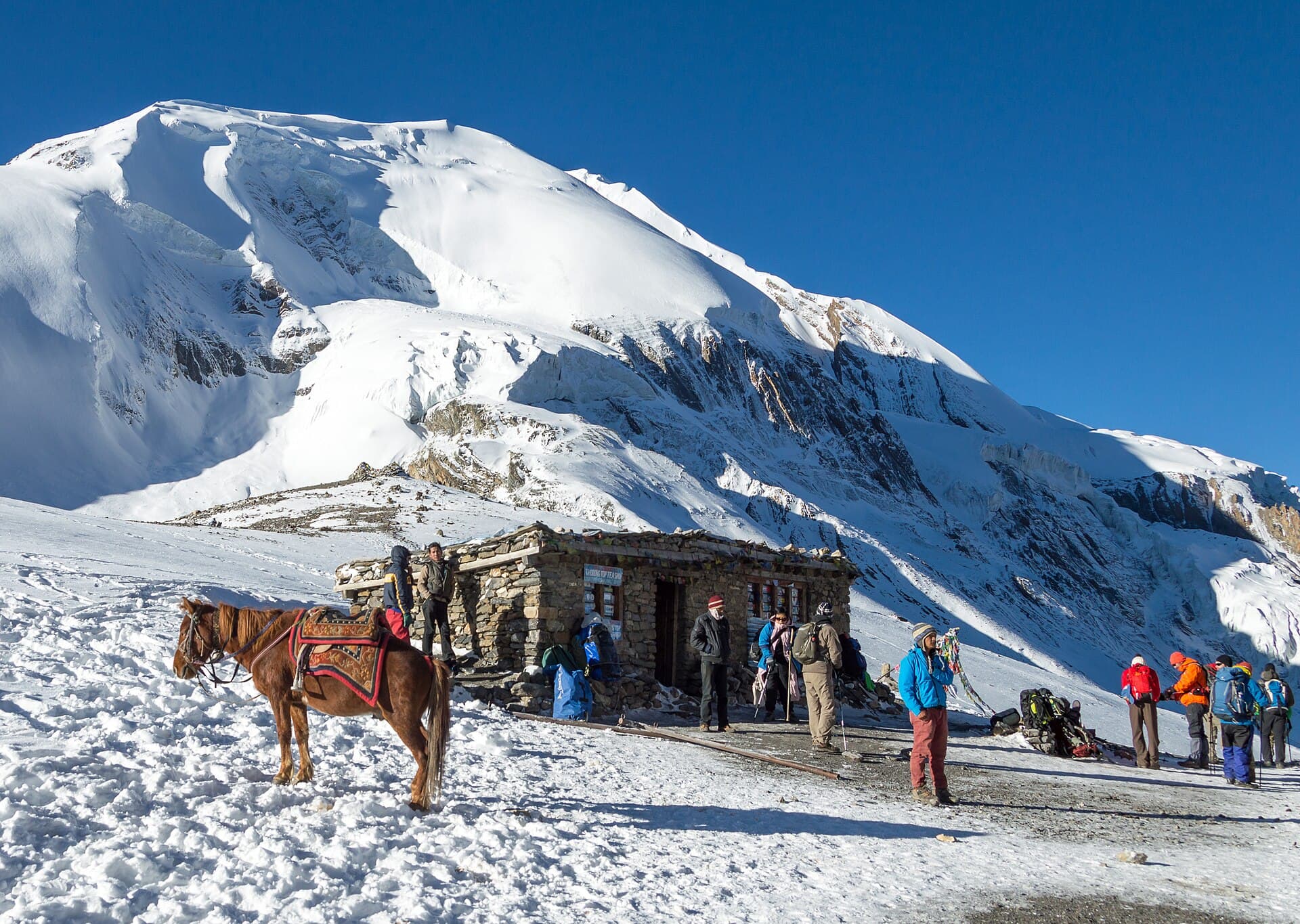
The Blinding White Massif
Dhaulagiri I stands at 8,167 meters above sea level, making it the seventh-highest mountain on Earth. Its name comes from the Sanskrit words dhavala (white) and giri (mountain). From certain angles the description is literal: the peak carries enormous volumes of snow and ice year-round, its flanks dropping away in near-vertical walls of glaciated rock. For trekkers on the popular Poon Hill viewpoint in the Annapurna region, Dhaulagiri dominates the northwestern horizon, a massive white pyramid rising above everything around it.
The mountain sits in the Dhaulagiri Himal range in north-central Nepal. The Kali Gandaki gorge, one of the deepest valleys in the world, separates it from the Annapurna massif to the east. That gorge drops more than 5,500 meters below the summit of Dhaulagiri, creating one of the most dramatic elevation contrasts on the planet.
A Long Road to the Summit
Dhaulagiri resisted climbers for over a decade. Between 1950 and 1958, seven expeditions attempted the mountain and all failed. The Argentine, Swiss, German, and Austrian teams that tried various routes were turned back by avalanches, extreme cold, and the sheer technical difficulty of the upper ridges.
The first successful ascent came on May 13, 1960. A Swiss-Austrian expedition led by Max Eiselin put six climbers on the summit: Kurt Diemberger, Peter Diener, Ernst Forrer, Albin Schelbert, and Sherpas Nyima Dorje and Nawang Dorje. The expedition was notable for using a small aircraft -- a Pilatus Porter -- to ferry supplies to a base camp on the Northeast Col, a logistical innovation that was controversial but effective.
Kurt Diemberger later recalled the final push to the summit as a battle against wind and exhaustion. The team had spent weeks acclimatizing and fixing ropes on the Northeast Ridge before the weather opened a brief window.
Continue reading Ama Dablam — The Matterhorn of the Himalayas →
The Danger
Dhaulagiri has earned a grim reputation. As of recent records, roughly 691 climbers have reached the summit while 87 have died on its slopes -- a fatality rate of approximately 12.6 percent. Some broader analyses place the rate closer to 16 percent when accounting for all attempts, not just summits. These numbers put Dhaulagiri among the deadliest of the fourteen 8,000-meter peaks.
The worst single year was 1969, when thirteen climbers from two separate expeditions -- American and Austrian -- died on Dhaulagiri I and Dhaulagiri IV. Avalanches were the primary killer. The mountain's steep, heavily glaciated faces produce frequent and unpredictable slides, and the weather windows at this altitude are narrow and unreliable.
Routes and Conditions
The standard route follows the Northeast Ridge, the same line used by the 1960 first-ascent team. Climbers typically establish base camp on the northeast side at around 4,700 meters, then push through a series of higher camps along the ridge. The route involves sustained sections of steep snow and ice, with significant avalanche exposure on the approach.
Other routes have been climbed, including the South Face and the Southeast Ridge, but they are far more technical and rarely attempted. The South Face, in particular, is one of the great walls of Himalayan mountaineering -- a 4,000-meter sweep of ice and rock that has seen only a handful of successful ascents.
Trekking Below
For those not bound for the summit, the Dhaulagiri Circuit is a challenging but rewarding trek that circumnavigates the massif. It crosses French Pass at 5,360 meters and passes through remote valleys with minimal infrastructure. The trek sees far fewer visitors than the Annapurna Circuit, offering a quieter experience in exchange for rougher trails and more self-sufficiency. From the high points of the circuit, the mountain fills the sky -- white, steep, and indifferent to everyone below it.
8 Sources
- ntb.gov.npNepal Tourism Board — Dhaulagiri
- britannica.comEncyclopaedia Britannica — Dhaulagiri
- himalayandatabase.comThe Himalayan Database — expedition and fatality archive
- publications.americanalpineclub.orgAmerican Alpine Journal — "The Ascent of Dhaulagiri" (review of Max Eiselin's account)
- theuiaa.orgUIAA — Diemberger recalls the first ascent of Dhaulagiri
- explorersweb.comExplorersWeb — Dhaulagiri: A Short History of Successes and Failures
- publications.americanalpineclub.orgAmerican Alpine Club — Avalanche Fatalities in Himalayan Mountaineering
- ntnc.org.npNTNC — Annapurna Conservation Area Project (ACAP)