
The Basics
Kangchenjunga stands at 8,586 meters (28,169 feet), making it the third-highest mountain on Earth and the second-highest in Nepal. It sits on the border between Nepal's Taplejung District and the Indian state of Sikkim. The name translates roughly to "Five Treasures of the Great Snow" in Tibetan, referring to its five distinct summits. Until the Great Trigonometrical Survey confirmed Everest's superior height in 1856, Kangchenjunga was believed to be the world's tallest mountain.
The massif is enormous. Four of the five summits exceed 8,450 meters. The mountain dominates the skyline of Darjeeling, India, roughly 75 kilometers to the southeast, where it has been a sacred landmark for centuries. In Sikkim, the mountain is revered as a deity, and every expedition that has summited has honored a tradition of stopping a few feet short of the actual top.
Continue reading Ama Dablam — The Matterhorn of the Himalayas →
First Ascent
Joe Brown and George Band reached the summit on May 25, 1955, via the Yalung Face on the southwest side. Norman Hardie and Tony Streather summited the following day. The expedition was led by Charles Evans — the same Charles Evans who had turned back just 91 meters from Everest's summit in 1953. Both summit teams stopped short of the true highest point, honoring a promise to the Chogyal (king) of Sikkim that the sacred summit would remain untrodden. This tradition has been respected by nearly every subsequent expedition.
Before 1955, Kangchenjunga had already claimed 11 lives with zero summits. The mountain's fearsome reputation was well established.
Routes and Difficulty
The standard route follows the 1955 path up the Yalung Face from the southwest. The approach starts from the Yalung Glacier and climbs a 3,000-meter face. The key feature is the Great Shelf, a massive sloping plateau at approximately 7,500 meters covered by a hanging glacier. Above the Shelf, the route steepens dramatically toward the summit ridge.
The Northeast Spur, first climbed by an Indian Army expedition in 1977, is considered more technically demanding. In 1979, Doug Scott, Pete Boardman, and Joe Tasker made a landmark ascent via a new route on the north face — without supplemental oxygen or high-altitude porters.
Kangchenjunga is remote. The approach trek from the nearest roadhead takes roughly two weeks. There are no teahouses along the way — it is a full camping expedition from the start. This isolation filters out casual attempts, but it also means rescue is nearly impossible.
Death Rate
Kangchenjunga has one of the highest fatality rates among the 8,000-meter peaks. Approximately 50-55 climbers have died against roughly 500-540 confirmed summits, producing a death-to-summit ratio between 9% and 12%. Some decade-specific analyses show rates as high as 15-22%. For comparison, Everest's ratio sits around 1%. Only Annapurna I is consistently deadlier in percentage terms.
The causes are varied: avalanches on the Yalung Face, exposure on the upper ridges, and the sheer length of the climb. The mountain's remoteness means that a climber in trouble above 8,000 meters has essentially no chance of rescue.
From the Trail
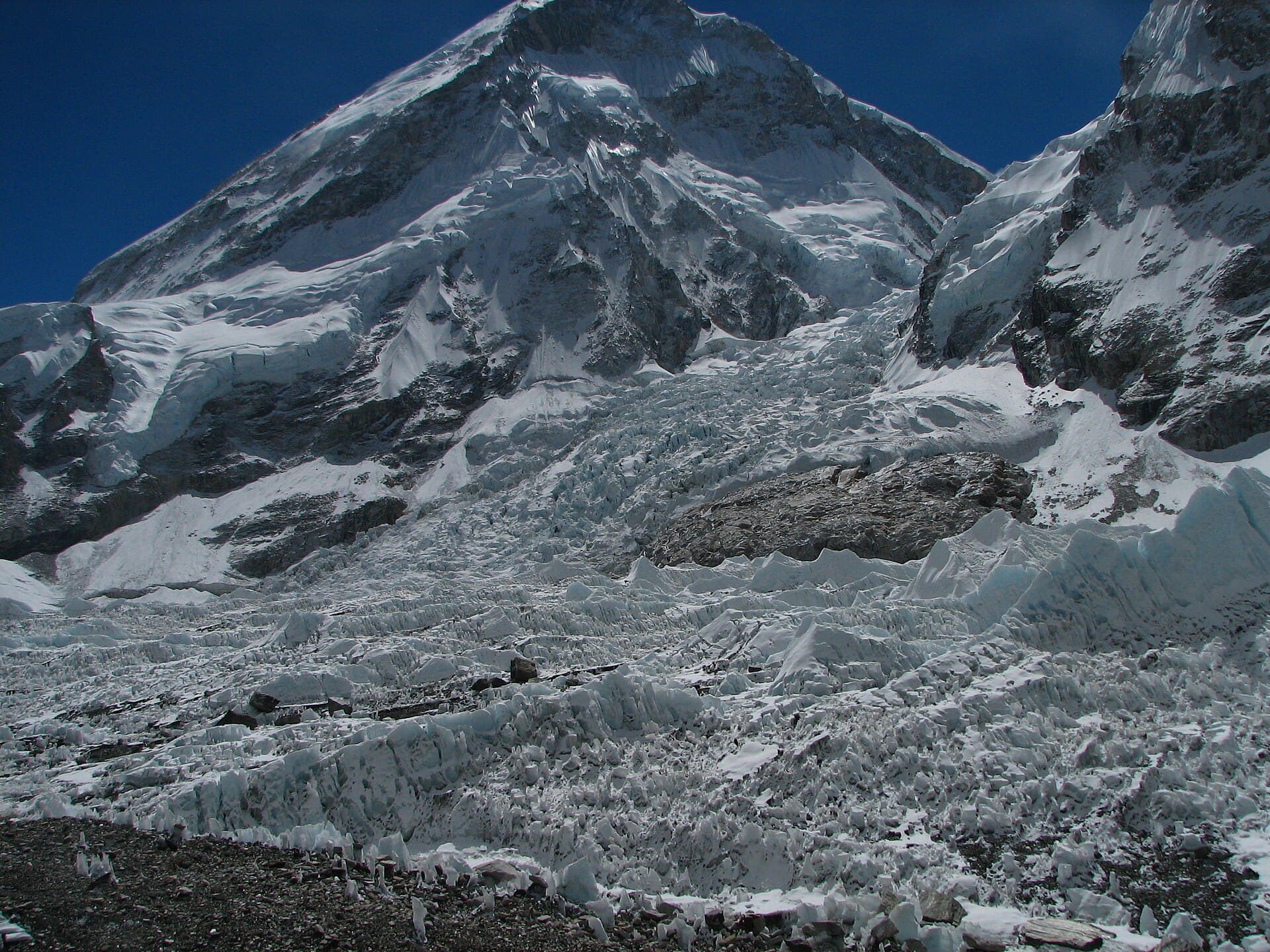
The Kangchenjunga Base Camp trek is one of Nepal's most isolated trekking routes. From the north base camp at Pangpema (5,143 m), the mountain's north face fills the entire horizon — a wall of ice and rock that rises nearly 3,500 vertical meters. From the south base camp at Oktang, the Yalung Glacier leads the eye up to the Great Shelf and the summit pyramid above.
From Darjeeling, India, Kangchenjunga is one of the great mountain views on Earth. At sunrise, the five summits catch the light in sequence, turning from deep blue to gold to white. It is visible on clear days from over 150 kilometers away.
Why It Matters
Kangchenjunga represents what the 8,000-meter peaks were before commercialization. There are no helicopter rescues, no luxury base camp services, no queue of guided clients. The mountain demands self-sufficiency and genuine mountaineering skill. It is the last of the "big three" (Everest, K2, Kangchenjunga) and arguably the one that best preserves the character of Himalayan climbing as it existed in the golden age of the 1950s.
The tradition of not stepping on the true summit — maintained for seven decades — is unique among the world's highest mountains. It is a rare instance of mountaineers choosing reverence over conquest.
8 Sources
- 8000ers.com8000ers.com — Kangchenjunga General Info (Eberhard Jurgalski)
- himalayandatabase.comThe Himalayan Database — Expedition Archives of Elizabeth Hawley
- britannica.comEncyclopaedia Britannica — Kanchenjunga
- unesco.orgUNESCO — Khangchendzonga National Park
- guinnessworldrecords.comGuinness World Records — First ascent of Kangchenjunga
- explorersweb.comExplorersWeb — The 70th Anniversary of the First Ascent of Kangchenjunga
- alpinejournal.org.ukAlpine Journal 1980 — Joe Tasker, 'Kangchenjunga North Ridge 1979' (PDF)
- publications.americanalpineclub.orgAmerican Alpine Journal 1980 — Doug Scott, 'Kangchenjunga from the North'