The Basics
Mount Everest stands at 8,849 meters (29,032 feet) above sea level, a figure confirmed by a joint Chinese-Nepali survey in 2020 that revised the long-accepted 8,848-meter measurement. The mountain sits on the border between Nepal's Solukhumbu District and Tibet's Tingri County. Nepalis call it Sagarmatha. Tibetans call it Chomolungma. The English name honors George Everest, a British Surveyor General of India who never actually saw the peak.
First Ascent
Edmund Hillary of New Zealand and Tenzing Norgay, a Nepali-Indian Sherpa, reached the summit on May 29, 1953, as part of a British expedition led by John Hunt. What many people forget is how close the Swiss came in 1952 — Raymond Lambert and Tenzing Norgay (the same Tenzing) reached approximately 8,595 meters on the southeast ridge, turning back only 254 meters short. The 1953 success built directly on that Swiss route.
Before 1953, the mountain had been attempted from the north (Tibetan) side exclusively. George Mallory and Andrew Irvine disappeared near the summit in 1924. Whether they reached the top remains one of mountaineering's great unsolved questions. Mallory's body was found in 1999 at 8,155 meters, but the camera that might have proved a summit was never recovered.
Continue reading Ama Dablam — The Matterhorn of the Himalayas →
Routes and Difficulty
There are two standard routes. The South Col route from Nepal starts at Everest Base Camp (5,364 m), passes through the Khumbu Icefall — a constantly shifting maze of seracs and crevasses — then ascends the Western Cwm to Camp 2, up the Lhotse Face to Camp 3, and on to the South Col at 7,906 meters. From there, climbers push through the Balcony, the Hillary Step (partially collapsed in the 2015 earthquake), and the summit ridge.
The Northeast Ridge route from Tibet is longer and more exposed to wind, but avoids the Khumbu Icefall. It passes through the North Col (7,020 m) and follows the ridge over the First, Second, and Third Steps — the Second Step being the crux, a near-vertical 40-meter rock band at 8,610 meters.
Neither route is technically extreme by alpine standards. The difficulty is altitude. Above 8,000 meters — the so-called Death Zone — the human body consumes itself. Supplemental oxygen is used by the vast majority of climbers, and the window for summit attempts is typically just a few days in May when the jet stream lifts off the peak.
Death Rate
At least 344 people have died on Everest. The overall death rate has dropped significantly over the decades — from above 5% in pre-1990 expeditions to roughly 1% in the 2006-2024 period. This improvement reflects better weather forecasting, improved gear, fixed ropes maintained by Icefall Doctors, and the sheer volume of institutional knowledge accumulated over seven decades. Still, the mountain kills reliably. Avalanches, falls, altitude sickness, and exhaustion remain constant threats. The 2015 earthquake triggered an avalanche that killed 22 people at Base Camp — the deadliest single disaster in Everest history.
Key facts
Everest is not the hardest 8,000-meter peak to climb. Not even close. It is, however, the most crowded. In peak season, hundreds of climbers may be on the mountain simultaneously, creating bottlenecks at the Hillary Step and above the South Col. The famous photos of "traffic jams" near the summit are real and dangerous — standing still in the Death Zone while waiting in line burns oxygen and body heat.
The mountain's commercial infrastructure is enormous. A guided expedition on the south side costs between $30,000 and $100,000 or more. Nepal charges $15,000 per climber for a permit. The Sherpa workforce — fixing ropes, hauling loads, cooking meals — makes the entire operation possible. Sherpas account for a disproportionate share of Everest fatalities relative to their summit numbers, a fact that rarely gets the attention it deserves.
From the Trail
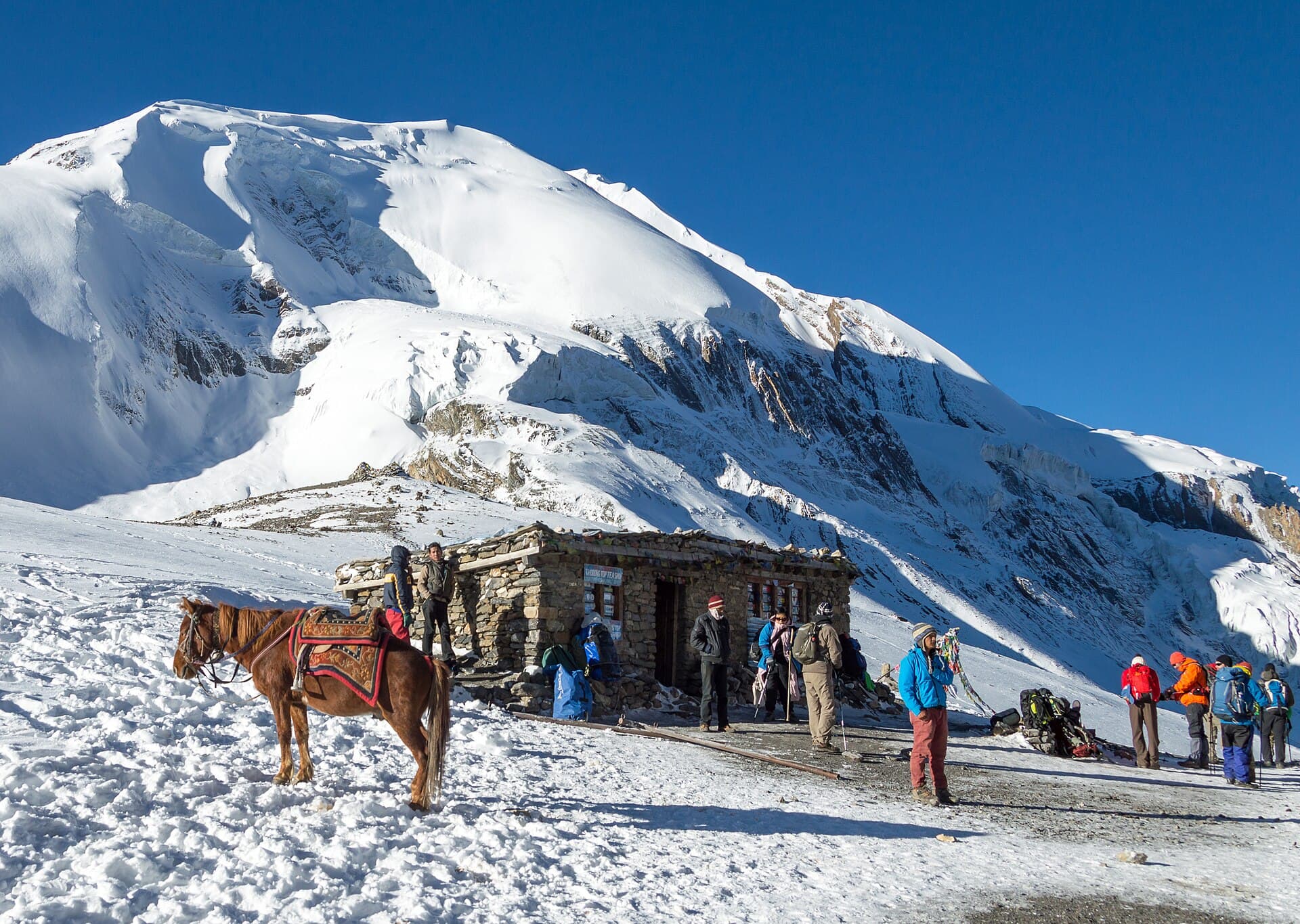
From the Everest Base Camp trek — one of the most popular trekking routes in the world — the mountain is visible from Kala Patthar (5,643 m) and from the ridge above Gorak Shep. From these vantage points, Everest appears as a dark, wind-scoured pyramid with a distinctive plume of snow streaming from its summit. It looks smaller than you expect, partly because Nuptse's massive wall dominates the foreground. The mountain reveals its true scale only when you understand the distances involved.
Why It Matters
Everest is the reference point for all high-altitude mountaineering. Every route, every technique, every piece of equipment used on other 8,000-meter peaks was tested or refined here first. It is also a barometer for how humans interact with extreme environments — the tension between commerce and wilderness, between access and preservation, between ambition and responsibility. The mountain does not care about any of it.
9 Sources
- kathmandupost.comThe Kathmandu Post — Everest's official height set at 8,848.86 m (2020 Nepal-China joint survey)
- snp.gov.npSagarmatha National Park (Nepal DNPWC) — official park authority
- nationalgeographic.comNational Geographic — Hillary and Tenzing's 1953 first ascent
- nationalgeographic.comNational Geographic — Conrad Anker and the Mallory-Irvine mystery
- himalayandatabase.comThe Himalayan Database — expedition and death archive (Elizabeth Hawley)
- pmc.ncbi.nlm.nih.govFirth et al., 'Mortality on Mount Everest, 1921-2006' (BMJ, 2008)
- alanarnette.comAlan Arnette — 'Everest by the Numbers: 2026 Edition'
- alanarnette.comAlan Arnette — Nepal raises the Everest permit fee to $15,000 (Sept 2025)
- furtenbachadventures.comFurtenbach Adventures — Mount Everest camps and elevations (South Col route)