
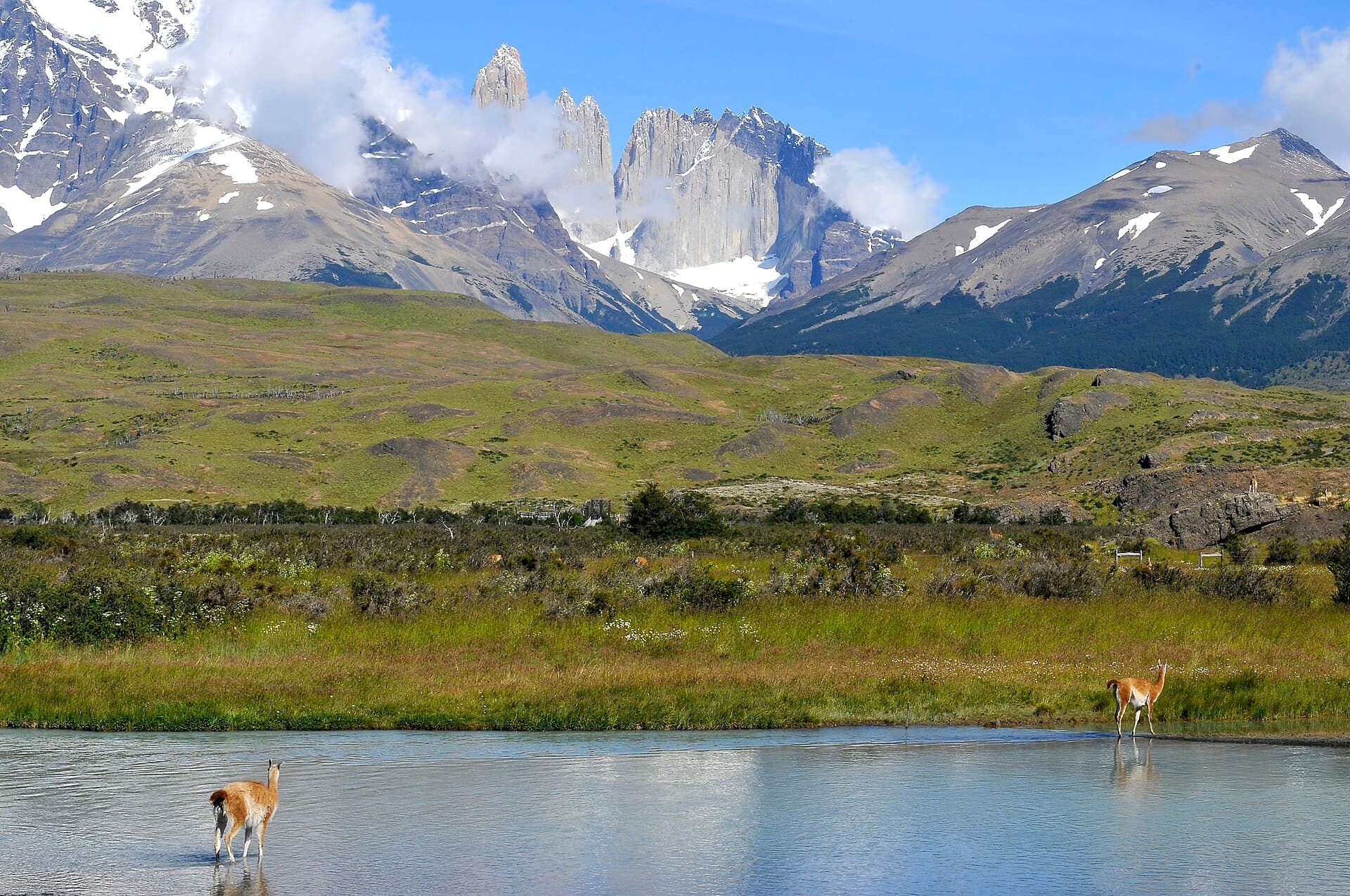
The full loop — what most W-trekkers don't do
Update — 25 August 2026: CONAF and Pases Parques keep the Macizo Paine / La O circuit closed until 31 October 2026. Do not book or attempt a full O itinerary before 1 November 2026 unless CONAF publishes an earlier reopening. The W Trek remains unaffected (CONAF; Pases Parques).
Most visitors to Torres del Paine walk the W Trek — a 4–5 day point-to-point that covers the southern face of the massif. It is a great trek. It is also crowded, frequently misgraded as "moderate," and leaves out the entire northern and western back side of the massif — including the single most dramatic day of trekking in Patagonia.
The O Circuit adds 4–5 days to the W by looping around the back of the massif (Serón → Dickson → Los Perros → John Gardner Pass → Grey) before joining the W route at Paine Grande and continuing east. It is the same park, the same massif, the same booking system — but a different experience in almost every dimension that matters. The back side carries a fraction of the W's traffic. The camps are more basic. The weather is harsher. And on day 4, you cross John Gardner Pass — the point where the trek stops being a hut walk and becomes something that requires weather judgment, physical preparation, and clear-eyed self-assessment.
This guide is for the O Circuit specifically. If you're considering the W, see the separate W Trek guide.
The numbers
- Total distance: ~116 km (including the Base Torres spur from the W section). Sources report 110–130 km depending on which side-trips you include. 116 km is the most commonly cited independent figure.
- Days: 8 standard / 9 recommended (add a weather-buffer day at Dickson or split the crux day by sleeping at Camp Paso)
- Max elevation: ~1,180 m (John Gardner Pass — some older sources say 1,241 m; the SRTM-derived figure is closer to 1,180 m)
- Direction: Counter-clockwise ONLY. This is not a recommendation; it is a CONAF rule enforced at the Laguna Amarga entrance. Rangers stamp your itinerary and will turn you back at Paso if you attempt clockwise. Rationale: one-way traffic through the pass bottleneck reduces collision risk on the narrow ladder descent and simplifies rescue logistics.
- Season: October through April in a normal year — but for 2026, CONAF keeps the back side (Serón → Dickson → Los Perros → Paso) closed until 31 October 2026, so full O itineraries start 1 November at the earliest unless CONAF changes the notice. John Gardner Pass may have snow through November. Refugios on the back side begin closing ~mid-April (Vertice closes Los Perros around April 15).
- Park entry fee (foreign adult): buy the current Macizo Paine section ticket through pasesparques.cl after confirming La O is open. Treat pre-May-2026 CLP 48,500 figures as historical only.
Continue reading Torres del Paine trekking guide — three booking portals, two operators, and the 140-year history that explains why →
Day by day — the 8-day standard
Day 1 — Laguna Amarga → Serón (13 km, +250 m, 4–5 h)
Easy. Rolling pampa, open steppe views, guanacos. This is the gentle introduction — the O Circuit's equivalent of a rest day. Campamento Serón (operated by Las Torres Patagonia, ex-Fantástico Sur) has full refugio facilities, meals available, and a spectacular setting against the northern face of the massif.
Practical note: You start at Laguna Amarga (the CONAF portería), not at Hotel Las Torres. Make sure your morning bus from Puerto Natales drops you at Laguna Amarga, not Pudeto.
Day 2 — Serón → Dickson (18 km, +150 m, 6–8 h)
Long and flat, mostly lakeshore. Wind is the defining variable — you walk directly into the prevailing westerlies for several hours. Trekking poles are useful for balance.
Campamento Dickson (Vertice) sits against Lago Dickson with Glaciar Dickson calving in the background. This is the most photogenic camp on the O Circuit and the strongest case for a rest day if you have 9 days.
Day 3 — Dickson → Los Perros (9 km, +350 m, 3–5 h)
Short. Forest walking with glacier views. Arrive at Los Perros early, set up camp, and rest. Tomorrow is the crux.
Campamento Los Perros (Vertice) is the most basic camp on the circuit — camping only, no dormitory, exposed to wind, with a small shop selling hot drinks. Many trekkers rank it the worst-quality camp on the O. This is where your gear quality matters most, because you need a full night of sleep before the pass.
Day 4 — Los Perros → John Gardner Pass → Grey (15 km, +800 m / −1,100 m, 7–10 h)
This is the day the O Circuit earns its reputation.
The climb from Los Perros (~400 m) to John Gardner Pass (~1,180 m) gains roughly 800 meters in ~5 km through dense lenga forest that opens to exposed rock and scree near the top. The wind at the pass routinely exceeds 100 km/h in the trekking season — gusts strong enough to blow a loaded trekker off their feet. The CONAF / Vertice warden at Los Perros posts a daily go/no-go decision at 06:00 based on the Punta Arenas DMC (Dirección Meteorológica de Chile) wind forecast.
If the pass is closed, you wait at Los Perros. Closures of 24–48 hours happen several times per season. This is the strongest argument for the 9-day itinerary — a buffer day absorbs one closure without destroying your booking chain.
The go/no-go decision is real, not advisory. The warden's call is based on a professional weather forecast and backed by enforcement authority. Pushing past a closed-pass call does not make you brave. It makes you the person the Carabineros GOPE mountain unit has to stretcher out of the pass zone at the cost of a day and a helicopter they might have needed for someone else.
At the pass: The reward is your first view of the Southern Patagonian Ice Field — the third-largest ice body on Earth outside the polar caps, stretching to the horizon in every direction west. This single view is why people walk the O instead of the W. There is nothing comparable on the W route.
The descent to Grey: From the pass (~1,180 m) to Refugio Grey (~80 m), the trail drops 1,100 meters in roughly 5 km. It is the steepest sustained descent on any major Patagonian trek. Five sections of fixed ladders (installed and reinforced 2016–2018) handle the worst of the grade, but the descent is still the most common injury point on the circuit — knees, ankles, and footing on wet rock.
The ladders are also the queue choke-point in peak season. When multiple groups converge from a delayed morning start, expect 1–2 hours of waiting at the ladder sections. An early start from Los Perros (06:00–07:00 if the pass is open) avoids the worst of this.
Refugio Grey (Vertice) at the bottom is a full-service refugio with dorms, meals, and a beer that tastes better than any other beer you have had or will have.
Day 5 — Grey → Paine Grande (11 km, +250 m, 4–5 h)
Decompression day. Walk along the southern shore of Lago Grey, cross suspension bridges, and arrive at Refugio Paine Grande (Vertice). This is where you join the W route. The terrain is gentle and the crowds return.
Days 6–8 — The W section (Paine Grande → Italiano/Francés → Cuernos → Central → Chileno → Base Torres)
From here you are on the W Trek. See the separate W Trek guide for stage details. The signature experiences: Mirador Británico at the top of the French Valley (day 6), the Cuernos traverse (day 7), and the pre-dawn push to Base Torres from Chileno for sunrise (day 8).
The rescue system — key details for John Gardner Pass
Rescue in Torres del Paine is coordinated by CONAF guardaparques with the Carabineros de Chile GOPE mountain unit and Chilean Army helicopters based in Punta Arenas (~45 minutes flight time in good weather).
Two things the brochures don't tell you:
- Helicopter evacuations are frequently grounded by the same wind that makes the pass dangerous. If you injure yourself at or near John Gardner Pass in high wind, helicopter extraction may not be available. Ground evacuation from the pass zone to a road requires a stretcher team over steep terrain, and response times run 4–12 hours depending on conditions (longer if the team has to come from Administración rather than from Los Perros or Grey). A serious injury on the pass in bad weather is a 1–2 day evacuation.
- There is no dedicated volunteer mountain rescue inside Torres del Paine (unlike El Chaltén, which has the Comisión de Auxilio). CONAF rangers are the first responders, and they are generalists — fire, visitor management, rescue. Their capacity is spread thin, and the CONAF → SBAP institutional transition in 2026 may introduce additional uncertainty.
What this means operationally: the same things it means everywhere on this site. Your first hour of injury is yours. The go/no-go call at Los Perros is load-bearing. Trekking poles on the descent are not optional gear. And your travel insurance must cover backcountry trekking and emergency evacuation without altitude exclusions (altitude is not a factor here at ~1,180 m, but some budget policies exclude "mountaineering" or "backcountry hiking" as a category — read the fine print before you fly).
As of 2025, Chile does not legally require travel insurance for entry. But the park and several guided operators now ask to see proof. The recommendation: minimum USD 100,000 emergency medical + evacuation, explicit trekking coverage, no Patagonia/remote exclusions.
Planning this route? We're forming a founding group for Torres del Paine — W Trek — registering interest is free, no commitment. See the expedition →
The back-side camps — what the W-trekkers don't know
The back side of the O (Serón, Dickson, Los Perros) is a materially different product than the W-side refugios. Here's the practical comparison:
| Dimension | W-side (Las Torres / Vertice front) | O back side (Vertice / Las Torres) |
|---|---|---|
| Lodging | Refugio dorms + camping | Camping + basic shelters (Los Perros has NO dorm) |
| Meals available | Full board at most refugios | Limited (Serón yes, Dickson limited, Los Perros hot drinks only) |
| Crowd level | High (hundreds/day at peak) | Low (~50–100/day, capacity-capped) |
| Booking pressure | Sells out 4–6 months ahead | Sells out within weeks of opening |
| Infrastructure | Hot showers, electricity, wifi at some | Basic composting toilets, no electricity at Los Perros |
| Scenery | Granite towers + lakes (the postcard) | Glacier valleys + ice field + lenga forest (the wilderness) |
If you want the wilderness experience — the one the W-side marketing images promise but the W-side trail no longer delivers — the back side of the O is the only path to it. But it books out faster than the W because the daily capacity is an order of magnitude smaller. For the 2025–26 season, all Las Torres camping-only slots sold out by early May 2025 — within weeks of release. Source: Backcountry Emily O circuit.
Self-guided vs guided — the same practical framework
CONAF does not require a guide for the O Circuit in the standard October–April season. Registration at Laguna Amarga is mandatory; a guide is not. Source: Stingy Nomads O circuit.
The trail is well-marked. The refugios are staffed. The camps have wardens. The waymarking between Los Perros and Grey (the pass day) is the weakest section and can be challenging in whiteout, but CONAF has improved it substantially since 2020.
When self-guided is the right call:
- You have at least two multi-day treks in comparable conditions (wind, rain, cold — NZ Great Walks, Scottish Highlands, Patagonian Argentina, etc.)
- You can read a wind forecast and make a go/no-go call instead of pushing because you have a return flight
- You have good rain gear, a reliable tent, and trekking poles
- You have a partner (the O Circuit solo is legal but poor judgment for the pass day)
When a guide makes sense:
- This is your first multi-day outside temperate-climate trails
- You want the logistics handled (the three-portal booking system is the real argument for guided, not the terrain)
- You are inflexible on dates and cannot absorb a pass closure
Major guided operators 2026: Chile Nativo (~USD 2,700–2,900/pp for the W; O-circuit pricing is quote-based but roughly 1.5×), EcoCamp Patagonia (day-hike-from-basecamp model, not a circuit product), Cascada Expediciones. Source: Chile Nativo W Trek.
When to go — for the O Circuit specifically
The O Circuit has tighter weather constraints than the W because John Gardner Pass creates a binary go/no-go bottleneck. The practical assessment:
- October / early November: Pass may have significant snow. Some back-side camps not yet open. For experienced parties with flexibility.
- Late November – December: Wind building toward peak. Pass closures less frequent than mid-summer but increasing. Crowds ramping on the W section.
- January – mid-February: Peak season. Pass closures are most frequent (highest wind). Ladder queues are longest. Back-side camps are full. The W section is a queue. Everything is booked.
- Late February – March: The sweet spot for the O specifically. Wind drops 30–40% from the December peak. Pass closures less frequent. Crowds thin significantly. Autumn color starts in the lengas. Daylight still adequate (13+ hours in March). Source: Wanderlog March.
- April: Closing window. Back-side camps shutting by mid-April. For experienced parties only.
The guide-industry consensus is "December–February." The repeat-visitor and climber consensus is late February through mid-March. The same divergence seen at El Chaltén, for the same reason: the December push is operator-capacity-driven, not weather-driven.
The booking sequence — step by step
For a standard 8-day counter-clockwise O Circuit after La O reopens:
- CONAF park entry via pasesparques.cl — buy the current "Macizo Paine" section ticket after verifying the O is officially open. This is the section-based system replacing the old park-wide pass.
- Las Torres Patagonia (lastorres.com) — book Serón (night 1), then any W-section nights you need on the way out (Cuernos, Chileno, Central).
- Vertice Patagonia (vertice.travel) — book Dickson (night 2), Los Perros (night 3), Grey (night 4), Paine Grande (night 5).
- Camp Paso (free CONAF) — no reservation needed. Emergency/overflow camp between the pass and Grey. Use it as a bail-out if you start the pass late or the weather changes.
Key timing: Vertice typically opens bookings April for the following season. Las Torres opens April–June. For December–February O-Circuit dates, you need to book within weeks of portal opening. March dates hold longer.
For the full booking walkthrough (cancellation policies, portal quirks, what to do if sold out), see the separate booking article.
Cost breakdown — 2026 O Circuit
| Line item | Low USD | Mid USD | High USD |
|---|---|---|---|
| Park entry (foreign, Macizo Paine section ticket) | verify current checkout | verify current checkout | verify current checkout |
| Lodging (8 nights — Vertice camps + Las Torres camps) | 480 | 880 | 1,400 |
| Food on trek (half self-catered back side, half-board W side) | 220 | 380 | 540 |
| Gear rental (9 days, if needed) | 140 | 250 | 400 |
| Travel insurance (14 days, backcountry) | 70 | 130 | 220 |
| Tips + contingency | 60 | 150 | 280 |
| On-ground subtotal | ~1,061 | ~1,881 | ~2,931 |
Add international and domestic flights + bus transfers (see the logistics article): roughly USD 900–2,300 depending on origin, carrier, and advance-booking window.
Total O Circuit trip cost (mid-budget, post-reopening): approximately USD 3,000–3,500 from North America or Europe, after adding the current Pases Parques checkout price. This is meaningfully more expensive than most English-language guides imply, because most of them are quoting pre-2025 prices.
Sources: cost data from the economic research lens.
What makes the O Circuit the first-principles pick
The O Circuit is the trek in Torres del Paine that most closely delivers what the park's marketing promises — a multi-day immersion in genuine Patagonian wilderness, with fewer people than you'd find on a Sunday hike in most European national parks, and a single crux day that genuinely earns the view it rewards.
The W Trek is a great trek. But it is a crowded, well-serviced, frequently-misgraded-as-moderate product that feels less like wilderness and more like a long walk between refugios with beer and wifi. The O Circuit's back side — Serón through Los Perros — is the experience the W cannot deliver: empty trails, basic camps, glacier valleys visible from no other angle, and a pass where the weather makes the decisions.
If you have 8–9 days, the fitness for a 15 km / 1,900 m-elevation day with a 15 kg pack, and the judgment to listen when the warden says no — walk the O. It is the full Torres del Paine, and everything else is a curated excerpt.
Book the route
The O adds the back-side camps to everything the W already demands, and the same three disconnected booking systems govern all of it. The full mechanics — who runs what, when dates release, the sequencing mistakes that break itineraries — are in booking the three portals. Or hand it off: tell us your route and dates and we place the requests across all three operators and confirm back, at no extra cost.
→ Request your huts on /refugios
16 Sources
- conaf.clCONAF — differentiated fee system postponement, Dec 18, 2025
- vertice.travelVertice Patagonia — 2025-2026 season announcement
- lastorres.comLas Torres Patagonia — 2025-2026 season rates
- torreshike.comTorresHike — reservations guide 2025-2026
- torreshike.comTorresHike — booking changes and capacity tightening 2025-2026
- backcountryemily.comBackcountry Emily — O Circuit campground guide (sell-out documentation)
- stingynomads.comStingy Nomads — O Circuit trekking guide
- wanderlog.comWanderlog — Torres del Paine weather, March
- wanderlog.comWanderlog — Torres del Paine weather, November
- theclinic.clThe Clinic — "Alza histórica" Torres del Paine fee, Dec 17, 2025
- chilenativo.travelChile Nativo — W Trek 5-day guided pricing
- swoop-patagonia.comSwoop Patagonia — W Trek overview
- itvpatagonia.comITV Patagonia — HYST disputes CONAF visitor numbers, Feb 2026
- turismointegral.netTurismo Integral — 2024 visitor growth +66%
- conaf.clCONAF — Torres del Paine park page and Macizo Paine / La O closure notice
- pasesparques.clPases Parques — Torres del Paine tickets and La O closure notice