
The numbers
The W Trek covers 71-80 km over 5 days, depending on which side-trips are included. The low end (71 km) is the official Las Torres Patagonia figure; the high end (80 km) is Lonely Planet's count, which includes the full Grey Glacier out-and-back. Swoop Patagonia splits the difference at 76 km. The variance is not an error — it reflects whether you count the Base Torres scramble, the Britanico mirador spur, and the Grey extension as integral stages or optional additions.
Total elevation gain across the five days: approximately 2,200 m cumulative. Maximum sleeping elevation: roughly 400 m at Refugio Chileno. This is not a high-altitude trek. Wind, not altitude, is the defining variable.
Direction: E-to-W vs W-to-E
There are two ways to walk the W. The choice matters significantly.
East to West (Torres first, Grey last) is the independent trekker default. The hardest single effort — the Base Torres scramble — comes on day 2, while legs are fresh. The downside: if weather kills visibility on days 1-2, the marquee view of the granite towers is lost with no recovery option. The trek ends at Grey Glacier, which is spectacular but not the postcard shot.
West to East (Grey first, Torres last) is the guided-group default (Chile Nativo, Cascada Expediciones, EcoCamp). It builds to a climax at Base Torres. The downside: the 600 m scramble up loose moraine arrives on tired legs, day 4 or 5, after 50+ km of cumulative fatigue. Guided operators choose this direction because the emotional arc is better for client satisfaction, not because it is easier.
Neither direction is wrong. But the choice should be conscious, not accidental.
Continue reading Torres del Paine trekking guide — three booking portals, two operators, and the 140-year history that explains why →
Day-by-day stage breakdown (E-to-W, standard 5-day itinerary)
All times below reflect realistic walking pace under a 12-15 kg pack. CONAF trail signs underestimate actual walking time by 15-25% (Erratic Rock pre-trek briefing; corroborated by Swoop Patagonia and TorresHike field reports). Plan on the high end of every range below, not the low end.
Day 1: Laguna Amarga to Refugio Chileno
- Distance: 7-8 km
- Elevation gain: +400 m
- Realistic time: 3-4 hours
- Character: Approach day. Bus from Puerto Natales drops at Laguna Amarga porteria (2.5 hours from town). CONAF checks park entry QR, refugio confirmations, and passport. Shuttle or walk to Hotel Las Torres trailhead. Steady climb through lenga forest to Refugio Chileno. Short day by design — arrival is typically mid-afternoon.
- Accommodation: Refugio Chileno (Las Torres Patagonia, lastorres.com). Dorm beds or camping.
Day 2: Refugio Chileno to Base Torres and back, then move to Refugio Central
- Distance: 14 km round-trip to mirador, plus 3 km descent to Central
- Elevation gain: +600 m (to mirador), -600 m return
- Realistic time: 6-8 hours total
- Character: This is the hardest day of the W Trek, not day 1. Most English-language guides do not reflect this accurately. The final 45 minutes to Mirador Base Torres is a scramble up loose glacial moraine at 30-40% grade with no fixed ropes and no maintained path (Swoop Patagonia W Trek guide). It is not technical climbing, but it is not a groomed trail either. Trekking poles are strongly recommended for the descent.
- Accommodation: Refugio Central / Camp Torres (Las Torres Patagonia).
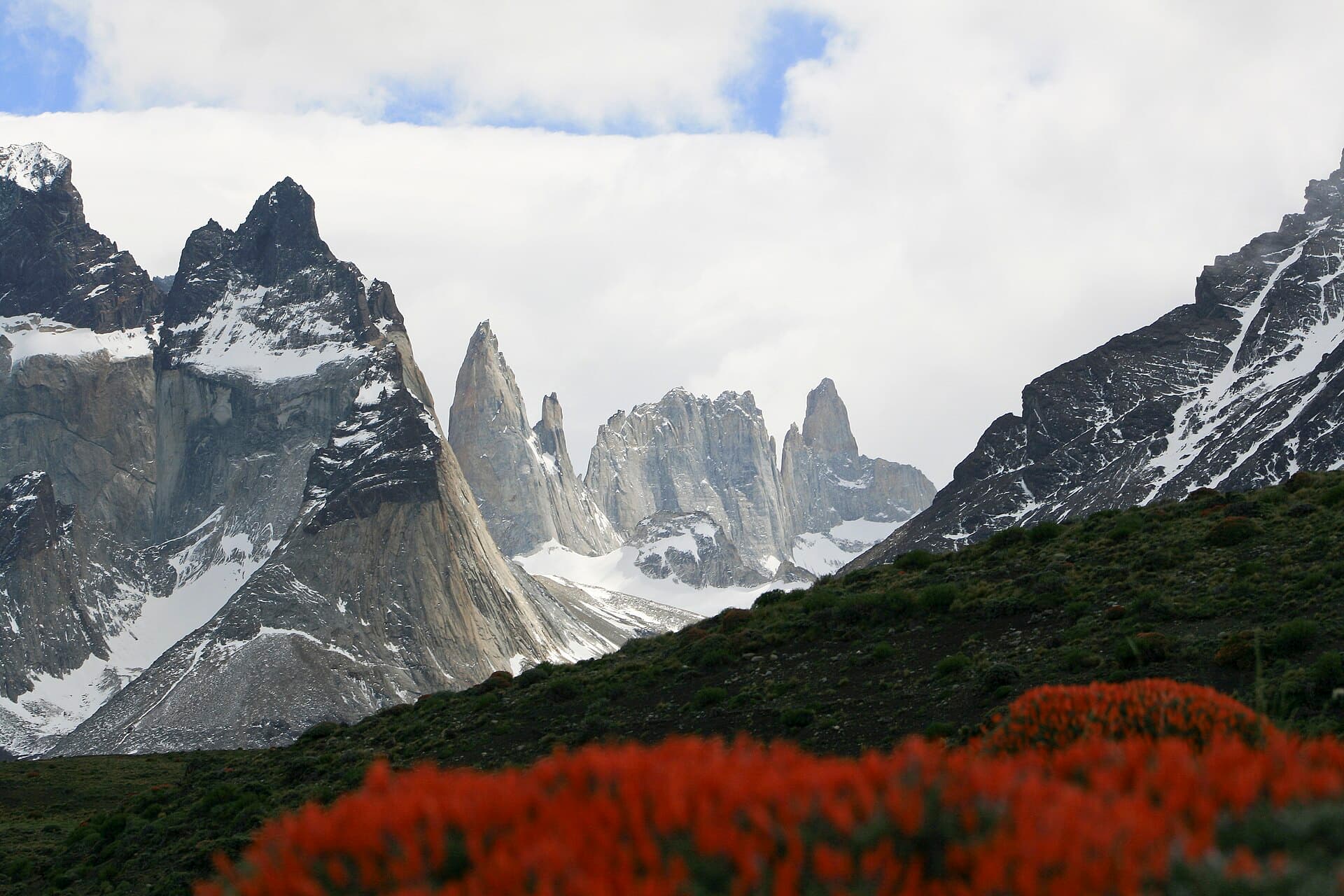
The Base Torres scramble reality. The mirador sits at approximately 870 m elevation on a glacial moraine shelf facing the three granite towers across Laguna Torres. The approach from Refugio Chileno gains 470 m in roughly 4.5 km, with the final kilometer being the steepest and loosest. There are no ladders, no fixed ropes, and no maintained switchbacks on the final section — just a use-trail through boulder fields. In wet conditions the rocks are slick. In wind, the exposed moraine offers no shelter. The descent is harder on knees than the ascent is on lungs.
Day 3: Refugio Central to Refugio Los Cuernos or Camp Frances
- Distance: 16 km
- Elevation gain: +300 m
- Realistic time: 6-7 hours
- Character: The transition day. Descends from the Ascencio valley to the main W corridor, then traverses east to west along the shore of Lago Nordenskjold beneath the Cuernos del Paine. Relatively gentle terrain with exposed windy sections along the lake. The Mirador Nordenskjold spur (short, flat) is worth the 15-minute detour.
- Accommodation: Refugio Los Cuernos (Las Torres Patagonia) or Camp Frances/Italiano (Las Torres Patagonia). The choice depends on booking availability and whether the French Valley day-hike is being done from the east or west side.
Day 4: French Valley — Camp Italiano to Mirador Britanico and on to Refugio Paine Grande
- Distance: 18 km (including Britanico round-trip)
- Elevation gain: +500 m
- Realistic time: 7-9 hours
- Character: The second-hardest day. From Camp Italiano, the trail climbs into the French Valley — a deep cirque between the Cuernos and Paine Grande. The spur to Mirador Britanico (approximately 780 m) adds 4 km round-trip and 300 m elevation. Wind exposure is the crux of this day, not terrain. Gusts in the upper French Valley routinely exceed 60 km/h in December-February; the ridge is fully exposed. After the spur, the main trail continues west to Refugio Paine Grande along Lago Pehoe.
- Accommodation: Refugio Paine Grande (Vertice Patagonia, vertice.travel). This is the western hub of the W — the catamaran departure point.
Day 5: Paine Grande to Grey Glacier and exit via catamaran
- Distance: 22 km round-trip to Refugio Grey and back
- Elevation gain: +400 m
- Realistic time: 8-10 hours (including glacier viewing time and return to Paine Grande for catamaran)
- Character: The longest day by distance. The trail follows the western shore of Lago Grey with views of icebergs calved from Grey Glacier. Refugio Grey (Vertice Patagonia) sits at the glacier viewpoint. The return to Paine Grande must be timed to catch the catamaran at Pudeto dock — miss it and there is no alternative exit that day.
- Accommodation: None — this is exit day. Catamaran from Paine Grande to Pudeto, then bus to Puerto Natales.
The post-May-2026 CONAF ticket system
On December 18, 2025, CONAF announced the postponement of a restructured park-entry fee system from January 1 to May 1, 2026, after tourism industry pushback. That transition has now happened: W trekkers buy the current W Circuit section ticket through pasesparques.cl.
Historical context:
- Foreign adult, multi-day pass through April 30, 2026: CLP 48,500 (~USD 55)
Current system:
- Foreign adult W Circuit ticket: verify the current Pases Parques checkout price before payment
- Sold through pasesparques.cl (not the old parquetorresdelpaine.cl)
- Tickets are now section-specific — Base Torres day-hike, W Circuit, Macizo Paine (O Circuit), and Full Day are priced separately
Source: CONAF; Pases Parques.
Any guide quoting park entry at "about USD 35" or CLP 21,000-25,000 is citing prices that predate even the transitional rate. Budget accordingly.
Planning this route? We're forming a founding group for Torres del Paine — W Trek — registering interest is free, no commitment. See the expedition →
Crowd reality at Base Torres
Torres del Paine received 367,426 visitors in 2024 — a 66% increase over 2023. CONAF reported 366,642 for 2025, but the hotel and tourism services association (HYST) disputes this figure, claiming real entries exceeded 415,000 — a 13% gap attributed to a mid-year system migration.
At trail level, the Base Torres mirador in peak season (December-January) receives upward of 1,000 hikers per day on the final ascent (Swoop Patagonia, corroborated by HYST capacity estimates). Between 11:00 and 14:00, the mirador is a queue, not a viewpoint. Thirty or more people are visible in the scramble zone at any given time during midday.
Dawn start is essential. The best window is 06:30-07:30 — a pre-dawn departure from Refugio Chileno, arriving at the mirador for first light. This is also the window with the highest probability of clear tower visibility (anecdotally 40-50% of December-February mornings; higher in April at approximately 60%). After 09:00, the mirador fills regardless of weather.
The alternative window is after 17:00, when day-hikers from Hotel Las Torres have turned back. Late afternoon light on the towers is arguably better than dawn light, and the crowds are a fraction of midday.
The catamaran sell-out trap
The Hielos Patagonicos catamaran at Pudeto dock crosses Lago Pehoe to Paine Grande. It is the only motorized connection on the W Trek and it is the exit point for westbound trekkers.
Peak season schedule: 09:00, 11:00, 14:00, 18:00 from Pudeto; returns 10:00, 12:30, 15:00, 18:30 from Paine Grande. Crossing time approximately 30 minutes. One-way fare approximately CLP 32,000 (~USD 34). Source: Hielos Patagonicos / hielospatagonicos.com.
The trap: the catamaran sells out in peak season. It does not run hourly, as several English-language guides claim. There are four departures per day at peak, fewer in shoulder season. Miss the last sailing and there is no alternative exit from Paine Grande that day — the only option is to walk back east along the W corridor or wait for the next morning.
Book the catamaran in advance. This is not optional advice for December-February dates.
The three-portal booking nightmare
There is no unified booking system for Torres del Paine. There has never been one. To walk the W Trek, reservations must be made on three separate portals, each with its own account, payment system, and cancellation policy:
| Portal | Operator | What you book |
|---|---|---|
| pasesparques.cl | CONAF | Park entry ticket (section-specific) |
| vertice.travel | Vertice Patagonia S.A. | Paine Grande, Refugio Grey |
| lastorres.com | Las Torres Patagonia (ex-Fantastico Sur) | Central/Torres, Chileno, Cuernos, Frances |
Vertice typically opens bookings in April for the following October-April season. Las Torres Patagonia opens April-June. CONAF entries are sold year-round with no advance cap.
Realistic booking lead times:
- December-February peak: 4-6 months minimum for the W; 6-9 months for the O Circuit
- Las Torres camping-only slots sold out by early May 2025 for the entire 2025-26 season — within weeks of release
- March shoulder: 2-3 months suffices
If availability is mismatched — Las Torres has Chileno but Vertice is full at Paine Grande — the entire itinerary must be restructured. There is no workaround. Wild camping is prohibited and fined. Rangers at Laguna Amarga check refugio confirmations by name and night.
Full walk-through of the three-portal booking flow: booking the three portals. For the seasonal tradeoffs on when to start, see when to go to Torres del Paine.
Source: TorresHike 2025-26 booking guide; TorresHike booking changes 2025-26.
Note: any source that still says "book with Fantastico Sur" is out of date. The company rebranded to Las Torres Patagonia in 2024-25. The URL is lastorres.com.
What's changed for 2026
Several claims in widely-read English-language W Trek guides are now outdated or materially incomplete:
- "Park entry is about USD 35." It is not. The old CLP 48,500 transitional pass ended on 30 April 2026, and the current W ticket is sold by section through Pases Parques. Verify the live checkout instead of copying old guide numbers. Source: Pases Parques, CONAF.
- "Book with Fantastico Sur for the eastern refugios." Fantastico Sur no longer exists. The company is Las Torres Patagonia, booking at lastorres.com.
- "CONAF fees can be paid at the gate." Cash payment at the gate was phased out in 2024. Online pre-purchase is required. Source: parquetorresdelpaine.cl.
- "The catamaran runs hourly." Four departures per day in peak season, fewer in shoulder. Source: Hielos Patagonicos.
- "Day 1 is the hardest day." Day 2 (Base Torres round-trip plus camp move) is the hardest day by every measure — more elevation gain, longer distance, more technical terrain. Day 1 is a 3-4 hour approach hike. Source: Erratic Rock; Swoop Patagonia stage analysis.
- "Book 6 months in advance." For peak-week W dates, 6 months may already be too late. Las Torres camping slots sold out within weeks of opening. Source: Backcountry Emily.
- "December-February is the best time." December-February is the most available time (coinciding with Northern Hemisphere school holidays). March has lower wind (20.4 kph average vs November's 37.6 kph), similar rain probability, warmer temperatures, and materially fewer crowds. The "best time" advice is operator-capacity-driven, not weather-driven. Source: Wanderlog March, Wanderlog November.
- "There are free CONAF campsites." No free campsites exist on the W or O corridors in 2026. Historical free camps (Italiano, Torres, Paso) were progressively commercialized through the 2010s. Source: TorresHike FAQ.
- "Cerro Paine Grande is 3,050 m." Modern Chilean sources (CONAF, Andeshandbook) give 2,884 m. The 3,050 m figure is from older climbing literature.
- "Chile requires travel insurance by law." As of 2025, travel insurance is not legally required to enter Chile or the park. Some refugios and guided operators ask to see proof, but the legal mandate does not exist. Source: CONAF entry requirements, cross-checked against Chilean immigration policy.
The "moderate" difficulty reframe
SERNATUR (Chile's tourism service) classifies the W Trek as "Intermedio" — roughly equivalent to a multi-day Appalachian Trail section or a Tour du Mont Blanc stage. On terrain alone, this is defensible. There are no ladders, no fixed ropes, no glacier crossings, and no technical scrambling beyond the Base Torres moraine.
But terrain is not the only variable. What makes the W Trek harder than "moderate" implies:
Wind. Sustained winds of 40-60 km/h are routine on exposed sections (Lago Nordenskjold traverse, French Valley upper section, Grey Glacier trail). In November-December, gusts regularly exceed 100 km/h. Walking into a 60 km/h headwind with a 15 kg pack on an exposed ridge is not a "moderate" experience by any practical definition. Source: Wanderlog November; DMC Punta Arenas climate data.
Pack weight. Self-supported camping trekkers carry 12-15 kg. Refugio trekkers carry 8-10 kg with half-board. The SERNATUR "moderate" rating does not specify a load. Most day-hikers who rate trails "moderate" are carrying 5 kg.
Consecutive days. Five days of 6-10 hours of walking, back-to-back, with no rest day built in. Cumulative fatigue by day 4 is real.
CONAF time underestimates. Trail signs consistently understate walking time by 15-25%. A sign reading "3 hours" to Base Torres from Chileno means 3.5-4 hours for a loaded trekker at moderate pace. Plan on the CONAF time plus 20%.
The Base Torres moraine. The final 45 minutes to the mirador is steep, loose, and unmaintained. It is not dangerous, but it is not the groomed path that "moderate difficulty" conjures. In rain or wind, it demands attention.
In practice: the W Trek is moderate-to-difficult for a fit person with multi-day trekking experience, and difficult for anyone without it. The distinction matters because underestimating it leads to blown knees on day 3, missed catamarans on day 5, and a worse experience than necessary. Pack trekking poles. Train for consecutive days. Respect the wind.
Book the route
Every night on the W crosses at least two of the park's three booking systems — and they don't talk to each other. The full mechanics (who runs what, when dates release, the mistakes that cost people their itinerary) are in booking the three portals. Or hand it off: tell us your route and dates and we place the requests across all three operators and confirm back, at no extra cost.
→ Request your huts on /refugios
16 Sources
- conaf.clCONAF — postponement of differentiated fee system, December 18, 2025
- theclinic.clThe Clinic — "Alza historica en precio de entrada a Torres del Paine," December 17, 2025
- parquetorresdelpaine.clparquetorresdelpaine.cl — current tariffs and schedules
- lastorres.comLas Torres Patagonia — About (rebrand from Fantastico Sur)
- vertice.travelVertice Patagonia — 2025-2026 season announcement
- torreshike.comTorresHike — Torres del Paine reservations for 2025-2026 season
- torreshike.comTorresHike — booking changes and cancellations 2025-2026
- backcountryemily.comBackcountry Emily — O Circuit campground guide (sell-out documentation)
- torreshike.comTorresHike FAQ — campsite and refugio ownership
- swoop-patagonia.comSwoop Patagonia — W Trek guide
- itvpatagonia.comITV Patagonia — HYST disputes CONAF visitor numbers, February 13, 2026
- turismointegral.netTurismo Integral — Torres del Paine 2024 visitor growth
- wanderlog.comWanderlog — Torres del Paine weather, March
- wanderlog.comWanderlog — Torres del Paine weather, November
- erraticrock.comErratic Rock — pre-trek briefing and gear rental
- hielospatagonicos.comHielos Patagonicos — Pudeto catamaran schedule