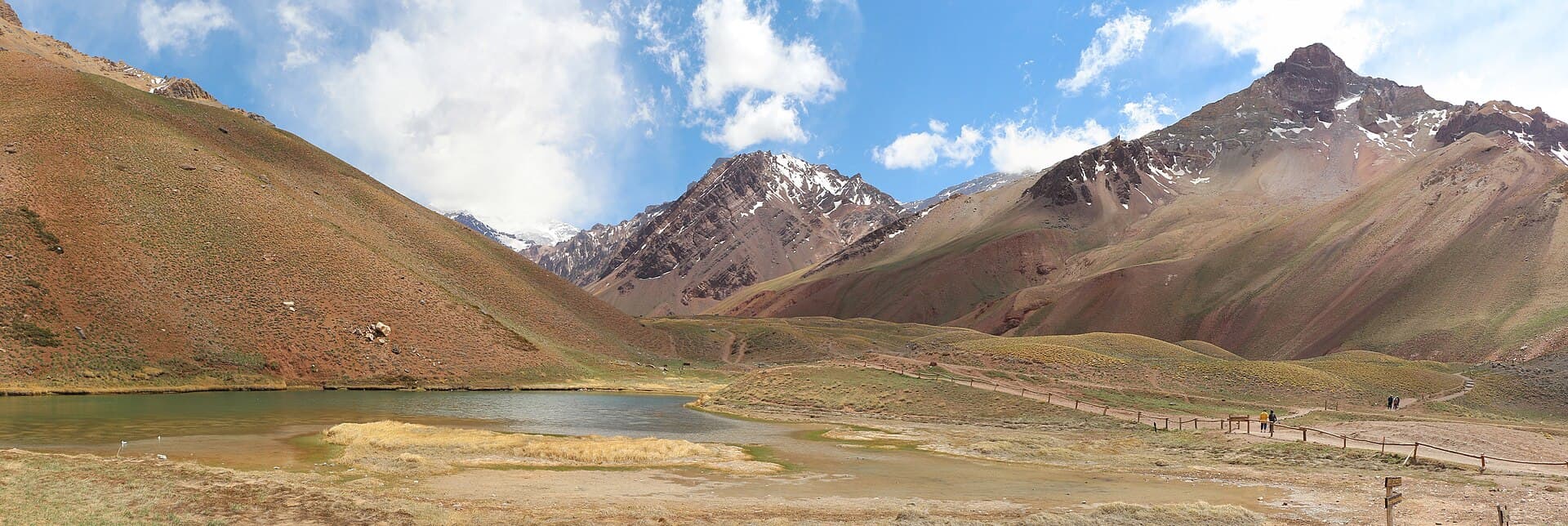
Aconcagua (6,961m) is the highest peak outside Asia and the tallest in both the Western and Southern Hemispheres. It sits in Mendoza Province, Argentina, roughly 15km from the Chilean border. The normal route requires no technical climbing — no ropes, no glacier travel, no vertical ice. You walk to the summit.
That description is accurate. It is also incomplete.
The altitude reality
The normal route's lack of technical difficulty can create a misleading sense of accessibility. Aconcagua is a serious high-altitude expedition. The primary risks are physiological — HAPE (High-Altitude Pulmonary Edema), HACE (High-Altitude Cerebral Edema), severe hypothermia, and frostbite — not technical.
Medical data from the mandatory base camp health checks shows a high incidence of HAPE. The likely explanation: the non-technical route attracts climbers who underestimate the acclimatization timeline required above 6,000m.
The base camp medical service at Plaza de Mulas (4,370m) is free, professional, and mandatory. Two medical checks are required before climbers can continue higher. This service is a genuine safety asset — better-staffed and more systematic than what exists on many world peaks.
Continue reading Normal Route Stage-by-Stage: Horcones to Summit →
The current permit system
Aconcagua is a provincial park, managed by Mendoza's Secretaría de Ambiente — not the national parks agency (APN). This matters: funding, regulations, and rescue resources are tied to Mendoza's provincial budget, not the federal one.
Permits must be processed in person in Mendoza city. The system is not fully online. This catches many climbers who arrive expecting to handle everything digitally.
2026-27 fees are not final yet
As of 25 August 2026, Mendoza had not published the final 2026-27 Aconcagua tariff resolution. Treat exact permit prices as pending until the province publishes the season's official tariff. The last verified official reference is the 2025-26 advance sale, where the foreign Normal Route ascent permit was USD 980.
Fees remain tiered by nationality, route, and season, so expect the official tariff to distinguish at least these buckets:
| Category | Last verified context | 2026-27 status |
|---|---|---|
| Foreign — Normal Route ascent | 2025-26 advance sale USD 980 | Pending official tariff |
| Foreign — Polish Glacier / 360° | Historically higher than Normal Route | Pending official tariff |
| Argentine national | Lower ARS-denominated tariff | Pending official tariff |
| Mendoza resident | Local resident tariff | Pending official tariff |
Fees change annually. Verify the official Aconcagua tariff before paying or publishing fixed 2026-27 prices.
Mandatory requirements beyond the permit
- Rescue insurance: Required. Must specifically cover high-altitude evacuation. Helicopter rescue is a private service and expensive. Verify your policy covers unguided climbing above 6,000m if you plan to go independent — some policies exclude this. (Source: MDZ Online, 2024)
- Medical certificate: A physician's written approval for high-altitude activity, acknowledging hypoxia risks. Carry the original.
- Mule service: Available for gear transport to base camp. Not mandatory but common. Contracted through licensed operators in Mendoza.
Do you need a guide?
No. There is no legal requirement to hire a guide on the normal route. Many climbers go independently.
That said, the decision has practical dimensions beyond legality:
- Insurance: Some policies only cover guided expeditions. Check your specific policy before deciding.
- Logistics: A guided expedition handles mule transport, meals at base camp, weather routing, and camp setup. Going independent means managing all of this yourself.
- Experience: If this is your first time above 5,000m, acclimatization support matters. The base camp medical team is there regardless, but an experienced guide adds a layer of judgment about when to push and when to descend.
Guided expedition costs range from $4,000–$8,000+ USD depending on services included. A "logistics only" option — mule transport + base camp meals, no summit guide — exists in the $2,000–$3,500 range and is a practical middle ground.
Planning this route? We're forming a founding group for Aconcagua — Ruta 360 Traverse — registering interest is free, no commitment. See the expedition →
Weather and summit windows
The climbing season runs November 15 through March 15. The weather is defined by the viento blanco — a fierce white-out wind that can pin climbers in their tents for days with sustained winds above 100 km/h and wind chill below -40°C.
Month-by-month overview
| Month | Conditions | Notes |
|---|---|---|
| November | Early season. Snow on route. Cold. | Quieter but more variable weather |
| December | Season opening. Warming. | Can still be unstable early in the month |
| January | Peak season. Warmest temps. Busiest. | Most guided groups target Jan 10–31 |
| February | Often more stable weather. Fewer people. | Days shorten. Good summit probability. |
| March | Late season. Cold returning. Short days. | Viable but narrowing weather windows |
The data and climber experience suggest the January 10 – February 10 window has the highest probability of summit-quality weather. January is the busiest month because guided operators concentrate their schedules there. February produces comparable weather windows with significantly fewer climbers.
Acclimatization strategy
The standard approach is 14–21 days on the mountain (normal route). Shorter itineraries reduce acclimatization time and lower success rates.
A strong alternative: spend 3–5 days in Cordon del Plata before entering Aconcagua. This sub-range of the Andes, accessible from Mendoza via Vallecitos, has multiple peaks above 5,000m and even a few above 6,000m. It's cheaper (no Aconcagua permit needed), less crowded, and used by Mendoza's andinista community as their primary training ground.
Acclimatizing at Cordon del Plata before starting the Aconcagua permit clock effectively extends your acclimatization without burning expedition days. This approach is standard among Mendoza's climbing community.
The normal route — overview
| Stage | From → To | Elevation | Distance | Days |
|---|---|---|---|---|
| 1 | Horcones (2,950m) → Confluencia (3,390m) | +440m | ~7km | 1 |
| 2 | Confluencia → Plaza de Mulas (4,370m) | +980m | ~21km | 1–2 |
| 3 | Rest & acclimatization at Plaza de Mulas | — | Day hikes | 2–3 |
| 4 | Plaza de Mulas → Camp Canada / Nido de Cóndores (5,560m) | +1,190m | ~6km | 1 |
| 5 | Nido → Camp Berlín / Cholera (5,950m) | +390m | ~3km | 1 |
| 6 | High camp → Summit (6,961m) | +1,011m | ~4km | Summit day |
| 7 | Descent to Plaza de Mulas | -2,591m | ~13km | 1 |
Total time: 14–21 days including rest days and weather contingency. The Canaleta — a steep scree/snow gully near the summit — is the crux of summit day. Not technical, but physically demanding at nearly 7,000m.
Other routes
- Polish Glacier (Glaciar de los Polacos): Approaches from the east via the Vacas Valley. More remote, fewer people, requires glacier travel experience. Higher permit cost.
- 360° Traverse: Ascends via the Vacas Valley / Polish Glacier approach, descends the normal route (or vice versa). Combines both sides of the mountain. Requires the higher permit tier.
Getting there
- International flights to Mendoza (MDZ) from Buenos Aires (1.5h, multiple daily flights) or Santiago, Chile (seasonal).
- Mendoza → Puente del Inca/Horcones: ~180km via Ruta 7 (Ruta Nacional 7). Buses operated by Andesmar and others, ~4 hours. Private transfer also available. Ruta 7 is paved but subject to winter closures and construction. Check pass status before traveling.
- Park entrance at Horcones, ~2,950m elevation.
Cost summary — solo foreign climber
| Item | Budget | Mid | High |
|---|---|---|---|
| International flight (NA/EU → MDZ) | $800 | $1,200 | $1,800 |
| Mendoza accommodation (3–4 nights) | $80 | $200 | $500 |
| Permit (normal route) | 2026-27 pending | 2026-27 pending | 2026-27 pending |
| Mule service | $300 | $500 | $700 |
| Guide / logistics | $0 (independent) | $2,500 (logistics) | $6,000+ (full guide) |
| Gear rental | $200 | $400 | $600 |
| Food + supplies | $200 | $400 | $600 |
| Insurance | $150 | $300 | $500 |
| Transport (MDZ ↔ Horcones) | $50 | $100 | $200 |
| Total before permit | $1,780 | $5,600 | $10,900 |
Add the current official permit price once Mendoza publishes the 2026-27 tariff. For orientation only, the 2025-26 foreign Normal Route advance sale was USD 980.
Currency note
As of early 2026, the "dólar blue" parallel exchange rate has converged closer to official rates. Credit cards now offer near-market rates in many cases, reducing the historical advantage of bringing cash USD. That said, always carry some USD cash — ATMs in smaller towns can run dry, and some services at base camp are cash-only.
Beyond the mountain
Mendoza is a world-class wine region. Day tours visiting 3 top bodegas (Catena Zapata, El Enemigo, Bodega Norton) with lunch run $180–250 USD. The wine country is south and east of the city — plan wine tours from Mendoza, not from Potrerillos.
Potrerillos, 70km west of Mendoza, is an adventure hub built around a reservoir created by a dam completed in the early 2000s. Rafting, kayaking, and trekking. Good base for Cordon del Plata access.
The deeper history
An Inca mummy discovered at 5,300m on Aconcagua's slopes — documented by archaeologist Juan Schobinger — suggests pre-Columbian activity near the summit centuries before Matthias Zurbriggen's 1897 expedition, traditionally credited as the first ascent. The mountain sits along the Qhapaq Ñan (Inca road system), a UNESCO World Heritage site since 2014.
The town of Puente del Inca, the traditional gateway to Aconcagua, was once a thermal bath destination connected by railway. A 1965 avalanche destroyed the historic hotel; its ruins and the natural rock bridge remain.
7 Sources
Planning-critical claims in this article are sourced inline. Key references:
- aconcagua.mendoza.gov.arAconcagua Provincial Park official site: aconcagua.mendoza.gov.ar
- mendoza.gov.arMendoza Government, 2025-26 advance permit sale: mendoza.gov.ar
- MDZ Online reporting on rescue resources (Jan 2024)
- El Sol reporting on patrol budget constraints (Dec 2023)
- whc.unesco.orgUNESCO Qhapaq Ñan listing: whc.unesco.org/en/list/1459
- Juan Schobinger's archaeological work on the Aconcagua mummy
- Edward Fitzgerald, The Highest Andes (1899) — primary account of the first ascent