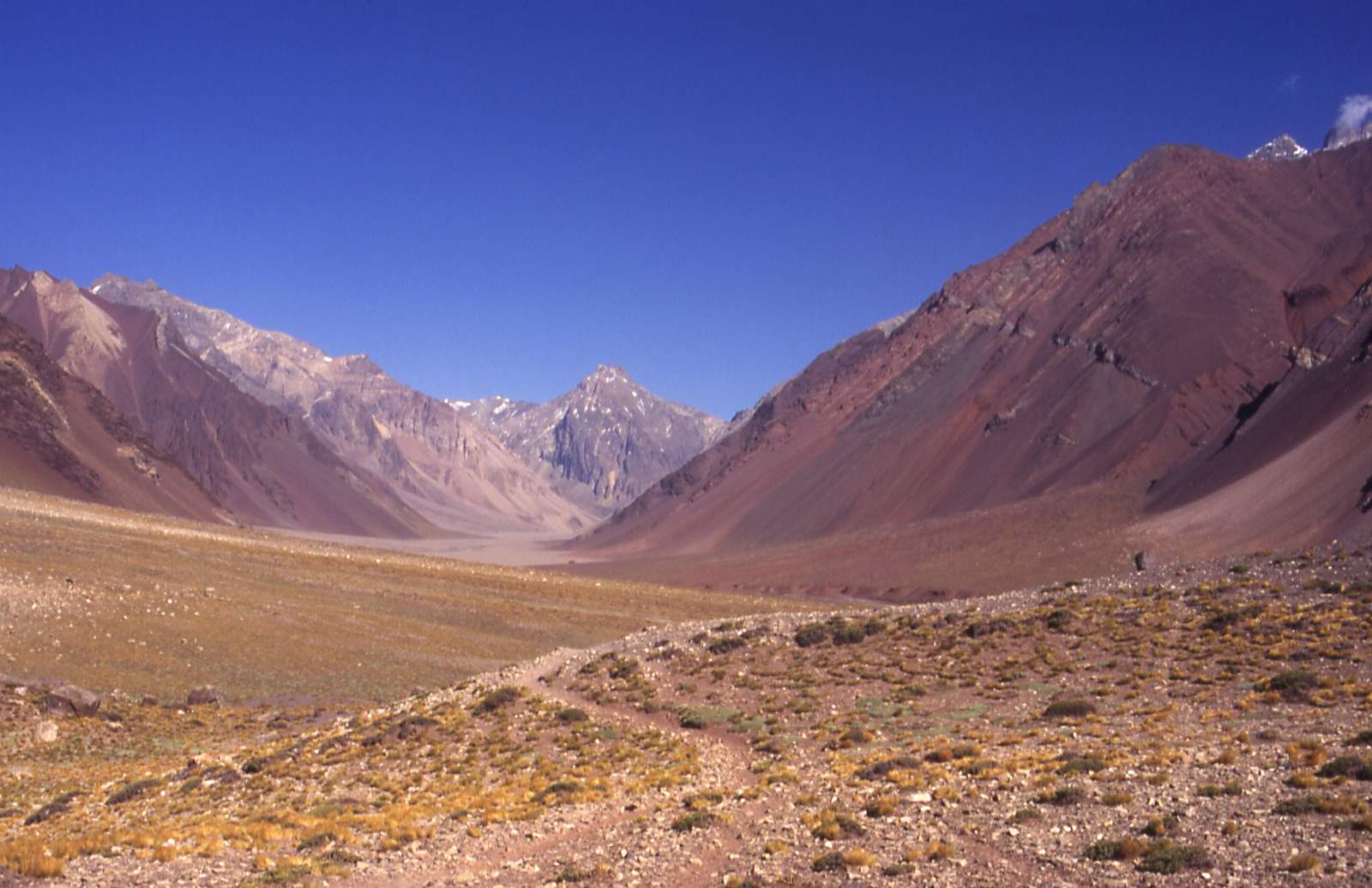
The normal route up Aconcagua follows the Horcones Valley on the mountain's northwest side. It is the most popular route — roughly 60–70% of all climbers use it — and requires no technical climbing. No ropes, no glacier travel, no ice axes on the standard path. You walk the entire way.
That does not make it easy. You are walking to 6,961m, where the atmospheric pressure is roughly 40% of sea level. The route's difficulty is altitude, weather, and the sheer duration of the effort. Most itineraries take 14–21 days, including rest days and weather contingency.
Here is what each stage looks like.
Stage summary table
| Stage | From | To | Distance | Elevation change | Typical time | Camp facilities |
|---|---|---|---|---|---|---|
| 1 | Horcones (2,950m) | Confluencia (3,390m) | ~8 km | +440m | 4–5 hrs | Ranger station, toilets, water, camping, dining tent |
| 2 | Confluencia | Plaza Francia (3,980m) | ~15 km RT | +/-590m | 6–8 hrs | Day trip — return to Confluencia |
| 3 | Confluencia | Plaza de Mulas (4,370m) | ~18–21 km | +980m | 7–9 hrs | Full base camp: medical, dining, gear storage, toilets |
| 4–5 | Rest / acclimatization at Plaza de Mulas | — | Day hikes | Variable | — | — |
| 6 | Plaza de Mulas | Camp Canada (5,050m) | ~2.5 km | +680m | 3–4 hrs | Tent platforms, no services |
| 7 | Camp Canada | Nido de Cóndores (5,560m) | ~2 km | +510m | 3–4 hrs | Tent platforms, ranger check, emergency shelter |
| 8 | Nido de Cóndores | Berlín/Cholera (5,950m) | ~1.5 km | +390m | 2–3 hrs | Emergency shelter (Berlín), tent platforms |
| 9 | High camp | Summit (6,961m) | ~4 km | +1,011m | 8–12 hrs RT | None |
| 10 | Summit/high camp | Plaza de Mulas | ~6 km | -1,580m | 3–4 hrs | — |
| 11 | Plaza de Mulas | Horcones | ~26 km | -1,420m | 7–8 hrs | — |
Total distance: approximately 70–80 km point-to-point (not counting acclimatization hikes). Plan for 2–3 weather contingency days beyond this schedule.
Continue reading Aconcagua: What the 2026 Data Actually Shows →
Stage 1: Horcones to Confluencia
Distance: ~8 km | Elevation: 2,950m → 3,390m (+440m) | Time: 4–5 hours
The trailhead at Horcones is where the park rangers check permits and insurance. The trail follows the Horcones River through a wide, dry valley — mostly flat with gentle uphill sections. The terrain is desert-like: loose gravel, sparse vegetation, no shade.
Confluencia is a developed camp with a ranger station, toilets, a dining tent operated by concessionaires, and flat camping areas. Water is available from streams but should be filtered or treated. Most climbers spend one night here. The medical team may perform an initial check.
What to know: This stage feels deceptively easy. The real purpose is to begin gentle acclimatization at 3,390m, not to cover ground quickly.
Acclimatization hike: Plaza Francia
Distance: ~15 km round trip from Confluencia | Elevation: +/-590m | Time: 6–8 hours
Most itineraries include a day hike from Confluencia to Plaza Francia (3,980m), the viewpoint for Aconcagua's massive south face. This is an acclimatization hike — you return to sleep at Confluencia. The trail follows the Horcones Inferior River into a side valley. The south face view is one of the most impressive mountain walls in the Andes: nearly 3,000m of vertical rock and ice.
Planning this route? We're forming a founding group for Aconcagua — Ruta 360 Traverse — registering interest is free, no commitment. See the expedition →
Stage 2: Confluencia to Plaza de Mulas
Distance: ~18–21 km | Elevation: 3,390m → 4,370m (+980m) | Time: 7–9 hours
This is the longest single day on the route. The trail continues up the Horcones Valley, crossing several stream beds. The terrain is mostly flat to moderate incline — wide, rocky valley floor — but the distance and altitude gain make it a serious day.
The final approach crosses a broad, barren plain called the Playa Ancha before reaching Plaza de Mulas. By late afternoon, headwinds can be strong in this section.
Plaza de Mulas is Aconcagua's main base camp and a small temporary city during high season. Facilities include:
- Mandatory medical check station (free, staffed by doctors) (Source: Aconcagua Provincial Park)
- Dining tents and meal service run by concessionaires (Inka Expediciones, Grajales, and others)
- Gear storage, toilet facilities
- Some operators offer Wi-Fi and showers for a fee
- Camping areas for independent climbers
You will need medical clearance to continue higher. Two medical checks are required during the expedition — one at Plaza de Mulas and a second before moving above Nido de Cóndores. (Source: MDZ Online, Jan 2024)
Rest and acclimatization at Plaza de Mulas
Days: 2–3 | Elevation: 4,370m
Most teams spend 2–3 days at base camp before pushing higher. Typical acclimatization activities include:
- Day hike toward Camp Canada (5,050m) and back
- Carry loads to Camp Canada (cache gear, return to sleep at base camp)
- Rest days between efforts
This period is critical. Rushing through it is a frequent cause of altitude illness higher up. The base camp medical team monitors climbers during this phase and can refuse clearance to continue if signs of poor acclimatization appear. (Source: Centro Cultural Argentino de Montaña)
Stage 3: Plaza de Mulas to Camp Canada
Distance: ~2.5 km | Elevation: 4,370m → 5,050m (+680m) | Time: 3–4 hours
The trail leaves base camp and climbs steeply on a well-worn path up loose scree and rock. Camp Canada sits on a series of flat platforms carved into the hillside. There are no services — you bring everything with you. Water comes from snowmelt when available, otherwise you melt snow.
Some teams skip Canada and move directly to Nido de Cóndores in one push from Plaza de Mulas. This saves a day but adds 1,190m of elevation gain in a single stage, which is aggressive above 4,000m.
Stage 4: Camp Canada to Nido de Cóndores
Distance: ~2 km | Elevation: 5,050m → 5,560m (+510m) | Time: 3–4 hours
A steep, exposed climb on scree and rock. The terrain becomes more barren. Wind exposure increases significantly above Camp Canada. Nido de Cóndores has tent platforms, an emergency shelter (a small metal hut), and a ranger presence during the season. The second mandatory medical check typically happens here or at this elevation.
At 5,560m, the effects of altitude are pronounced. Appetite drops, sleep quality declines, and even simple tasks require more effort. This is normal. What matters is whether you are stable at this altitude or deteriorating.
Stage 5: Nido de Cóndores to Berlín/Cholera
Distance: ~1.5 km | Elevation: 5,560m → 5,950m (+390m) | Time: 2–3 hours
Two high camp options exist at roughly the same elevation:
- Camp Berlín (5,950m): Has an emergency shelter (Refugio Berlín), a small stone/metal hut. Cramped but can provide critical wind protection.
- Camp Cholera (5,970m): Slightly higher, more exposed tent platforms. Named after a historical cholera incident among early expeditions. More commonly used by guided groups.
The terrain is exposed scree. Wind can be severe. Most teams arrive by early afternoon to rest before a pre-dawn summit attempt. Water must be melted from snow.
Stage 6: Summit day
Distance: ~4 km to summit | Elevation: 5,950m → 6,961m (+1,011m) | Time: 8–12 hours round trip
Summit day starts between midnight and 4:00 AM, depending on conditions and camp choice. The route climbs steadily on loose rock and scree.
The crux is the Canaleta — a steep gully of loose scree (and sometimes snow/ice depending on season) at roughly 6,700–6,900m. It is not technical, but at that altitude, climbing 200m through loose rock at a 35–40° angle is physically brutal. In peak season, queues can form here, adding time and cold exposure.
Above the Canaleta, the terrain eases to a broad ridge leading to the summit cross at 6,961m. On a clear day, the views extend across the Andes into Chile.
Turnaround times matter. Most guided groups set a turnaround of 1:00–2:00 PM. Weather deteriorates rapidly in the afternoon, and descending in darkness through the Canaleta adds serious risk.
Descent
Most climbers descend from the summit to high camp the same day, then continue to Plaza de Mulas the following morning (-1,580m). The descent from base camp to Horcones can be done in a single long day (~26 km, 7–8 hours). Mules can carry gear down from Plaza de Mulas if arranged in advance.
Water and fuel
Water availability varies by stage:
- Horcones to Confluencia: Stream water available (treat it)
- Confluencia to Plaza de Mulas: Stream crossings along the valley
- Plaza de Mulas: Water from streams and snowmelt; some operators sell purified water
- Above base camp: Melt snow. Carry a stove and fuel. No reliable liquid water sources above 5,000m during most of the season.
Fuel canisters (isobutane/propane) are available for purchase in Mendoza and sometimes at Plaza de Mulas. White gas is harder to find — buy it in Mendoza if your stove requires it.
Alternative routes — brief overview
The normal route is not the only option.
Polish Glacier (Glaciar de los Polacos): Approaches from the east via the Vacas Valley through Pampa de Leñas and Casa de Piedra to Plaza Argentina base camp (4,200m). The approach is longer (3 days vs 2) but more scenic and far less crowded. The glacier section requires crampon and ice axe skills and experience with 40–60° snow and ice. It sits in a higher permit tier than the Normal Route; as of 25 August 2026, the exact 2026-27 foreign tariff was still pending official publication. (Source: Aconcagua Provincial Park)
360° Traverse: Ascends via the Vacas Valley / Polish Glacier approach and descends the normal route (or the reverse). Combines both sides of the mountain in a single expedition. Same permit tier as the Polish Glacier route. Requires the higher fee. Adds 2–3 days compared to the normal route alone. The traverse joins the normal route at Camp Cholera/Berlín, so summit day and descent are identical.
Both alternatives are detailed in the complete guide.
Planning notes
- Itinerary length: 14 days is the absolute minimum for the normal route. 18–21 days is more realistic when you factor in acclimatization days, weather holds, and contingency. Shorter itineraries correlate with lower summit success and higher rates of altitude illness. (Source: Centro Cultural Argentino de Montaña)
- Mule service: Available from Horcones to Plaza de Mulas and back. Typical cost is ~$450 USD for 60 kg round trip. Weight limits are enforced. Book through licensed operators in Mendoza — Acomara is the main mule cooperative. (Source: Acomara)
- Contingency days: Build at least 2–3 into your schedule. The viento blanco can shut down all movement above base camp for days at a time, and there is no way to predict it more than 48–72 hours out.
- Pre-acclimatization: Consider spending 3–5 days in the Cordon del Plata range (peaks to 5,000m+, accessible from Vallecitos near Mendoza) before entering the park. This extends your effective acclimatization without using permit days.
12 Sources
- aconcagua.mendoza.gov.arAconcagua Provincial Park official site: aconcagua.mendoza.gov.ar
- aconcagua.mendoza.gov.arAconcagua Provincial Park tariff page: aconcagua.mendoza.gov.ar/tarifas
- culturademontania.org.arCentro Cultural Argentino de Montaña: culturademontania.org.ar
- MDZ Online, reporting on rescue resources and medical checks (Jan 2024)
- El Sol, reporting on patrol budget constraints (Dec 2023)
- acomara.com.arAcomara mule cooperative: acomara.com.ar
- clubandinistamendoza.com.arClub Andinista Mendoza: clubandinistamendoza.com.ar
- Edward Fitzgerald, The Highest Andes (1899) — primary account of the first ascent route
- Reglamento Parque Provincial Aconcagua (park regulations)
- AAGM (Asociación Argentina de Guías de Montaña) route documentation
- Multiple guided expedition operator itineraries (Grajales, Inka Expediciones) cross-referenced for distances and times
- Climber trip reports and GPS tracks for distance verification