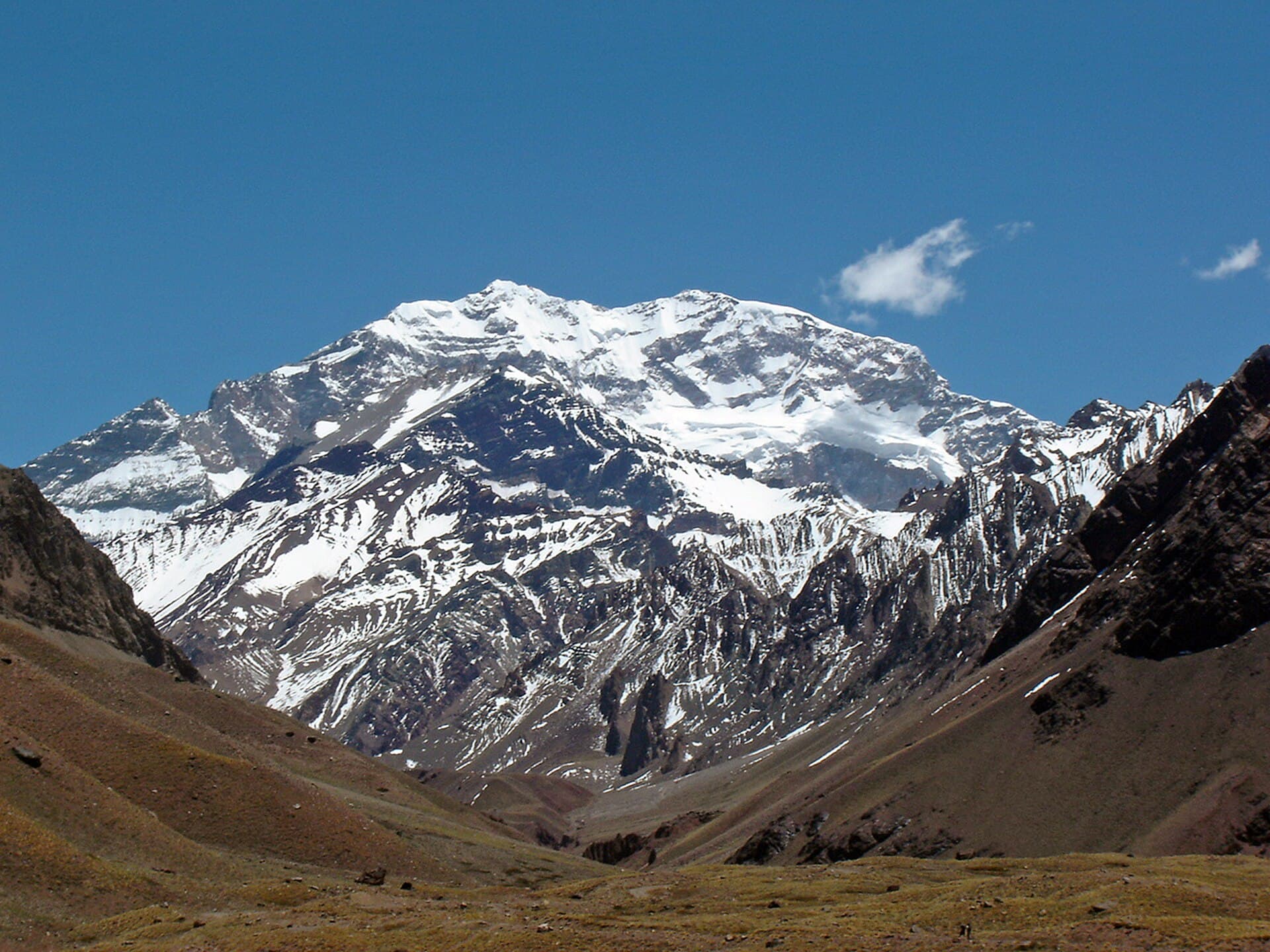
The logistics chain from your home airport to Aconcagua's trailhead at Horcones is straightforward but has a few details worth knowing in advance.
Flights to Mendoza
Mendoza Airport (MDZ) — officially Gobernador Francisco Gabrielli International Airport — receives domestic and some international flights.
From Buenos Aires
Multiple daily flights on Aerolíneas Argentinas, Flybondi, and JetSMART. Flight time approximately 1.5 hours. Fares range from $40–150 USD depending on airline and booking lead time. Flybondi and JetSMART are low-cost carriers — check baggage allowances carefully if carrying expedition gear.
From Santiago, Chile
Seasonal flights operate in summer. Alternatively, the overland route via Paso Los Libertadores (Cristo Redentor) connects Santiago to Mendoza by bus — roughly 6–7 hours, operated by companies including Andesmar and CATA Internacional. The pass can close in bad weather, even in summer.
International connections
No direct long-haul flights to Mendoza. Connect through Buenos Aires (Ezeiza, EZE) or Santiago (SCL). From Buenos Aires, you'll need to transfer from Ezeiza (international) to Aeroparque (domestic) — they're different airports, roughly 45 minutes apart by taxi. Allow at least 4 hours for the connection.
Continue reading The 461-meter trap: which insurance actually covers Aconcagua →
Mendoza city: 1–3 days
Most climbers spend 1–3 days in Mendoza before heading to the mountain. Use this time for:
- Permit processing — in-person at the provincial office (see permits article)
- Gear rental — several shops in the city center
- Final grocery shopping — Mendoza has full supermarkets; prices are significantly lower than anything available closer to the mountain
- Rest and acclimatization — Mendoza sits at 750m elevation, so there's no altitude benefit, but jet lag recovery matters
Gear rental shops
Several shops in central Mendoza rent expedition-grade equipment:
- El Refugio — established mountaineering shop with a good rental selection
- Aconcagua Mountain Gear — expedition-focused rental
- Various operators — most guided expedition companies also rent gear to independent climbers
What typically rents well:
- Double mountaineering boots ($15–25 USD/day)
- Expedition down parka ($10–20 USD/day)
- -20°C or colder sleeping bag ($10–15 USD/day)
- Crampons and ice axe ($5–10 USD/day)
- Expedition duffel bags
What to bring from home:
- Personal clothing layers (baselayers, midlayers) — fit matters
- Broken-in hiking boots for the approach (you'll switch to mountaineering boots higher up)
- Category 4 sunglasses and ski goggles
- Your own glove/mitten system
- Backpack (proper fit is essential)
- Trekking poles
Rental gear quality is generally good but availability tightens in peak season (late December through January). Reserve in advance if possible.
Mendoza to Puente del Inca
By bus
Andesmar operates the primary bus service from Mendoza to Puente del Inca via Ruta 7. Departures from the Mendoza bus terminal (Terminal del Sol).
- Duration: approximately 4 hours
- Fare: $15–30 USD
- Schedule: multiple departures daily during climbing season; reduced in off-season
- Stop: request the Puente del Inca or Horcones drop-off when boarding
Other bus companies serving the route include Buttini and seasonal services during peak climbing months.
By private transfer
Arranged through hotels, expedition operators, or independent drivers. Costs $100–200 USD per vehicle (not per person). Faster and more flexible than the bus, especially if you have heavy gear.
By rental car
Mendoza has standard car rental agencies. The drive is roughly 180km on Ruta 7, mostly paved. Parking is available at Puente del Inca and near the Horcones park entrance. Be aware that Ruta 7 is also the main truck route to the Chilean border — heavy vehicle traffic is common.
Planning this route? We're forming a founding group for Aconcagua — Ruta 360 Traverse — registering interest is free, no commitment. See the expedition →
Ruta 7: the road to the mountains
Ruta Nacional 7 runs west from Mendoza through the Precordillera and into the high Andes, eventually crossing into Chile at Paso Los Libertadores. The road is paved but subject to:
- Winter closures: The Cristo Redentor pass closes regularly in winter and occasionally in summer during severe storms
- Construction: Ongoing road improvement projects can cause delays
- Altitude gain: The road climbs from 750m in Mendoza to about 2,700m at the Horcones park entrance
Check pass status before traveling: argentina.gob.ar/gendarmeria/pasos-de-frontera/cristo-redentor
Key stops along the way
- Potrerillos (1,400m, ~70km from Mendoza): Last town with services, restaurants, cabañas. Fuel available.
- Uspallata (1,900m, ~110km): Small town with basic supplies, accommodation, fuel. Last reliable ATM.
- Penitentes (2,580m, ~165km): Former ski resort. Some accommodation available. Close to the park entrance.
- Puente del Inca (2,720m, ~175km): Historic thermal springs site, small settlement. The natural rock bridge is worth seeing. Basic supplies and accommodation.
Park entrance: Horcones
The Horcones ranger station (approximately 2,950m) is the entry point for the Normal Route. Located a few kilometers past Puente del Inca on Ruta 7.
At Horcones, rangers check your:
- Valid permit
- Insurance documentation
- Medical certificate
- Registration
From Horcones, the trek begins — the first stage takes you to Confluencia camp (3,390m), roughly 7km and 4–5 hours of walking.
Summary: the logistics timeline
| Day | Activity |
|---|---|
| Day 1 | Arrive Mendoza. Rest, grocery shopping |
| Day 2 | Permit processing, gear rental, final prep |
| Day 3 | Optional: Mendoza wine tour or rest day |
| Day 4 | Bus/transfer to Puente del Inca / Horcones. Begin trek |
Some climbers compress this into 2 days (arrive + permit, depart next morning). Adding a third day for rest and a wine tour is the more comfortable option — especially after a long international flight.
7 Sources
- mendoza.gov.arGobierno de Mendoza — How to buy the online ticket for Parque Provincial Aconcagua
- mendoza.gov.arGobierno de Mendoza — Advance sale of Parque Aconcagua permits (2024-25 season)
- argentina.gob.arArgentina.gob.ar — Sistema Cristo Redentor (Paso Los Libertadores) status and hours
- argentina.gob.arArgentina.gob.ar — Cristo Redentor border crossing (centro de frontera)
- catainternacional.comCATA Internacional — Mendoza–Santiago de Chile cross-Andes bus service
- andesmar.comAndesmar — official destinations (Argentina–Chile connections)
- aeropuertosargentina.comAeropuertos Argentina — Mendoza airport (MDZ, Gobernador Francisco Gabrielli)