
The grammar of the white blaze
The Appalachian Trail is signed, end to end, with a single symbol: a rectangle of white paint, six inches by two, brushed onto trees and posts in both directions of travel (ATC — Decoding the Appalachian Trail). That is the entire wayfinding system for a footpath of roughly 2,200 miles. No trailhead arches, no mile markers counting you down, no you-are-here boards at every junction. The white blaze means one thing — this is the A.T. — and every side trail blazes in another color, most often blue. The vocabulary is so stable that it became the trail's slang: to "blue-blaze" is to take the side route.
Virginia holds about 550 miles of this line — more than any of the trail's 14 states, roughly a quarter of the whole (Appalachian Trail Travel Guide — Virginia). Which means the state's day hikers and weekend backpackers are, whether they know it or not, guests inside the longest-running piece of the system. The white paint is the surface. The machinery underneath is shelters, logbooks, volunteer clubs and a human tide that moves on a schedule you can compute.
Two hundred fifty shelters, one rule
Strung along the trail are 250-plus three-sided shelters — open-fronted wooden structures spaced about 8 miles apart on average, as close as 5 and as far as 15, stretching to 30 near towns. Every one of them is free, and every one is first-come, first-served (ATC — Camping & shelters). No reservation exists anywhere in the system. The etiquette that makes this work is the ATC's camping doctrine: camp on durable surfaces, 200 feet from water, in sites that already exist, and look up before you pitch — the dead limbs hikers call widow-makers.
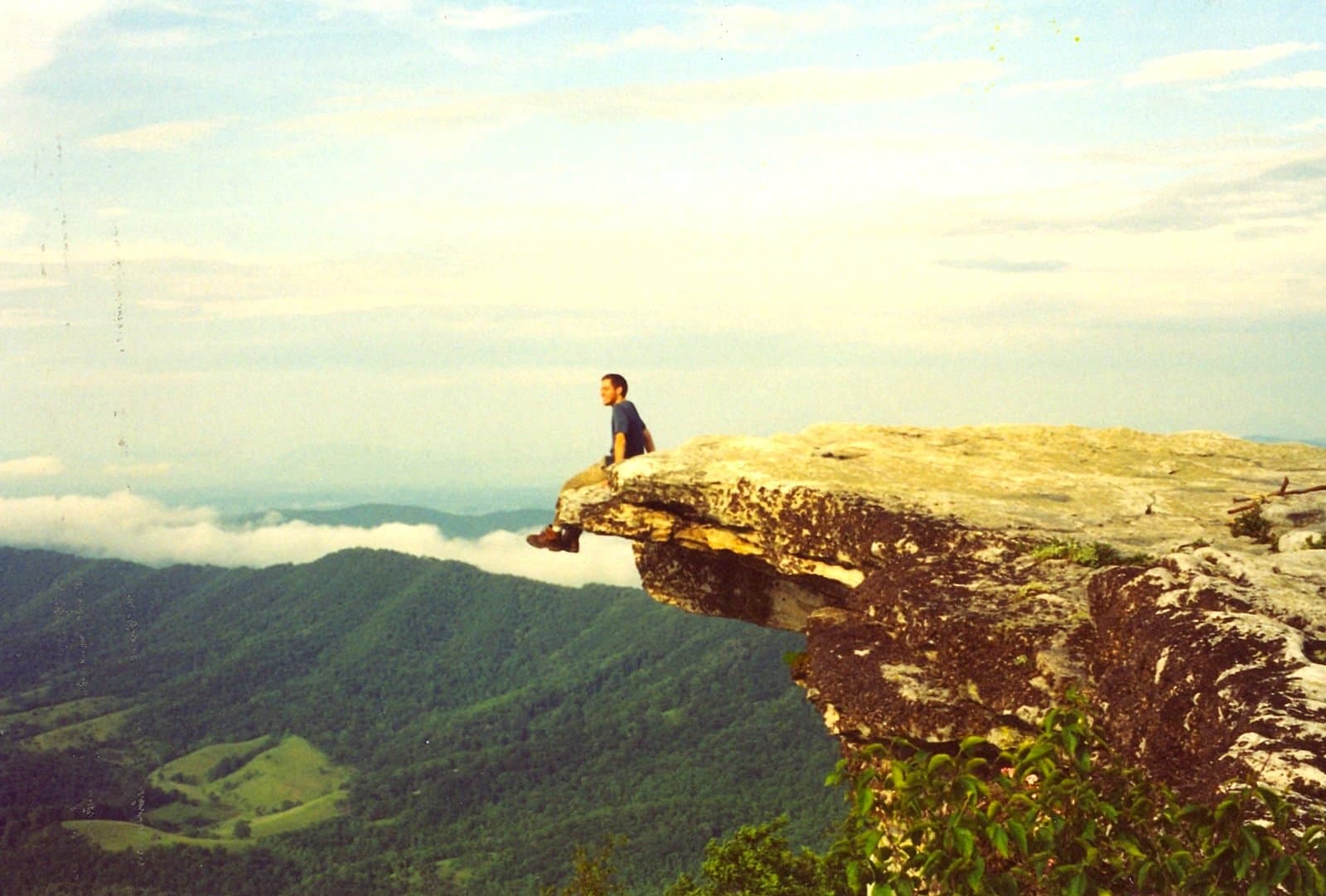
In the Triple Crown country west of Roanoke, that loose doctrine hardens into law. Along 28 miles of narrow National Park Service corridor between VA 624 and VA 652, camping is legal at exactly seven designated sites — John's Spring Shelter, Catawba Mountain Campsite, Catawba Mountain Shelter, Campbell Shelter, Pig Farm Campsite, Lamberts Meadow Shelter and Lamberts Meadow Campsite — a restriction "designed to concentrate environmental impacts," with McAfee Knob and Tinker Cliffs marked NO CAMPING and fires confined to the metal rings at designated sites (ATC/NPS camping-restriction map). The inversion is the point: nobody counts you in, but where you sleep is dictated absolutely.
Continue reading Dragon's Tooth and Tinker Cliffs as day hikes: the Triple Crown à la carte →
The wave is arithmetic, not folklore
Every spring a crowd sets out from Georgia intending to walk to Maine, and its movement through Virginia is predictable enough to plan around. The ATC's 2025 registers logged 2,187 northbound starts at Amicalola Falls, plus 195 southbounders, 336 flip-floppers and 697 section-hike registrants; 834 hikers finished a thru-hike that year, and northbound completion ran about 25 percent (ATC — 2,000-milers). The all-time roll of 2,000-milers stands at 21,553. Start dates cluster tightly from early March to early April (The Trek — 2025 thru-hiker survey), and many register their plans voluntarily at ATCamp so the crowd can see itself coming.
Now run the mileposts. Damascus, the trail town on the Tennessee line, sits near northbound mile 476–486. By mid-May the bubble is there — Trail Days, the annual reunion that swells a town of a few hundred to roughly 25,000 people (Visit Damascus), runs 15–17 May in 2026 (ATC — Trail Days 2026). Catawba Mountain Shelter, in the heart of the Triple Crown, sits at northbound mile 713.3. So the wave rolls over McAfee Knob country roughly late May through June, filling the seven legal campsites as it passes. A section hiker who wants the ridge quiet aims for weekdays outside that window, or September and October. One who wants the culture at full volume walks straight into it.
The Priest hears confession
South of the Triple Crown, the trail climbs out of the Tye River valley in one sustained pull: 3,169 feet of gain in 4.5 miles, through more than 30 switchbacks, to the 4,063-foot summit of The Priest — the biggest climb in the region and a recognized rite of passage for northbounders (Go Hike Virginia — The Priest). Near the top stands the Priest Shelter, built during the 1950s relocation of the trail (Appalachian Trail Histories).
Its logbook is the most famous register on the A.T., because of what the shelter's name invited: it is traditional for hikers to confess their sins "to the Priest" in the pages — the stolen Pop-Tarts, the undug catholes, the socks unwashed since Georgia — a folklore ritual documented back to 1980s logbooks (The Trek — Thru-hikers confess their sins; Dartmouth Folklore Archive). The register is the trail's institution in miniature: unmonitored, unenforced, maintained entirely by the people passing through, and somehow intact after four decades. Nobody grades the confessions. The point is that you stop, sit, and add yours.
June 2026: the month a bear rewrote the rules
The system's failure mode arrived at Catawba Mountain Shelter — that same mile 713.3 — when a mother bear and her cubs took hikers' food, unafraid of the people present, and got into trash that earlier hikers had left behind. The ATC's notice, updated 16 June 2026, records the consequence: the National Park Service now requires overnight hikers in the Triple Crown area to store food, trash and every scented item — via the provided bear boxes, cables or poles, an IGBC-approved bear canister, or a proper hang 12 feet up and 6 feet out — with Campbell Shelter and Pig Farm Campsite named as frequent-activity sites and the ATC strongly recommending canisters outright (ATC — McAfee Knob area bear activity).
Read the sequence honestly: trash left at a shelter taught a bear to associate people with food, and an etiquette that had been voluntary for a century became a federal requirement in a season. Every regulation on the A.T. is the fossil of a courtesy somebody stopped extending.
A hundred years of nobody in charge
There is no agency running this. The Appalachian Trail Conference was founded at a Washington meeting in March 1925 to realize Benton MacKaye's 1921 proposal for the trail; the Conservancy marked its centennial in March 2025 by launching a $50 million Centennial Campaign, the largest fundraising effort in its history (ATC — Centennial Campaign).
The local chapter of that story explains why the region's most famous view exists at all. On 13 November 1932, three clubs — the Roanoke College outings club, the Hollins College outings club, and The Nomads, a hiking club largely of Roanoke and Salem women — merged after a Carvins Cove hike and supper into the Roanoke Appalachian Trail Club: 17 founding members, roughly 70 miles of new route blazed within a year (RATC — founding history). In 1933 the new club talked Myron Avery into swinging the A.T. west off the Blue Ridge crest and through the Catawba Valley ridges — putting McAfee Knob on the trail because local hikers argued it there (ATC — How hikers helped route the A.T. to McAfee Knob). Today RATC volunteers maintain more than 120 miles of the A.T. and its side trails (RATC). The white blazes are repainted by people with day jobs.
The hole in the map south of here
One honest asterisk before you plan southward. Hurricane Helene, in the fall of 2024, destroyed the upper Virginia Creeper Trail and still closes the A.T. between Straight Branch and Grassy Ridge Road near Damascus — northbound miles 476.6 to 485.8 — with two ATC-sanctioned detours, both of which count for 2,000-miler credit (ATC — Creeper closure and detour). Reconstruction broke ground on 18 December 2025, part of a rebuilding effort Cardinal News reports at $240 million (Cardinal News), and the Forest Service's announced target for full reopening is 31 March 2027. The Triple Crown and the Lexington country are untouched. But an A.T. culture piece that sent you toward Damascus without the closure map would be malpractice.
What a section hiker owes
Here is the economic fact underneath all of it: this trail is free. "Most of the Appalachian Trail does not require permits or fees," in the ATC's own words — the only three permit points on 2,200 miles are Great Smoky Mountains ($44.50 thru-hiker permit), Shenandoah ($9 per person plus a $6 reservation) and Baxter State Park, none of which touch this region (ATC — Permits & fees). No quota, no lottery, no timed entry. The shelters cost nothing. The view from McAfee Knob costs nothing.
That freedom is not a natural condition. It is the accumulated output of the culture this article has been describing — clubs that blazed the route, volunteers who repaint it, hikers who police their own trash and honor a first-come bunk — and it persists only as long as compliance substitutes for enforcement. The Catawba bear showed exactly how fast the substitution can fail. So the section hiker's debt is specific: learn the blaze grammar before you need it, sleep only at the seven legal sites in the corridor, store your food as if the June 2026 rule had always applied to you, keep your fire inside the ring, and when you reach a shelter, sign the register. The thru-hikers built the culture by walking through it for a hundred years. You keep it solvent by behaving, for a weekend, like one of them.
21 Sources
- appalachiantrail.orgATC — Decoding the Appalachian Trail, Vol. 1 — white-blaze dimensions and conventions, blue-blazed side trails.
- appalachiantrail.orgATC — Camping & shelters — 250+ shelters, spacing, first-come rule, camping doctrine.
- appalachiantrailtravelguide.comAppalachian Trail Travel Guide — Virginia — ~550 Virginia miles, most of any state.
- ratc.orgATC/NPS Triple Crown camping-restriction map (RATC-hosted PDF) — 7 designated sites along 28 miles, no-camping zones, fire rings.
- appalachiantrail.orgATC — 2,000-milers — 2025 start and finish counts, completion rate, 21,553 all-time.
- thetrek.coThe Trek — 2025 A.T. thru-hiker survey, part 1 — March–April start-date cluster.
- atcamp.orgATCamp — voluntary start registration.
- visitdamascus.orgVisit Damascus — Trail Days — ~25,000-person event scale.
- appalachiantrail.orgATC — Trail Days 2026 — 15–17 May 2026 dates.
- gohikevirginia.comGo Hike Virginia — The Priest — climb statistics, rite-of-passage status.
- appalachiantrailhistory.orgAppalachian Trail Histories — The Priest Shelter — shelter origin in the 1950s relocation.
- thetrek.coThe Trek — Thru-hikers confess their sins — confession logbook tradition.
- journeys.dartmouth.eduDartmouth Folklore Archive — The Priest Shelter log — folklore documentation, 1980s logbooks.
- appalachiantrail.orgATC — McAfee Knob area: ongoing bear activity — Catawba incident, NPS food-storage requirement, 16 June 2026 update.
- appalachiantrail.orgATC — Centennial Campaign — 1925 founding, March 2025 centennial, $50M campaign.
- ratc.orgRATC — How three hiking clubs became the RATC — 1932 founding story.
- appalachiantrail.orgATC — How hikers helped route the A.T. to McAfee Knob — the 1933 Avery reroute.
- ratc.orgRATC — home — 120+ miles maintained today.
- appalachiantrail.orgATC — SW Virginia Creeper closure & A.T. detour — Helene closure miles, detours, 31 March 2027 target.
- cardinalnews.orgCardinal News — Creeper Trail groundbreaking — 18 December 2025 groundbreaking, $240M rebuilding.
- appalachiantrail.orgATC — Permits & fees — the free-trail baseline and the three permit points.