The short answer, and the reframe behind it
Is Egypt safe for a solo traveler in 2026? On the route most solo travelers actually take — Cairo and Giza, the Nile at Luxor and Aswan, and a guided White Desert overnight from Bahariya — the answer is yes, with conditions. But the honest version of that answer requires correcting where the fear comes from.
The two events that built the Western image of "dangerous Egypt" both happened on this exact route. In 1997, gunmen killed 62 people, most of them foreign tourists, at the Mortuary Temple of Hatshepsut at Deir el-Bahari on the Luxor West Bank — the deadliest attack in a five-year campaign against tourists, carried out by al-Gama'a al-Islamiyya (Wikipedia: Luxor massacre). In 2015, an Egyptian military aircraft bombed a tourist convoy near the Bahariya oasis in the Western Desert, killing 8 Mexican tourists and 4 Egyptian guides who had stopped for lunch in a zone under a counter-terrorism operation (Wikipedia: 2015 Wahat convoy incident). One was terrorism at the temple this itinerary visits. The other was friendly fire in the desert this itinerary crosses.
So the fear is not irrational. It is misallocated. The thing most likely to hurt a solo traveler on this route in 2026 is not a man with a gun. It is the sun, the road, and the steady pressure of scams and baksheesh. This article reallocates the fear honestly, with sources, and tells you the one factual correction that matters most before you go.
What three governments actually say right now
The most useful safety signal is not a blog's vibe — it is the direction the official advisories are moving, and they are moving toward "go."
In July 2025, the US State Department downgraded Egypt from Level 3 ("Reconsider Travel") to Level 2 ("Exercise Increased Caution") — the lower-risk tier that also covers countries like France and the UK (travel.state.gov/Egypt; TravelPulse, Jul 2025). The advisory remains Level 2 as of mid-2026. The UK FCDO holds a country-wide caution with specific regional carve-outs rather than a blanket warning (gov.uk FCDO Egypt regional risks). Canada's Global Affairs sits at "exercise a high degree of caution" (travel.gc.ca/Egypt).
| Government | Overall level | Posture on this route |
|---|---|---|
| US State Dept | Level 2 "Exercise Increased Caution" (down from L3 in Jul 2025) | Cairo / Nile valley unrestricted; Western Desert allowed with a licensed tour company |
| UK FCDO | Country-wide caution, regional carve-outs | White/Black Desert, Bahariya, Farafra listed as exceptions to the western no-go zone — permitted with permit + official guide |
| Canada (GAC) | "Exercise a high degree of caution" | Bahariya/White Desert reachable via the Oasis Road with permit + guide; flags landmines off-track |
The two events that made Egypt famous for danger are also reflected in where the warnings still apply, and where they do not.
Where the warnings still apply — and why this route never goes there:
- North and Middle Sinai remain "Do Not Travel" (US) / "advise against all travel" (UK) due to a long-running terrorist insurgency. That insurgency has been militarily degraded since around 2023, but the do-not-travel posture stands. Nothing on a Nile-and-Western-Desert itinerary goes to Sinai.
- The Libya border strip — within roughly 20 km (UK) to 50 km (Canada) — is a military and smuggling-interdiction zone. The Al Bawiti–Siwa road is physically closed with checkpoints. The White Desert sits well inside the safe side of that line.
- The deep southwest desert toward the Sudan and Libya corner carries unexploded landmines, armed groups, no comms, and no medical access. Canada specifically flags landmines in desert and coastal areas — the literal reason not to wander off-track.
Where this route lives — and what the governments say about it: Cairo, Giza, and Saqqara are under no restriction. The Luxor West Bank — Valley of the Kings, Hatshepsut, Karnak — is explicitly not under any warning by any of the three governments, and Luxor and Aswan are repeatedly described in 2026 solo-travel reporting as among the safest, most walkable places in the country (Egypt Tours Plus: solo safety 2026). Tourism numbers back the read: Egypt recorded ~15.7 million visitors in 2024 and ~19 million in 2025, a 21% year-on-year rise (Egyptian Streets, Jan 2025; SIS.gov.eg: 21% surge in 2025). A country in the middle of a record tourism rebound is not a country at war with its visitors.
Continue reading The walk you came to Egypt for is closed. Here's the one that isn't. →
The one factual correction that matters most
If you take nothing else from this piece, take this: the over-the-mountain crossing from the Valley of the Kings to the Hatshepsut temple is officially closed to tourists, and the closure is enforced.
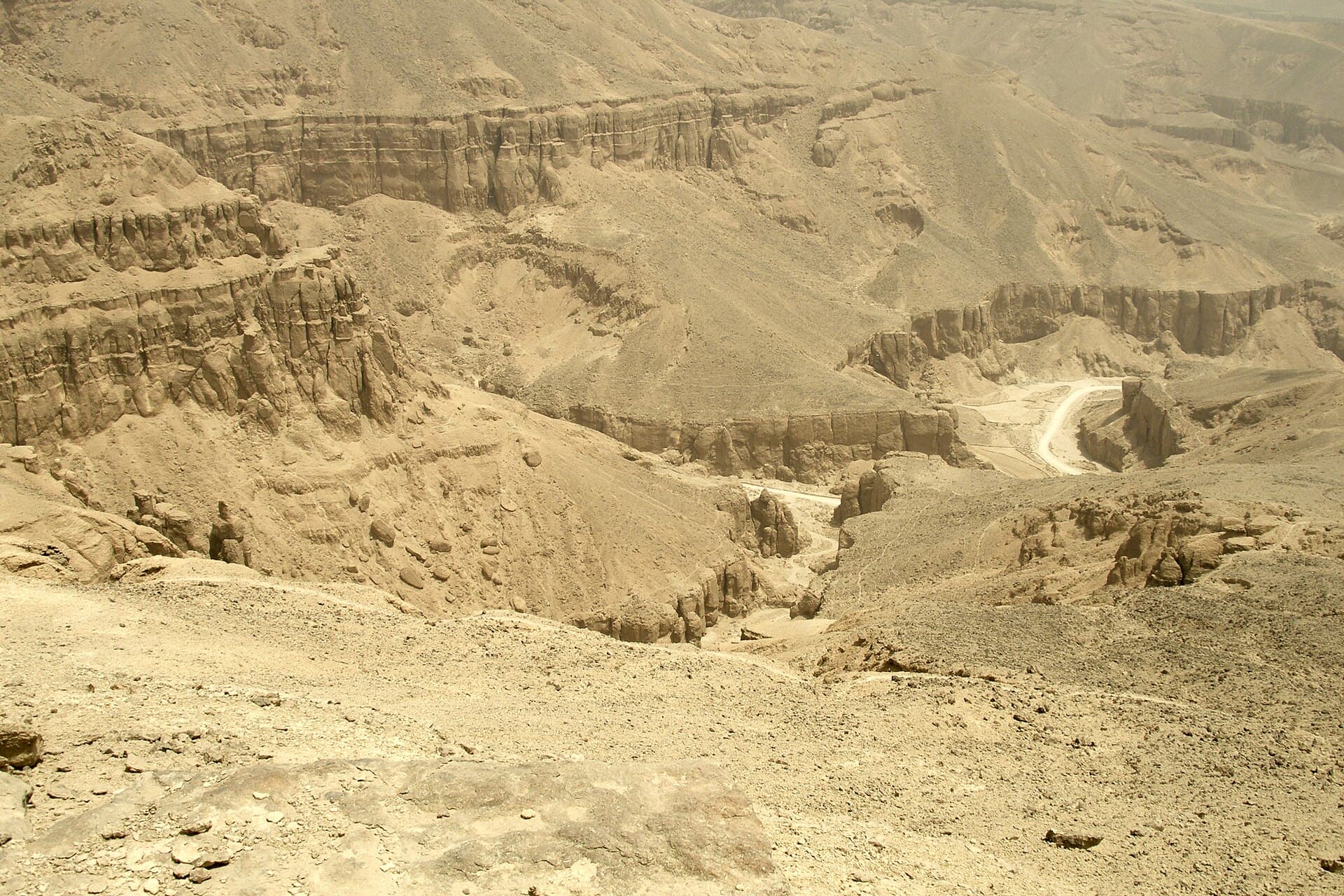
This is the single most common dangerous instruction in older Egypt guides. The romance is real — the Theban mountain path from the tomb-builders' village at Deir el-Medina, up past El Qurn (the pyramid-shaped sacred peak, ~450 m, sacred to the cobra-goddess Meretseger) and down into the Valley of the Kings, was the 3,500-year-old commute of the artisans who carved and painted the royal tombs for some four centuries. Walking it and looking down onto Hatshepsut's temple is one of the most evocative things imaginable on the West Bank.
It is also exactly the path the 1997 attackers used to reach the temple. The over-the-top Theban routes have been shut since 1997, and the closure is actively enforced — walkers report being stopped, shouted at, and having police called, with new guard stations, cameras, and motion sensors on the ridge (Tripadvisor forum: path from Seti I to Hatshepsut; Wikipedia: El Qurn). Even the separate El Qurn ascent from Deir el-Medina is now reported as restricted and patrolled. Do not tell anyone — and do not plan — to walk the Valley of the Kings to Hatshepsut crossing independently. If you want the Theban mountain, treat it as a guided, permission-dependent objective with a licensed West Bank guide who confirms access on the day, never a solo walk-through.
A note on certainty: the strongest evidence for this closure comes from consistent forum reports plus a non-authority wiki, not a current Ministry statement; the brief flags that no live official page was found spelling out independent-walking rules in 2026. The safe reading is unambiguous regardless — closed independently, guided only, verify on the ground.
Why the desert needs a permit — and why that protects you
There is a sharp, important distinction between two "you need a guide" claims in Egypt, and conflating them is how travelers either get scammed or get hurt.
At the monuments, "you need a guide" is sales mythology you can refuse. Giza, Saqqara, Karnak, the Valley of the Kings, and the Grand Egyptian Museum are all fully self-guidable with a ticket. The line that you must hire a guide for every site is an operator upsell, not a rule (Egypt Tours Plus).
In the Western Desert, the guide-plus-permit is the law — and it descends directly from the 2015 Wahat tragedy. After foreign tourists died in a military strike on an unescorted desert group, Egypt formalized the rule: no independent or self-drive desert travel, a licensed Egyptian operator handles the permit, and the Tourism Police can re-route the convoy for safety (Sem Elegant Voyage: Bahariya / White Desert guide; Memphis Tours: Bahariya Oasis). The permit is not a tourist tax. It is what makes you legible to the security apparatus watching the Libya border for smuggling vehicles — the apparatus that, in 2015, could not tell a tourist convoy from a target. Being on a permitted, licensed operator's manifest is precisely what keeps you from being the next mistake. It also keeps your travel insurance valid.
Under current UK FCDO wording, the White Desert, Black Desert, Bahariya, and Farafra are listed as exceptions to the western no-go zone — meaning travel there with a permit and official guide is travel in line with the advice, not against it (gov.uk FCDO Egypt regional risks). Go with a permitted licensed operator and you are inside the lines of all three governments.
Two honest uncertainties the research flagged: the exact permit-issuing authority and lead time are not Tier-1 confirmable (commonly Tourism & Antiquities Police with military coordination, arranged by the operator), and the White Desert National Park entrance fee exists but has no confirmable current figure. Verify both with your operator before you pay.
Planning this route? We're forming a founding group for White Desert — Bahariya Overnight — registering interest is free, no commitment. See the expedition →
The risks that will actually hurt you
Heat is the real hazard
This is the most important non-security finding in the entire research, and it is environmental. Luxor in June averages highs around 41 °C (106 °F), with a UV index near 12 (extreme), ~27% humidity, and zero rain (Weather Atlas: Luxor June). The White Desert is comparably brutal by day; its one mercy is that desert nights cool hard, which is exactly why the overnight camp is structured around the cool hours.
Heatstroke and dehydration are realistic outcomes here, not abstractions — and on any exposed walking, with blinding white rock and no shade, they are the primary threat. The mitigation is discipline, not toughness:
- Walk early. All walking and sightseeing done between roughly 05:30 and 10:00. The Valley of the Kings opens at 06:00 — the genuine dawn option; be at the gate at opening (valleyofthekingsegypt.org). The Giza plateau does not open until 08:00, so there is no true dawn entry — just be first in line (vacatis: Giza hours 2026). Midday is for indoors, a pool, or Nile shade.
- Carry at least 4 litres of water per person per day, more when walking, plus electrolytes (Sem Elegant Voyage).
- SPF 50+, sunglasses, a wide-brim hat, light long sleeves, and neck cover. Pack a fleece even in June — desert nights are cold.
- The desert tour itself is built around heat: drive in late afternoon, camp through the cool night, watch sunrise, and be out before peak heat.
If your dates are flexible at all, late October through April is dramatically safer and more pleasant for the walking-heavy parts. Mid-June is the hot edge of doable. And because 2025–2026 has seen record regional heat events, re-check the actual forecast about ten days out — a spike above the 41 °C average can push exposed walking from "manageable with discipline" to "skip it."
Roads, and rideshare over street taxis
Road accidents are a genuine statistical risk in Egypt and a recurring theme in the advisories. The practical move for a solo traveler in Cairo and Giza is to use Uber or Careem rather than hailing street taxis — the price is fixed and transparent (Cairo airport to Giza runs roughly EGP 150–250, about USD 3–5, on rideshare versus an open-ended negotiation in a street cab), and there is a record of your trip (Machu Picchu: Giza transport 2026).
Scams and baksheesh — constant, low-grade, manageable
None of this is dangerous. It is the friction tax of solo travel here, and knowing the playbook defuses most of it. The recurring scams:
- The camel ride that costs more to dismount than to mount — "getting up is cheap, getting down costs extra." Agree the full round-trip price, in writing if possible, before you sit.
- "The site is closed / come with me" — a fake official or tout steering you to a "better" entrance, a shop, or a private guide. Walk to the actual ticket gate and verify.
- Papyrus and perfume "factory" detours — a driver or guide routing you to a shop where they collect commission. Decline the detour.
- The "tomb guardian" baksheesh — an attendant beckons you past a rope, points at a detail, then demands a tip. You can decline before following.
- "The card machine is broken — pay cash" at a site that is card-only. Since 2025, almost all state monuments are card-only at the gate; a "broken machine" pushing you to cash is a flag (Nile Empire: entrance fees, updated Apr 2026).
On money: bring a working chip card — monuments are card-only since 2025, and the Grand Egyptian Museum is online-only. But also carry small bills for baksheesh, budgeting roughly USD 5–15 per day for bathroom attendants, bag carriers, and the guardians who will, in practice, expect a tip (economic research; Nile Empire). Baksheesh is not optional in practice; budget for it and it stops feeling like an ambush.
A note for women traveling solo
The advisories and 2026 solo-travel reporting are consistent: the dominant issue for women is harassment and persistent hassle, not violent crime (travel.state.gov/Egypt; Egypt Tours Plus). Crowded markets and tourist chokepoints are where catcalling, unwanted attention, and pickpocketing concentrate. The same tools that handle the scams — firm refusals, rideshare over street taxis, dawn timing that thins the crowds, and a licensed operator for the desert — also lower the harassment exposure. This is friction to manage, not a reason to stay home.
The honest verdict
The Nile-and-Western-Desert route deliberately avoids the genuinely dangerous parts of Egypt. North Sinai and the Libya-border strip are real do-not-travel zones, and this itinerary never touches them. What remains is a country in a record tourism rebound, with three governments moving their advisories toward "go," where the actual threats are heat, roads, and hassle — all of which respond to preparation.
Three rules cover the residual risk almost entirely:
- A licensed, permitted operator for the desert, every single time. No self-drive, no off-track walking — landmines and the border security apparatus are why.
- Dawn discipline for all walking. Treat June heat as the real threat. Walk 05:30–10:00, retreat indoors at midday, carry more water than feels necessary.
- The Valley of the Kings to Hatshepsut crossing is closed. Do not walk it independently. Guided and permission-dependent only.
Follow those, and "I don't want to get killed" is well covered. The residual risk is sunburn, an overpriced felucca quote, and aching legs.
The one sentence
Egypt is safe for a solo traveler in 2026 on the Nile-and-Western-Desert route — the two tragedies that made it feel dangerous both happened on this exact ground, but the thing that will actually hurt you now is the sun, not a gunman, so book a licensed operator for the desert, walk at dawn, and never try to walk over the mountain to Hatshepsut.
14 Sources
- en.wikipedia.orgWikipedia — Luxor massacre (1997 Deir el-Bahari / Hatshepsut attack; 62 killed, 58 foreign tourists + 4 Egyptians).
- en.wikipedia.orgWikipedia — 2015 Wahat convoy incident (friendly-fire airstrike near Bahariya; 8 Mexican tourists + 4 Egyptian guides killed).
- travel.state.govUS Department of State — Egypt Travel Advisory (Level 2, current 2026).
- travelpulse.comTravelPulse — US updates Egypt travel advisory, Level 3 to Level 2 (Jul 2025).
- gov.ukUK FCDO — Egypt regional risks (Western Desert exceptions; Sinai and Libya-border zones).
- travel.gc.caGlobal Affairs Canada — Egypt travel advice (high degree of caution; landmines off-track; 50 km border line).
- egyptianstreets.comEgyptian Streets — Egypt records 15.7M tourists in 2024 (Jan 2025).
- sis.gov.egState Information Service (SIS) — Egypt tourism sees 21% surge in 2025 (~19M visitors).
- egypttoursplus.comEgypt Tours Plus — Is Egypt safe to travel alone (2026).
- tripadvisor.comTripadvisor forum — Path from Seti I to Hatshepsut (crossing closed/enforced).
- en.wikipedia.orgWikipedia — El Qurn (sacred peak; patrolled/restricted ascent; summit ~450 m).
- semelegantvoyage.comSem Elegant Voyage — Bahariya Oasis / White Desert guide (mandatory licensed guide + permit; water and gear).
- memphistours.comMemphis Tours — Bahariya Oasis / White Desert (permit handled by licensed operator; Tourism Police re-routing).
- weather-atlas.comWeather Atlas — Luxor weather in June (highs ~41 °C, UV ~12, ~27% humidity, no rain).