The walk that isn't there
There is a walk in Egypt that almost every traveler with a romantic streak ends up imagining. You stand in the Valley of the Kings at dawn, and instead of filing back out the way the tour buses came, you climb the dry limestone ridge behind the tombs, cross the saddle below the pyramid-shaped peak of El Qurn, and drop down the far side into the natural amphitheatre of Hatshepsut's temple at Deir el-Bahari. It is the route the ancient tomb-builders walked to work for four hundred years. It is barely five kilometres. From a satellite photo it looks obvious, even easy.
It is closed. It has been closed, and actively enforced, since 1997. Walkers who try it are stopped, shouted at, and in several documented cases had the police called; the ridge is also threaded with open tomb shafts you can fall into. The most evocative short walk in Egypt is not a hidden gem the blogs forgot to mention. It is a deliberately sealed corridor, and the reason it is sealed is the same reason Egypt feels dangerous to so many people who have never been.
This article is the reframe. If you are coming to Egypt to sleep in the desert and walk — and you do not want to get hurt — read this before anything else.
Why the walk is closed, and what that has to do with your fear
On 17 November 1997, six gunmen attacked tourists at the Temple of Hatshepsut at Deir el-Bahari, killing 62 people, most of them foreign visitors. The attackers came and went over the Theban mountain paths — the same paths the romantic crossing uses. The massacre is the single most important event in modern Egyptian tourism history: it collapsed the industry for years, and it is the reason the over-the-mountain routes were shut and the antiquities police now patrol the ridge with guards, cameras, and motion sensors. (Wikipedia: Luxor massacre; Wikipedia: El Qurn).
Eighteen years later, on 13 September 2015, an Egyptian military aircraft mistook a tourist convoy for militants in the Western Desert near the Bahariya Oasis and opened fire, killing 8 Mexican tourists and 4 Egyptian guides who had stopped for a desert lunch. (Wikipedia: 2015 Egyptian Western Desert tourist attack). That incident is why, today, you cannot enter the Western Desert without a licensed guide and a permit — the rule exists to keep tourists legible to a security apparatus that is hunting smugglers along the Libyan border, not to gouge you.
Here is the thing worth sitting with. The two events that made Egypt feel dangerous to a Western traveler both happened on this exact route — the Theban mountain above the Valley of the Kings, and the desert track out of Bahariya. They are burned into the Western image of Egypt as "the place with the terrorism." And the closed crossing, the desert permit, the armoured-looking checkpoints — all of it is downstream of those two days.
But that fear is now badly misallocated. The genuine, statistically real ways a solo traveler gets hurt in Egypt in 2026 are, in order: heat, roads, and scams. Terrorism on the Nile-and-Western-Desert route this trip uses is not on the list. The United States moved Egypt from a Level 3 ("reconsider travel") to a Level 2 ("exercise increased caution") advisory in 2025 — the same direction the UK and others have moved — while explicitly keeping North Sinai, which this route never touches, as do-not-travel. (US State Department — Egypt Travel Advisory; UK FCDO — Egypt travel advice). Egypt drew roughly 15.7 million visitors in 2024 and around 19 million in 2025. (Reuters / Egyptian Ministry of Tourism figures).
The fear is real. It is just pointed at the wrong thing. The man with the gun is a 1997 memory. The sun is a 2026 certainty.
Continue reading Is Egypt safe for a solo traveler in 2026? The fear is real, but it's pointed at the wrong threat. →
What you actually came for — and can absolutely have
Strip the trip down to what you said you wanted: sleep in the desert, walk, see something insane, and not get killed. None of that requires the closed crossing. All of it is available, legally and safely, this week.
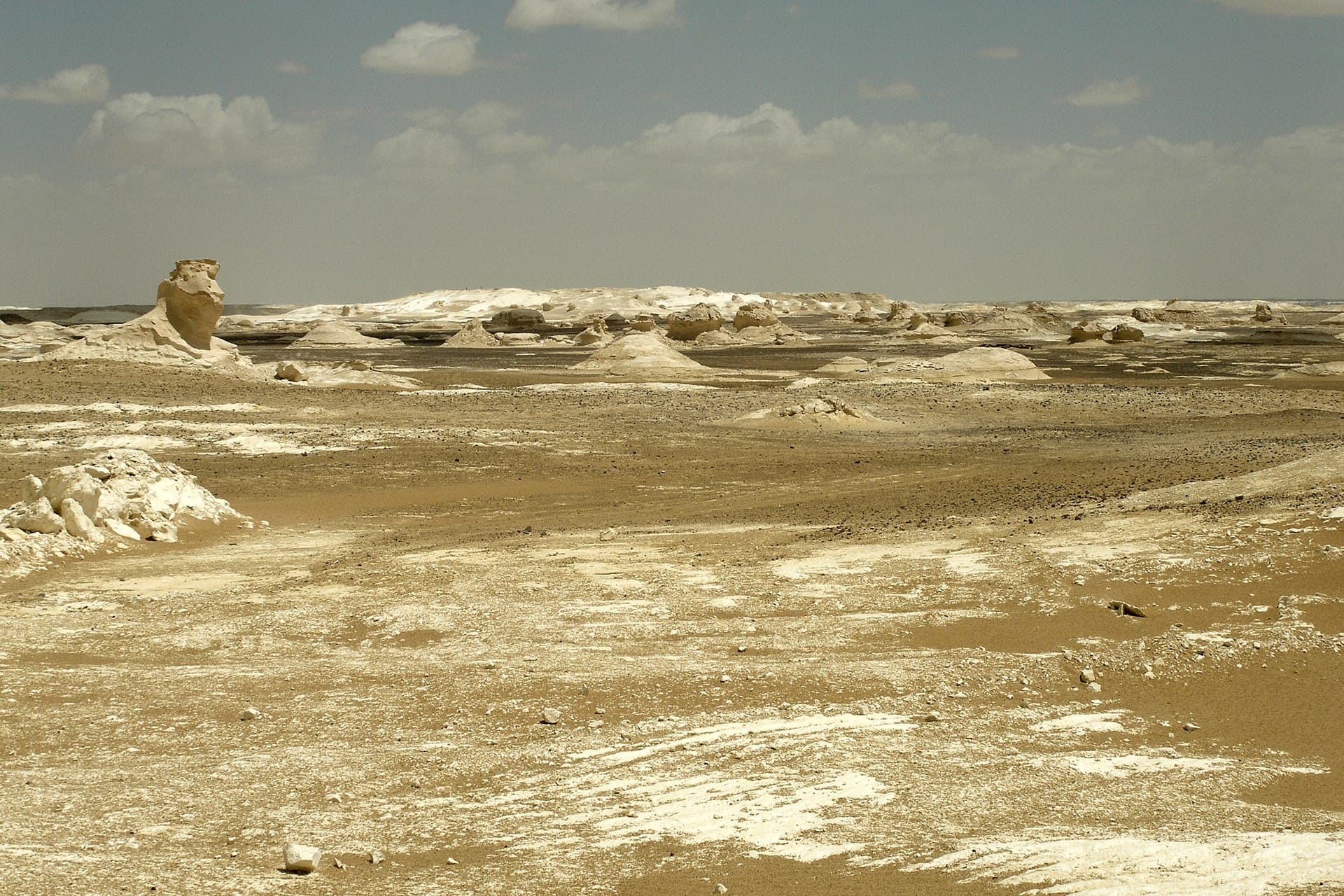
The White Desert overnight from Bahariya is exactly the experience. You drive four hours southwest of Cairo to the Bahariya Oasis, switch to a 4x4, cross the black volcanic desert and the quartz ridge of Crystal Mountain, and at sunset you arrive among the White Desert's chalk formations — wind-carved towers of Cretaceous seabed that look like nothing else on Earth. You sleep in a Bedouin camp among them, the desert night cooling hard after the 40°C day, and you wake before dawn for the light coming up over the formations. It is guided, permitted, and supervised — which, after reading the section above, you now understand is a feature, not a bureaucratic insult. This is the walk-and-sleep-in-the-desert adventure, and it is the spine of the trip. The full how-it-works, what-it-costs, and how-to-vet-an-operator is in the White Desert overnight guide.
And if the mountain still calls: the one walkable Theban route that historically existed — the ascent of El Qurn (the ~450 m peak the tomb-builders held sacred to the cobra-goddess Meretseger) from the Deir el-Medina side — can sometimes be done with a licensed West Bank guide who confirms access on the day. Emphasis on sometimes and licensed and confirms on the day: even El Qurn is now reported restricted and patrolled, and no honest guide will promise it. Treat it as a maybe, arranged in person, never as a plan. The history of that route, and the tombs it overlooks, is in the Valley of the Kings guide.
The three things this reframe changes about your trip
Once you accept that the risk is heat-roads-scams and not terrorism, the whole plan re-optimizes around three facts.
1. The sun runs your clock, not your itinerary
Luxor in June sits around 41°C with a UV index near 12 and effectively zero shade on the West Bank. This is not a backdrop; it is the single most dangerous thing on the trip. The discipline that keeps you safe is simple and non-negotiable: all walking happens between roughly 05:30 and 10:00. The Valley of the Kings opens at 06:00 — that is your genuine dawn window, and the reason to be standing at the gate when it opens. (The pyramids at Giza, by contrast, do not open until 08:00 — there is no sunrise-pyramids walk, whatever the blogs imply.) After mid-morning you are indoors, in a tomb, or near water. Carry a minimum of four litres of water per person per day, more on any walking day, plus electrolytes. The desert overnight is the smart heat play precisely because the real activity happens at dusk, through the night, and at first light. The month-by-month heat detail and the full kit list live in the safety guide.
2. The permit is protection, not a markup
The instinct, reading "mandatory guide and permit for the desert," is to assume a shakedown. It is the opposite. After 2015, independent desert travel became the thing that gets foreigners killed by their own protectors. A licensed operator who handles the permit in their own name is the mechanism that keeps you from being mistaken for a smuggling vehicle near the Libyan border. So the rule of thumb has two halves, and they are not the same: at the monuments, refuse the guide upsell — Giza, Saqqara, Karnak, the Valley of the Kings are all self-guidable with a ticket, and "you need a guide for everything" is sales mythology. In the Western Desert, take the guide and the permit — it is the law, and it is the law for a reason that has nothing to do with money.
3. The 2024 currency float broke every old price
Egypt floated the pound in March 2024. It fell to roughly 50 EGP to the dollar, with inflation around 13%, and it has kept weakening through 2026. (Reuters — Egypt currency float, March 2024). Every English-language guide written before mid-2024 quotes a currency that no longer exists at that rate, and the practical fallout is specific and counterintuitive:
- The romantic "budget" sleeper train to Luxor is the expensive option (~USD 80–130 for a foreigner), not the cheap one. The GoBus coach (~USD 10–12) and the EgyptAir flight (~USD 35–125) are both cheaper, and the flight is faster. The full transport breakdown is in the Cairo–Luxor transport guide.
- The monuments are card-only at the gate since 2025, and the Grand Egyptian Museum — which finally opened in full on 4 November 2025 — is online-only. Bring a working chip card; the "card machine is broken, pay me cash" line is now a scam vector.
- Budget baksheesh as a real line (~USD 5–15/day) and a daily ground floor of ~USD 55–90, and the old "$20-a-day Egypt" is simply dead. The honest numbers, with a worked six-day example, are in the cost guide.
Planning this route? We're forming a founding group for White Desert — Bahariya Overnight — registering interest is free, no commitment. See the expedition →
What this route deliberately avoids
It is worth being explicit about geography, because "Egypt is dangerous" usually collapses two very different places into one word.
| Place | Status | On this route? |
|---|---|---|
| North Sinai | Do-not-travel (active insurgency, degraded since ~2023) | No — never |
| Egypt–Libya border / deep Western Desert | Restricted military zone (smuggling interdiction) | Only the permitted, guided White Desert fringe |
| The Theban mountain crossing (VoK ↔ Hatshepsut) | Closed and enforced since 1997 | No — walked only as history |
| Cairo, Giza, Luxor, the Nile, Bahariya/White Desert | Open, policed, ~19M visitors in 2025 | Yes — the entire trip |
The route you are actually doing — Cairo and Giza, the Nile to Luxor, the Theban West Bank, and a permitted night in the White Desert — is the part of Egypt that nineteen million people visited last year. The parts that earn the country its dangerous reputation are places this itinerary is specifically built not to go.
The honest uncertainty
Two things the research could not nail down from a top-tier official source, and you should treat them as live questions rather than settled facts:
- The exact permit-issuing authority and lead time for the Western Desert are described by operators as "handled" but are not published on any government page that could be confirmed. Ask your operator, in writing, whether they can secure the permit for your specific date and what they need from you.
- The current access status of even the guided El Qurn ascent is reported as restricted/patrolled across consistent but non-authoritative sources (a Wikipedia entry and Luxor traveler forums), with no current Ministry or Tourism-Police statement found either way. Verify on the ground with a licensed West Bank guide; do not commit to it in advance.
Everything else in this article is sourced below. Where the underlying sources disagreed on a number, the ranges are published as ranges, not flattened into false precision.
The one sentence
The most romantic walk in Egypt is closed for a reason that explains your fear — and once you understand that the danger that sealed it is a 1997 memory while the heat is a 2026 certainty, the trip rearranges itself into exactly what you wanted: sleep in the desert, walk at dawn, see something insane, and come home.
16 Sources
- en.wikipedia.orgWikipedia — Luxor massacre (17 November 1997, Deir el-Bahari, 62 killed)
- en.wikipedia.orgWikipedia — El Qurn (the Theban peak, summit and access notes)
- en.wikipedia.orgWikipedia — 2015 Egyptian Western Desert tourist attack (Wahat, 8 Mexican tourists + 4 guides)
- travel.state.govUS State Department — Egypt Travel Advisory (Level 2, North Sinai do-not-travel)
- gov.ukUK FCDO — Egypt travel advice
- reuters.comReuters — Egypt tourism and currency coverage
- en.wikipedia.orgWikipedia — Deir el-Bahari / Temple of Hatshepsut
- en.wikipedia.orgWikipedia — Deir el-Medina (the tomb-builders' village)
- tripadvisor.comTripadvisor — "Path from Seti I tomb to Hatshepsut" (closure/enforcement, traveler reports)
- tripadvisor.comTripadvisor — "Hiking around Valley of the Kings / Deir el-Bahari"
- reuters.comReuters — Egyptian pound float, March 2024
- nileempire.comNile Empire — Egypt attraction entrance fees (card-only, updated 1 Apr 2026)
- semelegantvoyage.comSem Elegant Voyage — Bahariya Oasis & White Desert guide (permit, gear, ≥4L water)
- seat61.comseat61 — Egypt trains (sleeper operator, foreigner pricing)
- visit-gem.comGrand Egyptian Museum — official (opened 4 November 2025, online tickets)
- Companion research compiled for this region: the safety brief and the technical, economic, and historical lenses in
docs/research/egypt/(every figure carries its own inline source).