Himalayan–Karakoram orogeny (India–Asia collision, with prior Kohistan arc accretion)arc magmatism from ~120 Ma; collision onset ~59–50 Ma; Baltoro granites 26–13 Ma; ongoingIndian Plate vs Eurasian Plate, with the Kohistan island arc accreted between them🌋 none — No Holocene volcanoes in the Karakoram or anywhere in northern Pakistan per the Smithsonian Institution's Global Volcanism Program. Karakoram magmatism is collisional crustal melting that ended around 13 Ma (Baltoro granite); it never reaches the surface today.
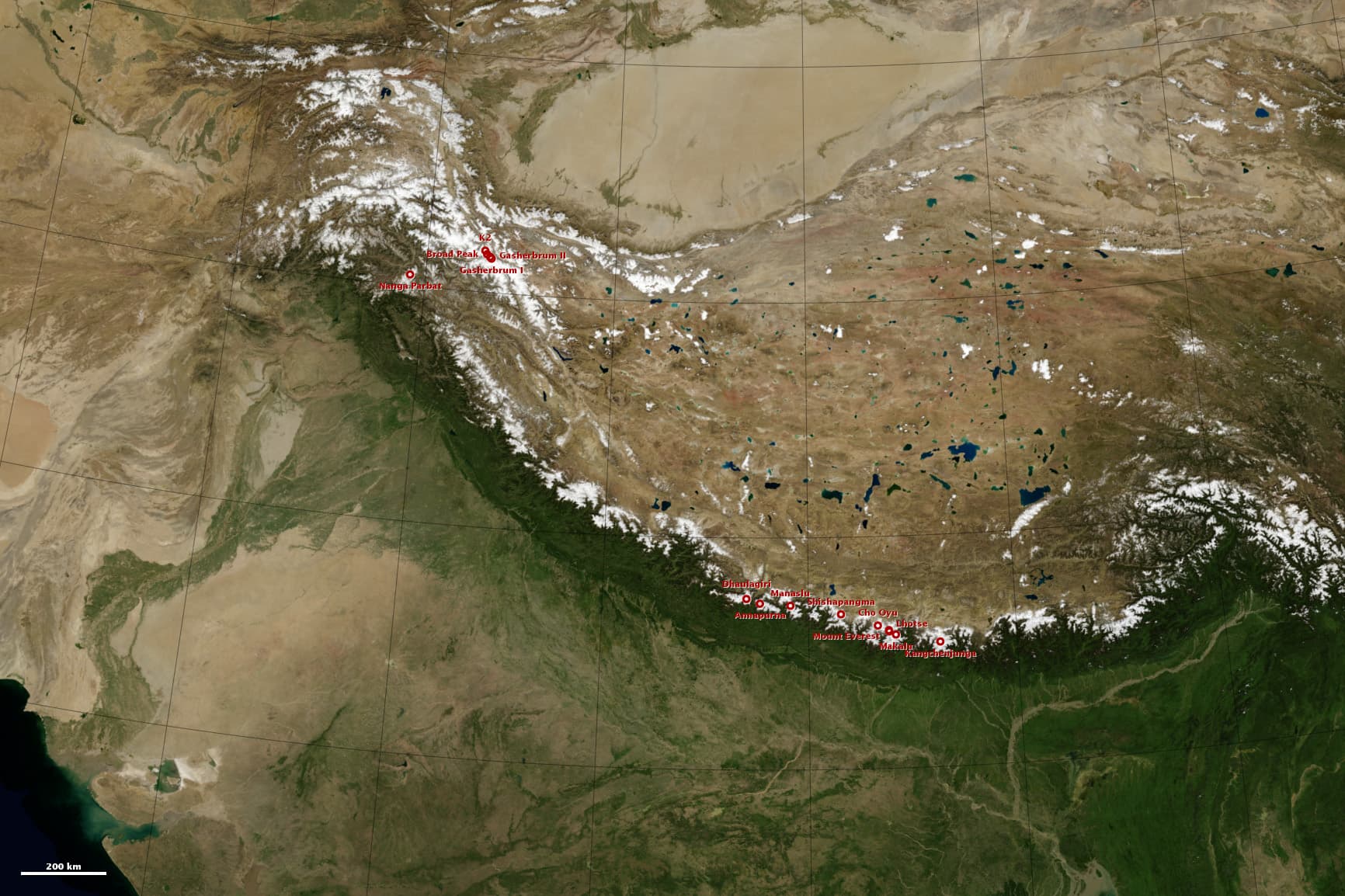
The India-Asia collision: white 8,000-meter peaks along the Himalaya and Karakoram, with the high Tibetan Plateau behind.
NASA Earth Observatory image by Robert Simmon, using Blue Marble and GTOPO30 data. · NASA media use guidelines · source
K2 is Everest's geological opposite. Where Everest wears untouched seafloor on its summit, K2's pyramid is built of gneiss — banded metamorphic rock forged deep in the crust. U–Pb dating of zircons from an orthogneiss on K2's south face gives a crystallization age of 115–120 million years: this rock began as magma intruding the southern margin of Asia in the Cretaceous, tens of millions of years before India even arrived, while an ocean called the Neo-Tethys was still being swallowed beneath the Karakoram. Metamorphism cooked it in the mid-crust, and the collision later heaved it more than eight kilometres into the sky.
The Karakoram was Asia's active edge long before the collision. Subduction of Neo-Tethys ocean floor built a chain of arc granites — the Karakoram batholith — through the Cretaceous, and an entire intra-oceanic island arc, Kohistan, was slammed onto Asia's flank. When India finally closed the ocean, the crust here was doubled in thickness. Metamorphism in the Baltoro region peaked at kyanite and sillimanite grade around 28–22 million years ago, and the thickened crust began to melt: the Baltoro granite batholith, a 100-km-long spine of pale crustal-melt granite, was assembled between about 26 and 13 million years ago.
That young granite is what makes the Baltoro trek one of the great rock landscapes on Earth. The Trango Towers, Cathedral and Paiju peaks — the vertical spires that wall the lower glacier — are Baltoro leucogranite dated at roughly 21–15 Ma, cracked into some of the tallest sheer walls anywhere. Upstream at Concordia the geology changes character: K2 and Broad Peak expose the old gneisses in a structural culmination, while the Gasherbrum Range carries folded Carboniferous to Lower Cretaceous sediments — and Marble Peak, true to its name, gleams with metamorphosed Tethyan limestone. Within a single day's walk you cross from a young granite factory into exhumed deep crust and cooked seafloor sediments.
And the machine is still running at full speed. Nanga Parbat (8,126 m), the western anchor of the Himalaya just south of the Karakoram, is being exhumed at 9–13 mm per year — a pulse that began about one million years ago and is the fastest known intracontinental exhumation on the modern Earth, published in Science Advances in 2022. Rocks there were still melting in the Pleistocene: Nanga Parbat hosts some of the youngest granites on the planet. There are no volcanoes in any of this — the Smithsonian Global Volcanism Program lists no Holocene volcanoes in northern Pakistan. The heat here is the friction and thickening of a continental collision, not magma from a subducting slab.
What you can see on the trail
Trango Towers and Cathedral spires — vertical walls of young Baltoro granite
📍 The Baltoro glacier stages of the K2 Base Camp trek, between Paiju and Urdukas
These impossibly sheer spires are leucogranite that crystallized only ~21–15 million years ago from melting of the collision-thickened crust. Young, massive and almost unlayered, the granite fractures along huge vertical joints — which is why it forms towers instead of slopes.
K2's gneiss — banded deep crust forming the summit pyramid
📍 Concordia and the walk up the Godwin-Austen glacier to K2 Base Camp
The great pyramid of K2 is orthogneiss dated at 115–120 Ma — rock that was once magma in the roots of Asia's continental margin, metamorphosed and then raised to 8,611 m. Look for the pale sheets cutting the dark faces: younger granite dikes injected into the old gneiss.
Marble Peak and the Gasherbrum sediments — cooked Tethyan seafloor beside deep crust
📍 Concordia, looking across the glacier junction toward Marble Peak and up the Upper Baltoro toward the Gasherbrums
The pale bands on Marble Peak and the layered faces of the Gasherbrum Range are Carboniferous to Lower Cretaceous marine sediments, folded and metamorphosed during the collision. At Concordia you stand between rocks born on an ocean floor and rocks born 20 km down in the crust.
Nanga Parbat's Raikot Face — the fastest-rising rock on any continent
📍 Fairy Meadows and the trail to Nanga Parbat Base Camp (Raikot side)
The wall above you gains on erosion: this massif is being exhumed at 9–13 mm per year, the fastest known intracontinental rate on modern Earth, and its summit stands roughly 7,000 m above the Indus gorge below. Some of its granites crystallized in the Pleistocene — among the youngest on the planet.
Fun fact
K2's summit gneiss crystallized 115–120 million years ago in the deep crust of Asia's margin — long before India arrived. And nearby Nanga Parbat is shedding its cover at 9–13 mm per year, the fastest known intracontinental exhumation on modern Earth, with granites young enough to have crystallized while humans' ancestors walked Africa.