
The trade wind pattern
Hawaiʻi's weather is governed by the northeast trade winds. They blow approximately 70% of the time, pushed by the North Pacific subtropical high-pressure system. These trades keep coastal temperatures between 24–30°C (75–86°F) year-round and create the fundamental division that shapes every hike on every island: the windward (northeast) side is wet, and the leeward (southwest) side is dry.
When the trades are blowing, conditions are predictable. Clouds build against the windward mountains in the morning, rain falls on the wet side, and the leeward side stays clear. Humidity is managed. Trail conditions are stable.
When the trades break down — which happens 10–15 times per year, mostly between October and March — weather becomes unpredictable. Kona storms (low-pressure systems from the southwest) bring rain to the normally dry leeward coasts. Flash floods become likely on both sides of every island. The air turns muggy and still.
The trade wind calendar is the single most important weather variable for planning a hiking trip to Hawaiʻi. Every other seasonal consideration flows from it.
Source: NWS Honolulu Climate Summary.
Wet side vs. dry side
Every major Hawaiian island has a dramatic rain shadow. The difference is not subtle — it can be an order of magnitude.
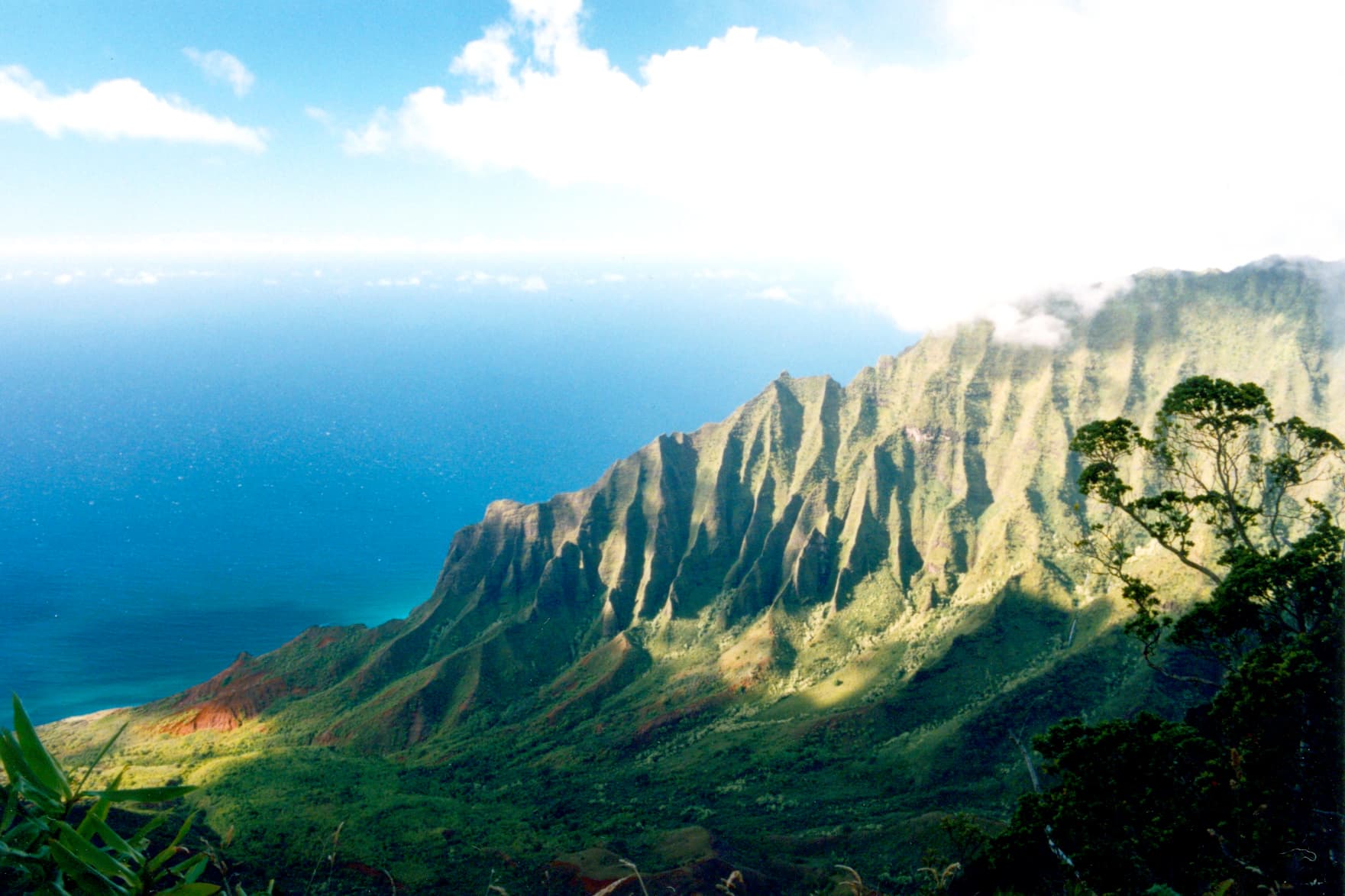
Kauaʻi: Mount Waiʻaleʻale, near the island's center, receives approximately 1,100 cm (433 inches) of rain per year — making it one of the wettest spots on Earth. The west coast of the same island, around Waimea and Poʻipū, gets less than 50 cm (20 inches). The Kalalau Trail runs along the Na Pali Coast on the wet north shore. Waimea Canyon is on the dry side.
Maui: The windward northeast coast (Hāna) receives 200–500 cm of rain per year. The leeward southwest (Kīhei, Wailea) gets 25–50 cm. Haleakalā's summit sits above the inversion layer and is relatively dry, but the Kīpahulu district (Pipiwai Trail) is solidly in the wet zone.
Big Island: Hilo averages 330 cm (130 inches) of rain annually — the wettest city in the US. Kailua-Kona, on the opposite coast, gets 45 cm (18 inches). Hawaiʻi Volcanoes National Park sits on the wet side near Hilo. Mauna Kea's summit, above the inversion layer, is a dry, cold desert.
Oʻahu: The Koʻolau range captures moisture on the windward (Kailua/Kāneʻohe) side. The leeward coast (Waikīkī, ʻEwa Beach) is drier. Diamond Head, on the south shore, is in a relatively dry zone.
What this means for hikers: You do not choose between "rainy season" and "dry season" in Hawaiʻi the way you do in Nepal or Patagonia. You choose between the wet side and the dry side of whatever island you are on. On any given day, it may be raining at the Pipiwai Trail and sunny at Haleakalā's summit, 30 miles and 2,800 m apart.
Source: NWS Honolulu; Wikipedia — Climate of Hawaiʻi.
Continue reading The trails are not the danger — the water is. Hawai'i hiking in 2026. →
Month-by-month table
| Month | Trade winds | Rain risk | Flash flood risk | Temperature (coast / summit) | Notes |
|---|---|---|---|---|---|
| January | Moderate (60%) | High | High | 24°C / 2°C | Kona storm season peak. Mauna Kea may have snow. |
| February | Moderate (60%) | High | High | 24°C / 2°C | Wettest month for many stations. Whale season. |
| March | Increasing (65%) | Moderate-High | Moderate-High | 24°C / 3°C | March 2026 Kona Lows closed trails on 4 islands. |
| April | Strong (70%) | Moderate | Moderate | 25°C / 4°C | Transition month. Conditions improving. |
| May | Strong (75%) | Low-Moderate | Low | 26°C / 5°C | Best overall month. Dry season starts. Pre-hurricane. |
| June | Strong (80%) | Low | Low | 27°C / 6°C | Excellent conditions. Hurricane season begins (June 1). |
| July | Strong (80%) | Low | Low | 28°C / 7°C | Peak summer. Best for summit hikes. Driest month. |
| August | Strong (75%) | Low | Low | 28°C / 7°C | Peak hurricane risk begins. Historically rare landfalls. |
| September | Moderate-Strong (70%) | Low-Moderate | Low-Moderate | 28°C / 7°C | Hurricanes still possible. Trades may weaken. |
| October | Weakening (60%) | Moderate | Moderate | 27°C / 6°C | Trade wind breakdown begins. Kona storms start. |
| November | Weak (50%) | High | High | 26°C / 4°C | Wettest transition. Flash flood risk spikes. |
| December | Moderate (55%) | High | High | 25°C / 3°C | Winter storms active. Big surf on north shores. |
Summit temperatures are approximate ranges for Haleakalā (3,055 m) and Mauna Kea (4,207 m). Actual summit temperatures can drop below freezing year-round before dawn.
Source: NWS Honolulu; NWS FAQ.
Flash flood risk
Flash flooding is Hawaiʻi's most persistent hiking hazard. More people die from water on Hawaiian trails than from falls, heat, or any other cause. The mechanism is specific and counterintuitive:
The upstream rain problem. Hawaiian islands are steep. Rain falling on the mountains — sometimes from a single slow-moving cloud — funnels into narrow stream channels that can rise from ankle-deep to chest-deep in under an hour. The dangerous part: the rain may be falling in the mountains, 3–5 km upstream, while the sky above the stream crossing is clear and sunny. Hikers at the crossing have no visual warning.
Trails with highest flash flood exposure
| Trail | Island | Risk level | Specific hazard |
|---|---|---|---|
| Kalalau Trail (all stream crossings) | Kauaʻi | Critical | Hanakāpiʻai, Hanakoa, and Kalalau streams. Warning sign tallied 83 drownings at Hanakāpiʻai as of 2008; at least 29 independently confirmed (1970–2012). |
| Pipiwai Trail / ʻOheʻo Gulch | Maui | High | Streams drain the wettest part of Maui. NPS does not recommend swimming in the pools. |
| Mānoa Falls | Oʻahu | High | Narrow valley, rapid runoff. Multiple rescues per year. |
| Sacred Falls (Kaluanui) | Oʻahu | Closed permanently | 1999 rockslide killed 8 hikers. Flash flood and rockfall risk. Still appears in some guides. |
| Any waterfall trail | All islands | Moderate-High | Hawaiian topography channels rain into steep, narrow drainages with minimal warning time. |
What to do
- Check weather before starting. NWS Honolulu issues flash flood watches and warnings: weather.gov/hfo.
- Watch the stream, not the sky. Rising water level, brown discoloration, or debris in the current are immediate warning signs.
- Do not cross a rising or discolored stream. Wait. Streams typically recede within hours. The inconvenience of a multi-hour delay is not comparable to the risk.
- Morning crossings are generally safer. Orographic rain (cloud buildup against mountains) tends to intensify through the afternoon.
When do floods happen
There is no safe season. The highest risk is October through May during Kona storms and winter weather systems. But floods can and do occur year-round when isolated thunderstorms or tropical moisture arrive. The March 2026 Kona Low storms — which closed trails across four islands — happened outside the traditional peak of winter.
Source: NWS; DLNR Kalalau Trail; Maui County Flash Flood Precautions.
Hurricane season
Officially June 1 through November 30. Peak risk is July through September. Hurricanes in Hawaiʻi are extremely rare — most Central Pacific storms pass south of the islands or weaken before arrival.
When they hit, the consequences are severe. Hurricane Iniki struck Kauaʻi on September 11, 1992 (Category 4), causing $3.1 billion in damage. Hurricane Lane in August 2018 dumped over 130 cm (52 inches) of rain on the Big Island in four days without making landfall.
For trip planning purposes: Hurricane risk is real but low-probability. It is not a reason to avoid summer hiking. It is a reason to have flexible travel dates and trip insurance during July–September. If a hurricane is approaching, trails will close before it arrives and may remain closed for days to weeks afterward due to flooding, landslides, and debris.
The NWS Central Pacific Hurricane Center issues watches and warnings: nhc.noaa.gov/cp.
Source: NWS; Wikipedia — Hurricane Iniki.
Mauna Kea summit weather
Mauna Kea at 4,207 m (13,796 ft) has its own climate zone — a dry, cold, high-altitude desert above the trade wind inversion layer. Summit conditions bear no relationship to what is happening at the coast 40 km away.
What to expect by season:
- May–September: Generally clear and dry. Wind 20–50 km/h. Temperature 0–10°C (32–50°F) during the day, below freezing at night. UV exposure is extreme.
- October–April: Snow is common. Ice forms on the summit road. Wind gusts can exceed 100 km/h. The summit road closes regularly for weather — sometimes for days at a time. Driving conditions are genuinely dangerous.
Altitude: The summit is higher than most Alpine peaks. Visitors typically drive from sea level to 4,200 m in under 2 hours. A Tripler Army Medical Center study found that 30% of tourists experienced acute mountain sickness (AMS) at the summit. The only treatment for AMS is descent.
The VIS rule: The Visitor Information Station at 2,804 m (9,200 ft) is the recommended acclimatization stop. Spend at least 30 minutes here before continuing to the summit. Children under 13 and pregnant individuals are advised not to go above the VIS.
Source: UH Hilo Maunakea Safety; PMC/NIH AMS Study.
Haleakalā temperature swings
The drive from sea level to Haleakalā's summit (3,055 m) produces one of the most extreme temperature transitions in any US national park. Beach temperature at Kaʻanapali: 30°C (86°F). Summit temperature at 4 AM for sunrise: 0–5°C (32–41°F). Wind chill can push it well below freezing.
Visitors arriving for sunrise in shorts and slippers (flip-flops) is a cliché because it happens constantly. The NPS posts temperature warnings at the park entrance, but people do not internalize that they are driving from a tropical beach to an alpine environment in 90 minutes.
What to bring: Fleece or heavy layer, windbreaker, long pants, closed-toe shoes, gloves. If you are doing the Sliding Sands trail into the crater, add sun protection and 2–3 liters of water — the crater floor can be intensely hot during midday despite the altitude.
Source: NPS Haleakalā.
Best months per activity
| Activity | Best months | Why |
|---|---|---|
| Kalalau Trail (Kauaʻi) | May–September | Driest months; streams lowest; shuttle service running; longest daylight |
| Haleakalā crater traverse (Maui) | May–October | Stable weather; clear summit days; less wind |
| Haleakalā sunrise (Maui) | Year-round | Cloud-free mornings are never guaranteed. Reservations hardest to get June–August. |
| Pipiwai Trail (Maui) | May–September | Lower flash flood risk; streams manageable |
| Kīlauea Iki / Volcanoes NP (Big Island) | Year-round | Park is at 1,200 m — comfortable year-round. Rain gear always needed. |
| Mauna Kea summit (Big Island) | May–September | Best chance of clear summit road; least snow/ice; calmest winds |
| Diamond Head (Oʻahu) | Year-round | Low elevation, dry side. Go early morning for heat and crowd management. |
| Waimea Canyon (Kauaʻi) | May–October | Dry-side trail, but muddy after rain. Best views on clear mornings. |
| Mauna Loa backcountry (Big Island) | June–September | Snow and ice make winter summit attempts more technical. Check eruption status. |
The contrarian take
The common claim that "Hawaiʻi is great year-round" is true for beach vacations. For hiking, it understates the risk.
November is the month that changes everything. It marks the convergence of three factors: trade winds weaken to their annual low, Kona storm season begins in earnest, and flash flood risk spikes across all islands. The March 2026 Kona Low storms — which dumped enough rain to close trails on four islands simultaneously — are a pattern, not an anomaly. Similar events hit in March 2024 and January 2025.
The window is May through September. This is when trade winds are strongest, rain is lowest on most trails, streams are at their safest levels, and summit roads are most reliably open. Hurricane risk during this period is real but historically low-probability.
October through April is not off-limits — but it requires more flexibility, more weather monitoring, and more willingness to change plans. A week-long hiking trip in February that loses two days to trail closures after a Kona storm is a common experience, not an unusual one.
Source: NWS Honolulu; Hawaii Guide Trail Closures.
9 Sources
- weather.govNWS Honolulu — Climate of Hawaii Summary
- weather.govNWS Honolulu — Weather FAQ
- dlnr.hawaii.govHawaii DLNR State Parks — Kalalau Trail (Na Pali Coast)
- mauicounty.govMaui County Emergency Management — Flash Flood Precautions
- hilo.hawaii.eduUH Hilo Center for Maunakea Stewardship — Public Safety
- pmc.ncbi.nlm.nih.govHigh Altitude Illnesses in Hawaiʻi (Shin, Tripler Army Medical Center)
- nps.govNPS — Haleakalā National Park Hiking
- weather.govNOAA Central Pacific Hurricane Center
- aoml.noaa.govNOAA AOML — Hurricane Iniki (25th Anniversary)