What the Alpine Route is
The Tateyama Kurobe Alpine Route is a 37.2 km transit corridor through the Northern Alps connecting Toyama Prefecture (west) with Nagano Prefecture (east). It uses six distinct transport systems — each engineered for the specific terrain it crosses — plus walking segments. The maximum elevation on the route is 2,450 m at Murodo Terminal. Opened June 1, 1971.
2026 operating season: April 15 to November 30.
The route is simultaneously a tourist attraction and the most efficient gateway to serious Northern Alps trekking. Most visitors ride the transport chain, photograph the snow corridor, and return. Trekkers use Murodo Terminal as an elevator to 2,450 m, then walk away from the crowds toward Tateyama summit or Tsurugi-dake.
The six transport modes
The route uses six transport systems in sequence. No single vehicle makes the full crossing.
| # | Segment | Mode | Distance | Elevation | Time | Fare (JPY) |
|---|---|---|---|---|---|---|
| 1 | Dentetsu-Toyama → Tateyama Stn | Railway (Toyama Chiho) | 34 km | 7 m → 475 m | ~60 min | ¥1,420 |
| 2 | Tateyama → Bijodaira | Cable car (funicular) | 1.3 km | 475 m → 977 m | 7 min | ¥1,090 |
| 3 | Bijodaira → Murodo | Highland bus | 23 km | 977 m → 2,450 m | ~50 min | ¥3,000 |
| 4 | Murodo → Daikanbo | Tunnel electric bus | 3.7 km | 2,450 m → 2,316 m | 10 min | ¥2,200 |
| 5 | Daikanbo → Kurobedaira | Aerial ropeway | 1.7 km | 2,316 m → 1,828 m | 7 min | ¥1,700 |
| 6 | Kurobedaira → Kurobeko | Cable car (funicular) | 0.8 km | 1,828 m → 1,455 m | 5 min | ¥1,150 |
After transport segment 6, you walk across the crest of Kurobe Dam — Japan's tallest at 186 m — in approximately 15 minutes. Then an electric bus through a tunnel to Ogisawa, followed by a regular bus to Shinano-Omachi.
Estimated full one-way cost: approximately ¥10,000–13,000 ($65–85), depending on ticket type and direction. Three ticket options exist: Web Tickets (advance online), Alpine-Takayama-Matsumoto Area Tourist Pass, and same-day tickets. Web ticket reservations are required for the cable car from Tateyama Station and the electric bus to Kurobe Dam.
Luggage forwarding: ¥4,000 per piece. You can send bags ahead while you hike.
Continue reading Getting to the Japanese Alps — Shinkansen, Azusa express, and the JR Pass that just got expensive →
Yuki no Ōtani: the snow corridor
Between Bijodaira and Murodo, the highland bus passes through walls of compacted snow reaching 15–20 meters (50–65 feet) in height. A 500-meter pedestrian walking section opens from mid-April to mid-June, allowing visitors to walk between the towering snow walls on a cleared road.
The snow accumulates to this depth because the route traverses one of the snowiest inhabited areas on Earth. The Tateyama range receives extreme winter snowfall from moisture-laden northwest winds off the Sea of Japan. The corridor is cut fresh each spring using GPS-guided bulldozers.
Best time for the snow corridor: Late April to early June. By mid-June, walls have melted to under 10 meters. By July, the snow is largely gone at the road level (though patches persist above 2,500 m).
Murodo as trekking base
Murodo Terminal (2,450 m) is the highest point on the Alpine Route and the starting point for mountain routes on both Tateyama and Tsurugi-dake.
Tateyama summit (2–3 hours from Murodo)
Tateyama (立山) is one of Japan's Three Holy Mountains (Nihon Sanzan), alongside Fuji and Haku. The mountain comprises three peaks: Ōnanjiyama (3,015 m, the true summit), Ōyama (3,003 m, site of the Ōyama Shrine), and Fuji-no-Oritate (2,999 m). The summit trail from Murodo is well-marked and non-technical — the hardest part is the altitude gain.
First climbed circa the 8th century AD by Saeki no Ariyori. The nearby volcanic features — hot springs, sulfurous vents at Jigokudani ("Hell Valley") — were interpreted as manifestations of Buddhist hell, reinforcing Tateyama's sacred status. The Ōyama Shrine at the summit has operated for centuries.
Tateyama contains a small andesite-dacite stratovolcano with its last recorded eruption in 1961.
Mikurigaike
A volcanic crater lake, short walk from Murodo. Turquoise water surrounded by alpine terrain. The adjacent Mikurigaike Onsen is Japan's highest-altitude hot spring bath.
Jigokudani (Hell Valley)
Volcanic vents and sulfurous hot springs near Murodo. The fumes can concentrate to dangerous levels — trail closures occur when gas concentrations spike. Check conditions before walking this section.
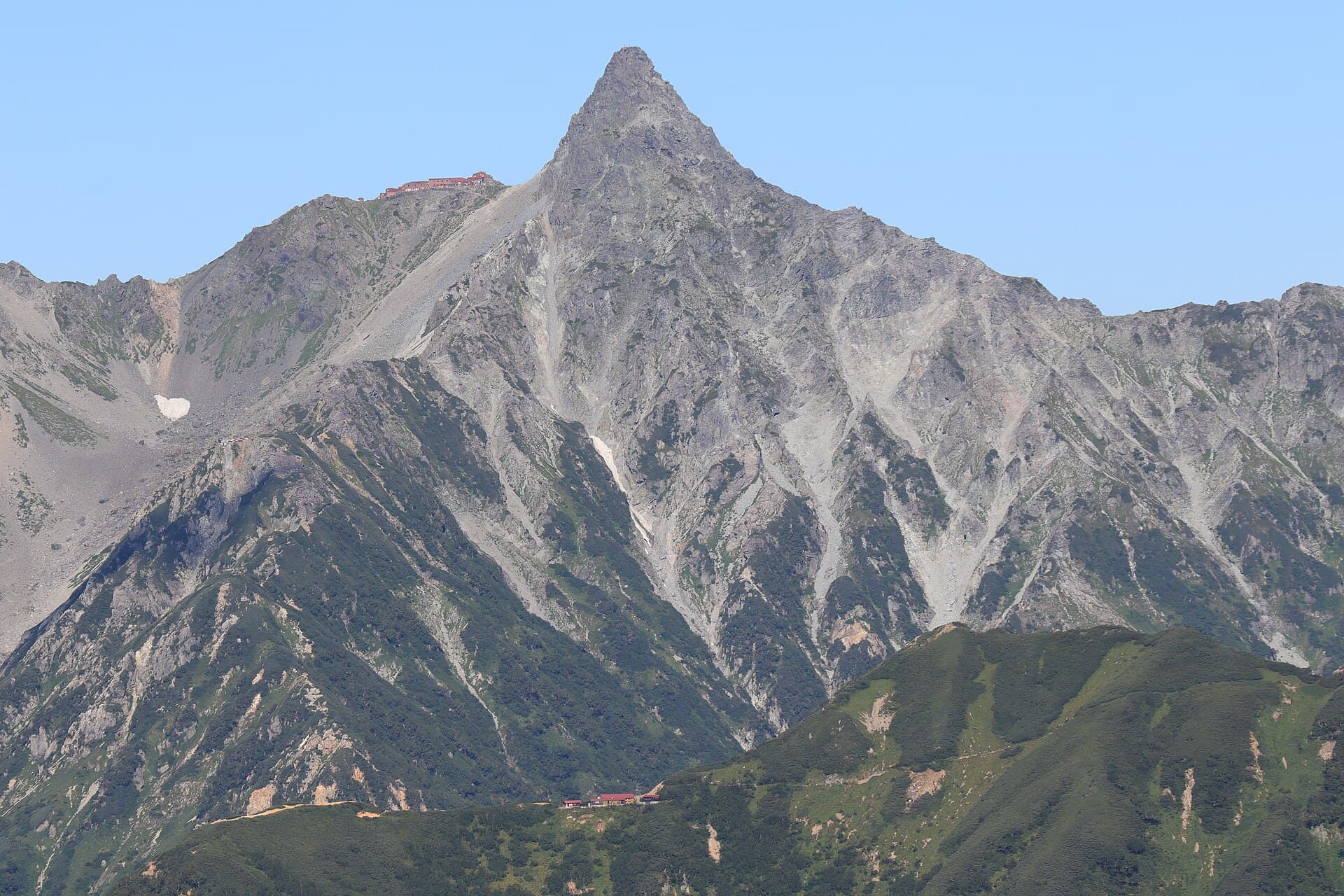
Tsurugi-dake: the most dangerous mountain in Japan
Tsurugi-dake (2,999 m) carries the label "most dangerous mountain climbable in Japan" (日本で最も危険な山). The label has merit.
The route (2 days from Murodo)
Day 1: Murodo (2,450 m) → traverse Tateyama ridgeline → Tsurugi Gōzen-goya → Tsurugi-dake Sansō (approximately 6–7 hours)
Day 2: Tsurugi-dake Sansō → summit attempt → return to Murodo (approximately 8–10 hours)
The summit route involves the Kani-no-Yoko-bai ("Crab's Traverse") — a near-vertical cliff face crossed via chains — and multiple exposed traverses with ladders on the Betsuzan ridge. In winter, Tsurugi-dake is considered Japan's premiere technical mountaineering peak.
The summer route, while exposed, is a maintained trail with fixed aids. The "most dangerous" label is partly historical reputation: Mount Tanigawa (1,977 m), a much smaller peak near Tokyo, has killed 805 people since the 1930s — approximately four times the death toll of Everest over a comparable period. Tsurugi's danger is concentrated on technical winter routes and the Betsuzan traverse, not the standard summer approach.
The 1907 discovery
When modern mountaineers Yoshitarō Shibasaki and Ikuta Nobu reached the summit in 1907, they found a rusted iron sword and religious staff dating to approximately 800 AD. Shugenja (Buddhist ascetics) had climbed this mountain over a thousand years earlier — without ropes, without metal fixtures, without modern equipment. The 2009 film Mt. Tsurugidake dramatizing this first ascent won the Japan Academy Film Prize for Director of the Year.
Sansō
- Tsurugi-dake Sansō: Below the summit, approximately 2,870 m. Reservation required.
- Tsurugi Gōzen-goya: On the approach traverse from Tateyama. Reservation required.
- Raichō-sansō: Near Murodo, an alternative base for the circuit.
Registration
Toyama Prefecture requires a mandatory climbing notification (tozan todoke) for Tsurugi-dake. Forms are submitted at trailhead registration boxes. This is not a suggestion — it is a prefectural ordinance.
Hotel Tateyama: closing August 2026
Japan's highest-located hotel, at Murodo (2,450 m), is scheduled to close at the end of August 2026. This is a significant loss of high-elevation accommodation. The hotel provided Western-style rooms with restaurant dining at alpine elevation — a category of accommodation that has no replacement on this route.
After the closure, high-elevation lodging options near Murodo include:
- Murodo Sansō (mountain lodge)
- Raichō-sansō
- Raichōzawa campground
Expect increased booking pressure at all remaining Murodo-area accommodation from September 2026 onward.
Is it a tourist trap?
The Alpine Route draws massive crowds — particularly for the snow corridor in April–June and autumn foliage in October. Most visitors never leave the transport corridor. The pricing is steep (¥10,000+ one way). The sightseeing infrastructure is undeniably commercial.
It is also the most efficient access to serious mountain terrain in the Northern Alps. Murodo puts you at genuine alpine elevation (2,450 m) without a multi-day approach hike. Within 30 minutes of leaving Murodo Terminal, you are in genuine mountain wilderness. Within 2 hours, you are on the summit of one of Japan's Three Holy Mountains. Within 2 days, you can summit the most dangerous mountain in Japan.
Use it as an elevator. Then walk away from the crowds.
Getting to the Alpine Route
From Tokyo (west-to-east, most common direction)
- Hokuriku Shinkansen: Tokyo → Toyama, approximately 2 hours, ¥13,000
- Toyama Chiho Railway: Toyama → Tateyama Station, approximately 1 hour, ¥1,420
- Begin the Alpine Route from Tateyama Station
From Osaka
- JR Thunderbird Limited Express: Osaka → Kanazawa, approximately 2.5 hours
- Hokuriku Shinkansen: Kanazawa → Toyama, approximately 25 minutes
- Then as above to Tateyama Station
Completing the traverse to the east side
If you traverse the full Alpine Route from Toyama to Nagano:
- Ogisawa → Shinano-Ōmachi (bus, approximately 40 minutes)
- Shinano-Ōmachi → Matsumoto (JR Ōito Line, approximately 55 minutes)
- Matsumoto → Tokyo (JR Azusa, approximately 2.5 hours)
This makes a natural loop: Tokyo → Toyama → Alpine Route → Matsumoto → Tokyo. The JR Pass covers the Shinkansen and Azusa legs but not the Toyama Chiho Railway or Alpine Route transport.
Full logistics guide: getting to the Japanese Alps.
Kurobe Dam: Japan's tallest
The Alpine Route crosses Kurobe Dam on foot — a 15-minute walk across the dam crest at 1,455 m elevation. The dam is 186 m tall (610 ft), Japan's tallest, and impounds a deep gorge reservoir fed by snowmelt from the surrounding peaks.
The dam was completed in 1963 after seven years of construction. 171 workers died during its building — a fact commemorated at the site. The engineering involved boring a tunnel through unstable rock under extreme conditions (the Kurobe Gorge was considered one of the most difficult construction sites in Japanese civil engineering history). The dam is both an infrastructure marvel and a memorial.
For trekkers, the crossing is primarily logistical — it connects the aerial ropeway/funicular descent on the Toyama side to the electric bus tunnel on the Nagano side. But the views into the gorge below are worth stopping for. If you are traversing the full Alpine Route, plan time at the dam rather than rushing to the next transport connection.
Tateyama's volcanic context
Tateyama contains a small andesite-dacite stratovolcano. The last recorded eruption was in 1961. The volcanic features near Murodo — Jigokudani's sulfurous vents, the hot springs, the crater lake at Mikurigaike — are expressions of ongoing geothermal activity.
Jigokudani ("Hell Valley") is not a metaphor. Buddhist ascetics who climbed Tateyama in the 8th century interpreted the sulfurous fumes, boiling mud, and barren yellow-stained ground as literal manifestations of Buddhist hell realms. The mountain's sacred status derives partly from this perceived proximity to the underworld.
Volcanic gas hazard: Trail closures in the Jigokudani area occur when hydrogen sulfide concentrations exceed safe levels. These closures can happen without warning. Check conditions at Murodo Terminal before walking the Jigokudani circuit. The Mikurigaike Onsen — Japan's highest-altitude hot spring bath, adjacent to Murodo — draws its water from the same geothermal system.
Season at Murodo
Murodo's seasonal profile differs from Kamikōchi because of the Alpine Route transport chain:
- April 15 to mid-June: Snow corridor season. Murodo is accessible but mountain routes are winter conditions. Tateyama summit and Tsurugi-dake require winter mountaineering skills. Day visitors dominate.
- Mid-July to mid-October: Trekking season. Summer trails to Tateyama summit (2–3 hours) and Tsurugi-dake circuit (2 days) are open. Sansō operating. All Alpine Route transport running.
- October: Autumn foliage at lower elevations on the route. First snow at Murodo. Sansō begin closing.
- November 30: Alpine Route closes for winter. Murodo is inaccessible.
The snow corridor and trekking season barely overlap. If you want both the 20-meter snow walls and a summit of Tateyama, target late June to early July — but be prepared for tsuyu (rainy season) disruption and residual snow on the summit trail.
9 Sources
- alpen-route.comTateyama Kurobe Alpine Route — Official Site (English)
- alpen-route.comTateyama Kurobe Alpine Route — Official Fares & Tickets
- alpen-route.comSnow Wall Walk 2026 — Official Announcement
- h-tateyama.alpen-route.co.jpHotel Tateyama — Accommodation ends 31 August 2026 (official notice)
- kurobe-dam.comKurobe Dam — Official Site (Kansai Electric Power / KEPCO)
- pref.toyama.jpToyama Prefecture — Tsurugidake climbing-notification ordinance (登山届出条例)
- data.jma.go.jpJapan Meteorological Agency — Midagahara (Tateyama) volcano
- en.culmina.jpCulmina — Mt Tsurugidake climbing guide
- yamatomo.co.jpMt Tanigawa — Japan's most lethal mountain (1,977 m)