The mountain range that serves dinner at 5 PM
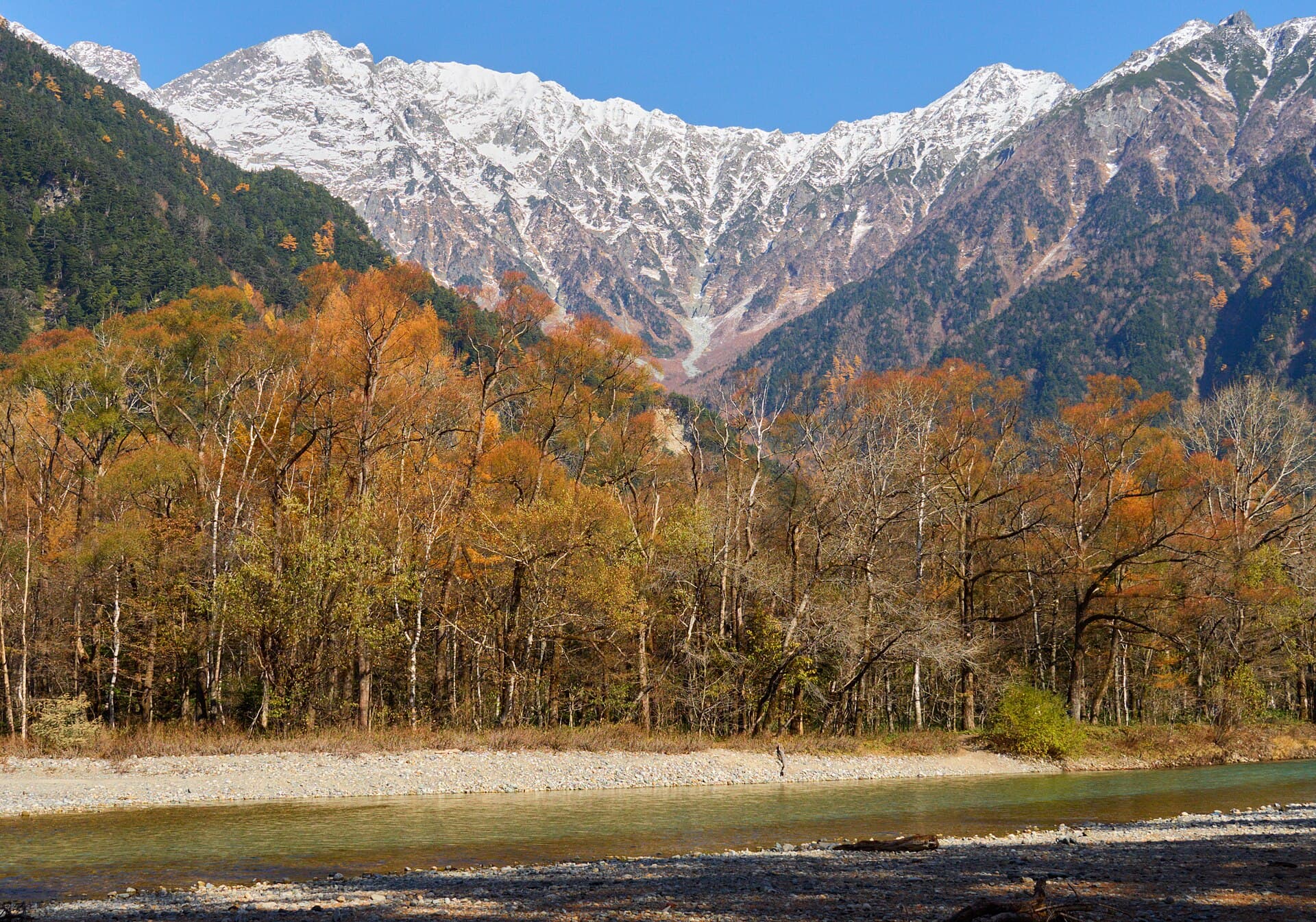
The Japanese Alps are three parallel ranges — Northern (Hida), Central (Kiso), Southern (Akaishi) — running 200 km through central Honshu. Twenty-one peaks exceed 3,000 meters. The highest, Kita-dake at 3,193 m, is the second-tallest mountain in Japan after Fuji. Seven active glaciers were confirmed in 2012, overturning the scientific assumption that Japan had none.
None of this is news. What English-language trekking guides consistently understate is the infrastructure.
The sansō (mountain hut) system across the Northern Alps alone places staffed huts every 3–6 hours along major ridgelines. Each hut provides dinner, breakfast, and a futon for ¥10,000–13,000 ($64–83 at May 2026 rates). Dinner is served at 5 PM. Lights out at 8–9 PM. Departure by 5–6 AM. This is not a European hut where you order à la carte and drink grappa until midnight. This is a system designed around the mountain's rhythm: sleep when it's dark, walk when it's light, be off exposed ridgelines by 3 PM.
The sansō system has operated for over a century. Many huts are privately owned, run by the same families for generations. The communal futon rooms, the set-time meals, the 8 PM lights-out — this is not a budget compromise. It is the culture.
The naming: two Englishmen and a century of framing
The term "Japanese Alps" was coined by William Gowland (1842–1922), a British mining engineer stationed at the Osaka Mint from 1872 to 1888. Gowland was not a mountaineer. He climbed recreationally during his sixteen years in Japan, making first recorded Western ascents of several peaks in the Hida range. He saw steep granite ridges, glacial cirques, and snowfields — and reached for the only reference frame his European audience would understand. The name was first published by Basil Hall Chamberlain in 1888.
Walter Weston (1861–1940) gave the name international currency. An Anglican missionary stationed in Japan across two stints (1888–1895, 1902–1915), Weston published Mountaineering and Exploration in the Japanese Alps in 1896. The book reframed Japan's central mountains — previously understood as sites of Buddhist and Shugendō ascetic practice — as recreational destinations comparable to the European Alps.
Weston's contribution was cultural, not cartographic. He did not discover the mountains. Buddhist ascetics called yamabushi had been climbing them for centuries. What Weston did was translate them into a framework Western audiences could consume. He catalyzed the founding of the Japanese Alpine Club in 1905 — the oldest mountaineering club in Asia — and became its first honorary member. Emperor Hirohito awarded him the Order of the Sacred Treasures (Fourth Class) in 1937. A bronze memorial relief stands at Kamikōchi. Each June 11, the Weston Festival ceremonially opens the climbing season.
The naming was an act of colonial-era categorization. It was also geologically apt. But it flattened a thousand years of sacred mountain culture into a European sports framework. The peaks Weston popularized were Shugendō sites — places where ascetics practiced austerity to acquire spiritual power. The most dramatic proof: when modern mountaineers reached the summit of Tsurugi-dake (2,999 m) in 1907, they found a rusted iron sword and religious staff dating to approximately 800 AD. Shugenja had climbed "the most dangerous mountain in Japan" over a thousand years earlier, using no ropes, no modern equipment — only faith and conditioning.
Continue reading Getting to the Japanese Alps — Shinkansen, Azusa express, and the JR Pass that just got expensive →
The sansō system: what makes it different
The sansō model differs from European mountain huts in ways that matter practically.
All-inclusive pricing. Most sansō charge a single rate — ¥10,000–13,000 ($64–83) — that covers dinner, breakfast, and bedding. European huts typically charge separately for bed, meals, and linen. A night at a Swiss SAC hut with half-board runs CHF 90–135 ($100–150) for non-members. An Austrian DAV/OeAV hut runs €48–72 ($52–78). The sansō price includes everything. No member/non-member tiers, no sheet rental surcharge, no à la carte decision fatigue.
Fixed schedule. Dinner at 5–5:30 PM. Breakfast at 5–5:30 AM. Lights out at 8–9 PM. Generators shut down. This is headlamp territory after dark. The rhythm is mountain-dictated: alpine starts at 3–4 AM are standard.
Communal futon rooms. During peak season — especially Obon week (mid-August) and weekends in July through September — sansō pack hikers shoulder-to-shoulder. One futon space per person is not guaranteed. This density would be culturally unacceptable in most European huts. In Japan, it is the norm.
Reservation mandatory since COVID. Before 2020, most sansō operated on a first-come, first-served basis and would never turn away a climber. COVID-19 forced a fundamental shift: reservations are now mandatory at most Northern Alps huts, capacity limits are enforced, and the old "no refusal" tradition has largely ended. Several huts launched online booking systems between 2022 and 2024. Cancellation policies and fees exist for the first time.
Price comparison at current exchange rates (May 2026):
| System | Bed + dinner + breakfast | USD equivalent |
|---|---|---|
| Japanese sansō | ¥10,000–13,000 | $64–83 |
| Austrian DAV/OeAV (non-member) | €48–72 | $52–78 |
| Italian CAI rifugio (non-member) | €63–100 | $68–109 |
| Swiss SAC (non-member) | CHF 90–135 | $100–150 |
The sansō system is price-competitive with Austrian huts and significantly cheaper than Swiss or Italian huts for the same package. The weak yen has made this gap even more favorable since 2022.
Practical how-to: sansō booking and etiquette guide.
Bears: the population tripled
Japan's Asian black bear (Ursus thibetanus japonicus) population on Honshu has grown from approximately 15,000 individuals in 2012 to around 44,000 in 2023. The drivers: reduced hunting (aging rural population), conservation policies that restricted culling, and poor mast (acorn/nut) production driven by climate change pushing bears into lower elevations and closer to human corridors. A 2024 government policy shift moved toward more proactive population management through hunting. Record bear-related injuries were reported in 2025.
The Japanese Alps are core bear habitat.
Bear bell culture (kumayoke suzu) is deeply ingrained. Bells are clipped to packs and produce a continuous jingle while walking, alerting bears to human presence. They are sold at trailheads, mountain shops, and convenience stores throughout the Alps region for ¥500–1,500. Carrying one is not optional in practice — it is expected.
Between 1979 and 1989, nine people were killed by black bears in Japan. Four fatalities occurred in Akita Prefecture in 2016 among people picking bamboo shoots. Encounters increase in autumn when bears forage intensively before hibernation.
Bear spray is uncommon in Japan but not prohibited. The standard protocol: make noise on the trail (bells, talking, clapping). Never run from a bear. If encountered at distance, back away slowly. Store food securely at huts and campsites.
Sacred mountains: the spiritual layer beneath the sport
Tateyama (3,015 m) is one of Japan's Three Holy Mountains (Nihon Sanzan), alongside Fuji and Haku. First climbed circa the 8th century AD by Saeki no Ariyori, Tateyama became a major center for mountain asceticism. The Oyama Shrine occupies the summit of Oyama Peak (3,003 m). Nearby volcanic features — hot springs, sulfurous vents at Jigokudani ("Hell Valley") — were interpreted as manifestations of Buddhist hell.
Shugendō ("the way of training and testing") is a syncretic Japanese religion blending Esoteric Buddhism, Shinto, Taoism, and folk mountain worship. Originating in the 7th century, its practitioners — yamabushi ("those who prostrate on mountains") — undergo ascetic training in steep mountain terrain to acquire spiritual power. The mountains were places of practice for centuries before they were places of sport.
The 1907 Tsurugi-dake discovery — a rusted iron sword at the summit, placed there over a millennium earlier — changed the narrative of Japanese mountaineering permanently. What modern climbers treated as a first ascent was, in fact, a rediscovery.
The weak yen: what it means in practice
The JPY has depreciated approximately 43% against the USD since 2019 (from ~109 JPY/USD to ~156 JPY/USD in May 2026). For a USD-based trekker, Japan is effectively 30–40% cheaper than it was pre-pandemic.
A ¥13,000 sansō night that cost $119 in 2019 now costs $83.
A convenience store (konbini) meal costs ¥500–800 ($3–5). Equivalent grab-and-go food in Chamonix or Zermatt costs €10–15 ($11–16). Japan's public transport is more expensive than budget travelers expect but far cheaper than Swiss rail.
The "Japan is expensive" narrative is a relic of the strong-yen era and Tokyo-centric budgeting. In 2026, for a trekker planning a 7-day hut-to-hut route, the Japanese Alps are cheaper than the Dolomites and comparable to Austrian Tyrol — with significantly better food.
Full cost breakdown: budget calculator.
Tokyo to trailhead in four hours
The access logistics are a strength, not a barrier.
Kamikōchi (Northern Alps, east side): JR Azusa limited express from Shinjuku to Matsumoto (2.5 hours), Kamikōchi Line train to Shin-Shimashima (30 minutes), shuttle bus to Kamikōchi (65 minutes). Total: approximately 4–4.5 hours. Private vehicles have been banned from Kamikōchi since 1994.
Tateyama (Northern Alps, west side): Hokuriku Shinkansen from Tokyo to Toyama (2 hours), Toyama Chiho Railway to Tateyama Station (1 hour). Total: approximately 3.5 hours.
No rental car needed. Public transit is the infrastructure. Detailed route guide: getting to the Japanese Alps.
The tent crackdown
Pre-COVID, camping in the Japanese Alps was relatively informal — show up at a designated campsite near a hut, pay ¥500–1,000, pitch your tent. Post-COVID, many campsites (tenbajō) now require advance reservations, particularly in the Northern Alps. Popular sites at Karasawa Cirque and the Yari-ga-take area have introduced capacity limits. Tent site fees have risen to ¥1,000–2,000 at popular sites. Wild camping is increasingly prohibited within national park boundaries.
The reservation requirement is the biggest practical change. It mirrors a broader trend toward managed access across Japanese mountain areas — driven by both COVID-era crowd control and longer-term conservation goals within Chubu Sangaku National Park (established 1934). For international trekkers, the tent reservation system adds logistical complexity and often requires Japanese-language phone calls. The sansō system, despite being more expensive, is now paradoxically easier to access — more huts have online English-language booking.
The language barrier: real but solvable
The language barrier in the Japanese Alps is comparable to trekking in rural Austria or the Italian Dolomites — many older hut keepers speak only the local language.
Trail signage is generally excellent. Markers are color-coded, with distance and time estimates in Japanese and often romaji (Latin script). Major trailheads — Kamikōchi, Tateyama, Shin-Hotaka — have English signage. Route maps posted at huts are in Japanese but graphically readable.
Hut staff speak limited to no English at most sansō. Online reservation systems increasingly offer English options, but phone reservations — still required at many huts — are Japanese-only. The phrase "yoyaku onegai shimasu" (予約お願いします, "reservation please") and basic numbers handle most of the interaction.
Emergency communication is the genuine concern. The 110 (police) and 119 (fire/ambulance) dispatch centers increasingly have English support, but not reliably in mountain areas. Cell coverage is spotty above treeline — NTT Docomo has the best mountain network, but many ridges and most valleys have no signal. Satellite communicators (Garmin inReach or similar) are the only reliable backcountry communication option.
Translation apps have largely solved the practical problem. Google Translate with the offline Japanese language pack handles restaurant menus, bus schedules, and hut check-in conversations. The bigger barrier is the reservation system, not trail navigation. This is where advance planning — or a curated itinerary with pre-booked sansō — eliminates the hardest friction point.
The daily cost comparison
The numbers, side by side, at May 2026 exchange rates:
| Item | Japanese Alps (JPY / USD) | Dolomites (EUR / USD) | Austrian Tyrol (EUR / USD) |
|---|---|---|---|
| Hut night + 2 meals | ¥11,000 / $71 | €70–90 / $76–98 | €48–72 / $52–78 |
| Trail lunch (self-catered) | ¥500–1,000 / $3–6 | €5–10 / $5–11 | €5–8 / $5–9 |
| Beer at hut | ¥600–800 / $4–5 | €4–6 / $4–7 | €3–5 / $3–5 |
| Transport to trailhead | ¥2,500 / $16 | €10–20 / $11–22 | €10–15 / $11–16 |
| Daily total (in-mountain) | ~$90–100 | ~$100–130 | ~$75–100 |
The Japanese Alps sit between Austrian Tyrol (the cheapest major European alpine destination) and the Dolomites. The weak yen has closed the gap with Austria and made Japan significantly cheaper than Switzerland or the Dolomites for equivalent multi-day hut-to-hut trekking. The all-inclusive sansō pricing eliminates the budgeting anxiety that plagues European hut trekking — no member surcharges, no sheet rental, no à la carte dinner decisions adding €15–25 per night.
Active glaciers: the 2012 discovery
Seven active glaciers were confirmed in the Hida range (Northern Alps) in 2012 — a discovery that overturned the longstanding scientific assumption that no active glaciers existed in Japan. Ice masses measured upward of 30 meters in thickness. The glaciers persist in north-facing cirques where heavy winter snowfall (driven by moisture-laden winds from the Sea of Japan) accumulates faster than summer melting can remove it.
The Karasawa Cirque, surrounded by the four Hotaka peaks, is a glacially carved amphitheater at 2,300 m — the textbook landform. The Shirouma Daisekkei maintains year-round snowcover as a perennial snowfield, though it is not classified as a glacier. These features are actively monitored and the research is ongoing within Chubu Sangaku National Park, which was established in 1934 and covers 1,743 km² of the Northern Alps.
Hotel Tateyama closes August 2026
Japan's highest-located hotel, at Murodo (2,450 m) on the Tateyama Kurobe Alpine Route, is scheduled to close at the end of August 2026. This removes significant high-elevation accommodation. Alternative lodging at Murodo-area mountain lodges will absorb some demand but likely at reduced capacity.
This matters for anyone planning a Tateyama or Tsurugi-dake trip in the second half of 2026 or beyond. The remaining sansō near Murodo — including Raichō-sansō and the Murodo mountain lodge — will see increased booking pressure.
What this means for planning
The Japanese Alps reward preparation more than most ranges. The sansō reservation system, the language barrier on phone bookings, the bear awareness, the weather windows, the tent crackdown — these are friction points that dissolve with advance planning and remain significant without it.
The payoff: a mountain range with world-class ridge traverses, a century-old hut culture that serves dinner at altitude, sacred peaks climbed by ascetics a millennium before European missionaries gave them an Alpine name, and a weak yen that makes the entire system 30–40% cheaper than it was five years ago.
Practical guides for each route and logistics question:
- Kamikōchi gateway guide
- Yari-Hotaka traverse
- Tateyama and the Alpine Route
- Sansō booking and etiquette
- When to go
- Getting there
- Budget calculator
9 Sources
- kamikochi.orgKamikochi Official — About Kamikochi & Chubu Sangaku National Park
- kamikochi.orgKamikochi Official — History & Culture
- ndl.go.jpNational Diet Library (Japan) — Establishment of the Japanese Alpine Club
- japan.travelJNTO (Japan.travel) — Hut Life: Everything You Need to Know About Mountain Huts in Japan
- h-tateyama.alpen-route.co.jpHotel Tateyama (Official) — End of accommodation services notice
- alpen-route.comTateyama Kurobe Alpine Route (Official)
- toyama-bunkaisan.jpToyama Prefecture Cultural Heritage — Glaciers of the Tateyama Range
- aljazeera.comAl Jazeera — Japan deploys military in north to battle surge in bear attacks (Nov 2025)
- wildlife.orgThe Wildlife Society — Deadly bear attacks surge in Japan