
The trekking window
The optimal trekking window in the Japanese Alps is mid-July to mid-October. Within this range, conditions vary significantly.
| Period | Conditions | Crowding |
|---|---|---|
| April–June | Snow-covered above 2,000 m. Winter mountaineering skills required. Alpine Route snow corridor open (mid-Apr to mid-Jun) | Low (snow corridor draws day-trippers, not trekkers) |
| Early–mid July | Tsuyu (rainy season) ending. Snow patches melting. Huts beginning to open | Moderate |
| Mid-July to mid-August | Peak season. Warmest weather. All huts open. Alpine flowers | Heavy (Obon week: extreme) |
| Late August–September | Typhoon risk increasing. Fewer crowds. Autumn colors beginning | Moderate |
| October | Autumn foliage at lower elevations. First snow on summits. Many huts closing | Moderate to low |
| November | Winter conditions above 2,500 m. Most huts closed. Kamikōchi and Alpine Route close mid-to-late November | Very low |
Tsuyu: the rainy season
The East Asian rainy season (梅雨, tsuyu or baiu) affects central Honshu approximately June 7 to July 20. This is not intermittent rain. It is a sustained weather pattern driven by the collision of maritime tropical and continental polar air masses along the Baiu front.
During tsuyu:
- Heavy, persistent rainfall with high humidity
- Trails become muddy and streams swell dangerously
- Visibility is frequently poor — ridge walking is largely impossible
- Risk of mudslides and flooding increases significantly
- Most sansō are not yet open for the season
- Most trekkers avoid this window entirely
The end of tsuyu is called "tsuyu-ake" and varies by year — it can arrive as early as late June or as late as late July. When tsuyu breaks, the trekking season begins in earnest.
Continue reading Getting to the Japanese Alps — Shinkansen, Azusa express, and the JR Pass that just got expensive →
Peak season: mid-July to mid-August
Once tsuyu lifts, the Northern Alps experience their warmest and most stable weather. Alpine flowers bloom across ridgeline meadows. All sansō are open. Trails are snow-free on the standard routes below 3,000 m (though patches persist above 2,800 m into early August).
This is also the most crowded period.
Obon week (approximately August 13–16) is the single worst bottleneck. Obon is Japan's major Buddhist holiday for honoring ancestors, and most of the country takes the week off. The mountains fill. Sansō are booked solid weeks in advance. Popular trails (Yari-ga-take, Karasawa, Tateyama) see continuous lines of trekkers. The Daikiretto can develop multi-hour bottlenecks at chain sections.
If you have any flexibility in scheduling, avoid Obon week. The weeks immediately before (late July) and after (late August) offer similar weather with significantly fewer people.
The 3 PM rule
An informal but universally observed safety convention in the Japanese Alps: plan your itinerary so you are off exposed ridgelines by 3:00 PM.
The rationale is twofold:
Lightning. Afternoon convective storms build rapidly over the peaks from July through September. The mechanism is consistent: solar heating of valleys produces updrafts that generate cumulonimbus clouds over ridgelines by early-to-mid afternoon. These storms bring intense lightning to exposed terrain. The Yari-Hotaka ridge, the Tsurugi-dake summit route, and any traverse above treeline are lightning-exposed terrain with no shelter.
Visibility. Afternoon cloud typically envelops ridges from 2 PM onward. Navigation on exposed terrain — particularly the Daikiretto and Tsurugi-dake — becomes dangerous in fog. Painted route markers on rock are invisible at 10 meters in thick cloud.
The sansō system is designed around this rhythm. Dinner at 5 PM means trekkers arrive by 3 PM. Departure at 5 AM means the exposed ridge crossing happens in the morning, when skies are clear and stable. The entire mountain culture — the early bedtime, the early wake, the set-time meals — exists because of afternoon weather.
Practical implication: Plan your itinerary backwards from 3 PM. If a ridge section takes 6 hours, depart by 9 AM. If it takes 8 hours, depart by 7 AM. Factor in rest stops. Do not start late.
Typhoon season
Typhoons affect Japan primarily from August through October, with September being the most active month. In the mountains, typhoons bring:
- Extreme wind and rainfall (trails become impassable)
- Hut closures during severe storms
- Trail damage that may persist for the remainder of the season
- Multi-day disruption to bus services (Kamikōchi buses suspend operations in severe weather)
- Flooding of river valleys and stream crossings
Typhoon tracks are forecast several days in advance. Japan Meteorological Agency (JMA) provides accurate tracking. If a typhoon approaches during a multi-day traverse:
- Descend if possible. Get off ridgelines and exposed terrain.
- Shelter at a sansō. Huts will accommodate storm-stranded trekkers.
- Do not attempt river crossings. Stream levels can rise meters within hours.
- Wait. Typhoons move through in 1–3 days. The weather windows between typhoons in September can be excellent — clear, cool, stable.
A September trek requires typhoon awareness and flexible scheduling. It does not require avoiding September entirely. The rewards — fewer crowds, cooler temperatures, autumn colors beginning — are substantial.
Snow patches
On high routes (above 2,800 m), snow patches can persist well into August. The Shirouma Daisekkei (大雪渓, "great snow valley") maintains year-round snow cover and is a primary access route to Shirouma-dake (2,932 m).
Early season (July): Crampons or traction devices are recommended for routes above 2,800 m. The Shirouma Daisekkei requires crampons even in mid-summer.
Mid-season (August–September): Most snow patches on standard routes below 3,000 m have melted. The Daikiretto and Yari-Hotaka ridge are typically snow-free.
Late season (October): First snowfall on summits. Winter conditions return above 2,500 m by late October. Many sansō close by mid-October.
The Tateyama snow corridor window
The Yuki no Ōtani snow corridor on the Tateyama Kurobe Alpine Route — walls of snow reaching 15–20 meters — is a separate weather window from the trekking season. The corridor is most impressive mid-April to early June, before significant melting reduces the walls.
This overlaps with the pre-trekking season. The Alpine Route opens April 15, but mountain routes from Murodo (Tateyama summit, Tsurugi-dake) require winter mountaineering skills until mid-July. The snow corridor is a sightseeing experience, not a trekking one — though Murodo itself is accessible via the Alpine Route transport chain throughout the operating season (April 15 to November 30).
Autumn foliage
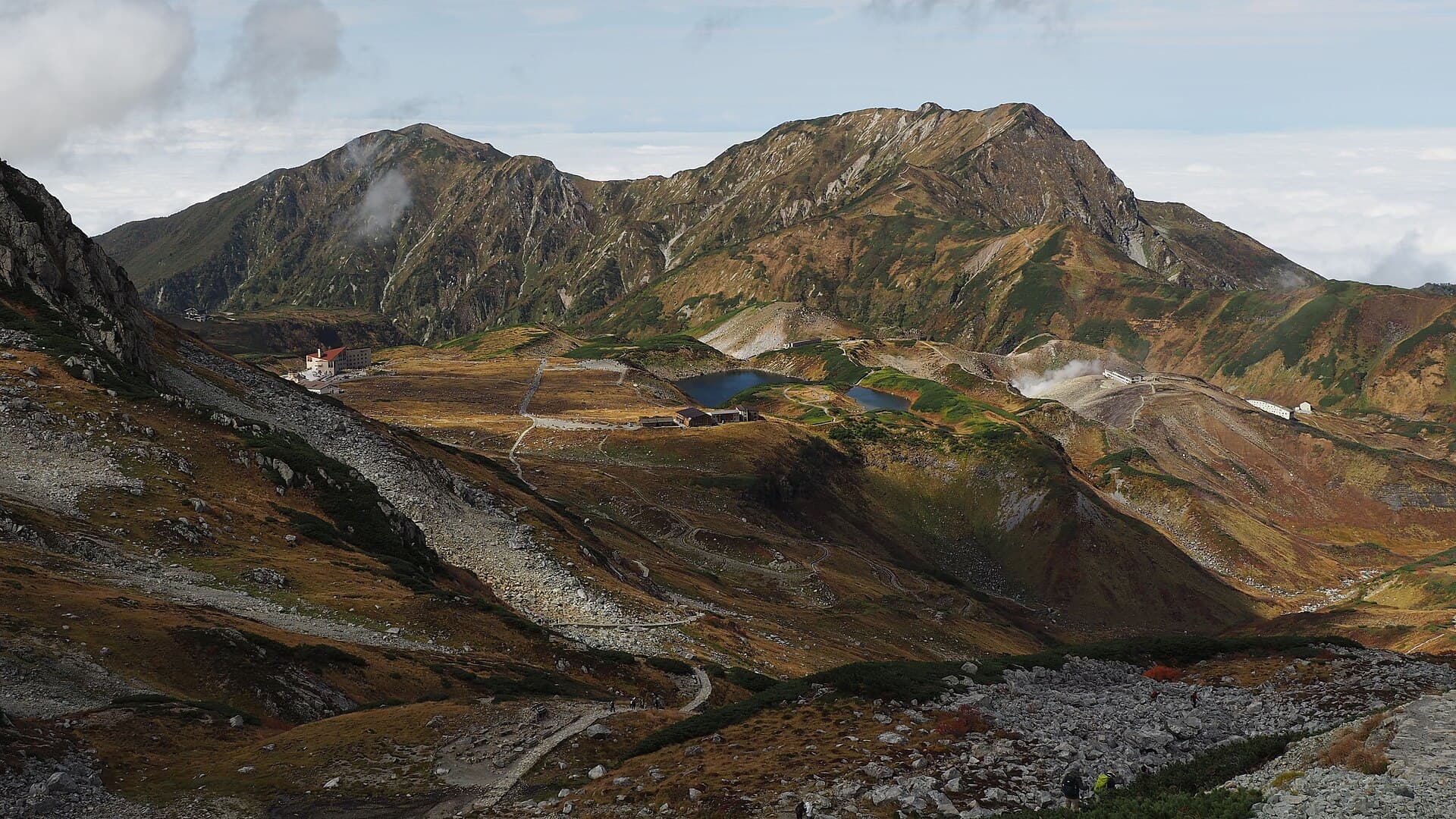
The Japanese Alps produce exceptional autumn color, driven by nanakamado (rowan/mountain ash) turning crimson against grey rock and green conifers.
Timing by elevation:
- Above 2,500 m: Late September to early October
- 2,000–2,500 m: Early to mid-October
- Below 2,000 m (Kamikōchi valley floor): Mid to late October
The Karasawa Cirque (2,300 m) is considered the finest autumn foliage location in the Japanese Alps — the cirque bowl of crimson nanakamado beneath the Hotaka peaks is the defining photograph of Japanese Alps autumn. Peak color at Karasawa is typically the first week of October. Karasawa Hyutte books far in advance for this window.
Month-by-month summary
| Month | Verdict | Key consideration |
|---|---|---|
| April | Snow corridor only | Alpine Route opens mid-April. Mountains snow-covered. Day-trip only |
| May | Snow corridor fading | Some valley walks possible in Kamikōchi (opens mid-April). No alpine routes |
| June | Tsuyu begins | Avoid. Rain, mud, poor visibility. Snow corridor ending |
| July (early) | Tsuyu ending | Unstable. Snow patches. Huts opening. Possible if flexible |
| July (late) | Season starts | Good weather likely. Fewer crowds than August. Snow mostly melted below 3,000 m |
| August | Peak season | Best weather, worst crowds. Avoid Obon week (Aug 13–16) |
| September | Typhoon watch | Excellent between storms. Crowds thinning. Autumn beginning at altitude |
| October | Autumn foliage | Karasawa peak color early Oct. Many huts close mid-month. First snow on summits |
| November | Season ends | Winter conditions above 2,500 m. Kamikōchi and Alpine Route close |
Temperature and gear implications
Summit temperatures in the Northern Alps vary dramatically across the season. At 3,000 m (Yari-ga-take, Oku-Hotaka):
| Month | Daytime high | Nighttime low | Wind chill on ridges |
|---|---|---|---|
| July | 10–15°C | 3–8°C | Can drop below 0°C |
| August | 10–15°C | 5–10°C | Can drop below 0°C |
| September | 5–10°C | 0–5°C | Below freezing common |
| October | 0–5°C | -5 to 0°C | Severe — winter layers needed |
The implication: warm layers and waterproof shells are non-negotiable in every month of the trekking season. The combination of altitude, wind exposure on ridges, and rapid afternoon weather changes means hypothermia is a real risk even in August.
At the Kamikōchi valley floor (1,500 m), daytime temperatures are pleasant — 20–25°C in July and August. But trekkers ascending to the ridgeline face a 15–20°C temperature drop within a few hours of walking. Layering is essential.
Altitude considerations
The Japanese Alps do not reach extreme altitude — the highest point is 3,193 m (Kita-dake). Acute mountain sickness (AMS) is possible but uncommon among healthy trekkers acclimatizing gradually via multi-day approaches from valley floors.
The exception is the Tateyama Kurobe Alpine Route, which delivers trekkers from near sea level to 2,450 m (Murodo) in approximately two hours via mechanized transport. This rapid ascent profile can trigger AMS symptoms — headache, nausea, fatigue — particularly in trekkers who arrive at Murodo and immediately attempt the Tateyama summit (3,015 m) or the traverse toward Tsurugi-dake. Spending a night at Murodo before ascending further is advisable.
Humidity and hydration
The Japanese Alps are significantly more humid than the European Alps. Tsuyu (rainy season) is the extreme, but even in peak season (late July through September), humidity at the valley floors is high. Above treeline, conditions are drier, but the combination of heat, humidity, and sustained climbing produces dehydration faster than trekkers accustomed to dry alpine environments expect.
Water is available at most sansō but may be limited or charged for at high-altitude huts (¥100–200 per liter). Stream water in the valleys is generally clean but should be purified. Carry at least 1.5 liters for any section between huts.
The bottom line
The trekking window is narrow: mid-July to mid-October. Within that window, late July and September offer the best balance of weather and crowd levels. August has the most stable weather but the worst crowding. October has the best colors but the first snow and hut closures.
Every day in the Japanese Alps is structured around the 3 PM rule. Every itinerary is constrained by sansō reservation availability. Every week from August through October carries typhoon risk. Planning around these constraints — rather than ignoring them — is the difference between a world-class ridge traverse and a storm-bound retreat to a valley lodge.
8 Sources
- data.jma.go.jpJMA — Baiu (rainy season) normal onset and withdrawal dates
- alpen-route.comTateyama Kurobe Alpine Route — Official Site
- japan.travelJNTO (Japan National Tourism Organization) — Tateyama Kurobe Alpine Route
- kamikochi.orgKamikochi Official Website (Chubu Sangaku National Park)
- db.go-nagano.netGo! Nagano (Nagano Prefecture) — Submitting a climbing itinerary (tozan-todoke)
- visitazumino.comAzumino City — Northern Japan Alps hiking guide
- karasawa-hyutte.comKarasawa Hyutte — Official mountain hut site
- nippon.comNippon.com — Japan's Typhoons: Peak Numbers in August, Peak Damage in September (JMA data)