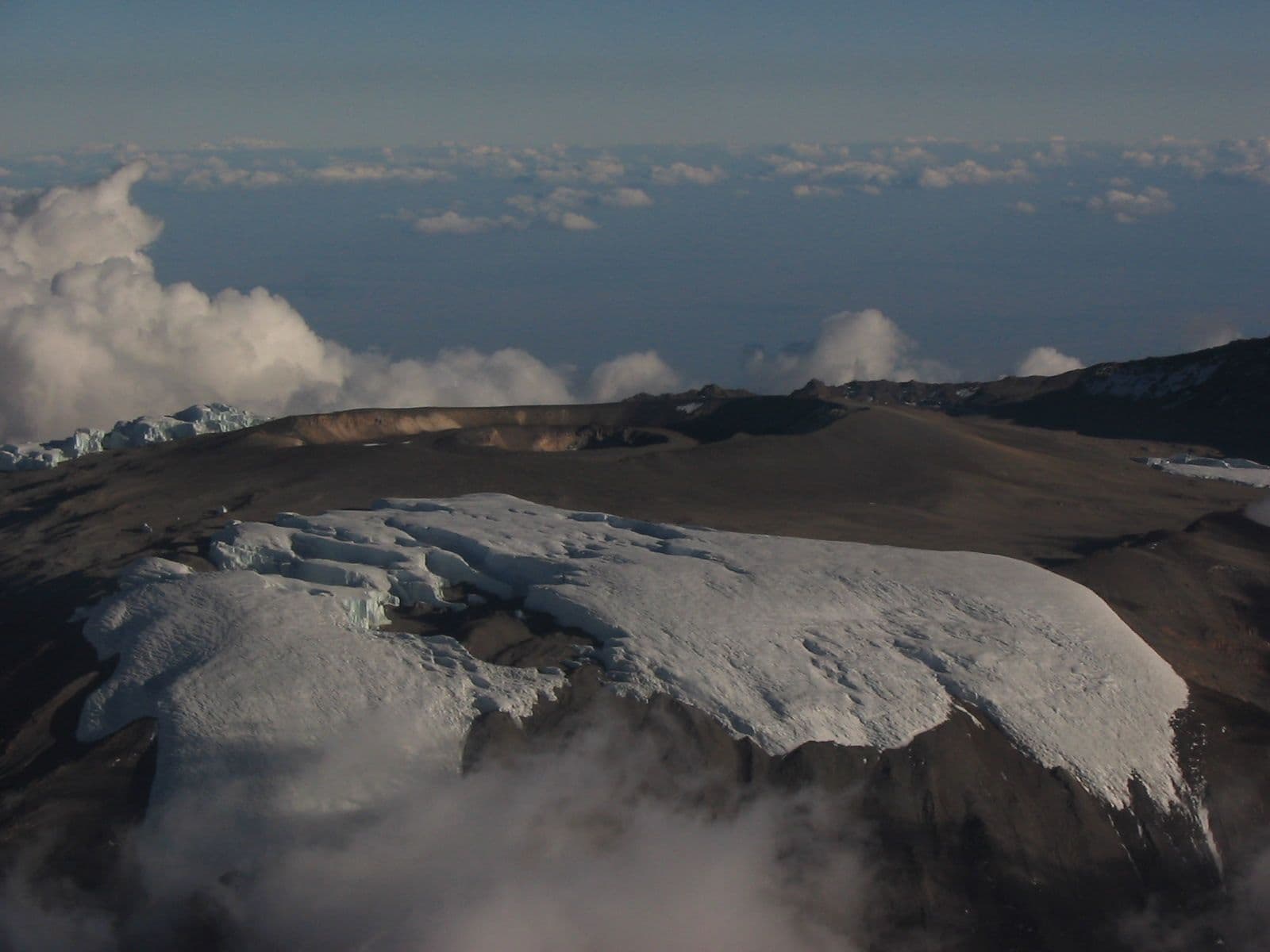
Kilimanjaro (5,895m) is the highest point in Africa, the tallest free-standing mountain on Earth, and the only Seven Summit you can walk up without technical climbing gear. No ropes. No crampons. No ice axes on the standard routes. You walk to the summit.
That description is accurate. It is also the reason 35% of climbers fail.
The fee structure that punishes acclimatization
TANAPA (Tanzania National Parks Authority) charges park fees per day. The current structure (valid through June 2026):
| Fee | Amount | Basis |
|---|---|---|
| Conservation fee | $70 | Per day |
| Camping fee | $50 | Per night |
| Rescue fee | $20 | One-time |
| Crater fee | $100 | One-time (above 5,000m) |
| VAT | 18% | On all fees |
Sources: TANAPA Tariff Schedule, Altezza Travel — Park Fees 2026
This means a 5-day Marangu route costs roughly $630 in park fees. An 8-day Lemosho costs roughly $1,080. The difference — $450 — is the price of three extra acclimatization days.
The problem: the only official KINAPA success rate data ever published (2006) shows that 5-day routes have a 27% summit success rate. Eight-day routes: 85%. The extra $450 in fees nearly triples your chance of standing on Uhuru Peak.
Budget climbers — the ones most price-sensitive — are systematically steered toward shorter, cheaper routes. The per-day fee model creates a perverse incentive where saving money directly increases your probability of failure, altitude sickness, and evacuation.
Source: Ultimate Kilimanjaro — KINAPA Success Rate Data, 2006
And it's about to get worse. TANAPA has gazetted 15% annual increases starting in the 2026/2027 season. The conservation fee alone rises from $70 to $81 (2026/27), then $93 (2027/28), then $107 (2028/29). By 2031, park fees for a 7-day Machame trek will approach $2,000 — before you've paid a single dollar to your operator. Source: Altezza Travel — Fee Projections
Continue reading Kilimanjaro Guides and Porters: Who Carries Your Mountain and What They're Paid →
The operator spread: $1,500 to $6,000+
The all-in package price for a Kilimanjaro trek varies by a factor of 4x. This isn't a quality gradient — it's a structural split:
Budget operators ($1,500–$2,200)
What gets cut to hit this price point:
- Porter wages at or below the KPAP minimum ($8/day)
- Older, thinner tents
- Lower food quality and variety
- Higher guide-to-climber ratios (1:8+)
- No private toilet tent
- Possibly non-KPAP-certified
Mid-range operators ($2,500–$3,500)
The sweet spot for most climbers:
- KPAP-certified (porter welfare standards met)
- Decent tents, sleeping pads, dining tent
- Hot meals, varied menu
- Guide ratio ~1:4-6
- Private toilet tent included
- Pulse oximeter monitoring
Premium operators ($4,000–$6,000+)
What you're paying for:
- Expedition-grade tents, sleeping pads, all gear
- Professional chef, diverse menu, altitude-adjusted nutrition
- Guide ratio 1:2-3
- Supplemental oxygen available
- Gamow bag for emergency descent simulation
- Pre-trip fitness consultation, altitude training advice
- Post-trek safari packages often bundled
The ethical question: 70% of Kilimanjaro expeditions fail KPAP (Kilimanjaro Porters Assistance Project) porter welfare standards. The minimum daily porter wage is TZS 20,000 (~$8 USD). KPAP-affiliated operators pay an average of TZS 36,074/day; non-affiliated pay TZS 25,860/day. The cheapest packages fund the worst porter conditions.
Sources: KPAP/KRTO, Wikipedia — KPAP
The full cost breakdown
A realistic budget for a solo foreign trekker, 7-day Machame route, mid-range operator:
| Line item | Budget | Mid-range | Premium |
|---|---|---|---|
| Operator package (7-day) | $1,800 | $3,000 | $5,000 |
| Park fees (included in package) | ~$960 | ~$960 | ~$960 |
| Tips (guide, cook, porters) | $200 | $350 | $500 |
| Tanzania e-visa | $50 | $50 | $50 |
| Travel insurance (altitude) | $80 | $150 | $250 |
| Flights (US/Europe → JRO) | $800 | $1,200 | $1,500 |
| Moshi hotel (2 nights) | $30 | $120 | $300 |
| Gear rental | $80 | $40 | $0 |
| Airport transfer | $40 | $50 | $0 (included) |
| Contingency | $100 | $200 | $300 |
| Total | $3,180 | $5,160 | $7,900 |
Note: Park fees typically represent 30-60% of the operator's package price. When an operator quotes $1,800, roughly $960 of that goes directly to TANAPA. The operator's actual margin on a budget package is thin — which is why corners get cut on porter wages and equipment.
Sources: Climbing-Kilimanjaro.com — Cost, Altezza Travel — Trip Cost
Park fees vs the world
For context, Kilimanjaro's government fees are among the highest of any non-technical trek on Earth:
| Destination | Government fees (7-day trek) | Guide required? |
|---|---|---|
| Kilimanjaro | ~$960 | Yes (mandatory) |
| Everest Base Camp (Nepal) | ~$40 (TIMS + park entry) | No |
| Torres del Paine (Chile) | ~$40 (park entry) | No |
| Tour du Mont Blanc (France/Italy/CH) | $0 (free access) | No |
| Aconcagua (Argentina) | ~$600-900 (permit) | No |
Kilimanjaro's fees are 25x Nepal's equivalent. The mandatory guide requirement — legally enforced since 1991 — adds another $500-1,500 to the cost. There is no independent trekking option.
Source: African Scenic Safaris — Park Fees
Tipping: the hidden $200-500
Tips are not included in any operator package and are culturally expected. KPAP-recommended minimums:
| Role | Recommended per day |
|---|---|
| Lead guide | $20-25 |
| Assistant guide | $15-20 |
| Cook | $15-20 |
| Porter | $8-10 |
A 7-day trek with 1 guide, 1 assistant, 1 cook, and 4 porters: that's roughly $350-500 in tips. This is not optional — it's a significant portion of the crew's income. Budget operators who undercut package prices rely on tips to make up the difference for their staff.
Source: KPAP — Tipping Recommendations
Payment reality: no cash at the gate
As of the 2025/2026 season, TANAPA does not accept cash payments at park gates. All fees are processed through the GePG (Government Electronic Payment Gateway) system, which requires a Control Number obtained through a registered tour operator. You cannot book independently — the system requires a licensed Tanzanian operator as intermediary.
Source: SafariGo — 2026 Tanzania Parks Rules
What the guides won't tell you
Every dollar saved on a shorter route is a bet against your own body. The mountain doesn't care about your budget. The altitude at 5,895m delivers roughly 50% of sea-level oxygen regardless of how fit you are, how much you paid, or how badly you want to summit.
A peer-reviewed study (Karinen et al., 2008) found that 77% of Kilimanjaro climbers experience acute mountain sickness. The primary determinant of summit success is not fitness — it's acclimatization time. A marathon runner on a 5-day route has worse odds than a moderately fit trekker on an 8-day route. The data is unambiguous.
The question isn't whether Kilimanjaro is worth the money. It's whether you're willing to pay for enough days to actually stand on the summit.
Sources: PubMed — Karinen et al., 2008, Ultimate Kilimanjaro — Success Rates
8 Sources
- tanzaniaparks.go.tzTANAPA — Tanzania National Parks Official Tariff Schedule (2023/24)
- altezzatravel.comAltezza Travel — Kilimanjaro Park Fees
- ultimatekilimanjaro.comUltimate Kilimanjaro — Kilimanjaro Summit Success Rates
- kiliporters.orgKPAP / KRTO — Our Impact (porter wages and welfare monitoring)
- ultimatekilimanjaro.comUltimate Kilimanjaro — Tips & Donations (KPAP tipping guidance)
- pubmed.ncbi.nlm.nih.govKarinen, Peltonen, Tikkanen (2008) — Prevalence of AMS among Finnish trekkers on Mount Kilimanjaro (High Alt Med Biol)
- pubmed.ncbi.nlm.nih.govDavies et al. (2009) — Determinants of summiting success and AMS on Mt Kilimanjaro (Wilderness Environ Med)
- safarigo.comSafariGo — 2026 Tanzania National Parks Ticket Prices & Entry Rules