The marketing image vs the reality
Search "Krasnoyarsk Pillars" in English and you get the same template every time: dramatic Siberian rock towers, a "nature reserve," a scenic day trip from the Trans-Siberian. The photos are real. The framing is wrong in the way that matters most — it describes the rock and skips the only thing that makes this place unlike any other climbing destination on Earth.
Stolby is not a rock formation that happens to attract climbers. It is a 150-year-old free-solo subculture that happens to have rocks. The towers are the stage. The thing worth crossing a continent for is the culture that grew up on them — a homegrown Krasnoyarsk tradition called stolbizm (столбизм), with its own ethics, its own footwear, its own 600-word slang, its own named routes, and, for most of its history, its own log-cabin communes built at the foot of the pillars.
This article is the reframe. If you read one thing about Stolby before you go, read this — because it changes what you're actually looking at when you stand under the First Pillar.
What stolbizm actually is
The conventional birth date of stolbizm is 1851, when a group of Krasnoyarsk townspeople are said to have first climbed the rock now called the First Pillar (Знание.Вики, "Столбизм"). Treat that date as traditional rather than documented — Russian sources themselves say it is "considered" the start. What is firmer: by the 1870s–1880s the schoolteacher and archaeologist Ivan Savenkov was organizing student excursions to the rocks, and in 1886 he published a topographic description that formalized Stolby as a recreational destination (Wikipedia, Krasnoyarsk Pillars).
From the start, the defining rule was the one that still defines it: you climb without a rope. In the purist stolbist ethic, a route — a ход (khod) — counts as climbed only if you complete it alone and without equipment (Wikipedia (ru), "Столбизм"). There is no protection, no belay, no fixed line. This is not a sport-climbing crag with bolts. It is free-soloing as a folk tradition, practiced by ordinary city people for six generations.
That ethic produced an entire vocabulary. Russian-language sources document over 600 specialized stolbist terms (Wikipedia (ru)). Climbers are stolbisty. Routes are khody, each with a name. Inside the community your profession and even your real name matter less than your nickname (кличка) — "Soyot Wolf," "Musk-deer." The proverbs carry the safety doctrine of a culture that refuses ropes: "Никогда не переоценивай свои силы" — never overestimate your strength; "Риск имеет границы, за ними — глупость" — risk has limits, beyond them lies stupidity.
Continue reading Stolbizm for the visitor — can you climb it, should you, and how it kills the unprepared →
The galoshes
Nothing tells you more about stolbizm than what they climb in.
There were no Soviet-made climbing shoes until the 1990s. Early stolbisty climbed in lapti — bast sandals. Then, in the early twentieth century, Krasnoyarsk climbers discovered that ordinary rubber galoshes (галоши / kaloshi) — the overshoes everyone owned — gripped the rounded syenite better than anything else, even when the rock was wet. The galosh became the badge of a real stolbist (Wikipedia (ru); Knife.media, "Кровавые камни"). For protection on exposed traverses they wrapped a wide cloth sash — a кушак — around the waist, and that was the whole system.
The most telling anecdote: at an international event in Wales in 1973, the Krasnoyarsk climber Gubanov handed his galoshes to the British climbers he'd been competing with, and the press there reportedly dubbed them the "secret weapon of the Russians" (Knife.media). A culture that out-climbed the West in galoshes is not a footnote to a scenic park. It is the point of the place.
The cabins on the rock
Stolbizm was never just climbing. It was a society with addresses.
From 1892, when the first communal log cabin — an izbushka — was built under the Third Pillar, the stolbisty organized themselves into named "companies" (компании): the Eagles, the Wolves, and dozens more, each with its own cabin, its own bylaws, and its own logbooks tracking decades of climbs and members (Knife.media; Wikipedia (ru)). The cabins were unlocked and communal. You could arrive cold and be fed. This is the part that has no equivalent at Yosemite or Chamonix: at Stolby the rock came with a resident civilization.
It also came with politics. Because the cabins were remote and the authorities rarely climbed, the rocks became a space of dissent. In 1897 someone painted "Социализм" — Socialism — in red on the base of the First Pillar, adding "будет достигнут" (will be achieved) the next year. In 1899, in protest at police harassment of the stolbisty, the word "Свобода" — Freedom — was painted on the Second Pillar (Wikipedia (ru); Russia Beyond). It has been re-painted by hand, by strangers, for more than a century. It is still there. A protest slogan that has outlived the tsar who provoked it, the USSR that followed, and is now into its third Russian state, maintained by nobody in particular — that is the emblem of stolbizm, and there is nothing like it on any other crag in the world.
The climbers it made
Stolby was not a backwater. It was a feeder academy for the elite of Soviet mountaineering, and the headline names are the Abalakov brothers, who both learned to climb here.
Vitaly Abalakov (1906–1986), born in Krasnoyarsk, made the first Soviet ascent of Lenin Peak in 1934, lost fingers and part of a foot to frostbite on Khan Tengri in 1936, and invented the Abalakov thread — the "V-thread" ice anchor that climbers worldwide still use by that name — along with early camming devices. He is routinely called the father of Soviet mountaineering (Wikipedia, Vitaly Abalakov; American Alpine Club, obituary). His younger brother Yevgeny Abalakov was the first person to stand on the summit of Communism Peak (7,495 m), the highest point in the USSR, in 1933.
What the Soviet state did with that talent is its own dark chapter — Vitaly was arrested by the NKVD in 1938 and held until 1940 on absurd charges of propagandizing "Western" technique and spying for Germany (Wikipedia). We tell that story, and the story of the cabins the state razed during the Terror, in a separate article on Stolby's darker century. For the reframe, the point is simpler: the rounded city-edge pillars you can walk to in an afternoon trained the man who gave the world the V-thread.
What you are actually looking at
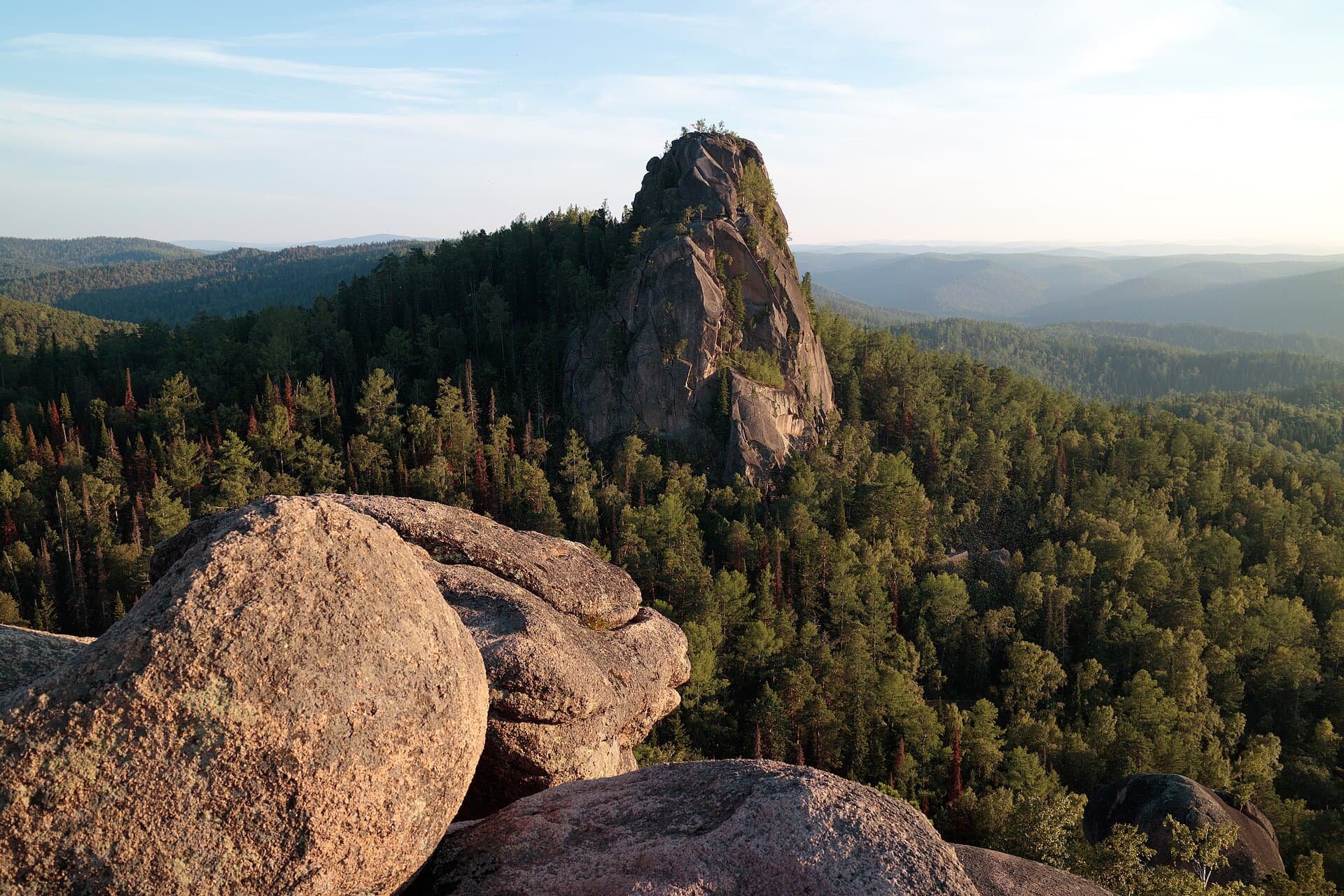
The geology is real and old. The pillars are quartz-syenite intrusions on the order of 600 million years old; the park counts hundreds of outcrops, with roughly sixty standing 50–100 m tall (Wikipedia). The First Pillar rises about 87 m above its own base; the Second, the tallest of the central group, about 96 m. By the standards of the world's great walls these are not big. Yosemite's faces are 900 m and sit deep in the Sierra. Stolby's tallest is the height of a 30-storey building and sits a 40-minute bus ride from a city of 1.1 million.
That scale gap is exactly why the lazy comparison — "Russia's Yosemite" — misleads. It is right about one thing: the granite-cathedral, free-climbing-mecca resonance. It is wrong about everything else. Yosemite's walls are an order of magnitude larger and genuinely remote; its modern climbing scene is an imported sport. Stolby's rock is small and peri-urban, and its climbing is a 150-year-old folk tradition specific to one Siberian city. A more honest line: not Russia's Yosemite — Krasnoyarsk's own thing, hundred-metre towers at a city's doorstep, climbed rope-free for a century and a half by a subculture that turned a crag into a society.
The two Stolbys
Here is the practical consequence, and the thing the scenic framing hides. There are two places sharing one name.
One is the boardwalk Stolby: the wide forest road and the wooden eco-trail that carry the overwhelming majority of the park's roughly one million visitors a year (kras-stolby.ru, visitation statistics) up to the central pillars on a busy weekend. Most of those visitors never touch real rock. They walk up, photograph the towers, and walk down. It is a city park that happens to be in the taiga.
The other is the stolbist Stolby: the rope-free climbing on a handful of named pillars, practiced year-round, including in deep Siberian winter, by a minority who inherited the ethic. The galoshes, the khody, the proverbs, the painted "Freedom" — that Stolby is still alive, but it is not what the day-trip crowd comes for, and it is not something you join by buying a ticket.
Knowing which one you're visiting changes the trip. If you want the boardwalk, go on a weekday morning and you'll have a pleasant, nearly-free half-day (the practicalities are in our trails and pillars guide). If you want to understand the rock as a culture, slow down: read the names, find the "Freedom" inscription, watch how the locals move on the syenite, and accept that the most interesting thing here is not a viewpoint.
What's changed recently
Two corrections that most English-language guides have not made:
- It is a national park, not a "nature reserve." Stolby was a strict zapovednik from 1925 — uniquely in Russia, established in 1925 at the initiative of local residents, the oldest citizen-initiated reserve in the country (rodina-history.ru, centenary coverage). But by government decree of 28 November 2019, effective 4 December 2019, it was reclassified as the National Park "Krasnoyarsk Stolby" (Russian Ministry of Natural Resources, 2019). Guides that still call it "Stolby Nature Reserve" and describe strict-reserve access rules are out of date.
- Reaching it as a foreigner in 2026 is the hard part — and it has nothing to do with the rock. The park is nearly free and a ₽26 bus ride from the city. Getting into Russia is the obstacle: no foreign bank cards work, no direct flights, voided Western insurance, and standing "do not travel" advisories. That is a whole article in itself — see Can you even go? Stolby's 2026 reality check.
The towers will photograph beautifully either way. But you'd be photographing a culture, not a crag — and that's the only frame that does Stolby justice.
7 Sources
- kras-stolby.ruKrasnoyarsk Stolby National Park — official history page
- kras-stolby.ruKrasnoyarsk Stolby National Park — official 'About the park' page
- kras-stolby.ruKrasnoyarsk Stolby — official news: park again in Russia's top-5 by visitation
- unesco.ruUNESCO Commission of the Russian Federation — 'The Giants of Siberia. 100 Years of the Krasnoyarsk Pillars National Park'
- rbth.comRussia Beyond — 'Rocks of freedom: What you didn't know about rock climbing in Siberia'
- publications.americanalpineclub.orgAmerican Alpine Club — obituary of Vitaly Mikhailovich Abalakov (1906–1986)
- knife.mediaKnife.media — 'Кровавые камни' (stolbizm long-read)