The one distinction that matters
There are two completely different acts at Stolby, and English-language pages routinely blur them.
The first is walking to the base of the pillars. That is non-technical. From the central entrance you climb a wide gravel and asphalt forest road, starting with a 1.3 km wooden boardwalk eco-trail, and end up standing at the foot of the First Pillar, the Second, Ded, Perya, and the rest. It is a long, moderate uphill walk on a road. No hands required.
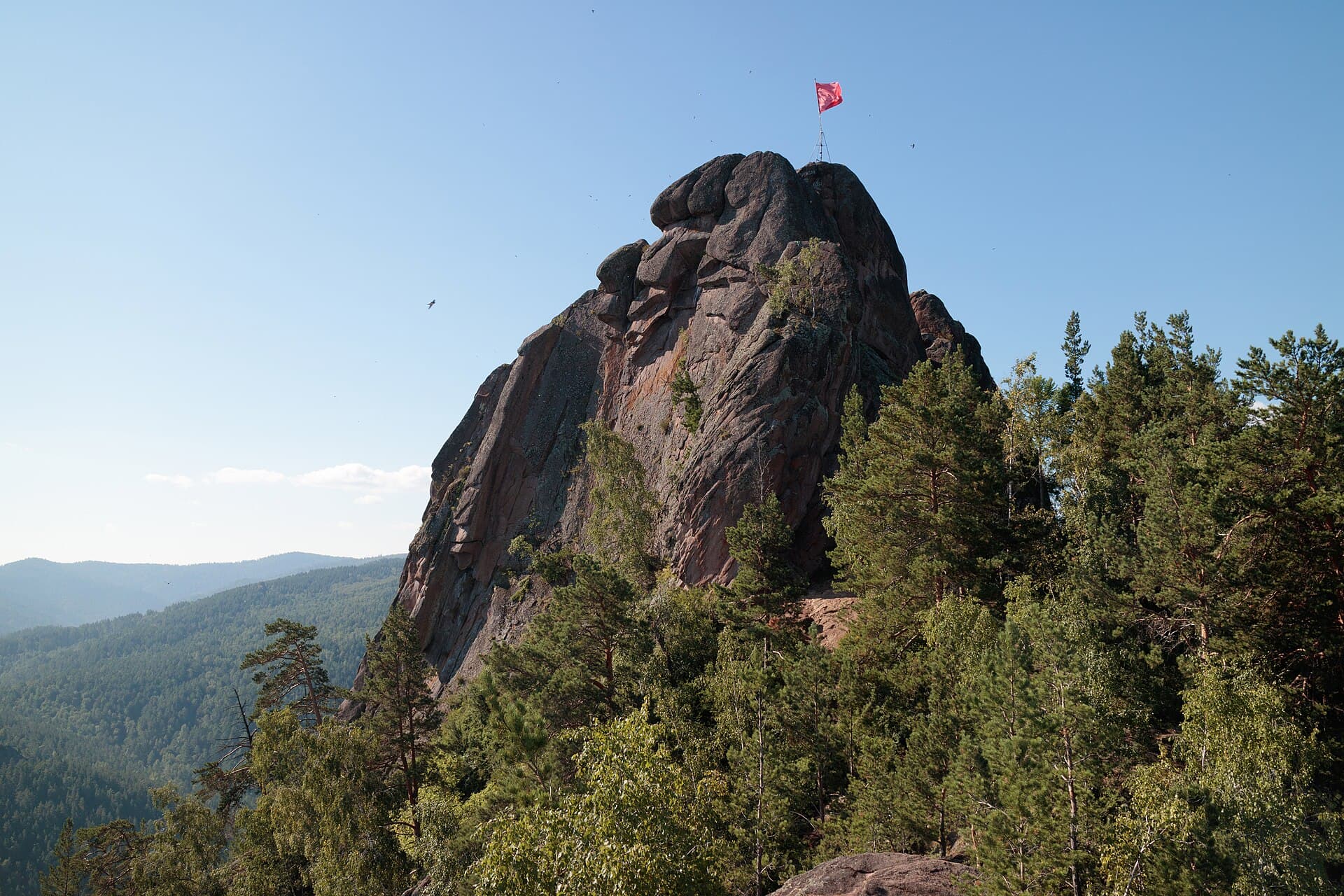
The second is getting on top of a pillar. That is free-soloing. There is no via ferrata at Stolby, no cables, no fixed protection, no bolts, and no stairs on the tourist pillars. The rock is rounded quartz-syenite that you climb on friction — your shoe rubber against bare, often slightly convex stone — with named routes (khody) that range from low scrambles to genuine free-climbs. In the purist stolbist ethic, a route counts as climbed only if you complete it alone and without equipment (Wikipedia (ru), "Столбизм"). That is not a marketing slogan. It is the literal physical reality on the rock: if you go up, you go up unroped, and if you fall, nothing catches you.
Hold those two acts apart for the rest of this article. Almost everything that goes wrong at Stolby comes from a visitor who walked to the base, watched it look easy, and started up without understanding which act they had just begun.
For the cultural backstory — why people climb rope-free here at all, the galoshes, the cabin communes, the painted "Freedom" — read the reframe. This piece is the practical and safety counterpart.
Walk-up, scramble, or free-solo: a pillar-by-pillar reality check
The table below sorts the experience by what your body actually has to do, not by what the photos suggest. Heights are above each pillar's own base, drawn from the official park site and Russian climbing sources; treat them as approximate.
| Pillar / formation | Walk TO the base | Getting ON TOP | Notes |
|---|---|---|---|
| First Pillar (Pervyy Stolb) | Non-technical road walk | Free-solo only; ~87 m above base, base perimeter 660 m | The classic. Looks approachable from below; the upper rock is friction free-soloing (kras-stolby.ru, First Pillar) |
| Second Pillar (Vtoroy Stolb) | Non-technical road walk | Free-solo, among the harder/iconic; ~96 m, tallest of the central group | Where the "Свобода / Freedom" inscription is. Multiple deaths here (see below) |
| Ded (Grandfather) | Non-technical road walk | Free-solo; ~40 m north wall, ~28 m from base on the south side | Site of the first organized rock-climbing competition, June 1950 (Wikipedia (ru)) |
| Perya (Feathers) | Non-technical road walk | Free-solo, exposed vertical blades ~30 m | Iconic and unforgiving; a legendary climber fell here in 1989 |
| Takmak / Chinese Wall (Takmakovsky district) | Loop trails with steep ascents | Free-solo on massive syenite | Reached from the eastern entrance / Bobrovy Log, not the central road (trekkingmania, official routes) |
| Deep-zone formations (Manskaya Stenka, Manskaya Baba) | Not in the current approved visitor-route inventory | — | In restricted/protected zoning; do not treat old route lines as permission to visit unless the park publishes a current passported route (official routes; Wikipedia, Krasnoyarsk Pillars) |
The pattern is the same on every famous pillar: the approach is a walk, and the summit is a free-solo. There is no middle "with a handrail" option built into the rock.
Continue reading Krasnoyarsk Pillars is not a crag with climbers. It's a 150-year-old free-solo society that happens to have rocks. →
The galoshes are not nostalgia
The signature stolbist footwear is kaloshi (галоши / калоши) — ordinary rubber galoshes. The usual way this is told makes it sound quaint: there were no Soviet-made climbing shoes until the 1990s, so early climbers used lapti (bast sandals), then discovered in the early twentieth century that rubber overshoes gripped the syenite better than anything else, even wet, and the galosh became the badge of a real stolbist (Wikipedia (ru); Knife.media, "Кровавые камни").
The part that gets lost is that this is a safety fact, not a heritage fact. Stolby is climbed on friction. On rounded syenite with no positive holds and no protection, the only thing keeping you on the rock is the coefficient of friction between your sole and the stone. Soft rubber on dry syenite has a lot of it; a hiking-boot lug sole, a worn trainer, or anything on wet or icy rock has dangerously little. The galosh tradition exists because Krasnoyarsk climbers, over six generations of unroped climbing, converged on the footwear that fails least often on this specific rock.
For a visitor the practical translation is blunt. If you are only doing the walking routes, you want sturdy hiking footwear with good grip plus tick-protective clothing — nothing exotic. If you are even thinking about touching the rock, understand that footwear here is life-safety equipment, not a fashion or comfort choice, and that the locals who climb this rock chose their soles deliberately. The rock does not care that your shoes were expensive.
What the 2026 rules actually say
For a while, English and even some Russian coverage carried scare stories that free-climbing at Stolby had been banned or fined. The park director's clarification, reported on 13 February 2026, corrected that (krsk.aif.ru, "Без штрафов," 13 Feb 2026). The actual position:
- Free-climbing remains legal for ordinary adult visitors. The director's line was that "for the ordinary visitor little has changed." There are no fines for an ordinary adult who free-climbs.
- Minors may not free-climb except under certified instructors in official training.
- Commercial tour packages may not include rock climbing. A guided day tour can take you to the pillars; it cannot sell you the act of climbing them as part of the package.
- Guides and tour operators must now be accredited — training plus an exam. Unregistered guides may not lead groups.
- Logbook registration at the Central and Eastern entrances: visitors are asked to sign in on arrival and out on departure. Rescue services note that many people skip it, which slows searches when someone goes missing. Sign the book — it is the cheapest safety measure available and it costs nothing.
So the legal picture is permissive toward the solo adult and restrictive toward the commercial and the underage. None of that changes the physics. Legal and survivable are different questions, and the rest of this article is about the second one.
The safety doctrine the locals already wrote
Stolbizm is a rope-free culture that has been killing and burying its own for over a century, and it distilled what it learned into proverbs that function as a safety doctrine. Two of them carry the whole thing:
- "Никогда не переоценивай свои силы" — never overestimate your strength.
- "Риск имеет границы, за ними — глупость" — risk has limits; beyond them lies stupidity (Wikipedia (ru)).
These are not decorative. In a discipline with no protection, the only margin you have is the gap between what you can do and what you attempt, and the deaths cluster in that gap — people who went up something they could climb but could not reliably down-climb, or who misjudged the rock's condition. The stolbist creed treats turning around as a skill, not a failure. A visitor who internalizes only those two lines will be safer than one who has read every route description.
The rescue reality and the toll
Stolby is rescued by the Krasnoyarsk rescue service / MChS (the regional branch of the Russian emergencies ministry) together with the park service; MChS publishes operational incident summaries (24.mchs.gov.ru, operational information).
The numbers are not abstract. Since 2017 there have been over 1,000 rescue call-outs, with 412 people injured, 6 deaths, and 406 people rescued; in 2025 alone there were 140 call-outs and 1 death (newslab.ru, "Кровь и камни"). The first documented death on the Stolby was a 190-metre fall in August 1897 — this place has been fatal from the beginning (newslab.ru).
Two facts in that data should reshape how a visitor thinks about risk here.
First, the deadly season is not deep winter. Accidents spike each autumn and spring, when school and student groups and casual crowds arrive and slip on wet or icy rock, or leave the marked trail. The local stolbisty who climb year-round in galoshes, including at −20 °C, are statistically safer than the September daytripper, because the daytripper is the one on greasy rock in the wrong shoes (newslab.ru). The single biggest hazard to a casual visitor is not the Siberian cold — it is the condition of the rock surface under their feet.
Second, experience is not immunity. This rock has killed people who knew it intimately. The stolbist legend Lyudmila Zvereva died on the Second Pillar in 1991, aged 74, with multiple hard routes named after her; the experienced climber Vladimir Popchenko fell roughly 190 m from the Second Pillar on 27 December 2009 (prmira.ru, "Смерти на Столбах"; newslab.ru). If decades of mastery on this exact syenite did not guarantee a margin, a visitor's confidence after one afternoon guarantees nothing at all.
Insurance: read this before you assume you're covered
Two layers of bad news stack here, and almost no English Stolby page assembles them.
Western policies are generally void in Russia. Major travel insurers — Allianz, AXA, World Nomads, Cigna, IATI — generally do not cover Russia even when they advertise "worldwide" coverage, and travelling against a standing government advisory typically invalidates cover on its own (russiable, Best travel insurance Russia 2026; World Nomads, countries covered). The practical fix is a Russian-issued policy (Ingosstrakh, AlfaStrakhovanie, Sovcombank, Soglasie); the e-visa requires medical insurance valid in Russia with a minimum of €30,000 (russiable, Russia travel insurance).
Most policies, Russian or not, exclude unroped climbing entirely. Free-soloing is a near-universal exclusion in standard travel and even many adventure-sports policies. So a visitor can do everything right — buy a Russian policy, meet the e-visa minimum — and still be completely uncovered the moment they leave the trail and put hands on the rock. Verify your policy's wording explicitly for rock-scrambling and free-climbing before you rely on it, and assume that if you free-solo here, you are self-insured against a fall. That is one more reason the honest answer below is what it is.
So should you actually free-solo here?
The honest answer, for almost every visitor, is no — not unroped, not unguided.
This is not moralizing. It is a sober reading of the act. You would be free-soloing on friction-dependent rounded rock, with no protection, in a country where your insurance probably will not pay, where Western consular help is limited outside Moscow, and where the rescue record shows the rock kills the prepared and the unprepared alike. The downside of a single mistake is not an injury claim — it is the fall.
A defensible plan for a visitor looks like this:
- Do the walking routes. Get to the bases of the central pillars on the road and trails. That is the genuinely accessible experience and it is most of what people come for.
- Watch the locals. Standing under the First or Second Pillar and watching stolbisty move on the syenite tells you more about the culture — and about how hard the "easy-looking" rock actually is — than any attempt of your own would.
- Do not free-solo unguided. If you are an experienced climber who genuinely wants to climb the rock, go with accredited locals who know the khody and the conditions, accept the legal constraints around commercial climbing, and treat their judgement about the day's rock as final.
- Use the current approved route inventory. Deep-zone formations like Manskaya Stenka and Manskaya Baba are not part of the current passported visitor-route list, and a large fraction of accidents involve people who left marked/approved routes (official routes; Wikipedia, Krasnoyarsk Pillars; newslab.ru).
The towers will reward the walk. They do not require the climb, and for the visitor the climb carries a downside the walk does not.
Gear, if you do climb
If you arrive intending to climb roped — which is not the stolbist tradition but is the only defensible way for most visitors to touch the rock — bring or buy your gear in-country. Foreign bank cards do not work in Russia and many international gear-shipping routes are blocked, so plan to source locally and pay cash.
The Krasnoyarsk shops worth knowing:
- Vertikal / "Магазинчик Вертикаль" — climbing and bouldering gear, staffed by people who climb (krasalpsnar.ru; krasnoyarsk.verticalshop.ru).
- Alpindustria Krasnoyarsk — ropes, harnesses, and protection (krasnoyarsk.alpindustria.ru).
For the walking routes you need none of this — grippy footwear and tick protection cover it. The park posts a recurring tick warning; tick-borne encephalitis is a real seasonal risk and repellent plus appropriate clothing are advised (kras-stolby.ru).
Open zones, closed zones, and registration
Stolby is a national park (reclassified from a strict reserve in December 2019), and it is zoned. The tourist-recreational area — the Central Pillars and the Takmakovsky district — is open through the park's current passported routes and eco-trails. A large protected zone containing formations like Manskaya Stenka and Manskaya Baba is not part of that visitor-route inventory. The 2026 rule of thumb is simple: use the approved routes published by the park; old OSM route lines are not proof of current permission (official routes; Wikipedia, Krasnoyarsk Pillars).
The park is open around the clock but explicitly recommends daylight visits, and asks visitors at the Central and Eastern entrances to sign the logbooks coming and going (kras-stolby.ru; krsk.aif.ru, 13 Feb 2026). Sign in. If something goes wrong, the logbook is what tells rescuers you are out there.
What's changed recently
The Februrary 2026 clarification is the development that matters for this article, so to state it plainly in one place:
- Free-climbing is still legal for ordinary adults, with no fines — correcting earlier reports that it had been banned or penalized.
- Minors may not free-climb except under certified instructors.
- Commercial tour packages may not include rock climbing.
- Guides must be accredited (training and exam); unaccredited guides may not lead groups.
- Logbook registration at the Central and Eastern entrances is now the expected norm.
All of it is from the park director's 13 February 2026 statement (krsk.aif.ru). None of it changes the fact that the tourist pillars have no fixed protection and that going up means going up unroped.
The short version
Walk to the bases — it is a non-technical road-and-trail outing and most of why people come. Getting on top is free-soloing on friction syenite with nothing to catch a fall, which is legal for adults but excluded by most insurance and lethal to people who misjudge it, experienced and inexperienced alike. The deadly seasons are autumn and spring, on wet and icy rock, not deep winter. Sign the logbook, stay on marked trails, wear footwear you trust, and if you want to actually climb, go with accredited locals rather than alone. For most visitors the right move is to walk up, watch the stolbisty, and not free-solo.
When you're planning the rest of the trip, the trails and pillars guide covers the routes and distances, when to go covers the seasons and the rock-condition windows, and the history explains the century of climbing and dying that wrote the safety doctrine above.
9 Sources
- kras-stolby.ruKrasnoyarsk Pillars National Park — official site (kras-stolby.ru)
- kras-stolby.ruKrasnoyarsk Pillars park — First Pillar (Pervyy Stolb) page
- krsk.aif.ruAiF Krasnoyarsk — 'Без штрафов': new Stolby visiting rules (13 Feb 2026)
- newslab.ruNewslab — '«Прямых запретов нет»': Stolby rules explained (Feb 2026)
- newslab.ruNewslab — 'Кровь и камни: самые громкие трагедии Столбов'
- gnkk.ruNash Krasnoyarsky Kray (НКК) — 'Ходите по тропинкам' (2026)
- 24.mchs.gov.ruMChS Krasnoyarsk Krai — operational incident summaries (сводка ЧС и происшествий)
- evisa.kdmid.ruRussian MFA Consular Department — unified e-visa portal (evisa.kdmid.ru)
- worldnomads.comWorld Nomads — 'How Travel Insurance is Affected by War, Sanctions and Restrictions'