Set your expectations first
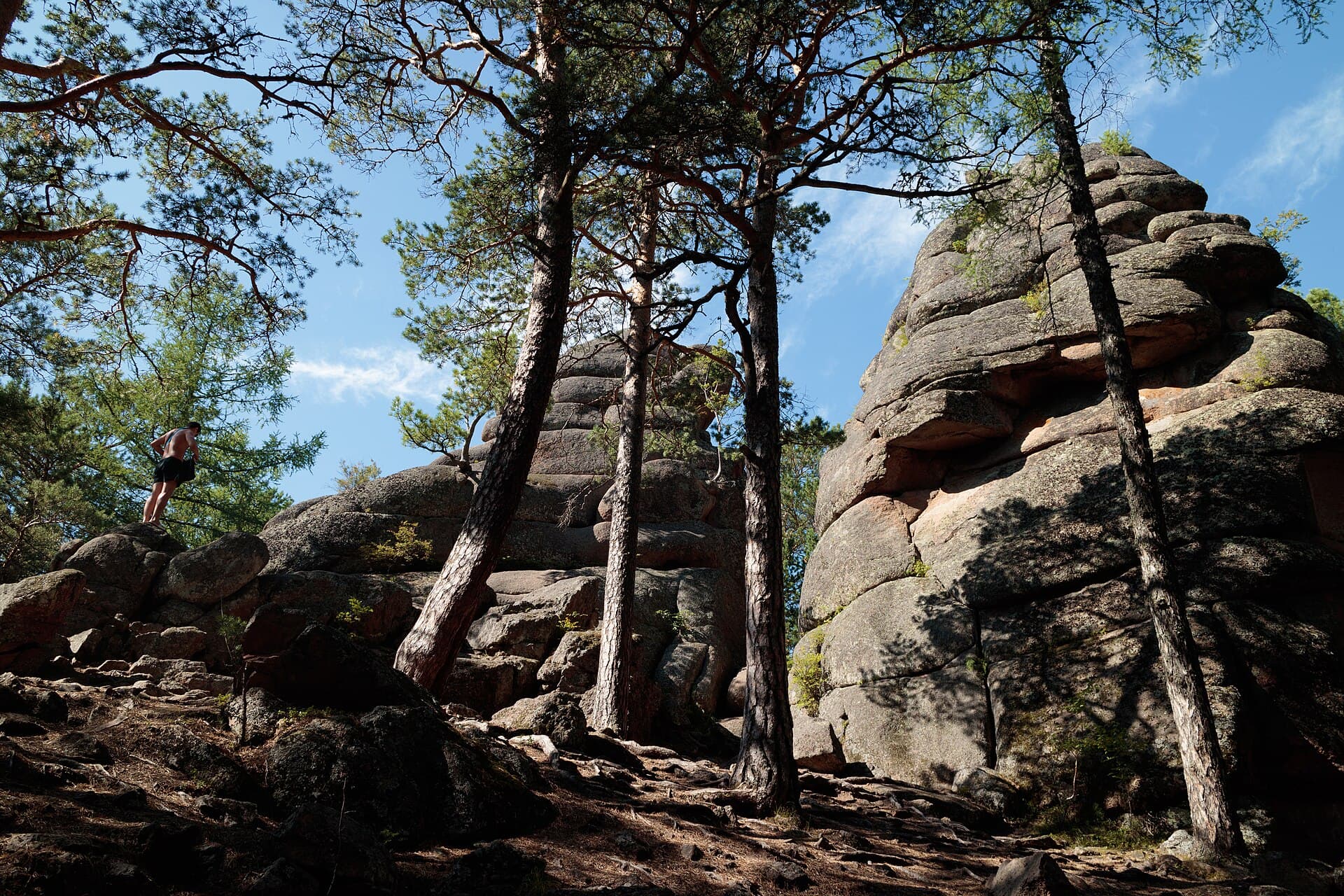
Stolby is not a multi-day trek. There is no hut circuit, no teahouse trail, no summit push. It is a large day-use forest-and-rock park on the southern edge of Krasnoyarsk, a city of 1.1 million, and the famous pillars sit roughly 10 km from town. The "hiking" is a half-day to full-day walk on a wide forest road and boardwalk to a cluster of syenite towers, where the local free-solo subculture — stolbizm — climbs the rock without ropes. (For why that culture, not the scenery, is the real story here, read our reframe of what Stolby actually is.)
This guide is for the walker: how to get to the pillars on your own two feet, which ones you can reach without climbing, and what the 2026 rules actually require. The current official inventory is narrower than older colour-route guides: since the December 2025 rule change, the park lists three passported tourist routes and four eco-trails in the recreation zone (Krasnoyarsk Stolby route page; Newslab, 30 Jan 2026). Older red and purple route lists remain useful history/orientation, not proof that those lines are open today.
One correction up front, because it changes the rules you'll read elsewhere: Stolby has been a national park since 4 December 2019, not a strict zapovednik nature reserve. It was a reserve from 1925, but the Russian government reclassified it as the National Park "Krasnoyarsk Stolby" by decree effective that date (Russian Ministry of Natural Resources, 2019). Most English-language guides — Lonely Planet, Advantour, VisitRussia and many blogs — still call it "Stolby Nature Reserve" and describe pre-2019 strict-reserve access. They are out of date.
The three ways in, at a glance
| Route | Distance / time | Effort | What you see |
|---|---|---|---|
| A. Central entrance → Central Pillars (Laletina road / "Book of Nature" boardwalk) | ~4.8 km / ~522 m gain to Pereval; ~13–15 km / 5–7 h round trip to the Central Pillars | Easy underfoot (it's a road), moderate by total ascent | The classic. Boardwalk eco-trail, then forest road, then the named central group: Slonik, First Pillar, Ded, Perya, Lion's Gate |
| B. Takmakovsky district (Takmak, Chinese Wall) from the eastern entrance | Current approved route: "Legends of Takmak" / ~6 km; older red/orange lines need re-checking against the park inventory | Steeper, more strenuous; less road, more rock | Takmak massif and the Chinese Wall outcrop — rock without the long road walk |
| C. Bobrovy Log chairlift | ~8-minute lift, then walk to the Takmakovsky rocks; denser pillar groups several km further | Least walking to get high; the rock beyond still requires a hike | Quick height gain onto the Takmak ridge; a commercial ski-resort lift, not a park facility |
The sections below detail each.
Continue reading Stolbizm for the visitor — can you climb it, should you, and how it kills the unprepared →
A. The Central entrance — the classic walk to the Central Pillars
This is the route most people mean when they say they hiked Stolby. It starts at the park stele / Laletino kordon and goes up the Laletinskaya doroga (Laletina road).
The first 1.3 km is the wooden boardwalk eco-trail "Kniga prirody" ("Book of Nature"), with 11 interpretive stops (turisticum.ru; trekkingmania route list). The boardwalk is genuinely accessible. After it ends you continue on a wide gravel/asphalt forest road — walkable, not driveable for visitors.
The distance to Pereval (the pass and service area, with benches, a picnic spot and a spring) is about 4.8 km with roughly 522 m of gain (trekkingmania route list). From Pereval, the blue "Priroda – velikiy skulptor" ("Nature, the great sculptor") loop of about 4 km takes you through Slonik, the First Pillar, Babka i Vnuchka, Ded, Lion's Gate (Lvinye Vorota), and Perya (route list).
A realistic round trip from the central entrance to the Central Pillars and back is commonly described as about 13–15 km / 5–7 hours at a tourist pace. Russian sources put the central-entrance-to-pillars distance anywhere from "almost 5 km" to about 7 km depending on where you stop (turisticum.ru; trekkingmania) — we publish the range because the sources disagree on where the walk "ends."
Difficulty: easy underfoot, moderate by total ascent. It is a steady climb on a road, not a scramble. A steeper shortcut variant called Pykhtun parallels the road for those who want to trade gradient for distance.
B. The Takmakovsky district — rock without the long road walk
If you want syenite without the long approach march, head for the Takmakovsky district, the massive-syenite cluster in the park's south-west, near Bobrovy Log. It is reached from the eastern entrance, near the "Bobrovy Log" bus stop (route 37).
The current approved visitor route here is shorter but steeper than the central road:
- "Legends of Takmak" — about 6 km from the Eastern entrance through the Chinese Wall, Storozhevoy, Borodok, Yermak, then back toward the Granite Quarry (official routes; Newslab, 30 Jan 2026).
- Older lists mention "Around Takmak", historical Takmak color labels, and an orange route to Kitaiskaya Stenka. Treat those as orientation history unless the park's current route page shows the same line as passported.
This is the district to choose if you want rock close at hand and don't mind earning it on steeper trail.
C. The Bobrovy Log chairlift — the least walking
The fastest way to gain height is the K1 four-seat open chairlift at the Bobrovy Log fanpark, which lifts you up the Takmak ridge in about 8 minutes (bobrovylog.ru). From the top station you reach the Takmakovsky rocks on foot; the denser pillar groups are several kilometres further south, so the lift shortens the climb but does not eliminate the walk.
Two important caveats. First, the chairlift is a commercial ski-resort lift, not a park facility — it has its own ticket and its own hours, separate from the (free) park. Second, the price has moved sharply. English guides still quote ₽200–280; the real recent price is far higher — an adult walking round trip is around ₽950, with older figures of ₽500 single and ₽1,600 for a day pass (bobrovylog.ru; ngs24.ru). Hours have been published as Mon–Wed 13:00–19:30, Thu–Sun 10:00–19:30 (bobrovylog.ru). Confirm both on arrival; they are inflation-sensitive.
The named pillars — which you walk to, which you climb
The pillars cluster in two areas. The Central Pillars (Tsentralnye Stolby) group sits in the park's north, within a roughly 1–2 km radius of the First Pillar. Takmak and the Chinese Wall are in the separate Takmakovsky district near Bobrovy Log.
The most important distinction for a hiker: you can walk up to the base of all the famous pillars. Getting onto or up one is a different sport. There are no via-ferrata cables, no stairs, no fixed protection on the tourist pillars. The rock is rounded syenite friction; standing on top of a pillar means free-scrambling or free-soloing, with the consequences that implies (see safety below).
A note on the numbers: the research flags several pillar heights and all precise coordinates except the First Pillar's as unverified. We therefore describe locations qualitatively rather than publishing lat/long you should not trust.
- First Pillar (Pervyy Stolb) — about 87 m above its own base, base perimeter around 660 m. The one formation with a cross-checked coordinate and height (stolby.ru; official kras-stolby.ru). You reach its base on the central blue loop.
- Second Pillar (Vtoroy Stolb) — the tallest of the Central group, height widely cited at about 96 m (secondary sources; treat as approximate). Among the harder, more iconic climbs.
- Ded ("Grandfather") — central group; north wall around 40 m, south side around 28 m from base, base perimeter around 200 m (kras-stolby.ru/tourism/rock/ded).
- Perya ("Feathers") — central group; vertical blades around 30 m, considered among the harder, most iconic stolbist climbs.
- Lion's Gate (Lvinye Vorota) — central group, on the blue loop.
- Slonik ("Little Elephant") — a small formation near the First Pillar / the "Theatre" platform.
- Takmak — Takmakovsky district; the massif top is around 540 m above sea level, the highest of the named stolby (tonkosti.ru).
- Chinese Wall (Kitaiskaya Stenka) — a fortress-wall-like outcrop in the Bazaikha valley, Takmakovsky district.
Heights for Ded, Perya, the Second Pillar and Takmak come from secondary Russian sources rather than park geodata, so we publish them as approximate. The First Pillar's 87 m is the only figure cross-checked from two sources.
A second zoning point matters for route planning: as a national park, Stolby has a large protected "wild" zone — containing formations like the Manskaya Stenka and Manskaya Baba — that is not part of the current approved visitor-route inventory. The rule of thumb for 2026 is simple: use the passported routes and eco-trails published by the park; do not treat old red/purple OSM lines as permission to wander into the deep interior (Krasnoyarsk Stolby route page; Wikipedia, Krasnoyarsk Pillars).
The 2026 rules — what actually applies
This is where most English guides are wrong, so here is the current picture, sourced.
- Entry is free for independent visitors. There is no ticket to walk in. A ₽300 recreation fee exists on paper (raised from ₽180 by decree on 5 June 2024), but for independent visitors it is covered by a regional Krasnoyarsk Krai subsidy and charged only to organized groups (tvknews.ru, 6 Jun 2024; kras-stolby.ru). Both "it's free" and "it costs ₽300" are half-true; the nuance is the subsidy.
- It's open 24/7, but daylight is recommended. The park's own wording: open around the clock, with a recommendation to visit in daylight (kras-stolby.ru).
- Logbook registration is mandatory at the Central and Eastern entrances. Visitors must sign in on arrival and out on departure. Rescue services note that many skip it, which hampers searches — this is the meaningful operational change of the last 18 months (krsk.aif.ru, 13 Feb 2026).
- Only passported routes should be treated as current. The park route page and contemporary Russian coverage list three tourist routes — Laletinsky, Nature the Great Sculptor, and Legends of Takmak — plus four short eco-trails. Older colour-route articles predate this filter and should not be used as the legal inventory (Krasnoyarsk Stolby route page; Newslab, 30 Jan 2026).
- Guides must now be accredited. As of 2026, guides and tour operators must be officially accredited (training plus exam); unregistered guides may not lead groups (krsk.aif.ru, 13 Feb 2026).
- Free-climbing remains legal for ordinary adults — with limits. The park director confirmed in February 2026 that "for the ordinary visitor little has changed," and that earlier scare stories about fines were wrong: there are no fines for ordinary free-climbers. But free-climbing by minors is prohibited except under certified instructors in official training, and commercial tour packages may not include rock climbing (krsk.aif.ru, 13 Feb 2026).
- Tick-borne encephalitis is a real seasonal risk. The official site posts a recurring tick warning. Use repellent and tick-protective clothing; vaccination is advised for the season (kras-stolby.ru).
For the full sanctions-and-advisories side of visiting in 2026 — bank cards, flights, insurance — see Can you even go? Stolby's 2026 reality check. For the climbing itself, see our stolbizm climbing guide, and for timing, when to go to Stolby.
Getting from the city to the trailhead
Everything runs on cash. Foreign-issued Visa, Mastercard and Amex do not work anywhere in Russia, so plan to pay buses, the chairlift and any vendors in rubles you've exchanged in advance.
- Central entrance: city buses № 19, 50, 78 (and weekend № 80) to the stop "Turbaza", then about a 200 m walk; roughly 40–50 minutes from the city. Fare is around ₽26 (thesandyfeet day-trip guide; tudali.ru). Verify the current fare on arrival; it is inflation-sensitive.
- Eastern entrance / Takmak / Bobrovy Log: bus № 37 to the "Bobrovy Log" stop (thesandyfeet).
- Taxi: Yandex Go works and is recommended, but a foreign-issued card won't fund the in-app wallet — keep cash.
The road to both entrances is paved; the in-park ascent is the wide gravel/asphalt forest road described above.
Safety — the honest version
The single biggest hazard to a casual visitor is not the Siberian cold. It is ice or wet on the rock.
Since 2017 the Krasnoyarsk rescue service has logged over 1,000 call-outs at Stolby, with 412 people injured, 6 deaths and 406 rescued; 2025 alone saw 140 call-outs (newslab.ru, "Krov' i kamni"). The pattern is consistent and counter-intuitive: accidents spike in autumn and spring, not deep winter — driven by unprepared visitors in the wrong footwear slipping on wet or icy rock, or leaving the marked trail. Local stolbists climbing year-round in galoshes are statistically safer than September daytrippers in smooth-soled shoes. This is exactly why the 2026 logbook registration push matters operationally.
For a walker, the takeaways are concrete: sign the logbook, stay on the marked trails, wear footwear with real grip, treat wet or iced rock as a no-go, and do not attempt to climb a pillar you can only walk to. Note also that most Western travel insurance is void in Russia under sanctions, and most policies exclude unroped climbing entirely — verify your own cover before you go (the access article covers this in detail).
What's changed recently
If you've read an older guide, here is what to update:
- It's a national park now, not a "nature reserve." Reclassified 4 December 2019; reserve-era access language no longer literally applies (MNR, 2019).
- Logbook registration is now mandatory at the Central and Eastern entrances, and guides must be accredited (krsk.aif.ru, 13 Feb 2026).
- The fine scare was wrong. Ordinary adult free-climbing is still legal and unfined; the new restrictions target minors, commercial climbing tours and unaccredited guides (krsk.aif.ru, 13 Feb 2026).
- The chairlift costs ~₽950 round trip, not ₽200–280 — English blogs quote pre-2022 prices (bobrovylog.ru).
- A ₽300 recreation fee exists on paper but is subsidy-covered for independents and billed to organized groups (tvknews.ru).
- The digital-permit channel is a moving target. Earlier 2024 coverage expected a Gosuslugi channel for the recreation zone in July 2026; treat that as stale planning context and check the park's own visitor pages for the current process (tvknews.ru; kras-stolby.ru).
Walk it for the towers if you like — but go knowing it's a city-edge national park with year-round access and a real subculture on the rock, not the strict, hard-to-reach Siberian reserve the old guides describe.
9 Sources
- kras-stolby.ruНациональный парк «Красноярские Столбы» — official site
- kras-stolby.ruКрасноярские Столбы — Правила посещения (visitor rules)
- kras-stolby.ruКрасноярские Столбы — Первый столб (First Pillar) rock page
- trekkingmania.ruОфициальные маршруты национального парка «Столбы» (route list)
- bobrovylog.ruФанпарк «Бобровый лог» — канатно-кресельная дорога К1
- krsk.aif.ruАиФ Красноярск — «Без штрафов. Новые правила посещения Столбов» (13 Feb 2026)
- tvknews.ruТВК Красноярск — платный вход на «Столбы»: 300 рублей? (6 Jun 2024)
- stolby.ruКлуб столбистов (stolby.ru) — Первый столб
- newslab.ruNewslab.ru — «Кровь и камни: самые громкие трагедии Столбов»