The Chadar was not a trek
Before the Chadar was a product sold on adventure travel websites, it was infrastructure. The frozen Zanskar River -- Chadar means "blanket" in Hindi and Urdu, referring to the sheet of ice -- was Zanskar's only winter connection to the outside world for centuries.
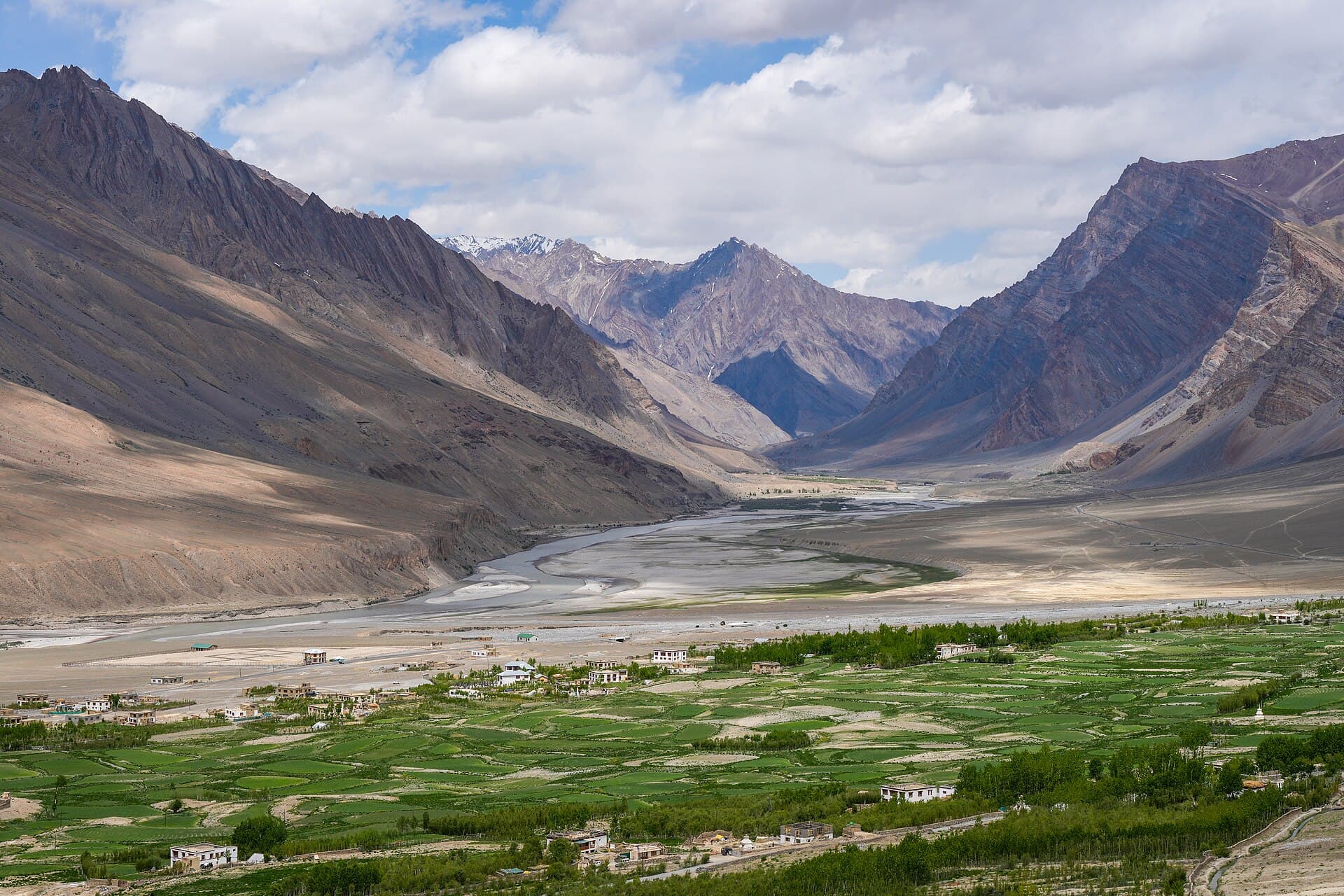
Zanskar is surrounded by the Great Himalayan Range to the southwest and the Zanskar Range to the northeast. The entire hydrographic system drains through the Zanskar River, which cuts a deep, narrow gorge inaccessible by any path other than the riverbed. When passes above 5,000 m close under meters of snow from October to May, the frozen river was the sole route out. Goods moved on it. Sick and injured Zanskaris were carried on it to hospitals in Leh. Children walked it to reach schools. Government officials used it to maintain contact with the valley.
The first road to Zanskar (Kargil to Padum via Pensi La, 235 km) was built in 1979. Even after the road, winter isolation continued because Pensi La (4,401 m) closes from roughly October through May. The Chadar remained a functional necessity into the modern era -- not a relic of pre-industrial times, but a living supply line used within the memory of people alive today.
Zanskar opened to foreign visitors in 1974. The Chadar as a recreational trek gained traction in the 1990s and 2000s, though no single source provides a definitive start date. By the 2010s, it was one of the most iconic adventure treks on Earth.
What happened in winter 2025-26
For the first time in living memory, the Zanskar River did not freeze sufficiently for safe passage. Authorities suspended the trek indefinitely after January 20, 2026. The threshold -- 30-35 km of continuous solid ice, minimum 6-10 feet thick [thickness figure from operator sources; no government standard published] -- was never met.
Climate data:
- Winter 2025-26 was the warmest in eight years.
- Average December-February temperature: -8.6 C. Historical norms saw peaks near -30 C.
- August 2025 rainfall: 80.3 mm -- the highest in 15 years, an indicator of destabilized precipitation patterns feeding into the freeze cycle.
The road factor: The Nimmu-Padum-Darcha road (298 km), built by the Border Roads Organisation and fully operational since March 2024, runs through the Zanskar gorge. Construction debris entered the river and disrupted ice formation. The road that is replacing the Chadar as Zanskar's link to the outside world is simultaneously destroying the conditions that made the Chadar possible.
This is not a simple climate story. It is an infrastructure-versus-heritage conflict. The road serves genuine military and civilian needs -- the Indian Army explicitly describes it as "strategic... set back from the international border", and Zanskar's 13,793 residents deserve year-round connectivity. But the physical reality is that road construction in the gorge degrades the conditions that allow the river to freeze.
Continue reading The river didn't freeze, the peak is closed, and the palace came first. →
Recent year-by-year
| Year | Status | Details |
|---|---|---|
| 2024 | Truncated | Route shortened due to NPD road construction. 584 trekkers participated (65 foreigners). Down from typical 700-800. |
| 2025 | Delayed, then proceeded | Scheduled January 7, postponed to January 13 due to delayed freeze. First batch flagged off January 13. |
| 2026 | Cancelled entirely | River never froze. First total cancellation in living memory. |
The trend line across three years: shortened, delayed, cancelled. No data is publicly available for systematic year-by-year cancellations before 2024 -- ALTOA likely holds this history but does not publish it online.
The route: Chilling to Nerak
When the Chadar forms and the trek operates, the route follows the frozen Zanskar River from Chilling (3,200 m) to Nerak (~3,400 m), approximately 105 km through a gorge inaccessible by any other means in winter.
Duration: 8-10 days including Leh acclimatization. Trekking days are typically 4-6, depending on ice conditions and group pace.
Terrain: Frozen river. Not flat ice -- the Chadar is uneven, broken, refrozen, covered in snow patches, interrupted by sections where the ice has not formed and trekkers must scramble along the gorge walls on narrow ledges. The river does not freeze uniformly. Sections that were solid in the morning can crack by afternoon as temperatures shift. Walking on the Chadar requires constant assessment of ice quality underfoot.
The gorge: Vertical rock walls rise hundreds of meters on both sides. In many sections, the gorge is narrow enough that sunlight does not reach the river floor until midday. This is what creates the cold necessary for ice formation -- and what makes it feel like walking through a frozen cathedral.
Camps: Caves and overhangs along the gorge walls serve as sheltered camping spots. Trekkers sleep in tents on the riverbank or on ice. No permanent structures exist along the route.
Nerak: The turnaround point is the village of Nerak, accessible only via the Chadar in winter. A frozen waterfall at Nerak is one of the visual highlights. The return follows the same route back to Chilling.
What the trek is like when it works
Temperature: -15 C to -35 C. Daytime temperatures on the ice hover around -15 to -20 C in direct sun sections, dropping to -25 to -35 C in shadowed gorge sections and overnight.
Daily routine: Wake before dawn. Pack camp. Walk 5-7 hours on ice. Reach the next cave or overhang. Set camp. Eat. Sleep. The gorge amplifies cold -- there is no escape from it. Layering is constant: base layers, insulating layers, windproof shell, balaclava, double gloves, insulated boots.
The ice: Ranges from smooth and blue (old, solid ice) to white and opaque (newer, potentially weaker). Sections of open water appear where the current is too fast or too warm for freezing. These must be bypassed by climbing the gorge walls -- scrambles that can be steep, loose, and exposed. Trekkers are roped in dangerous sections.
Sound: The river is audible beneath the ice at all times. The Chadar groans, cracks, and shifts. This is normal. What is not normal is a sudden crack that opens visibly -- that means move immediately.
Rescue: Extremely limited. No helicopter can access the gorge. No mobile phone coverage exists inside it. Satellite phones are prohibited for civilian use in India -- the military will confiscate them. Evacuation is on foot or horseback to Chilling, then by road to Leh. If someone develops serious AMS, frostbite, or a fracture in the middle of the gorge, they must be physically carried out. This is a multi-hour to multi-day process depending on location. There is no shortcut.
Cost breakdown
| Item | Cost | Notes |
|---|---|---|
| Chadar trek package (8-10 days) | INR 19,500-22,500 / USD 235-270 per person | Includes permits, guide, food, camping gear, Leh transfers |
| Delhi-Leh flight (January) | INR 7,500-11,000 / USD 90-130 one-way | Fewer winter flights; cancellations more frequent |
| Leh accommodation (2 nights acclimatization) | INR 500-2,000/night | Budget guesthouse to mid-range |
| Warm clothing rental (Leh) | INR 500-1,500 | Down jacket, sleeping bag, insulated boots available for rent |
| Travel insurance (mandatory for NOC) | Varies | Must cover high-altitude trekking in winter conditions |
| Total budget estimate | INR 35,000-45,000 / USD 420-540 | Per person, excluding Delhi airfare |
The package price is low compared to comparable treks globally because it is priced for the Indian domestic market. The all-inclusive INR 19,500-22,500 covers everything except the flight to Leh and personal gear. This makes the Chadar one of the cheapest high-altitude winter treks in the world -- if it operates.
Permits and requirements
| Requirement | Details |
|---|---|
| ALTOA No Objection Certificate (NOC) | Mandatory. Obtained after medical clearance. Processed through your operator. |
| Medical fitness certificate | From a designated medical centre in Leh. Required before NOC is issued. |
| Wildlife permit | Hemis NP / Zanskar gorge. INR 6,000-8,000, paid on-site or through operator. |
| Adventure travel insurance | Mandatory for NOC. Must cover winter trekking and high-altitude conditions. |
| Registered guide/operator | Mandatory. Independent Chadar treks are not permitted. Must go with a registered ALTOA operator. |
The Chadar is the only Ladakh trek where a guided package is legally required. The permit system is designed to control group sizes and ensure minimum safety standards. The NOC process includes a medical screening in Leh -- trekkers who fail the medical are not allowed to proceed.
The Nimmu-Padum-Darcha road
The road that is replacing the Chadar deserves its own section because understanding it is essential to understanding the Chadar's future.
The Nimmu-Padum-Darcha road is a 298 km highway connecting Leh (via Nimmu) to Zanskar (Padum) to Himachal Pradesh (via Darcha). Construction began in the 1970s as the "Chadar Road" project -- named for the very route it would eventually replace. The BRO took over in 1999 after the Kargil War. A remarkable 38 km section was built between 2014-2017 by a retired government employee, Tsultrim Chonjor, using personal funds before the BRO resumed.
The road became fully operational in March 2024. It crosses Shingo La at 5,091 m and is passable June through October. BRO continues blacktopping and widening to 7.5-9 m carriageway.
The under-construction Shinku La Tunnel (4.1 km, four lanes) targets August 2028 completion. When finished, the Nimmu-Padum-Darcha road becomes an all-weather route. Zanskar will have year-round road access for the first time in recorded history. The Chadar's historical function -- winter connectivity -- will be permanently obsolete.
The road's strategic dimension is explicit. It is described as facilitating safe troop movements set back from the international border. Every tunnel and highway in Ladakh has dual military-civilian purpose, a legacy of the 1999 Kargil War in which Pakistani shelling nearly cut the single supply route (NH1) to Leh.
Is the Chadar over?
An honest assessment requires separating three questions.
Is the Chadar's historical function over? Yes, or it will be within two years. The Nimmu-Padum-Darcha road already provides summer access. The Shinku La Tunnel will provide winter access by 2028. The frozen river is no longer needed as a supply line. This is not a loss for Zanskar's residents -- year-round road access is a generational improvement in quality of life, medical access, and economic opportunity. It is a loss only for the tourism product built on Zanskar's isolation.
Is the Chadar trek permanently cancelled? Not necessarily. A single warm winter does not prove a permanent trend. But the three-year pattern (truncated, delayed, cancelled) combined with warming temperatures, road construction debris in the river, and the broader trajectory of Himalayan climate change makes the prognosis poor. No official statement exists on whether authorities will attempt the trek in winter 2026-27. The ALTOA has not announced a permanent suspension, but it has not guaranteed a return either.
Should trekkers plan for a Chadar trip? Only with full flexibility. Book cancellable flights. Arrange alternative winter activities in Ladakh (the Snow Leopard trek in Hemis National Park operates February-March with near-100% sighting rates for multi-day expeditions). Do not build a trip around the Chadar alone. If the river freezes, the experience is irreplaceable. If it does not, you will be in Leh in January with no Plan B unless you made one.
The uncomfortable truth: the Chadar may survive as an intermittent phenomenon -- freezing in colder years, failing in warmer ones -- rather than as a reliable annual trek. This makes it harder to market but not impossible. The framing is: "This may be the last generation that can walk on ice through a Himalayan gorge." That is not a sales pitch. It is the observable trajectory.
Climate context
Ladakh sits in the rain shadow of the Greater Himalaya. Annual precipitation in Leh is approximately 100 mm. The aridity that makes Ladakh a high-altitude desert also makes it vulnerable to small temperature shifts -- because the freeze-thaw balance operates on thin margins. A winter that is 2-3 degrees warmer than average is enough to prevent the Chadar from forming. The margins have always been narrow. Climate change is compressing them further.
The August 2025 rainfall of 80.3 mm -- the highest in 15 years -- indicates destabilized precipitation patterns. More rain in summer means more erosion, more sediment in the river, and potentially altered water flow during the freeze window. The climate signal is not just temperature. It is systemic instability in the weather patterns that the Chadar depends on.
The economic damage
The 2026 cancellation was devastating for gorge communities. One homestay operator who typically earns approximately INR 300,000 from 70-80 trekkers reported almost zero visitors. This is not abstract economic data. The Chadar season was the primary winter income source for families in Nerak, Tibb, and other gorge settlements. Without it, families struggle with school fees, heating fuel, and basic household expenses during the coldest months of the year.
The broader tourism crisis compounds the problem. Ladakh received 75,089 visitors in June 2025 versus 153,711 in June 2024 -- a 51% drop driven by the Pahalgam terror attack, Operation Sindoor airport closures, record rainfall, and the Sixth Schedule protests. The Finance Department declared Ladakh disaster-affected. The 2026 season is a recovery year for the entire territory.
The economic future for Chadar communities depends on whether the road brings alternative livelihood options fast enough to replace the trek income that is disappearing. Zanskar was officially notified as a new district in April 2026 with headquarters at Padum -- administrative recognition that may bring government investment. But Zanskar's population is 13,793. The communities along the gorge number in the hundreds. The transition from ice-dependent to road-dependent economy is not guaranteed to work for everyone.
Practical: if you go
Window: January to mid-February. The trek is typically flagged off in the first or second week of January. The 2025 season started January 13 after a delay.
Duration: 8-10 days total from Leh, including 2-3 days acclimatization. Trekking days: 4-6.
Operator: Mandatory. Select a registered ALTOA operator. Package costs INR 19,500-22,500. Verify that the package includes permits, medical screening, guide, food, camping gear, and Leh transfers.
Gear: Extreme cold weather kit. Down jacket rated to -30 C. Insulated sleeping bag rated to -30 C. Insulated boots. Gaiters. Balaclava. Double gloves (liner + shell). Hand and toe warmers. Sunglasses (snow/ice glare is severe). Much of this is available for rent in Leh.
Physical preparation: The Chadar is not technically difficult -- it is flat walking on ice. The challenge is the cold. Extended exposure to -20 to -35 C for days drains the body faster than altitude or distance. Core fitness, cold tolerance, and previous winter camping experience are more relevant than trekking fitness.
Medical: AMS protocol applies -- Leh is at 3,524 m and the Chadar route does not gain significant altitude, but the cold compounds altitude effects. The mandatory medical screening in Leh checks blood pressure, oxygen saturation, and basic fitness. Trekkers with cardiac or respiratory conditions are typically turned away.
Communication: No mobile coverage in the gorge. Satellite phones are illegal in India. Your operator carries a radio or reaches a road for emergency contact. Accept this limitation before committing.
What to bring that guides do not mention: A book. A deck of cards. Evenings in the gorge are long, cold, and dark. Camp is made by 3-4 PM. Sleep comes at 7-8 PM. The hours between are unstructured and there is nothing to look at but rock walls and ice.
8 Sources
- leh.nic.inDistrict Leh Administration — Order: SOPs for the Chadar Trek
- tribuneindia.comThe Tribune — Chadar trek postponed as Zanskar river fails to freeze
- tribuneindia.comThe Tribune — Chadar trek route on Zanskar unsafe, hazardous: Recce report
- ddnews.gov.inDD News (Prasar Bharati) — BRO connects 298-km Nimmu-Padam-Darcha road to Ladakh
- 101reporters.com101Reporters — How Chadar trek's cancellation has hit Ladakh's winter economy
- dst.gov.inDept. of Science & Technology (Wadia Institute) — Rising temperature and low winter precipitation retreating Zanskar glaciers
- downtoearth.org.inDown To Earth — Ladakh's fading winter is rewriting life in the high Himalayas
- himalayanhikers.inHimalayan Hikers — Chadar Trek itinerary, dates and cost