The river did not freeze
For centuries, the frozen Zanskar River was Zanskar's only winter connection to the outside world. Passes above 5,000 m close under meters of snow from October to May. The gorge that the Zanskar River cuts through the mountains is too narrow and vertical for any road. So when the river froze -- forming a sheet of ice the locals call the Chadar, literally "blanket" -- people walked on it. Trade goods, sick children, government officials, school-bound teenagers: everything that needed to move between Zanskar and Leh in winter moved on ice.
Tourism adopted the Chadar in the 1990s-2000s. By the 2010s, it was one of the most iconic adventure treks on Earth. Eight to ten days, ~105 km, temperatures dropping to -30 to -35 degrees Celsius, walking on a frozen river through a Himalayan gorge. There is no comparable product anywhere.
In winter 2025-26, for the first time in living memory, the river did not freeze. Authorities suspended the trek indefinitely after January 20, 2026. The threshold of 30-35 km of continuous solid ice was never met. The season was the warmest in eight years, with an average December-February temperature of -8.6 C -- significantly above historical norms when peaks approached -30 C.
This was not a sudden event. The 2024 season was already truncated, with only 584 trekkers participating (down from a typical 700-800) due to a shortened route. The 2025 season was delayed from January 7 to January 13 because of a late freeze. The trend line is obvious. The question is not whether the Chadar is dying. The question is whether it is already dead.
And climate is not the only factor. The Nimmu-Padum-Darcha road, a 298 km highway built by the Border Roads Organisation that became fully operational in March 2024, runs through the Zanskar gorge. Construction debris entered the river and disrupted ice formation. The road that is replacing the Chadar as Zanskar's connection to the outside world is simultaneously destroying the conditions that made the Chadar possible. The infrastructure-versus-heritage conflict is rarely acknowledged in trekking media. It should be.
The economic impact is immediate and personal. One homestay operator who typically earns approximately INR 300,000 from 70-80 trekkers reported almost zero visitors. Families in the gorge villages struggled with school fees and household expenses. The Chadar was not just a trek. It was a winter economy.
The peak is closed
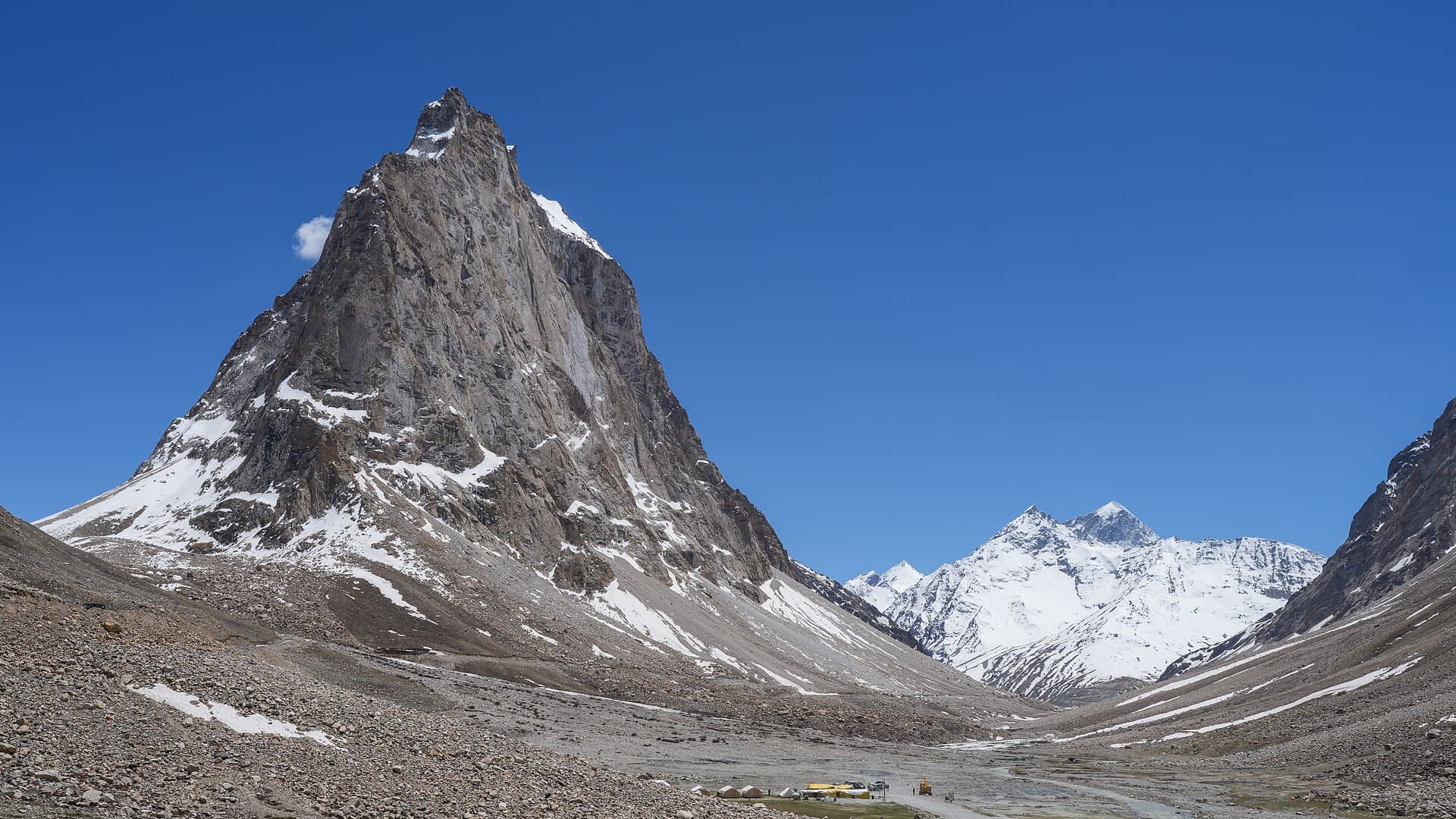
Stok Kangri (6,153 m / 20,187 ft) stands in the Stok Range south of Leh, visible from the city on clear days. For two decades it was marketed as "the most accessible 6,000-metre peak in the world" -- and the claim was genuine. The standard route from Stok Village required two days to base camp (4,969 m) and a summit day of 8-14 hours with over 1,000 m of elevation gain. No technical climbing skills required in good conditions. Base camp was a two-day walk from a road. No other 6,000 m summit offered anything comparable.
In January 2020, the Ladakh Autonomous Hill Development Council closed Stok Kangri to all expeditions. The official order: "In view of depletion of the Stok mountain glaciers and the environmental issue, it is ordered that all kinds of expedition to Stok Kangri carried out by travel agencies, Army, Air Force and paramilitary forces is temporarily closed with immediate effect."
The initial ban was announced as a three-year recuperation period (2020-2023). No reopening followed; the closure has been extended indefinitely. As of May 2026, no reopening date has been announced. The driving force was the All Ladakh Tour Operators Association (ALTOA), which advocated for the closure after years of over-tourism degraded the glacier that serves as Stok Village's water supply.
This is worth pausing on. The closure was not imposed by Delhi. It was driven by local operators who watched the glacier that supplies their own village shrink under the boots of commercial expeditions. The "accessible 6,000er" framing attracted unprepared climbers in volumes the mountain could not sustain. The ban is a case study in community-led conservation -- and in what happens when marketing overruns carrying capacity.
Several online guides and booking platforms still list Stok Kangri as available. They are either outdated or dishonest. The usual substitute is Kang Yatse II (6,250 m) in the Markha Valley.
Continue reading Chadar Trek — the frozen river that didn't freeze in 2026 →
The palace came first
Leh Palace was built circa 1600 by King Sengge Namgyal, the "Lion King" of Ladakh. Nine stories high, perched on a hilltop overlooking the Indus Valley and the old town of Leh. The Potala Palace in Lhasa -- the iconic symbol of Tibetan civilisation, the Dalai Lama's former residence, the building on every "Tibet" postcard -- was constructed in its current form in 1645 in the same architectural style. (Note: an earlier, smaller Potala structure may have existed on the site from the 7th century; the monumental palace that stands today dates to 1645.)
The original is in Ladakh. The famous version is in Tibet. Leh Palace predates the Potala by approximately 45 years.
This inverts the "Little Tibet" framing that every trekking brochure applies to Ladakh. The name implies a peripheral copy -- a smaller, secondary echo of the real thing. The architectural record suggests the opposite. Sengge Namgyal's palace on the hill above Leh came first. The Dalai Lama's palace on the hill above Lhasa came after. Ladakh was not always the margin. It was, at times, the model.
The name "Ladakh" itself derives from classical Tibetan La-dvags, meaning "land of high passes". Before this took hold, the region was called Maryul -- "the lowland" -- a name that reflected how Tibetans on the even higher Changthang plateau viewed it. The kingdom lasted from circa 930 to 1842, over 900 years of continuous monarchy, one of the longest-running Buddhist kingdoms in history.
46% Muslim
Per 2011 census data, the Ladakh Union Territory is 46% Muslim (primarily Shia), 40% Buddhist, and 12% Hindu. Leh district is majority Tibetan Buddhist. Kargil district is majority Shia Muslim. The trekking industry markets the Buddhist half and erases the other.
The Islamic presence is not recent. Between the 1380s and 1510s, missionaries including Sayyid Ali Hamadani and Sayyid Muhammad Nur Baksh converted populations in the western regions. After a Balti invasion in the early 1600s, Gyal Khatun married King Jamyang Namgyal, bringing Muslim servants and musicians to the court. "Several hundred Baltis migrated to the kingdom." Kargil's identity is closer to Baltistan (now in Pakistan-administered Gilgit-Baltistan) than to Leh. The Kargil-Leh divide is real and politically charged -- Kargil initially opposed separation from Jammu & Kashmir in 2019.
This is not a footnote. It is the demographic structure of the territory. Yet search "Ladakh trekking" and the results are monasteries, prayer flags, and butter tea. The Balti Muslims of Kargil, the Shia communities of Drass, the Purig-speaking populations along the Suru Valley -- they are as much Ladakh as Hemis Monastery. Their absence from trekking marketing is a choice, and it distorts the destination beyond recognition.
The military dimension
No other trekking region on Earth touches as many active military fault lines. Three contested borders converge in Ladakh:
- Line of Actual Control (LAC) with China -- 489 km through Ladakh. China controls Aksai Chin (38,000 sq km), which India claims as part of Leh district. China built the 1,200 km National Highway 219 across it in the 1950s; India only discovered this in 1957.
- Line of Control (LoC) with Pakistan -- runs through Kargil district. Site of the 1999 Kargil War, in which 527 Indian soldiers were killed in fighting at altitudes up to 5,485 m.
- Siachen Glacier -- the world's highest battlefield (6,000 m+, -50 degrees C). India has held it since Operation Meghdoot in April 1984. Both sides maintain thousands of troops permanently.
Combined border length: 857 km. There is no other trekking destination where permits exist because actual armies face each other across the ridgeline.
On June 15-16, 2020, the most violent India-China border clash in 45 years occurred in the Galwan River valley, eastern Ladakh. A six-hour melee using rocks, nail-studded clubs, and bare hands -- both sides observe an informal no-guns protocol. Twenty Indian soldiers were killed. Chinese casualties were never officially disclosed. The standoff lasted four years. Disengagement was achieved in December 2024, with buffer zones established and verification patrols resuming in January 2026.
The Galwan area is a restricted military zone, not a trekking destination. Standard routes (Markha Valley, Nubra, Pangong) are unaffected. But the military presence -- convoys on every highway, checkpoints at every border-area entry, fighter jets from Leh Air Force Station (one of the highest-altitude combat airfields in the world) -- is part of the Ladakh experience. It is invisible on Instagram but inescapable on the ground.
August 5, 2019
On that date, the Indian government abrogated Article 370, which had granted special status to Jammu & Kashmir. On October 31, 2019, the Jammu and Kashmir Reorganisation Act split the former state into two union territories: Jammu & Kashmir (with a legislature) and Ladakh (without one). Ladakh is now governed directly by a Lieutenant Governor appointed by the President.
What changed for trekkers: budget allocation jumped from INR 57 crore to INR 232 crore in the first year, visible in road improvements and infrastructure. The permit system was overhauled -- the Inner Line Permit for Indian nationals was eventually replaced by the Ladakh Environment/Development Fee (EDF).
What triggered local backlash: without a legislature, Ladakhis have no elected representatives making laws for them. Without Sixth Schedule constitutional protection, there are no safeguards preventing outside corporations from buying land. This is the core of the campaign led by Sonam Wangchuk) -- engineer, inventor of the Ice Stupa, inspiration for the character Rancho in 3 Idiots, and the most famous Ladakhi alive. In September 2025, protests in Leh turned violent -- four deaths, 50+ injured, a week-long curfew. Wangchuk was detained under the National Security Act for 170 days, released on March 14, 2026.
The most prominent citizen of the "last Shangri-La" spent nearly six months in detention for demanding constitutional rights. Trekking brochures do not mention this.
The road revolution
Roads are transforming Ladakh faster than any event since the 1962 border closure with China.
The Atal Tunnel (9.02 km), opened October 3, 2020, bypasses Rohtang Pass and provides year-round access from Manali to Keylong. The Nimmu-Padum-Darcha road (298 km), completed March 2024, connects Leh to Zanskar to Himachal Pradesh via Shingo La at 5,091 m. A remarkable 38 km section was built between 2014-2017 by a retired government employee, Tsultrim Chonjor, using personal funds before the BRO took over.
The Zoji La Tunnel (14.15 km), at 66.5% combined physical progress as of May 2026 with only 895 m of tunneling remaining from the eastern portal, has an expected completion date of February 2028. When open, Srinagar-Leh becomes an all-weather route. The Shingo La Tunnel (4.1 km; also called Shinku La Tunnel), under construction since May 2025, targets August 2028 and will make the Nimmu-Padum-Darcha road all-weather.
Within a decade, Ladakh goes from six-month seasonal access to year-round connectivity. Zanskar, population 13,793, is about to be connected to a billion-person road network. The first road to Zanskar (Kargil to Padum via Pensi La) was built in 1979. For all of recorded history before that, the Chadar was the only winter route out.
The BRO kept Zoji La open through the entire winter of 2025-26 for the first time in history -- even before the tunnel completes. Ladakh's winter isolation is ending.
Every new highway and tunnel has dual purpose. The Nimmu-Padum-Darcha road is explicitly described as "strategic for the Indian Army as it is set back from the international border and can facilitate safe troop movements." The 1999 Kargil War, in which Pakistani shelling threatened to cut the single supply route (NH1) into Leh, drove the road-building frenzy that followed. The trekker drives on military infrastructure.
The tourism crisis
In June 2025, Ladakh received 75,089 visitors versus 153,711 in June 2024 -- a 51% drop. Full-year 2025 visitors totaled approximately 335,872, roughly 10% below 2024. The causes compounded: the Pahalgam terror attack in April, Operation Sindoor airport closure in May (80% booking cancellations), record rainfall and road closures in August, and the Sixth Schedule protests turning violent in September.
Hotels in Leh have increased 30% over three years. Registered taxis grew from 3,646 in 2022 to over 5,500. The Finance Department declared Ladakh disaster-affected to offer loan relief. The industry is pushing for a recovery in 2026, but the structural oversupply remains.
Meanwhile, satellite phones are prohibited for civilian use in India -- the military will confiscate them. This creates a genuine safety gap on remote treks where there is no mobile coverage. In Nepal, sat phones are standard safety equipment. In Ladakh, rescue from remote locations depends on physically reaching a village or road, potentially while suffering acute mountain sickness. Helicopter rescue exists but is slower than Nepal's: Indian Air Force helicopters can respond within approximately two hours, but the process requires insurance company notification, embassy coordination, DC Office clearance, and military sign-off. No civilian helicopter operators fly in Ladakh. Only the IAF.
The sat phone ban and the permit maze
The satellite phone prohibition is worth isolating. In Nepal, a trekker on a remote route carries a satellite phone or a personal locator beacon. If something goes wrong -- AMS, a fall, sudden weather -- they press a button and a helicopter comes. In Ladakh, carrying a satellite phone is illegal. If something goes wrong on the Chadar, in the Zanskar gorge, or on the Rumtse-Tso Moriri traverse, the only option is to walk or be carried to the nearest village with a road. That can be hours or days.
The permit system reflects the same military logic. Foreign nationals require a Protected Area Permit (PAP) processed through a registered Leh travel agent. Indian nationals pay the Environment Development Fee (EDF): INR 400 one-time plus INR 20/day wildlife fee plus INR 50 Red Cross fee. Pangong Tso, Nubra Valley, Tso Moriri, and the Hanle Dark Sky Reserve each require specific permits. The Hanle permit has a strict daily cap and must be secured three or more weeks in advance. Citizens of Afghanistan, Bangladesh, China, Myanmar, Pakistan, Sri Lanka, and holders of diplomatic/journalist/UN passports must apply through the Ministry of Home Affairs in New Delhi -- not in Leh. Processing can take a month.
The permit system descends from the Bengal Eastern Frontier Regulation of 1873, originally designed to control movement near international borders, not to manage tourism. It was a security instrument. It still is. The "spiritual Himalaya" exists within a bureaucratic framework designed for military border control.
The outdated claims
Five statements that appear in top-ranking Ladakh guides and are wrong:
- "Khardung La is the world's highest motorable road." GPS-verified elevation is 5,359 m. That makes it approximately the ninth highest. Mig La Pass (5,913 m), completed by the BRO in October 2025, is the current record holder. Also in Ladakh. The inflated 5,602 m figure on Khardung La's signboard is not supported by any scientific survey. The gift shops still sell "world's highest" t-shirts.
- "Stok Kangri is open." Closed since January 2020. No confirmed reopening date. Multiple booking platforms still list it.
- "The Chadar trek happens every January-February." The 2024 season was truncated. The 2025 season was delayed. The 2026 season was cancelled entirely. It is no longer an annual event.
- "You need an Inner Line Permit." The ILP has been replaced by the Environment Development Fee for Indian nationals. The ILP no longer exists for Ladakh.
- "Markha Valley homestays cost INR 800-1,000." Current rates (2024-2025) are INR 1,200-1,600. Nimaling camp is INR 2,000. The price has moved significantly.
What Ladakh actually is
Every trekking trail in Ladakh is a palimpsest. The Markha Valley was an internal transit corridor. The Chadar was a winter supply line. The Nubra Valley route led to Yarkand via the Karakoram Pass, where countless pack animals died and bones were strewn along the way. The road to Pangong runs parallel to the Line of Actual Control. Tourism is the third or fourth use of these paths.
Ladakh is not "Little Tibet." It is a high-altitude desert at the intersection of three nuclear-armed nations' territorial claims, where a 900-year Buddhist kingdom coexists with a 46% Muslim population, where the most famous citizen fights for constitutional rights, where the original palace predates the famous copy, where the signature river trek did not freeze this winter, and where the most accessible 6,000 m peak is closed because its glacier is disappearing.
The rain shadow of the Great Himalaya means Ladakh receives less than 100 mm of annual precipitation -- making it one of the driest inhabited places in the mountains. This is why the Indian monsoon season (July-September), which ruins trekking everywhere else in India, is Ladakh's best trekking window. It is structurally inverted. The aridity produces a landscape that is more Mars than Manang -- 300+ sunny days, lunar erosion fields, and a clarity of light that does not exist in the lush Nepal Himalaya.
Hemis National Park (4,400 sq km) is the largest national park in South Asia and has the highest density of snow leopards in any protected area globally -- approximately 200 individuals. The Markha Valley trek passes through it. In February and March, specialist operators run Snow Leopard treks with near-100% sighting rates for multi-day expeditions.
Nestorian crosses carved into boulders and Arabic inscriptions from Sogdian Christian merchants have been found at Drangtse, demonstrating that the Silk Road carried religions through these valleys, not just goods. The 982 geographical text Hudud al-Alam mentions settlements along these routes. Leh was a major entrepot. Chinese knowledge of Ladakh trade routes existed "as early as the Kushan period (1st to 3rd centuries AD)".
This is the destination. Not the one in the brochure. The real one is more interesting.
8 Sources
- lahdclehpermit.inLAHDC Leh — Leh District Tourist Management System (Environment/Green Fee & restricted-area permits)
- in.usembassy.govU.S. Embassy India — Travel Alert: Satellite Phones and GPS Devices Prohibited in India (2025)
- india.mongabay.comMongabay India — A series of disruptions hit Ladakh's tourism industry
- tribuneindia.comThe Tribune — Trekking expeditions to Stok Kangri banned over depleting glaciers
- outdoorjournal.comThe Outdoor Journal — Why climbing was banned on India's most popular trans-Himalayan trekking peak
- newsgram.comNewsGram — How Chadar Trek's cancellation has hit Ladakh's winter economy
- tribuneindia.comThe Tribune — Chadar trek postponed as Zanskar river fails to freeze
- tribuneindia.comThe Tribune — BRO breaks record: Zoji La pass on Srinagar–Leh highway stays open through winter