Gilgit-Baltistan Is Not a Province
The Karakoram is not Nepal with bigger mountains. Everything about trekking here -- the permits, the security, the porters, the highway, the rescue infrastructure -- traces to a single constitutional fact that most trekking guides never mention: Gilgit-Baltistan is not a province of Pakistan.
It is not a province because making it one would weaken Pakistan's claim to all of Kashmir under UN resolutions. The 2009 Empowerment and Self-Governance Order gave GB an elected assembly and "de facto province-like status without constitutionally becoming part of Pakistan." The 2018 Order expanded those powers. But provincial status, promised by the Imran Khan government in 2020, has never materialized. As of May 2026, GB remains in constitutional limbo -- a territory administered by Pakistan, claimed as part of Kashmir, and governed by a parallel structure of elected assembly, federally appointed governor, and military presence.
This matters to trekkers because it shapes every operational detail. Trekking permits route through two jurisdictions -- the Alpine Club of Pakistan (federal) and the GB Tourism Department (territorial). Rescue is military, not civilian: Askari Aviation helicopters staged from Skardu Army base, because there is no civilian helicopter service. Law enforcement overlaps between GB Police, GB Scouts, and the Northern Light Infantry -- a Pakistan Army regiment recruited from the same Balti villages that provide Baltoro porters.
The Siachen Glacier, 50 km east of the Baltoro, has been a military frontline since 1984, with roughly 3,000 Indian and 3,000 Pakistani troops deployed at 150 combined outposts. The NLI soldiers there come from Askole and Hushe -- the same communities whose men carry expedition loads to K2 Base Camp for $12 a day. The Karakoram Highway exists because Pakistan needed a land route to its Chinese alliance after losing East Pakistan in 1971. The 2013 Nanga Parbat massacre happened because TTP militants could reach a base camp in a territory with ambiguous security jurisdiction.
Everything connects to the unresolved partition of 1947. That is the starting point for understanding what this range actually is.
The Security Reality in 2026
The Karakoram's security reputation is simultaneously out of date and newly complicated. The travel-press narrative splits into two camps: "Pakistan is safe now" (citing years of no incidents in GB) and "Pakistan is dangerous" (citing embassy advisories). Both are lazy. The actual picture requires distinguishing between Gilgit-Baltistan itself and the national security environment around it.
What happened in 2025
Two overlapping crises reshaped the risk picture.
The India-Pakistan military escalation (April-May 2025). On April 22, 2025, a terrorist attack in Pahalgam, Indian-administered Kashmir, killed 26 tourists. India attributed the attack to Pakistan-based groups, suspended the Indus Waters Treaty, expelled diplomats, and closed borders. On May 7, India launched Operation Sindoor -- missile strikes on targets in Pakistan. Pakistan retaliated with Operation Bunyan-um-Marsoos on May 10, with shelling in Poonch district described as "the heaviest since the 1971 war." A ceasefire was announced the same day. India closed 27 airports. Pakistan suspended operations from major airports. The US issued a Level 4 "Do Not Travel" advisory for Jammu and Kashmir.
The Afghanistan-Pakistan armed conflict (2025-2026). In February 2026, Pakistan launched airstrikes on Kabul and multiple Afghan provinces after a suicide bombing killed 36 in Islamabad. China brokered a ceasefire in March. As of April 27, 2026, cross-border attacks had resumed. The Pakistan-Afghanistan border remains largely closed since October 2025.
What the advisories say now
The US State Department rates Pakistan at Level 3 ("Reconsider Travel") as of March 4, 2026, and ordered non-emergency staff out of Lahore and Karachi consulates. Gilgit-Baltistan is not singled out for Level 4, but is not exempted from the overall warning.
The UK FCDO advises against all travel on the KKH between Mansehra and Chilas -- the transit route every Baltoro trekker uses if driving from Islamabad. It warns that GB Assembly elections on June 7, 2026 may cause "protests, demonstrations, and transport disruption." It notes flights to Gilgit and Skardu "may be unreliable."
Canada advises against road travel to Gilgit-Baltistan entirely, specifically flagging the KKH.
What operators are actually doing
The industry is genuinely split. Some European operators cancelled the 2026 season outright. Others are proceeding. Madison Mountaineering confirmed K2 and Broad Peak expeditions, with Garret Madison publicly stating Pakistan "is open to foreigners for climbing and tourism this summer." As of spring 2026, 53 expedition permits had been filed for GB. Local operators -- Adventure Pakistan, Jasmine Tours, Trango Adventure -- are booking summer 2026 treks and processing permits.
The assessment: Gilgit-Baltistan itself has not seen direct combat in either the India-Pakistan or Afghanistan-Pakistan conflicts. The conflict zones are geographically separated from the Karakoram trekking belt. But the national security environment has materially deteriorated since 2024. The transit corridor through Khyber Pakhtunkhwa carries real risk. The advisory language is harsher than at any point since 2013. Whether the usual "advisories lag reality by 3-5 years" argument still applies is genuinely uncertain -- for the first time in a decade, the advisories may be reflecting current risk rather than lagging behind improvement.
Who told you this: US/UK/Canadian government travel advisories, Al Jazeera, Explorersweb operator reporting. What they gain: Embassies are institutionally conservative. Operators have financial incentives to stay open. Cross-reference both.
Continue reading Gondogoro La — the technical reality of the K2 trek crossing →
The Porter Economy No One Is Watching
The International Porter Protection Group (IPPG) -- the primary international watchdog for porter welfare in high-altitude trekking -- ceased operations in January 2020. Its closure followed a dispute over rescue post operations in Nepal's Gokyo Valley. The website still exists as a static archive. The organization conducts no monitoring, publishes no reports, and certifies no operators.
There is no replacement. In 2026, there is zero independent international oversight of porter conditions on the Baltoro Glacier.
The wage reality
Standard porter daily wage on the Baltoro: $12/day for trekking below 5,000m. High-altitude porters above 5,000m earn $16/day. The government-set maximum load is 25 kg per porter, reduced to 15 kg for Gondogoro La crossings.
A porter working a full 14-day K2 Base Camp trek earns $168. The CKNP waste management fee that a single trekker pays is $190. A budget operator charges $2,100+ for the same trek. Porter labor amounts to roughly 8% of the package price at the cheapest end, less for premium operators.
The $12/day figure appears to be an industry floor, but whether it reflects a formal government minimum or an operator convention could not be confirmed from available sources. What is confirmed: the Pakistani rupee has lost roughly 60% of its value against the dollar since 2021. Porter wages, denominated in PKR and quoted in USD, have not kept pace with the inflation that followed Pakistan's 2023 IMF bailout. The $12/day a porter earns in 2026 buys significantly less than $12/day bought in 2020.
What enforcement exists
The 25 kg load limit is a government standard. CKNP rangers at checkpoints can theoretically inspect loads. But the park covers 10,557 km2 with limited staff, and systematic enforcement is not documented in any public data source. Porters are the de facto first responders, waste monitors, and trail maintainers on the Baltoro. They are also the lowest-paid participants in a multi-thousand-dollar product.
Some operators -- Jasmine Tours, Trango Adventure, Nazir Sabir Expeditions -- publish their porter welfare standards. But self-regulation without third-party audit is a statement of intent, not a guarantee.
What to verify with your operator
Since IPPG no longer exists, trekkers must run their own due diligence:
- Ask for the operator's written porter policy: load limits, equipment provision, wage rates.
- Confirm porters receive food, medical supplies, trekking boots, return transportation, and a uniform allowance for technical crossings.
- Verify the operator is registered with the GB Tourism Department (a minimum legitimacy bar, and now mandatory).
- Ask for named references from previous clients specifically about porter treatment.
Who told you this: IPPG archived site, Visit In Pakistan porter hiring guide, Express Tribune on GB tourism regulation. What they gain: operators promoting good porter policies gain reputational advantage. The IPPG reference is historical fact.
The Permit Fee Earthquake
Between September 2024 and May 2025, Pakistan's Karakoram trekking economy went through three distinct pricing regimes in nine months. Most English-language trekking guides still cite the pre-2024 rates.
Phase 1: The 20-year freeze
From approximately 2003 to September 2024, K2 climbing permits cost $12,000 for a group of 7. Trekking permits: $50. These rates were unchanged for two decades.
Phase 2: The September 2024 shock
Gilgit-Baltistan authorities announced individual permits replacing group permits. K2: $5,000 per climber. For a team of 7, the effective cost jumped from $12,000 to $35,000 -- a 192% increase. Trekking permits: $300 -- a 6x increase. The Pakistan Association of Tour Operators (PATO) petitioned the GB Chief Court for a stay. The court froze implementation. Over 200 foreign trekkers had applications stalled during the chaos.
Phase 3: The May 2025 compromise
The GB cabinet approved reduced -- but still increased -- rates that remain in effect through 2026:
| Permit Type | Pre-2024 Rate | Current Rate (2025-2026) |
|---|---|---|
| K2 climbing (per climber) | ~$1,714 (group) | $3,500 |
| Other 8,000m peaks (per climber) | ~$1,357 (group) | $2,500 |
| Trekking permit (summer, restricted zone) | $50 | $150 |
| CKNP waste management fee | $68 | $190/person |
| Total trekking permit cost (summer) | ~$118 | ~$340 |
Sources: Explorersweb -- fees and paperwork, Explorersweb -- fees won't increase until 2026, Trango Adventure -- royalty fee schedule, Abenteuer Berg -- fees not as much as planned.
The trekking permit tripled. The CKNP waste fee nearly tripled. For a trekker -- not a climber -- the combined permit cost went from ~$118 to ~$340, a 188% increase. Any guide citing "$50 trekking permit" or "$68 waste fee" is using numbers that expired in 2024.
The freeze is a court order, not a policy reversal. The GB government's original proposal to triple fees remains on the table. The hike could land any season.
The contrarian angle: Pakistan is still cheap
Even after the increases, K2 climbing permits at $3,500 are less than a quarter of Everest's $15,000 per-climber royalty. Pakistan remains, by a wide margin, the cheapest place on Earth to attempt an 8,000-meter peak. Khyber Pakhtunkhwa has gone further: a two-year waiver of all mountaineering royalties for the Hindu Kush and Hindu Raj ranges through 2026, including Tirich Mir (7,708m).
The Logistics Revolution
Dubai to Skardu: the game-changer
PIA now flies direct from Dubai to Skardu (KDU), with service resuming May 16, 2026, every Friday. Emirates and Saudi Arabian Airlines also serve the route. This is a material change. A trekker flying from Europe, the Gulf, or Southeast Asia can now reach Skardu without transiting through Islamabad and gambling on the domestic flight or enduring the 20-hour KKH drive.
The Skardu airport runway (11,944 ft) was extended to international standards in 2021. On April 29, 2026, the Pakistan Airports Authority announced a master plan for further terminal expansion and modernized facilities.
The RNP-AR navigation system
The most significant infrastructure development for Skardu air access is not a bigger terminal -- it is a satellite-guided approach system. The Islamabad-Skardu route is one of the world's most weather-dependent commercial routes. Aircraft must navigate visually around Nanga Parbat through narrow valleys. Cancellation rates in shoulder season historically exceed 50%. Even in peak summer, 20-30% cancellation rates are routine.
Pakistan's civil aviation authority is implementing RNP-AR (Required Navigation Performance -- Authorization Required) procedures for Skardu, Gilgit, and Chitral. This technology allows instrument-based approaches in conditions that currently force VFR-only cancellations. The consultant feasibility study is expected by June 2026. If implemented, it could substantially reduce weather cancellations. It is not operational for the 2026 trekking season.
The KKH reality
The Karakoram Highway remains the backup (and for many experienced operators, the default). The 20-26 hour drive from Islamabad to Skardu is reliable in the sense that the road exists, the Attabad Lake tunnels opened in 2015, and NATCO government buses run daily. It is unreliable in the sense that landslides are constant:
- March 11, 2026: GB cut off entirely after landslides between Diamer and Kohistan.
- March 14: Landslides in Pattan blocked the road completely.
- April 19: Landslide near Lachi blocked the road for 20 hours.
In July-August 2025, sections were blocked for 23+ days. This is annual. The KKH is built through one of the most geologically active corridors on Earth. The Jaglot-Skardu Road widening project is ongoing, with blasting operations creating additional one-way flow sections.
The contrarian take: for a 25-day trek, building in a 24-hour bus journey is a better risk-management decision than betting on a 50-minute flight with a 20-50% cancellation rate. Book the flight. Have a bus backup plan. Add 2 buffer days in Islamabad. Many experienced operators now default to road transport for reliability.
The Jhola bridge: one fewer trekking day
A bridge over the Dumordo River was completed in 2024-2025, extending jeep access from Askole to Jhola. This eliminates the first day of every published K2 BC itinerary -- the "Day 1: Askole to Jhola" stage is now driveable. This change is not yet reflected in most published itineraries. The trek shortens from 14 trekking days to 12-13.
What the Karakoram Offers That Nowhere Else Does
Strip away the logistics, the permits, the security calculus, and the porter ethics. What remains is a landscape that has no equivalent on Earth.
The concentration
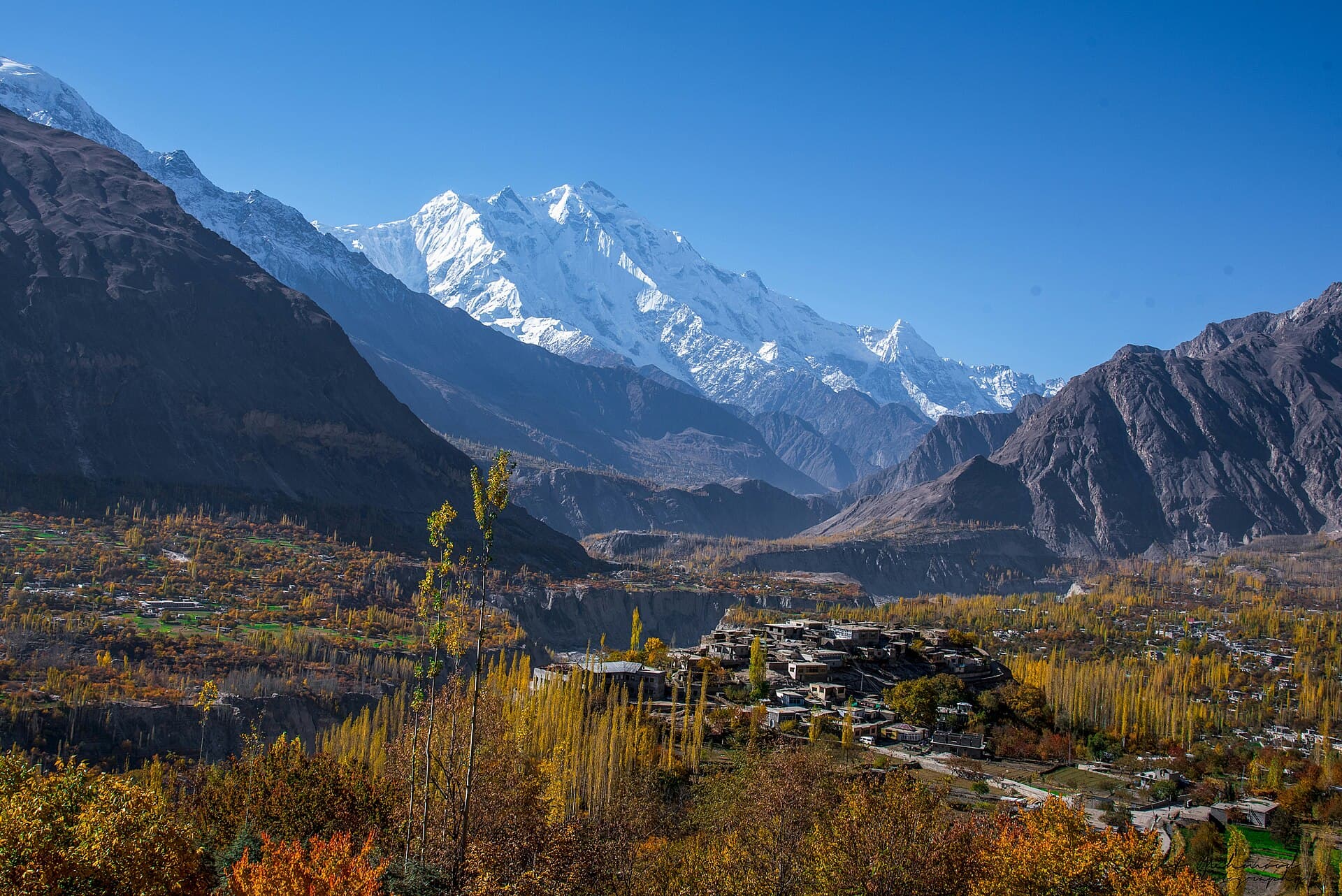
Within a 20 km radius of Concordia (4,600m), there are four peaks above 8,000 meters: K2 (8,611m), Broad Peak (8,051m), Gasherbrum I (8,068m), and Gasherbrum II (8,035m). Add Gasherbrum IV (7,925m), Masherbrum (7,821m), and dozens of 7,000m satellites. No other point on Earth) offers this density of extreme altitude visible from a single trekking campsite. The Everest region has one 8,000er. Annapurna has one. Concordia has four.
Nanga Parbat (8,126m), administered as part of the GB trekking product but geologically part of the western Himalaya, makes five 8,000-meter peaks accessible from a single region. Only Nepal (eight 8,000ers) has more, spread across a much larger area.
The glacial scale
The Karakoram contains between 28% and 50% glaciated terrain -- over 15,000 km2 of ice. The Siachen (76 km), Biafo (67 km), and Baltoro (63 km) are the second, third, and among the longest non-polar glaciers on the planet. The Biafo-Hispar traverse covers 120 km of continuous glacier -- the longest glacial crossing outside Antarctica. Snow Lake (Lukpe Lawo), at the head of the Biafo, is "one of the world's largest basins of snow or ice outside the polar regions."
The Karakoram Anomaly
While Himalayan glaciers are retreating at accelerating rates, studies have documented "slight increase or stability in glacier mass in central and western Karakoram." The Baltoro Glacier is "not retreating but experiencing surges." This anomalous stability -- possibly linked to increased winter precipitation from westerly weather systems -- makes the Karakoram glacial landscape more intact than comparable Himalayan systems. The trekker walking the Baltoro in 2026 is walking on a glacier that, against global trends, has not significantly diminished.
The wilderness question
The travel press calls the Karakoram "the last great wilderness." Aleister Crowley, during a 1902 K2 attempt, called it "the throne room of the mountain gods." These framings contain truth and hide operational reality.
The Baltoro is genuinely remote. Concordia is a minimum 7-8 days' walk from the last road, with no alternative access except military helicopter. There are no lodges, no teahouses, no phone signal past Askole. This is not the Annapurna Circuit.
But Mountain Wilderness International's 2025 assessment found the glacier's waste problem has "evolved from scattered litter into a broader strain on the entire ecosystem." Cleanup expeditions have removed 25,225 kg of waste and 143 animal carcasses to date. A single K2 BC group of 8 clients requires 30-50 porters. At peak season, hundreds of porters move up and down the Baltoro simultaneously. The $4,000 fine for waste violations exists but enforcement capacity is thin.
The framing: the Karakoram is not the last great wilderness. It is the last great glacial mountain system that has not been domesticated by tourism infrastructure. The difference matters. Wilderness implies emptiness. What the Karakoram actually offers is difficulty -- logistical, physical, ethical, and geopolitical. The trekker who goes there should want the difficulty.
The growth trajectory
International visitors to Baltistan grew 121% in a single year -- from 9,897 in 2023 to 21,862 in 2024. Domestic visitors grew 117%. GB approved a record 469 mountaineering permits in a single day in June 2025. Even at these numbers, the Karakoram sees a fraction of Nepal's traffic (~900,000 foreign tourists in 2023). The "undiscovered" narrative is still more true than false. But at 121% annual growth, the window has a shelf life.
What has changed recently
Five claims that appear in the top-ranking English-language results for "K2 base camp trek" and are wrong as of May 2026:
- "Trekking permit: $50." The $50 rate expired in September 2024. Summer trekking permit is now $150. CKNP waste fee is $190. Total: $340.
- "Day 1: Trek from Askole to Jhola (6-7 hours)." The Jhola bridge and road extension mean this stage is now driveable by jeep. Every itinerary listing it as a hiking day is out of date.
- "Pakistan offers visa on arrival / VPA for most nationalities." The Visa Prior to Arrival program was suspended January 1, 2026. All travelers now need a standard e-Visa ($35-60, 7-10 business days) via visa.nadra.gov.pk.
- "You need a liaison officer for the K2 BC trek." Liaison officers are required for climbing expeditions on peaks above 6,500m. The K2 BC trek is a trek, not a climb. No LO required. Guides routinely conflate climbing and trekking permits.
- "Helicopter rescue costs $12,000." The $12,000 is a refundable security deposit, not the rescue cost. Askari Aviation flies single-engine helicopters in pairs over glaciated terrain and bills for both aircraft. A Baltoro evacuation realistically costs $25,000-50,000+. Maximum landing altitude: 5,000m -- and K2 BC is at 5,150m.
Summary
The Karakoram in 2026 has changed significantly. The security situation is more complicated than "safe" or "dangerous" -- it is split along operator lines, with the national environment deteriorated and GB itself physically calm. The permit fees have nearly tripled but remain the cheapest 8,000m access on Earth. The porter protection infrastructure is gone. The logistics are being revolutionized by international flights and satellite navigation systems that are announced but not yet operational. The glacier is anomalously intact. The growth curve is steep.
A K2 Base Camp trek through a local operator costs $3,050-5,200 all-in from Islamabad, roughly comparable to an Everest Base Camp trek -- for a landscape that is objectively more dramatic, substantially less crowded, and logistically harder in every dimension.
The Karakoram does not need hype. It needs accurate information. This is the start.
18 Sources
- pk.usembassy.govUS Embassy Pakistan -- travel advisory Level 3 (Mar 2026) (Tier 1)
- gov.ukUK FCDO -- Pakistan travel advice (Apr 2026) (Tier 1)
- travel.gc.caCanada -- Pakistan travel advisory (May 2026) (Tier 1)
- aljazeera.comAl Jazeera -- ceasefire at risk, cross-border attacks (Apr 27, 2026) (Tier 1)
- explorersweb.comExplorersweb -- traveling to Pakistan: go or wait? (2026) (Tier 2)
- explorersweb.comExplorersweb -- Pakistan climbing fees frozen through 2026 (Tier 2)
- explorersweb.comExplorersweb -- K2 permits to almost triple (Sep 2024) (Tier 2)
- explorersweb.comExplorersweb -- fees and paperwork for a Karakorum trek (Tier 2)
- explorersweb.comExplorersweb -- Pakistan remains a bargain (Tier 2)
- trangoadventure.comTrango Adventure -- trekking and mountain royalty fees 2025 (Tier 2)
- abenteuer-berg.deAbenteuer Berg -- fees not as much as planned (2025) (Tier 2)
- visitinpakistan.comVisit In Pakistan -- hiring porters in Baltistan (Tier 2)
- mountainwilderness.orgMountain Wilderness -- Thirty years on ice: Baltoro (Oct 2025) (Tier 2)
- pamirtimes.netPamir Times -- Baltistan 119% tourist increase 2024 (Tier 2)
- thenews.com.pkThe News International -- GB record 469 permits (Jun 2025) (Tier 2)
- arabnews.comArab News -- Pakistan navigation system for Skardu (2025) (Tier 2)
- propakistani.pkProPakistani -- KKH blocked at multiple points (Mar 2026) (Tier 2)
- gypsytours.pkGypsy Tours -- heli rescue in Pakistan (Tier 2)