Why the Salkantay exists as an alternative
The Salkantay Trek exists for a structural reason: the Inca Trail's 500-person daily cap creates artificial scarcity that prices out a large segment of the trekking market. The Salkantay has no government quota, no permit lottery, and costs $250-$800 with an operator — roughly half the Inca Trail's $620-$2,500 range.
The trade-off is singular but important: the Salkantay does not arrive at Machu Picchu through the Sun Gate. Trekkers finish the trail at or near Aguas Calientes and take a bus or train to the citadel. The Inca Trail's final morning — cresting Inti Punku at dawn to see the ruins appear below — is an experience the Salkantay cannot replicate.
Everything else about the Salkantay is, by most measures, stronger: higher maximum altitude, more ecological diversity, fewer people per kilometer, and half the cost.
| Attribute | Detail |
|---|---|
| Distance | 72-74 km (45-46 mi) |
| Duration | 5 days / 4 nights (standard) |
| Max altitude | 4,630m — Salkantay Pass |
| Difficulty | Hard — higher pass than Inca Trail, longer daily distances |
| Permit required | No government quota — open access |
| Independent trekking | Technically possible, guided recommended |
| Guide required | Not legally mandatory |
| Cost range | Budget $250-$450 / Mid $450-$650 / Premium $650-$900+ |
| Start point | Mollepata (2,800m), 3-4 hours from Cusco |
Day by day
Day 1: Mollepata → Soraypampa (16 km)
Elevation: 2,800m → 3,900m. Gain: +1,100m. Time: 6-7 hours.
The trek begins at Mollepata (2,800m), reached by operator van from Cusco in 3-4 hours. Some operators drive further to Soraypampa to shorten the first day, but the full walk provides useful acclimatization.
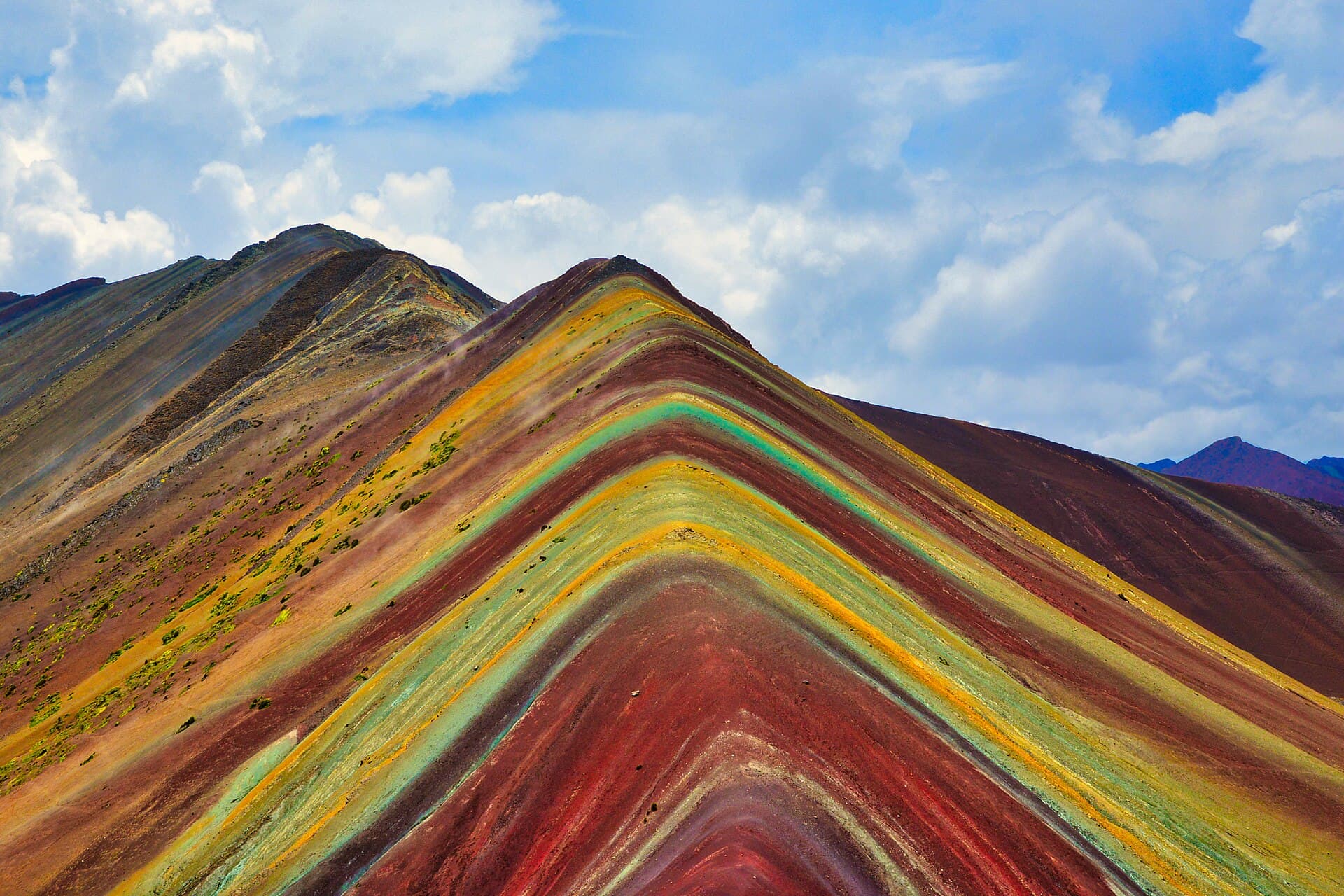
The trail climbs gradually through agricultural land and into high-altitude grassland with Salkantay peak (6,271m) dominating the horizon ahead — a massive ice-covered pyramid. Humantay Lake, a glacial turquoise lake at 4,200m, is a common side trip from Soraypampa and one of the most photographed sites in Peru.
Camp at Soraypampa (3,900m). Cold night. Clear skies here reveal the Milky Way with intensity unusual outside high-altitude environments.
Day 2: Soraypampa → Chaullay (22 km)
Elevation: 3,900m → 4,630m → 2,900m. Gain: +730m, then -1,730m. Time: 8-10 hours.
The crux day. From Soraypampa, the trail ascends 730 meters to Salkantay Pass at 4,630m — 415 meters higher than Dead Woman's Pass on the Inca Trail and the highest point on any standard trek in the Cusco region.
The pass sits between Salkantay (6,271m) and Humantay (5,473m). On clear mornings, both ice walls are visible from the col. The final approach is steep and exposed — snow and ice are possible year-round at this altitude. AMS symptoms are common. The descent from the pass is equally steep and dramatically longer: 1,730 meters of altitude lost in a single afternoon.
The ecological transition on day 2 is the Salkantay's defining feature. You begin above the treeline in puna grassland, cross a glacial pass, and descend into cloud forest by evening. Vegetation changes with every 500 meters of descent — from ice and rock to moss-covered trees to tropical ferns. No single day on the Inca Trail offers this range.
Camp at Chaullay (2,900m) in the upper cloud forest. Dramatically warmer than the previous night.
Day 3: Chaullay → Santa Teresa area (16 km)
Elevation: 2,900m → 1,500m. Loss: -1,400m. Time: 5-6 hours.
The transition day. The trail continues descending through increasingly tropical vegetation — orchids, bromeliads, coffee plants, banana trees. By the afternoon, the landscape is subtropical jungle at 1,500m, a world entirely different from the glacial pass 36 hours earlier.
Some operators route through or near Santa Teresa, where the Cocalmayo hot springs (S/10 entry) provide recovery after the pass day. These are natural thermal pools at varying temperatures, far less commercialized than the tourist hot springs at Aguas Calientes.
Day 4: Santa Teresa area → Aguas Calientes
Two options:
Option A — Hidroeléctrica walk: Walk approximately 10 km along the railway tracks from Hidroeléctrica station to Aguas Calientes (2-3 hours, flat). This is the budget route — free, scenic through the river gorge, and well-trafficked by other trekkers. Trains pass several times daily; stay on the walking path beside the tracks.
Option B — Train from Hidroeléctrica: Some operators include a train ticket from Hidroeléctrica station to Aguas Calientes (30 minutes). This costs $20-30 and eliminates the track walk.
Budget Salkantay packages typically include the Hidroeléctrica walk. Mid-range and premium packages include the train. The significant cost difference between Salkantay operators ($250 vs. $800) is partly explained by this single logistics choice.
Overnight in Aguas Calientes. A hotel bed — the first in 4 nights.
Day 5: Machu Picchu → Cusco
Bus from Aguas Calientes to the citadel ($35-36 roundtrip via Consettur). Tour Machu Picchu. Bus down. Train to Ollantaytambo ($40-90 depending on service). Van to Cusco.
Machu Picchu entry requires a separate ticket — S/152 (~$44) standard, S/200 (~$58) with Huayna Picchu or Montana Machu Picchu. Confirm your operator has booked this.
Continue reading Four routes to Machu Picchu, four different realities — and the altitude trap that ruins 30% of first days →
Why operators push the Inca Trail instead
Three reasons, all economic:
- Margin. The Inca Trail's permit scarcity lets operators charge 50-100% more for a shorter trek with lower logistical complexity. A 4-day Inca Trail at $1,000 has better margins than a 5-day Salkantay at $500.
- Brand recognition. "I hiked the Inca Trail" carries cultural cachet. The Salkantay has no equivalent brand equity despite being a stronger trek by several objective measures.
- Permit as lock-in. Once a trekker's Inca Trail permit is booked, they cannot switch operators — the permit is non-transferable and passport-linked. The Salkantay's open-access model creates no such lock-in.
The scenery argument
The Salkantay wins on ecological diversity:
- Glacial terrain at 4,630m with views of Salkantay (6,271m) and Humantay (5,473m) — active glaciers, ice walls, high-altitude desert
- Cloud forest transition from 3,000m to 2,000m — moss, ferns, orchids, hummingbirds
- Subtropical jungle below 2,000m — banana trees, coffee plants, tropical birding
- Humantay Lake — glacial turquoise at 4,200m, accessible only via this route
The Inca Trail stays within a narrower elevation band (2,600-4,215m) and traverses primarily puna grassland and cloud forest. It wins on archaeological content — five significant Inca ruins along the route versus none on the Salkantay.
Booking and logistics
No permit cap. Book 1-2 weeks ahead in peak season, a few days ahead in shoulder season. The only limitation is campsite capacity at popular stops, which self-regulates through operator coordination.
Independent trekking is technically possible (unlike the Inca Trail). The route is well-marked, and basic meals and accommodation can be found in villages along the way. However, navigation above the treeline, altitude management, and the pass crossing make guided trekking the standard recommendation.
4-day express variants exist — they compress days 3 and 4 into a single day, reducing the trek to 4 days/3 nights. The trade-off is a very long fourth day and less time in the cloud forest transition zone.
Operator tiers (2026)
| Tier | Price range | What you get |
|---|---|---|
| Budget | $250-$500 | Traditional camping, basic meals, Hidroeléctrica walk |
| Mid-range | $500-$900 | Improved camping, dome tents, better food, train included |
| Luxury | $1,200-$2,990+ | Lodge-to-lodge or sky dome, gourmet meals |
What is NOT included at any tier: Machu Picchu entry ticket (S/152-200), sleeping bag rental ($15-25), tips, personal expenses in Aguas Calientes.
When to go
| Period | Conditions |
|---|---|
| Jun-Aug | Best weather. Cold at pass. Maximum trekkers (though still fewer than Inca Trail). |
| May, Sep | Excellent. Slightly fewer people. |
| Apr, Oct | Good. Some rain possible. |
| Dec-Mar | Snow risk at the pass. Trail can be impassable. Avoid. |
The Salkantay does not close in February (unlike the Inca Trail), but the pass at 4,630m can be dangerously snowed in during wet season. Most operators suspend departures December through March.
The honest comparison
| Factor | Inca Trail | Salkantay |
|---|---|---|
| Cost | $620-$2,500 | $250-$800 |
| Permit | 6-8 months ahead (peak) | 1-2 weeks ahead |
| Max altitude | 4,215m | 4,630m |
| Ecological range | Puna + cloud forest | Glacial + cloud forest + subtropical |
| Inca ruins | 5 major sites | None until Machu Picchu |
| Sun Gate arrival | Yes | No |
| Difficulty | Moderate-Hard | Hard |
| Duration | 4 days | 5 days |
The Inca Trail is the better choice if: you value the archaeological sequence, the Sun Gate arrival matters to you, and the permit timing works.
The Salkantay is the better choice if: you want more ecological diversity, a higher physical challenge, flexibility on booking dates, or significant cost savings.
Neither is the "better" trek in absolute terms. They are different products optimized for different priorities.
Safety and physical reality
The Salkantay is rated Hard — harder than the Inca Trail by most measures. The pass is 415m higher. The descent on day 2 is 1,730m in a single afternoon. The total distance is 74 km over 5 days versus 43 km over 4 days.
The pass day: Day 2 is the crux. From 3,900m to 4,630m and back down to 2,900m is an enormous physical and physiological day. AMS symptoms are common at the pass even for acclimatized trekkers. Snow, ice, and near-zero visibility are possible any month. The final 200m of ascent to the pass is steep, exposed, and can be slippery. Trekking poles are essential, not optional.
Temperature range: The Salkantay traverses from -10 degrees C at the pass (June-August mornings) to 25+ degrees C in the subtropical sections near Santa Teresa. You need layering that covers both extremes — a down jacket for the pass and lightweight breathable clothing for the jungle. Some trekkers pack a complete change of clothing type for the transition day.
Water: Above the treeline, glacial streams are the primary water source. Below the treeline, the cloud forest and jungle sections have adequate water but require treatment. Budget operators may not provide treated water for the entire trek — confirm this before booking.
Independent trekking risks: Unlike the Inca Trail, the Salkantay can legally be hiked without a guide. The route is marked but not maintained by the government. Above the treeline, trail markers can be obscured by snow. The pass crossing in poor weather requires navigation skills. Medical evacuation from the pass area is difficult — there is no ranger station equivalent to the Inca Trail checkpoints. Independent trekkers should carry a satellite communicator (InReach or similar) and have experience with high-altitude route-finding.
Insurance: Same requirements as the Inca Trail — must explicitly cover trekking above 5,000m (Salkantay Pass at 4,630m is close enough that 4,000m cap policies may argue it). Helicopter evacuation coverage is essential for the pass section.
12 Sources
- salkantay.orgsalkantay.org — Route Guide
- salkantaytrekmachu.comSalkantay Trek Machu — Distance & Altitude
- muchbetteradventures.comMuch Better Adventures — Salkantay Guide
- kimkim.comKimkim — Salkantay vs Inca Trail
- localtrekkersperu.comLocal Trekkers Peru — Price 2026
- theonlyperuguide.comThe Only Peru Guide — Salkantay Costs
- journeybybackpack.comJourney by Backpack — Comparison
- skyhookadventure.comSkyhook Adventure — Comparison
- busconsettur.comConsettur — Bus Tickets
- machupicchusoul.comMachu Picchu Soul — Operators
- tourradar.comTourRadar — Operators
- skydomecamps.comSkyDome Camps — Operators
12 sources consulted. Prices verified May 2026.