The hike few guides write about in detail
If you read ten English-language guides to El Chaltén, nine of them will treat Laguna Torre as the consolation prize — the hike you do on the day the rangers flag too much wind on the Laguna de los Tres moraine, or the hike you fit in between Fitz Roy attempts, or the warm-up you check off on arrival day. That framing is wrong twice over.
First: Laguna Torre delivers the only view from the Chaltén trail network that squarely faces Cerro Torre, Torre Egger, and Cerro Standhardt across the water — the three finest granite needles in a massif built entirely out of fine granite needles. Fitz Roy is the face on the Patagonia Inc. logo. Cerro Torre is the mountain that climbers argue about for sixty years. You cannot see it from Laguna de los Tres. You cannot see it from the town. The only place you can walk to it from a hostel bed is this trail.
Second: the lake you reach at the end of this walk is the foreground to the longest-running, most technically litigated controversy in the history of alpinism. A man claimed a first ascent here in 1959. The community has argued about it ever since. In 2004 a Chaltén-based climber published a 30-page forensic reconstruction in the American Alpine Journal that is still the reference document. In 2012 two Americans climbed the southeast ridge by fair means and then, on the descent, removed approximately 120 of the disputed climber's bolts. They were briefly detained in El Chaltén by locals who disagreed with the decision. The global climbing community has not fully agreed on any of this yet.
For a trekker standing on the moraine at Laguna Torre with binoculars, the story is not a museum exhibit. It is visible. The scar of the 1970 Compressor Route is still on the southeast ridge. The absence of its bolt ladder is the reason the ridge is, in 2026, a serious climb again. That is what this article is about.
The numbers
- Distance: 18–20 km round trip from the trailhead at the end of Avenida San Martín. Add ~5 km return if you tack on the Mirador Maestri extension.
- Elevation gain: ~300–500 m cumulative, depending on the GPS track. Most of it is compressed into the first 2 km — a ~200 m climb to Mirador Margarita that gets the day's only real work out of the way before lunch.
- Time: 5–8 hours round trip at a walking pace that allows for stops. 9–11 hours with the Mirador Maestri extension.
- Difficulty: Moderate. There is no technical scramble, no loose moraine staircase, no exposed pass. The challenge is distance — a long mostly-flat valley walk where the wind, not the grade, will decide how tired you are at the end.
- Trailhead: western edge of El Chaltén off Avenida San Martín, near the APN Centro de Informes Ceferino Fonzo. Like every trail in the Chaltén sector, it begins at the end of a residential street. There is no bus to the trailhead because the trailhead is the town.
Compared to Laguna de los Tres — 20–25 km, ~1,060 m cumulative gain, a 400 m moraine scramble in the final kilometer, 8–11 h on a realistic plan — Laguna Torre is a different order of effort. If Los Tres is a full alpine day, Laguna Torre is a long walk in a spectacular valley with a climbing-history endnote.
Continue reading Loma del Pliegue Tumbado — the one day hike in El Chaltén where you see everything →
Waypoint by waypoint
Trailhead, Avenida San Martín west (400 m). Walk to the western edge of town near the APN visitor centre. The trail begins where the pavement ends. No gate, no turnstile, no ranger — at least not at the time of writing. See the section on fee ambiguity below.
Mirador Margarita (600 m, ~2 km in). The day's only sustained climb. Roughly 200 m of gain in the first two kilometers takes you out of the Río Fitz Roy forest onto a broad ridge that looks directly down-valley toward the Torre group. On a clear morning this is where Cerro Torre first resolves from horizon haze into the distinct silhouette that defines the rest of the day. From here the trail is nearly flat to the lake.
Río Fitz Roy valley floor (~3–5 km in). The trail drops into and then follows the valley of the Río Fitz Roy — which, confusingly, drains the Cerro Torre basin, not the Fitz Roy basin. Open meadows, stands of Lenga and Ñire, occasional exposed sections where the wind off the ice field announces itself.
Lagunas Madre e Hija junction (620 m, ~5–6 km in). A signed spur breaks north here toward the Lagunas Madre e Hija and eventually links to the Laguna de los Tres trail near Campamento Poincenot. Most walkers do not take the spur. It matters for one reason: this is the junction that makes a one-day traverse of both signature hikes possible, and it is the reason to consider the connector.
Campamento De Agostini (635 m, ~9 km in). The overnight basecamp for Laguna Torre. Historically free. Since the 2024–25 concession transfer to the non-profit Amigos del Parque Nacional Los Glaciares, it is approximately USD 14–18 per person per night, bookable in advance at amigospnlosglaciares.org/campamentos/. No electricity, no open fires, gas stoves only in designated areas, pack out all waste. If you are staying the night and doing Mirador Maestri at dawn, this is your base.
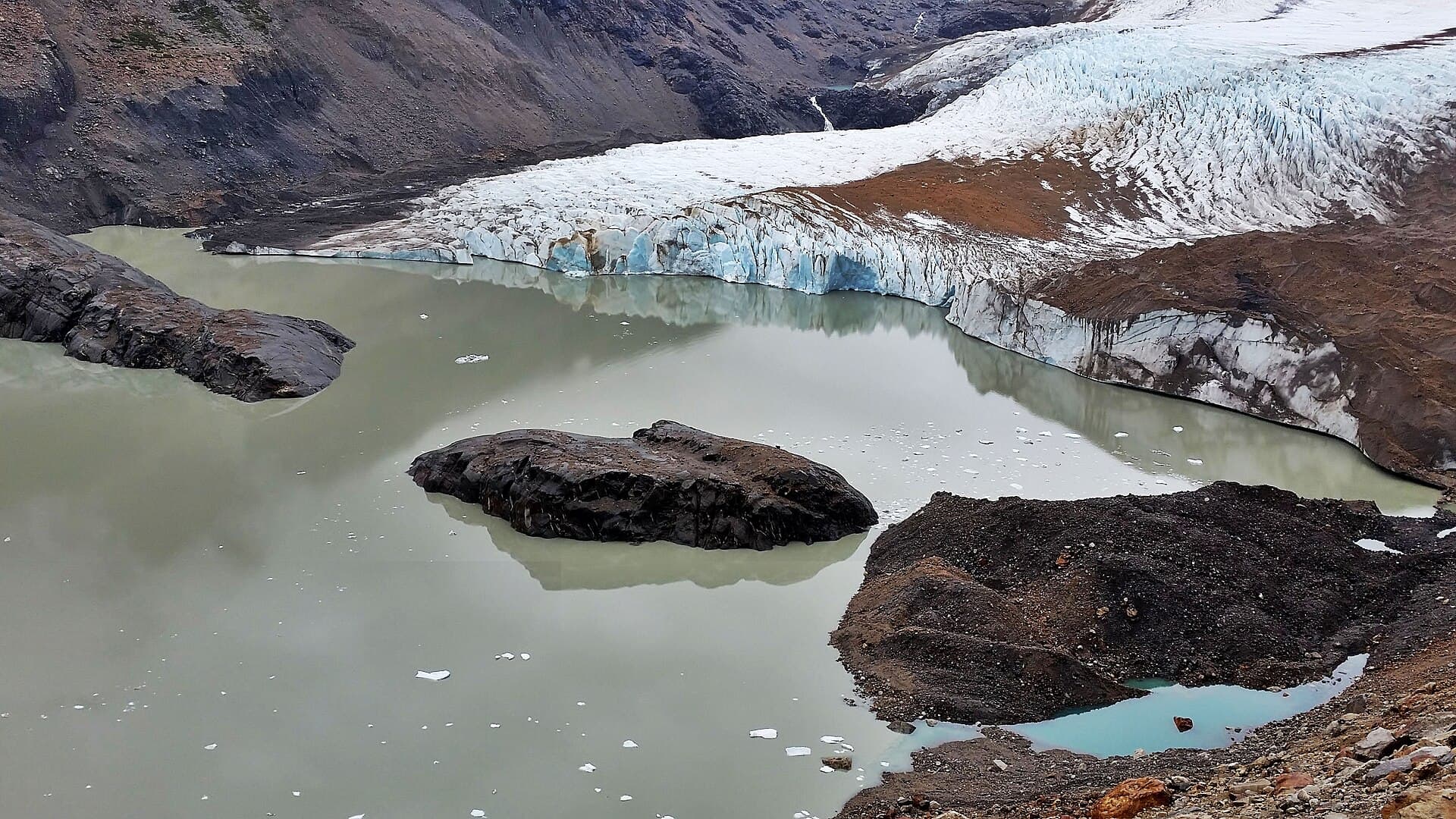
Laguna Torre (640 m, ~9–10 km in). The end of the main day hike. A narrow glacial lake with icebergs calved from the Torre glacier drifting across it, underneath the full Torre group skyline.
Mirador Maestri extension (700 m, +2.5 km one way beyond the lake). The detour along the southern lateral moraine of the Torre glacier toward a closer, higher, more exposed view of the southeast ridge and the icefall. Budget another 2–4 hours return, and an early start.
What you actually see
The view from Laguna Torre is not Fitz Roy's amphitheater. It is narrower, icier, and more vertical. From left to right, assuming you are standing on the moraine at the eastern end of the lake looking west:
- Cerro Torre (3,128 m) — the needle. The defining aesthetic object of modern alpinism. A ~1,200 m granite spike topped with rime-ice mushrooms that shift and calve on a timescale of hours. The southeast ridge is the line the Maestri story is about.
- Torre Egger (2,685 m) — immediately right of Cerro Torre, separated by the Col of Conquest. First ascended in 1976 by Jim Donini, John Bragg and Jay Wilson. Named for Toni Egger — the Austrian who died on the disputed 1959 attempt and whose camera, with any summit photos, went down with him.
- Cerro Standhardt (2,730 m) — further right again, the northernmost of the Torre skyline. Named for 1930s Bavarian climber Hermann Standhardt.
- The Torre glacier — descending directly into the lake. The icebergs in the water are yours courtesy of this glacier; they calve on clear warm afternoons and the cracks are audible from the moraine.
- Aguja Guillaumet (2,579 m) — visible from certain angles behind you, to the northeast. The easternmost tower of the Fitz Roy skyline and the starting point of Tommy Caldwell and Alex Honnold's 2014 Fitz Traverse.
With binoculars and a clear morning, the scar of the 1970 Compressor Route is visible as a thin diagonal line on the right-hand (southeast) side of Cerro Torre. It is fainter since 2012 but still traceable — a metal stain on the granite where a bolt ladder used to be.
Planning this route? We're forming a founding group for Huemul Circuit — Self-Guided Cohort — registering interest is free, no commitment. See the expedition →
The Maestri controversy
This is the part few day-hike guides cover. It is also the reason Laguna Torre is a destination for people who know what they are looking at, and not just people who want a lake in front of a mountain.
1959 — the original claim
In January 1959, Italian climber Cesare Maestri reported the first ascent of Cerro Torre with Austrian climber Toni Egger. The claimed line went up the north face. On the descent, Maestri said, Egger was swept by an avalanche. Egger died. His camera — carrying any summit photos — was lost with him. Maestri was found at the foot of the mountain by a support climber, Cesarino Fava, in a state of collapse. He reported a successful ascent.
Within a year, climbers who knew the mountain began to doubt the account. Italian alpinist Carlo Mauri, who attempted Cerro Torre from the west in 1958 and again in 1970, never publicly endorsed the claim. Through the 1960s and 1970s, as more climbers tried the peak and saw its upper terrain, the doubts compounded: the described line did not match the geometry of the face, 1959 equipment could not have climbed what Maestri described, and — the most persistent evidentiary problem — no physical trace of the ascent was found on the upper mountain. No fixed pitons, no rope segments, no bivouac debris, nothing above a certain elevation on the claimed route. Reinhold Messner and Italian climber Ermanno Salvaterra — the latter a four-time Cerro Torre summiter — both publicly concluded the 1959 ascent did not happen.
2004 — Garibotti's A Mountain Unveiled
The canonical technical critique is Chaltén-based climber Rolando Garibotti's "A Mountain Unveiled," published in the American Alpine Journal in 2004. It is the single most cited source in any serious discussion of the 1959 claim and the document you should read if you want to form a view. Garibotti reconstructed the 1959 story pitch by pitch, compared it to the physical upper mountain as known by climbers who had actually reached it, catalogued what Maestri's claimed route description requires versus what exists, and argued — without polemic, with a climber's technical specificity — that the ascent as described is not possible.
Garibotti's article was not a character assassination. It was the opposite: a careful piece of forensic mountaineering writing that let the evidence carry the argument. It is the reason the phrase "the Maestri controversy" no longer refers to a genuinely open question inside the climbing community. Outside the community, the controversy lingers. Inside it, the community has largely decided.
1970 — the Compressor Route
Eleven years after the disputed north-face claim, Maestri returned to Cerro Torre. He was now arguing the controversy publicly and he came back to settle it — not by repeating his 1959 line, but by climbing an entirely different one. He brought a gasoline-powered air compressor, had it hauled up the southeast ridge, and drilled a bolt ladder from roughly the Col of Patience to near the summit. Hundreds of bolts. The compressor itself was left hanging near the top of the ridge, where it remained for decades.
The result was the Compressor Route — a climbable line up Cerro Torre, established by siege tactics and mechanical aid, as both a climb and a monument. Many climbers regarded it as a defacement of the mountain. Others regarded it as a route that, once it existed, had a right to exist — climbing history is cumulative, and you do not re-edit the record. The climb itself became a mainstream objective through the 1990s and 2000s, repeated hundreds of times. The debate about whether it should have been there at all never resolved.
16 January 2012 — the bolts come down
On 13 January 2012, Americans Hayden Kennedy and Jason Kruk climbed Cerro Torre's southeast ridge largely by fair means — using only a handful of Maestri's bolts at the most difficult sections, and finding free or near-free solutions to the rest. It was a climbing statement: the southeast ridge, stripped of the bolt ladder, was climbable on its own terms. On the descent, Kennedy and Kruk removed approximately 120 of Maestri's bolts, concentrated in the sections where climbers had been relying on them as an aid staircase rather than a protection system.
When they returned to El Chaltén, a group of local climbers, some of whom held the Compressor Route in historical esteem regardless of its aesthetics, were furious. Kennedy and Kruk were briefly detained. The global climbing community split: some praised the bolt removal as restoring the mountain to a state where future climbers would have to meet it on its terms; others argued that altering historical routes — even controversial ones — was vandalism of the record. Kennedy wrote his account, "The Bolts Came Down," in Alpinist 38 (2012). It is the other document worth reading alongside Garibotti.
Why this matters at the lake
For the trekker standing at the eastern end of Laguna Torre, the significance of the 2012 chop is concrete, not symbolic. The southeast ridge you are looking at is, as of 2012, a serious alpine climb again. The bolt ladder that converted it from "serious climb" to "expedition via ferrata" is gone. Teams now attempting Cerro Torre from the southeast face a route closer to what the 1959 climbers pretended to have soloed — and on the days when conditions allow, climbers from the Rancho Grande common room down in town are up there, meeting it on its actual terms. The trail you walked is their approach trail. The campamento you passed is their basecamp. The community that detained Kennedy and Kruk, and the community that cheered them, are the same bartenders, guides, and rangers you met in town. This is not museum history. It is a live climbing economy on one specific ridge, visible with binoculars, four hours from the hostel.
The Mirador Maestri extension
Beyond the east end of Laguna Torre, a marked route climbs onto the Torre glacier's southern lateral moraine and follows it westward for roughly 2.5 km one way — call it a 5 km round-trip detour from Campamento De Agostini — to the viewpoint known as Mirador Maestri. The reward is a closer, higher, unobstructed view of the southeast ridge, the Col of Patience, the icefall feeding the Torre glacier, and in most light, the ice mushrooms on the summit block.
It is also, in 2026, the new concentrated crowd point of the Cerro Torre valley. The economic-lens research puts it plainly: "Laguna Torre is moderately less crowded than Los Tres, but Mirador Maestri is the new Instagram hot spot — shoulder-to-shoulder by 11 am." A dawn start from De Agostini, or a very early start from town (5 a.m. out of a hostel bed at the latest), is the only way to have the mirador to yourself. The route involves real moraine navigation — some exposure, some loose terrain, no technical climbing but genuine route-finding on a glacier margin — and it is not signed the way the main trail is. In bad visibility, skip it.
Mirador Maestri is often listed as an optional sidetrip. In practice it is the reason climbers keep returning to this valley and the reason the crowd dynamics of Laguna Torre have changed in the last three years. If you have the weather for it, it is the better half of the day.
Crowd reality
Laguna Torre is meaningfully less crowded than Laguna de los Tres. The reason is not that it is a lesser hike. It is that Fitz Roy is on the logo and Cerro Torre is not. Instagram and the marketing template of English-language Patagonia guides both converge on the Fitz Roy skyline, and the 1,000+ daily walkers of peak season do the same. On a mid-January morning, Laguna de los Tres will have 300 people on the final moraine scramble by 10 a.m. and a visible queue for the summit photo spot. Laguna Torre on the same morning has perhaps a third of that at the lake itself — less on the trail.
The crowd concentration has moved. It is at Mirador Maestri. If you go to Laguna Torre to avoid the Fitz Roy queues and then add the Maestri extension at 11 a.m., you will walk into the same shoulder-to-shoulder that you came here to escape. Early is the only answer.
Dawn start for Laguna Torre is less mission-critical than dawn start for Laguna de los Tres — the trail is wider for longer, the bottlenecks are fewer, and the final viewpoint is a lake shore rather than a staircase. But for Mirador Maestri it is non-negotiable.
The fee ambiguity
This needs to be said explicitly. On 21 October 2024, APN introduced paid entry to the Laguna de los Tres sector of Los Glaciares at three gates: Los Cóndores, Base Fitz Roy, and Río Eléctrico. Non-resident foreigners pay 30,000 ARS (roughly USD 20–42 depending on the inflation/exchange moment). Argentine nationals and Santa Cruz residents pay less. Online purchase at ventaweb.apn.gob.ar or at the gates themselves.
The sources disagree on whether Laguna Torre is inside the fee zone. The technical-logistics research flagged this directly: "Clearly gated: Laguna de los Tres. Ambiguous: Laguna Torre. No single Tier-1 APN page lists gated trails comprehensively."
In practice, as of early 2026, trekkers report walking the Laguna Torre trail without being stopped at a gate. That is not a guarantee. The fee boundary has expanded once and may expand again. Campamento De Agostini is separately paid through the Amigos del Parque concession regardless of the trail gate status — that one is not ambiguous. For budgeting purposes, assume Laguna Torre may be fee-gated on your visit; for USD 20–40 on a Patagonia trip, the cost of being wrong is smaller than the cost of being turned back at a gate without pesos. Confirm at the APN visitor centre on arrival, which is the only place in town that gives an authoritative current answer.
Combining with Laguna de los Tres
Via the Lagunas Madre e Hija spur, the two signature day hikes can be joined into a single loop. The numbers are unforgiving: roughly 30+ km total, ~12 hours of walking, and a lot of moraine. You finish Los Tres's final scramble in the morning, descend via Poincenot, contour south through Madre e Hija, and pick up the Laguna Torre trail inbound to town. Or — more accurately — you can do it in either direction, but you cannot do it slowly. It is a linkup for strong walkers in a one-day weather window when the wind forecast is favorable and the rangers are not posting turn-back warnings.
The alternative, and the one most trekkers choose when they want both lakes in the same trip, is to split them across two mornings and sleep in town in between. If you have the weather and the stamina, the linkup is a rare day. If you do not, do not force it — both views reward being present at them, and a 12-hour race does not leave time to sit at either lake.
The other alternative is an overnight at one of the campamentos — De Agostini for Laguna Torre, Poincenot for Los Tres — and a dawn push to the viewpoint from camp. That used to be the free budget option. Since the 2024–25 concession, both are paid, and the budget calculation is different, but the logic is the same: if you want to be at the mirador for sunrise without a 4 a.m. headlamp march from town, sleeping at altitude inside the park is the move.
The one sentence
Laguna Torre is the other signature day hike, the gentler one, the one that gives you the view of Cerro Torre and its disputed bolt-chopped southeast ridge — and if you do not know the Maestri story before you stand at the lake, you are looking at a beautiful mountain; if you do, you are looking at the foreground of the longest-running argument in alpinism, decided slowly, with bolts falling from the ridge in January 2012.
12 Sources
- americanalpineclub.orgGaribotti, Rolando. "A Mountain Unveiled," American Alpine Journal 2004. The definitive technical reconstruction and critique of the 1959 Maestri-Egger Cerro Torre claim. American Alpine Club archive: americanalpineclub.org/p/aaj-archive.
- Kennedy, Hayden. "The Bolts Came Down," Alpinist 38 (2012). First-person account of the 16 January 2012 southeast-ridge ascent and bolt removal.
- Caldwell, Tommy. "The Fitz Traverse," Alpinist 46 (2014); also American Alpine Journal 2014. Caldwell–Honnold first full Fitz Roy skyline traverse, useful context on the adjacent massif.
- Crouch, Gregory. Enduring Patagonia (Random House, 2001). Narrative history of Chaltén-massif climbing through 2000, including accessible treatment of the 1959 and 1970 Maestri chapters.
- Terray, Lionel. Les Conquérants de l'Inutile (Gallimard, 1961); English edition Conquistadors of the Useless (1963; Bâton Wicks reprint 2008). Primary source for the 1952 Fitz Roy first ascent and the climbing culture that preceded the Cerro Torre era.
- hikemetrics.comHikemetrics — Laguna Torre, El Chaltén trail data: hikemetrics.com/trails/argentina/laguna-torre-el-chalten-argentina.
- stingynomads.comStingy Nomads — Laguna Torre hike, El Chaltén: stingynomads.com/laguna-torre-hike-el-chalten/.
- elchalten.comelchalten.com trail pages — elchalten.com/v4/en/ (Laguna Torre and general trail data, El Chaltén tourism office–adjacent).
- amigospnlosglaciares.orgAmigos del Parque Nacional Los Glaciares — Campamentos reservation portal: amigospnlosglaciares.org/campamentos/. Authoritative source for De Agostini, Poincenot, and Laguna Capri paid-reservation status since 2024–25.
- trips-southamerica.comTrips South America — "New Entry Fees Introduced for Some Hiking Trails in El Chaltén" (October 2024): trips-southamerica.com/new-entry-fees-introduced-for-some-hiking-trails-in-el-chalten/.
- daytours4u.comDayTours4U — 2026 national parks fees Argentina: daytours4u.com/en/travel-guide/fees-national-parks-argentina.
- Salvaterra, Ermanno — writings and interviews on the four 1985–2005 Cerro Torre ascents, referenced in Alpinist and AAJ and summarized in Garibotti (2004). Primary climber-witness material on the physical state of the upper mountain.