The contrarian claim
Most visitors to El Chaltén arrive with a two-item list. Day one: Laguna de los Tres. Day two: Laguna Torre. Day three: bus back to El Calafate. The list is so universal that the APN rangers at Centro Ceferino Fonzo can recite it back to you before you've finished asking the question.
The list is also wrong. Or at least incomplete in a way that matters. Because the single best day hike in the valley — the only trail that gives you the full thing, Fitz Roy and Cerro Torre and Lago Viedma and the Southern Patagonian Icefield in one continuous horizon — is the one that few guides highlight. It's called Loma del Pliegue Tumbado, and on a first-principles ranking of "what do you actually go to El Chaltén to see, and which trail shows you the most of it," it is the correct pick.
It is not the Instagram pick. That's why it stays quiet. That's also why it's worth prioritizing.
Why this trail is uniquely valuable
Every other day hike in the north sector of Los Glaciares is a single-target trail. Laguna de los Tres is a Fitz Roy trail. Laguna Torre is a Cerro Torre trail. Chorrillo del Salto is a waterfall. Each one points at one feature and walks you to it.
Pliegue Tumbado does something different. It climbs a long, broad ridge that sits south and slightly east of both massifs at once, and the ridgeline keeps rising until you're above treeline, above the intermediate topography, and above the point where any one feature is blocking another. At the viewpoint at roughly 1,500 m, and more emphatically at the true summit at roughly 1,730 m, the panorama goes 360°:
- North: the Fitz Roy group — Fitz Roy itself (3,405 m), Poincenot, Mermoz, Guillaumet — stacked in profile.
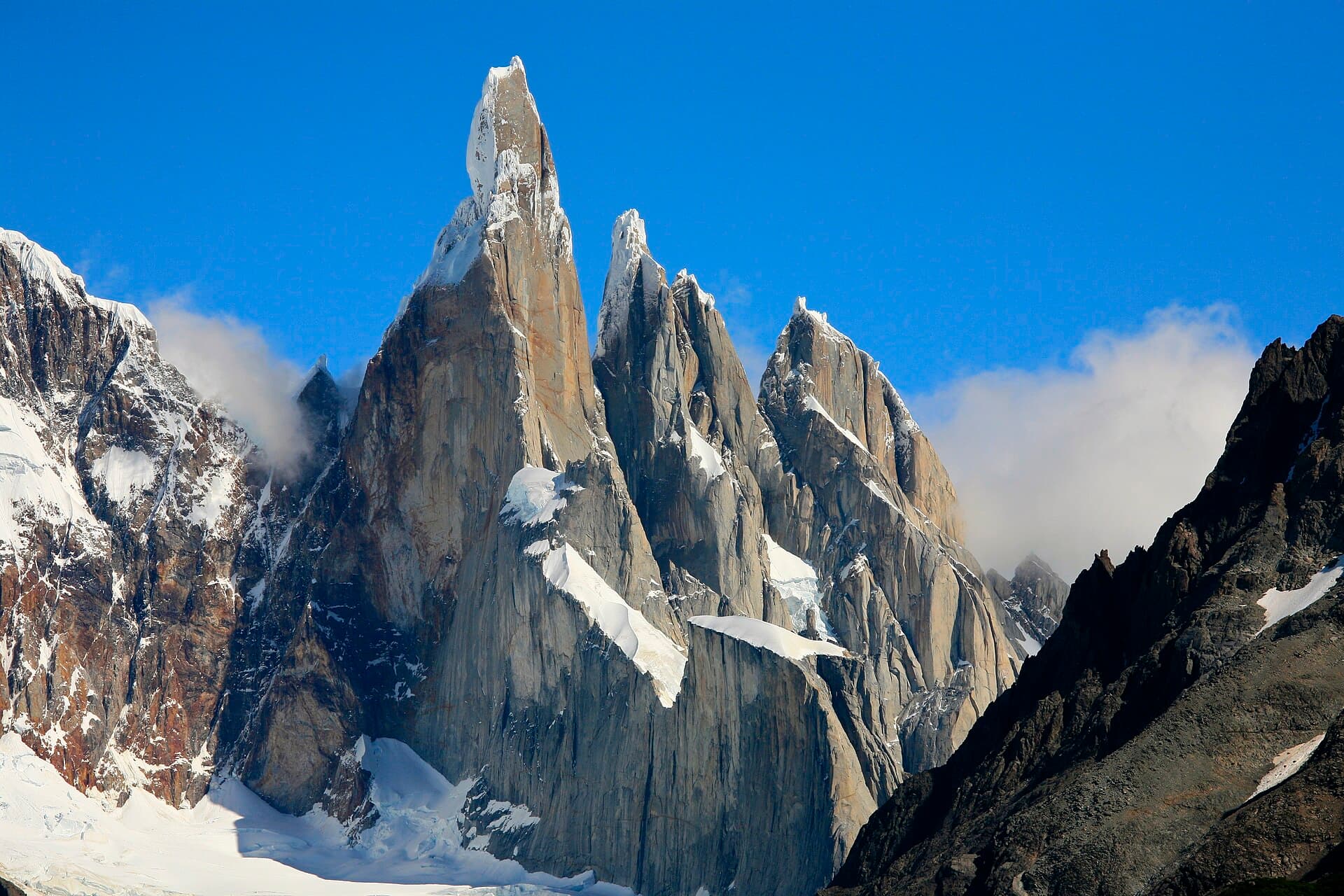
- West and north-west: the Cerro Torre group — Cerro Torre (3,128 m), Torre Egger, Standhardt — in full profile from a distance no other accessible vantage gives you.
- South: Lago Viedma, the huge glacial lake the Huemul Circuit circumnavigates on its last two days.
- West, beyond the Torre group: the Hielo Patagónico Sur, the Southern Patagonian Icefield — the third-largest ice mass on Earth after Antarctica and Greenland, normally hidden from walkers by the towers themselves.
No other day hike from town delivers more than one of these. Pliegue Tumbado delivers all four at once.
There are two other structural advantages that few guides mention:
No technical scramble. Laguna de los Tres ends with a ~400 m climb up a loose moraine staircase — an hour of exposed, knee-dependent, crowd-throttled effort that most firsthand accounts describe as harder than the "moderate" guidebook rating. Pliegue Tumbado's climb is sustained but clean: forest switchbacks, then an open ridgeline. No boulder hopping, no bottlenecks, no stepping aside for sunrise groups coming down while you're going up.
Meaningfully less crowded. AllTrails lists Laguna de los Tres with over 7,600 reviews and a "heavily trafficked" flag. Pliegue Tumbado has a small fraction of that traffic. Climbers and repeat visitors to Chaltén — people who have seen both — consistently rank the Pliegue Tumbado view higher than Laguna de los Tres, because one shows you a wall and the other shows you the whole system.
Continue reading El Chaltén is not a wilderness. It's a climbing-town basecamp — and the free-access regime just ended. →
The numbers
- Distance: 20–22 km round trip to the main viewpoint.
- Elevation gain: 1,000–1,100 m to the viewpoint at ~1,500 m. Optional +230 m and +0.8 km to the true summit at ~1,730 m.
- Walking time: 8–10 hours round trip. Plan the long end.
- Trailhead: APN Centro de Informes Ceferino Fonzo, at the southern entrance of town. Coordinates: -49.3372, -72.8858. Town elevation: 405 m.
- Difficulty: demanding. The largest single-day elevation gain of any day hike in the valley. The most wind-exposed summit in the north sector. Above treeline for roughly the upper half.
For reference: this is more vertical than Laguna de los Tres (~800 m net, ~1,060 m cumulative on GPS tracks), though similar in total distance. Laguna Torre is a different category entirely — 17–20 km round trip with only 300–500 m of cumulative gain. If you grade day hikes by metres climbed, Pliegue Tumbado is the hard one.
Most English-language guides list it as "moderate." That rating is wrong in two directions at once — it undersells the effort and it fails to tell you what you actually get in return.
Step by step
- Start at the APN Visitor Centre (405 m). This matters even if you're not on the Huemul Circuit: the rangers post a daily wind and weather forecast at the office, and they will tell you plainly whether Pliegue Tumbado is a go. Ask. This is the trail on which their turn-back protocol is most load-bearing.
- Forest climb. The first section is a steady, well-graded climb through Lenga (Nothofagus pumilio) forest. Switchbacks, soft footing, sheltered from wind. This is where the vertical accumulates.
- Treeline (~950 m). The Lenga thins out and the view opens. From here up, there is no more shelter — no trees, no boulders big enough to hide behind, nothing between you and the wind. If the rangers flagged wind and you ignored them, this is the point at which you learn what that meant.
- Pliegue Tumbado viewpoint (~1,500 m). The main payoff. The 360° panorama opens here, the ridge broadens, and most walkers stop, eat, take photographs, and turn around. For most people this is the correct turnaround.
- Optional true summit (~1,730 m). An additional ~230 m of gain over roughly 0.8 km. Rarely visited — on an average clear day you might have it to yourself. The view is incrementally better but the weather exposure is incrementally worse.
Planning this route? We're forming a founding group for Huemul Circuit — Self-Guided Cohort — registering interest is free, no commitment. See the expedition →
The wind problem
This is the single reason Pliegue Tumbado is not a casual choice.
The upper half of the trail is the most wind-exposed terrain of any day hike in the Chaltén massif. Above treeline the ridge runs broadly north-south, catching the full Pacific-driven westerly that defines Patagonian weather. Average summer wind in the valley sits around 30 km/h sustained; on this ridge it can double. The Huemul Circuit's Paso del Viento and Paso Huemul famously see 60–100 mph (100–160 km/h) routinely, strong enough to literally stop a loaded hiker — and while Pliegue Tumbado is not quite in that category, the physics are the same, and there is no topographic shelter once you're above the Lenga.
There is a formal turn-back protocol. The rangers at Centro Ceferino Fonzo publish a daily assessment and will tell you to turn back at the visitor centre if the forecast warrants. The informal cut-off in most local conversations is somewhere around 60 km/h sustained: above that, don't start. Above 80 km/h gusts, the upper ridge becomes unsafe for anyone not prepared to crawl.
December is the windiest month in the Chaltén massif — an under-reported fact that every "best time to visit Patagonia" guide skips past because it contradicts the capacity-driven operator consensus. Average sustained wind in December is around 25 km/h valley-level, gusts of 40–60 km/h are routine, and on the Pliegue Tumbado ridge those numbers shift upward. (Source: climate-data.org.)
The useful corollary: the months when Pliegue Tumbado is most walkable — late February through mid-March, and mid-to-late November — are also the months with the best Fitz Roy and Cerro Torre visibility. Winds ease, skies clear more often, crowds thin, daylight is still adequate. You get the best weather window for the hike and the best view conditions for the reward at the same time. This is the opposite of a coincidence. The clear days exist because the wind is lower.
Why it stays uncrowded
The trail's obscurity in English-language guides is not random. Four structural reasons:
- Fitz Roy is the face on the Patagonia Inc. logo. Pliegue Tumbado is not. The aspirational image every first-time visitor arrives with is Fitz Roy's silhouette reflected in a turquoise tarn. That image is at Laguna de los Tres. No amount of argument about "better" views shifts a brand-recognition default built over thirty years of outdoor-industry marketing.
- A thousand metres of gain scares off Instagram traffic. Casual day-hikers in Chaltén will cheerfully do 20 km on moderate grade for a famous photograph. They will not as cheerfully do 20 km with 1,000 m of vertical for a panorama they hadn't heard of.
- There's no dramatic single landmark. Pliegue Tumbado rewards with a view of the whole system — the composition, the scale, the ice beyond the towers. It doesn't give you one iconic foreground object. For photography that rewards context it is the best trail in the valley. For photography that rewards a recognizable subject, it looks less satisfying in a phone viewfinder.
- Almost every English-language guide labels it "moderate" and leaves it there. That rating is both wrong and uninformative. It tells you nothing about the view, nothing about the wind, and nothing about the fact that this is the only trail from town that shows you both massifs at once. A reader skimming guidebooks has no reason to prioritize it.
The result is that climbers, guides, repeat visitors, and the rangers themselves consistently rate Pliegue Tumbado higher than first-timers do. That gap is the signal.
Fee status: unclear, budget for it
Since 21 October 2024, the Laguna de los Tres sector is fee-gated — 30,000 ARS for non-resident foreigners, 10,000 ARS for Argentinian nationals, 4,000 ARS for Santa Cruz residents. There are three gates: Los Cóndores, Base Fitz Roy, and Río Eléctrico.
Whether Pliegue Tumbado is inside the fee zone is genuinely unclear as of early 2026. The trail begins at the APN visitor centre, not at any of the three confirmed Los Tres gates. Research into the 2024 fee rollout flagged Pliegue Tumbado as "implied but not clearly confirmed" — no single Tier-1 APN page lists the full set of gated trails, and sources disagree on whether this one is in or out.
Practical advice: ask the rangers at Centro Ceferino Fonzo when you stop in for the wind briefing. Budget for it. The fee boundary has expanded once already and may expand again mid-season; getting stopped at a gate without pesos is worse than overpaying. Sources: trips-southamerica.com 2024 fee update, daytours4u.com 2026 parks fees guide.
If you only have three days
The practical three-day plan for a first-time trekker who wants to actually see the massifs, not just tick boxes:
- Day 1 — arrive, acclimate, check weather. Walk Chorrillo del Salto (~6 km round trip, minimal gain, waterfall through Lenga forest) or take a rest day in town. Stop at Centro Ceferino Fonzo and look at the wind forecast for the next 72 hours.
- Day 2 — Laguna de los Tres in the clearest window. This is the baseline Fitz Roy experience and you want it in the best weather you can find. Start early (4:30–5:00 am is the realistic dawn window; midnight starts put you in a headlamp conga line).
- Day 3 — Pliegue Tumbado if the wind is manageable. If rangers flag wind above ~60 km/h sustained, fall back to Laguna Torre — it's in the lee of the Cerro Torre group, has only 300–500 m of cumulative gain, and is shorter. Laguna Torre is the correct fallback, not the correct default.
Or invert the plan. If the weather forecast tells you there's one good-wind window and it's tomorrow, go to Pliegue Tumbado first. You can do Laguna de los Tres in more marginal weather; you cannot do Pliegue Tumbado in high wind at all. Weather-driven plans beat calendar-driven plans in this valley every time.
The first-principles case
The point of coming to El Chaltén is to see the massifs. That's the whole reason the town exists as a trekking destination, and it's the reason anyone spends two days on a bus and a plane to get here. Everything else — the pasta at Maffia, the cabañas, the gear shops on San Martín — is infrastructure around the one thing.
Pliegue Tumbado is the only trail that delivers both massifs in one view.
That makes it, on strict value-per-kilometre, the correct pick. Not the Instagram pick. Not the brand-recognition pick. Not the pick that every English-language guide sends you to because it was the pick in 2015 and nobody has re-evaluated. The correct pick, on the narrow question of "which walk shows you the most of what you came to see."
Laguna de los Tres is a great hike. Laguna Torre is a great hike. Pliegue Tumbado is the one that shows you the system — Fitz Roy, Cerro Torre, Lago Viedma, and the ice beyond — as a single continuous thing. If you have the legs for 1,000 m of vertical, and the weather window for a few hours on a wind-exposed ridge, this is the trail you go to.
The rest of the valley is waiting for you in the meantime. The rangers at Ceferino Fonzo will tell you which day.
9 Sources
- elchalten.comelchalten.com — Pliegue Tumbado trek — distance, gain, time, viewpoint vs. summit elevations.
- triptins.comTriptins — Loma del Pliegue Tumbado — trailhead, terrain description, ridge exposure.
- elchalten.comelchalten.com — Weather in El Chaltén — wind seasonality, turn-back protocol context.
- en.climate-data.orgclimate-data.org — El Chaltén — monthly wind averages, December as windiest month.
- stingynomads.comStingy Nomads — Laguna de los Tres — comparison distances, moraine scramble description, crowding flags.
- alltrails.comAllTrails — Laguna de los Tres via Sendero al Fitz Roy — traffic volume comparison (7,600+ reviews, "heavily trafficked").
- trips-southamerica.comTrips South America — New Entry Fees in El Chaltén (Oct 2024) — fee structure, gate locations, implied-but-unclear status of Pliegue Tumbado.
- daytours4u.comDayTours4U — 2026 Argentina National Parks Fees — 2026 fee corroboration.
- journeylatinamerica.comJourney Latin America — El Chaltén and Fitz Roy, when to go — late February to mid-April as peak visibility window.