The marketing image vs the reality
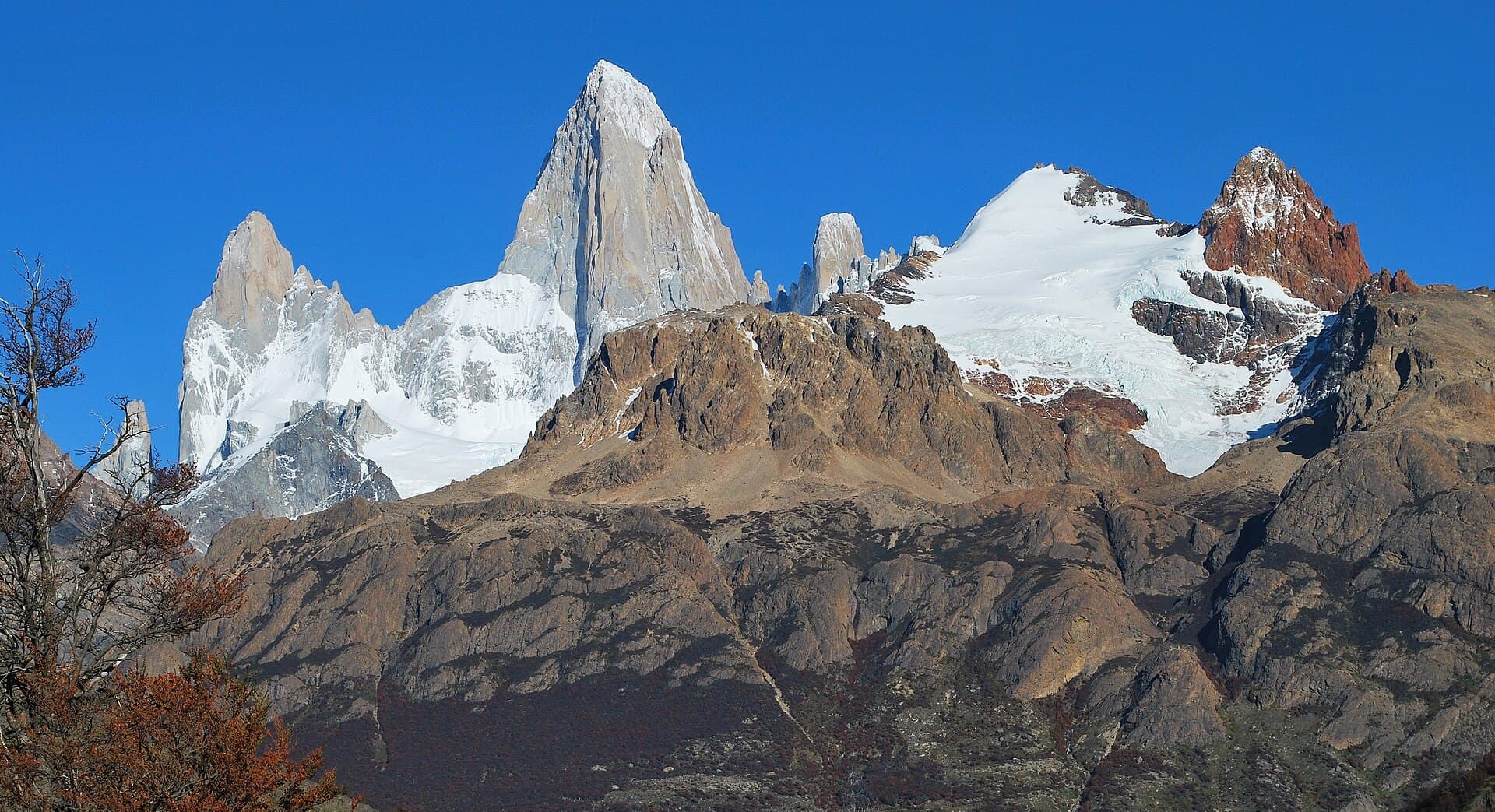
Most English-language guides describe El Chaltén as a "frontier" town, the trails as "wild," and the valley as "the last untouched corner of Patagonia." The marketing image invites you to expect solitary paths, rustic huts, and a clear, iconic view of Fitz Roy waiting on arrival. Here's what the place actually is:
Almost none of that is true.
Fitz Roy is visible from the town for maybe 20–35% of daylight hours in peak season. The main trails in Los Glaciares' north sector carry over a thousand walkers per day in December and January. The town itself has no 19th-century frontier architecture because there was no 19th-century settlement here — El Chaltén was founded by Argentine government decree on 12 October 1985, as a sovereignty-assertion measure during the still-unresolved Laguna del Desierto border dispute with Chile. Everything you see was built after the Reagan administration. The "rustic" aesthetic is deliberately constructed on a 1985 grid, and the trails that begin at the end of San Martín Avenue were cut by climbers in the last forty years.
And since 21 October 2024, Laguna de los Tres — the signature Fitz Roy hike — is no longer free. There are three new APN fee gates (Los Cóndores, Base Fitz Roy, Río Eléctrico), and non-resident foreigners pay 30,000 ARS to enter. The single most repeated claim in every English-language guide — that "Los Glaciares is free in the Chaltén sector" — stopped being true eighteen months ago. This changed in October 2024.
This article is the reframe. If you read nothing else before you go, read this.
What El Chaltén actually is
A first-principles description of El Chaltén is this: it is the only place on Earth where a walker can step out of a room in a serviced town and, within two to four hours on a trail that begins at the end of a residential street, stand beneath a cluster of the most aesthetically extreme granite alpine towers that exist anywhere, with no technical climbing required.
That is a rare and remarkable offer. But it is not a wilderness offer. It is a basecamp offer. The difference matters, because it changes what you pack, what you expect, and how many days you plan for.
A wilderness destination rewards solitude, self-sufficiency, and the ability to move for days without human contact. A basecamp destination rewards waiting for weather, walking out of a warm room with a day pack when the window opens, and letting go of the plan when the window closes. Yosemite Valley in high season is a basecamp destination. Chamonix is a basecamp destination. Karakoram Concordia is a wilderness destination. El Chaltén is the first kind, not the second — and every marketing page that describes it as the second is setting you up for disappointment.
What this means for your trip:
- Don't plan a tight itinerary. Plan days, not activities.
- Budget at least five nights in town if you want a reasonable probability of one clear Fitz Roy day.
- Pack for the walk from your bed to the trailhead, not for a deep wilderness expedition.
- The weather is the whole story. The activities are the variable you fit around it.
Continue reading Loma del Pliegue Tumbado — the one day hike in El Chaltén where you see everything →
"Chaltén" means "the smoker"
The Aónikenk (southern Tehuelche) named the mountain long before Europeans arrived. Perito Francisco Moreno recorded the name in his 1876–1877 journey and then, in 1877, renamed the peak "Fitz Roy" after the HMS Beagle's captain. The Aónikenk name is older by centuries.
It translates roughly as "the smoker" or "the one that smokes." The reference is not to a volcano — it's to the constant lenticular cloud cap that forms on the summit as moist Pacific air is forced upward by the massif. Pre-Darwinian Europeans, seeing the cloud, reasonably assumed it was a volcanic plume.
There is no better summary of what you should expect from the mountain. The Aónikenk, the French 1952 first-ascent expedition, the climbers who siege the walls every southern summer, and the rangers at the APN visitor centre all share one piece of knowledge: the cloud cap is the norm, not the exception. The 20–35% visibility figure isn't bad luck. It is the defining physical fact of the mountain, and the reason the 1952 Terray-Magnone ascent took weeks, and the reason a well-planned Chaltén itinerary budgets weather days first and activities second.
Many resources treat the weather as a footnote — a "be prepared for wind" sidebar somewhere on page three. The weather is not a footnote. It is the entire story. Budget for it accordingly.
How the town came to exist
El Chaltén was not founded by an estancia, a mission, a mine, a railhead, or a port. It was founded by a state that needed warm bodies on contested ground.
The backstory: after the 1984 Tratado de Paz y Amistad between Argentina and Chile resolved the Beagle Channel dispute, one chunk of the border remained explicitly unresolved — a roughly 530 km² zone east of the Andes watershed, around Laguna del Desierto. It was the site of a lethal 1965 incident in which Argentine Gendarmería shot and killed Chilean Carabinero Hernán Merino Correa during a confrontation over territorial control. That killing froze diplomatic progress for a generation; the 1984 treaty could not include Laguna del Desierto, and the two countries agreed in 1991 to send it to a binding five-member Latin American arbitration tribunal.
The tribunal ruled, 3–2, in favour of Argentina on 21 October 1994. Chile filed for revision; the tribunal rejected it in 1995. The award stood. The Lago del Desierto → Villa O'Higgins border crossing — still the only overland route between El Chaltén and the southern Carretera Austral — passes through the terrain this ruling resolved.
But in 1985, nine years before that ruling, the Argentine government established El Chaltén at the confluence of the Río de las Vueltas and the Río Fitz Roy, inside the northern buffer of Los Glaciares National Park. The decree is commemorated annually as the town's founding date: 12 October 1985. The purpose was not economic development. It was to pre-empt Chilean counter-claims by asserting effective civilian occupation — a standard move in international territorial law.
Everything about El Chaltén that you can see today flows from that founding purpose:
- The town has no historical quarter. There was no 19th-century town.
- The street grid is planned. The lots were allocated by the state.
- The free park access (until 2024) was structurally necessary, because you cannot reasonably charge residents to exit their own town onto trails that begin at the end of their residential streets.
- The APN Centro de Informes Ceferino Fonzo — the visitor centre at the south edge of town — functions as the town's de facto civic centre.
- The trails themselves are heavily engineered, well-signed, and maintained by a climbing community that uses them as approach routes to the walls.
And now, the same structural context explains why the 2024 fee introduction is meaningful: the regime of free access wasn't an ideological commitment, it was path-dependent. When APN finally built gates in October 2024, they put them not at the boundary of the town (impossible) but at chokepoints on the Laguna de los Tres trail — above the Cóndores viewpoint, at the Río Eléctrico crossing, and at the Base Fitz Roy approach. The geometry of the fee gates is the clue to the politics: they charge the hike, not the town, because the town cannot be charged.
Sources:
- Lacoste, Pablo. "La disputa por Laguna del Desierto y el Tratado de Paz y Amistad de 1984." Estudios Internacionales, Universidad de Chile, vol. 36 no. 142 (2003). Via SciELO Chile.
- "Sentencia del Tribunal Arbitral Internacional, Laguna del Desierto," 21 October 1994. Revista Española de Derecho Internacional vol. XLVII (1995).
- Memoria Chilena (Biblioteca Nacional de Chile), "Hernán Merino Correa": memoriachilena.gob.cl
- UNESCO World Heritage Centre, "Los Glaciares National Park": whc.unesco.org/en/list/145 (inscribed 1981)
Planning this route? We're forming a founding group for Huemul Circuit — Self-Guided Cohort — registering interest is free, no commitment. See the expedition →
The October 2024 fee change in detail
This is the single most important practical update any 2026 guide must surface. Almost none of them do.
On 21 October 2024, the Administración de Parques Nacionales (APN) introduced fee gates on the Laguna de los Tres trail. The structure:
- Non-resident foreigners: 30,000 ARS (approximately USD 20–42 depending on the exchange rate moment; the number is adjusted for inflation periodically)
- Argentine nationals: 10,000 ARS
- Santa Cruz residents: 4,000 ARS
- Second-day discount: 50% off for two-day hikers staying overnight at Campamento Poincenot
- Gate locations: Los Cóndores, Base Fitz Roy, Río Eléctrico
- Purchase: online at
ventaweb.apn.gob.aror at the gates themselves
Source: trips-southamerica.com — New Entry Fees Introduced for Some Hiking Trails in El Chaltén (October 2024), corroborated by daytours4u.com 2026 national parks fee guide and nomades.com national-parks-pass guide.
Which trails are gated, and which aren't:
- Clearly fee-gated: Laguna de los Tres (Fitz Roy). Confirmed across multiple 2025 sources.
- Implied but not clearly confirmed: Loma del Pliegue Tumbado, Chorrillo del Salto — both accessed via APN trailheads, but fee enforcement is inconsistent.
- Ambiguous: Laguna Torre. Sources disagree on whether this trail is inside the fee zone.
- Still free: the Huemul Circuit, which requires a free online permit via the APN visitor centre.
Warning for 2026 readers: no single Tier-1 APN page lists all gated trails comprehensively. The fee boundary has expanded once and may expand again. Assume the worst and budget for it — the difference between "free" and "$42 × 2 days" is not large in the context of a Patagonia trip, and getting stopped at a gate without pesos is a worse outcome than overpaying.
It's not just the entry fee
The fee change is the headline, but it is not the only thing that broke. Two other structural shifts happened in the same window, and both are even worse-documented in the English-language guides:
The historically-free trail campgrounds are no longer free
Campamento Poincenot (the overnight base for Laguna de los Tres), Campamento Laguna Capri, and Campamento De Agostini (the base for Laguna Torre) are now operated under concession by the non-profit Amigos del Parque Nacional Los Glaciares, at a rate of roughly 15,000–20,000 ARS (~USD 14–18) per person per night, with advance reservations required via amigospnlosglaciares.org/campamentos/.
These sites were free in every backpacker guide written between 2015 and 2023. Most of those guides are still top-ranked on Google. They are wrong.
The one still-free campsite in the El Chaltén network is Campamento Laguna Toro, the first-night base on the Huemul Circuit. That status is reported for 2025–26 but could change; confirm with the APN visitor centre on arrival.
The historically-free in-town campgrounds are gone
Campamento Confluencia and Camping Libre Madsen — the two free in-town options every 2019–2023 guide mentions — no longer allow overnight tent camping. Rangers are enforcing. Your choices for town camping are now the paid sites: El Relincho (~USD 11/person, hot showers, kitchen, wind shelter) and La Torcida (~USD 8/person). Source: Stingy Nomads 2025 El Chaltén camping update.
Argentina now legally requires travel insurance
As of May 2025, Argentina requires foreign visitors to carry travel insurance with at least USD 20,000 in medical coverage for entry. This is not optional. Many 2024 blog posts still describe it as recommended. Source: trips-southamerica.com — Argentina Travel Requirements 2025.
Combined, these three changes mean a "free Patagonia" El Chaltén trip — the specific fantasy the top Google results have been selling since 2015 — is no longer possible. A realistic 7-day foreign trekker budget in 2026 is between USD 1,300 (camping, self-catering, cheapest flights) and USD 3,200 (hostel privates, restaurants, premium tours, guided Viedma day). The middle number is around USD 2,100. That is still meaningfully cheaper than Torres del Paine on the Chilean side — but it is not free, and anyone planning on the old numbers will be caught short.
The "Yosemite of South America" problem
The comparison is old. It predates Chaltén's mass tourism and it is made by people reaching for a shorthand that communicates "big granite walls in a national park." On that narrow axis, it is accurate — Yosemite and the Chaltén massif are both granite meccas inside national parks with deep climbing histories that anchor local identity. Beyond that, the analogy misleads on almost every dimension that matters.
| Dimension | Yosemite | El Chaltén / Los Glaciares N |
|---|---|---|
| Granite wall quality | World-class (El Cap, Half Dome) | Arguably superior for alpine towers |
| Approach | Drive to trailhead; shuttle | Walk from town; zero km driving required |
| Park services | Dense, centralized, highly regulated | Sparse; one APN info centre; no in-park lodging |
| Visitor numbers | ~4 million/year park-wide | Los Glaciares ~500–700k combined; Chaltén sector a fraction |
| Permit system | Wilderness permits + peak vehicle reservation | Free Huemul permit; Los Tres day-fee since Oct 2024 |
| Multi-day backcountry | Extensive (JMT, Clouds Rest) with strict quotas | Limited by glaciation; Huemul Circuit is the standout |
| Climbing culture | Historical epicenter of American big-wall | Current global epicenter of alpine granite |
| Weather in peak season | Mediterranean; reliably clear | Maritime subpolar; reliably unreliable |
| Access fee | ~USD 35/vehicle/week | USD 20–42 foreign, day-gated |
Where the analogy holds: rock quality, climbing culture, the fact that both towns are organized around alpinists who then share the valley with tourists.
Where the analogy breaks:
- Weather. A five-day Yosemite trip will show you Half Dome. A five-day Chaltén trip has a real probability of never clearing Fitz Roy. "Yosemite" primes the wrong weather assumption by a factor of two.
- Access geometry. Yosemite is entered through a vehicle gate into a valley floor. El Chaltén is entered through the end of a residential street. Yosemite is a park with a town attached; El Chaltén is a town with a park attached. This is backward for the Yosemite analogy and forward for everything else about the experience.
- Permit system. Yosemite's backcountry is rationed by lottery. Chaltén's is self-register and walk in. They attract different kinds of trekkers and breed different kinds of mistakes. Yosemite's lottery forces advance planning; Chaltén's self-register system rewards arriving flexible and ready to wait for weather.
- Multi-day options. Yosemite has a century of engineered multi-day backcountry routes (JMT, Rae Lakes, Clouds Rest). Chaltén has essentially one serious multi-day — the Huemul Circuit — and it is technical enough (two tyrolean traverses, exposed passes routinely in 100+ km/h wind) that it is not a default day-after-day-hikes option.
The useful takeaway: if someone tells you "El Chaltén is the Yosemite of South America," what they mean is "the rock is good." Treat everything else they tell you about the experience as Yosemite-template projection and verify it independently.
What to do with this framing
If you have read this far, here is the practical outcome.
- Budget at least five nights in town, six if you can. This is the single most load-bearing trip-planning decision. Fewer nights radically increases the probability of never seeing Fitz Roy.
- Don't build a tight itinerary. Plan a set of possible activities — Laguna de los Tres, Laguna Torre, Pliegue Tumbado, Chorrillo del Salto, a Viedma glacier day — and pick each morning based on the wind forecast the rangers post at the Ceferino Fonzo visitor centre. The right framing is "I have a menu, and the weather is my chef."
- Treat the fee change as real. Bring pesos (or pay at the gate with card if the system is working that day), assume Laguna de los Tres is USD 20–42, assume campgrounds are paid, assume you need travel insurance with USD 20,000+ medical coverage.
- Rent Huemul gear in El Chaltén, not before. Bajo Zero and Viento Oeste on Av. San Martín carry pulleys, locking carabiners, harnesses, and slings. El Calafate doesn't. Buenos Aires sells but doesn't rent. Reserve by email 2–3 weeks ahead for peak Jan/Feb.
- Ignore "visit in December." The data favors March. December is the windiest month in the Chaltén massif — average 25 km/h sustained, gusts 40–60 km/h common. Late February through early March delivers similar temperatures with meaningfully less wind, fewer people, and autumn colour starting. Mid-to-late November is the other sweet spot (longest daylight, driest air) with the tradeoff of more wind and possible lingering snow on the Huemul passes. Every guide pushes December because that's when their partner operators have best capacity, not because it's the best weather. Source: climate-data.org El Chaltén.
- If you only have three days, pick Pliegue Tumbado. It's the single most overlooked day hike in the valley — 20 km round trip, 1,000 m gain, no technical scrambling — and it's the only trail that delivers a 360° panorama of both the Fitz Roy massif AND the Cerro Torre group AND Lago Viedma AND the Southern Patagonian Icefield in one view. It's also meaningfully less crowded than Los Tres. The only catch: it's the most wind-exposed trail in the park. If rangers flag wind above 60 km/h, don't go.
- If you're here for the climbing history, go in October–November. The climbing season is early November to late February; "climbing culture" is at peak in early season when teams are arriving, weather windows are still rare, and the town is full of people waiting. Later in the season is better weather for trekkers but quieter on the climber side.
The one sentence
El Chaltén is not a wilderness — it is a basecamp in the best climbing town in South America, inside a park whose free-access regime just ended, organized around a mountain whose defining feature is that you probably won't see it. Plan for that mountain, not for the one on the Patagonia Inc. logo, and you will have a good trip.
18 Sources
- Lacoste, Pablo. "La disputa por Laguna del Desierto y el Tratado de Paz y Amistad de 1984," Estudios Internacionales (Universidad de Chile), vol. 36 no. 142 (2003) — SciELO Chile. Canonical academic source on the border dispute chronology.
- Sentencia del Tribunal Arbitral Internacional, Laguna del Desierto, 21 October 1994. Published in Revista Española de Derecho Internacional vol. XLVII (1995).
- memoriachilena.gob.clMemoria Chilena, "Hernán Merino Correa": memoriachilena.gob.cl
- whc.unesco.orgUNESCO World Heritage Centre, "Los Glaciares National Park," inscription file 145, 1981: whc.unesco.org/en/list/145
- Terray, Lionel. Les Conquérants de l'Inutile (Gallimard, 1961); English edition Conquistadors of the Useless (1963; Bâton Wicks reprint 2008). Primary source for the 1952 Fitz Roy first ascent.
- Garibotti, Rolando. "A Mountain Unveiled," American Alpine Journal 2004. Technical critique of the 1959 Maestri-Egger Cerro Torre claim.
- Crouch, Gregory. Enduring Patagonia (Random House, 2001). Narrative history of Chaltén-massif climbing through 2000.
- trips-southamerica.comTrips South America — New Entry Fees Introduced for Some Hiking Trails in El Chaltén (Oct 2024)
- daytours4u.comDayTours4U — 2026 National Parks Fees Argentina
- nomades.comNomades — Argentina National Parks Pass Guide
- stingynomads.comStingy Nomads — El Chaltén Camping 2025 Update
- amigospnlosglaciares.orgAmigos del PN Los Glaciares — campamentos reservation portal
- trips-southamerica.comTrips South America — Argentina Travel Requirements 2025 (mandatory travel insurance)
- en.climate-data.orgClimate-Data.org — El Chaltén
- elchalten.comelchalten.com — The weather in El Chaltén
- journeylatinamerica.comJourney Latin America — When to Go, El Chaltén and the Fitz Roy Massif
- nps.govNPS — Yosemite Visitor Statistics
- Casamiquela, Rodolfo. Toponimia indígena del Chubut and related works on Tehuelche linguistics (CENPAT-CONICET). Canonical source on the Aónikenk "Chaltén" etymology.