The contrarian claim
Every travel-media piece about southern Patagonia describes the Lago del Desierto → Villa O'Higgins crossing with the same three words: end of road. As in: this is where the Carretera Austral terminates, this is where the map runs out, this is the place where you step off the bus in one country and into another on foot. Sold that way, it is irresistible. Sold that way, it is also a trap.
Because this crossing is not a hike. It is a five-leg logistics puzzle across two countries, with two independent boat operators, two border posts, a 22 km section of no-man's-land, and a failure mode — Hielo Sur cancels because of wind on Lago O'Higgins — that strands you on the Chilean side with no road alternative. The romance of the "end of road" is the marketing copy. The reality is that the same end of road is what makes the crossing fragile. When something breaks, you cannot drive around it.
This article is the deep-dive: what the crossing actually is, why it breaks, and whether it's the right choice for your trip. If you came for the romance and have a flight in four days, read the cancellation section first.
What this crossing actually is
The Lago del Desierto → Villa O'Higgins route is the only overland border crossing between El Chaltén (Santa Cruz province, Argentina) and the southern terminus of Chile's Carretera Austral. No road. No paved alternative. No scheduled bus that drives through. To get from El Chaltén to Villa O'Higgins without flying through Buenos Aires and Santiago, you take this route or you don't go.
The full sequence, north to south (Argentina → Chile):
- El Chaltén → Lago del Desierto. 37 km gravel road north of town. Bus or private shuttle — roughly 1.5 hours.
- Lago del Desierto ferry (Argentine side). ~45 minutes across the lake to the northern shore. Operated by Las Lengas / Exploradores del Lago del Desierto. Argentine Gendarmería exit stamp is given at Puesto Gendarmería Lago del Desierto before or at the ferry, depending on crew arrangements that day.
- Overland no-man's-land. Roughly 22 km between the Argentine border post and Candelario Mancilla on the Chilean side. Hike, or pay a local estancia for a horse. No vehicle road. No emergency exit. Plan a full day.
- Candelario Mancilla (Chile). Chilean Carabineros stamp your entry here. The post is seasonally staffed. Budget accommodation (hospedaje) and camping at Estancia Candelario Mancilla.
- Lago O'Higgins ferry (Chilean side). ~3 hours across Lago O'Higgins to Bahamondez port. Operated by Hielo Sur. This is the single most cancellation-prone leg.
- Bahamondez → Villa O'Higgins. 7 km road transfer to the village itself — the southern end of the Carretera Austral.
South to north (Chile → Argentina) runs the same legs in reverse, and the timing constraint flips: Hielo Sur sailings from Bahamondez to Candelario Mancilla typically depart in the morning, and if the Argentine ferry isn't running that day on Lago del Desierto, you sleep at Estancia Candelario Mancilla before you can continue.
Primary source on the operator chain: Travel With the Smile — Villa O'Higgins border crossing guide.
Continue reading Getting to El Chaltén in 2026 — flights, the paved Ruta 40, and the mandatory insurance you need →
The numbers
| Leg | Operator | Cost (2026) | Notes |
|---|---|---|---|
| El Chaltén → Lago del Desierto (bus/shuttle) | Las Lengas or Chaltén Travel | ~ARS 17,000 one-way | Seasonal; book day-of or 24 hrs ahead in peak |
| Lago del Desierto ferry (Argentine side) | Exploradores del Lago del Desierto | ARS 35,000–40,000 (~USD 25–28) | exploradoreslagodeldesierto.com |
| Hike / horse across no-man's-land | Estancia Candelario Mancilla (horses) | Horse ~USD 60–80; hiking free | ~22 km, elevation ~500 m cumulative |
| Lago O'Higgins ferry (Chilean side) | Hielo Sur | ~CLP 44,000 (~USD 45) | Mon/Wed/Sat typical summer schedule, weather-permitting |
| Bahamondez → Villa O'Higgins road transfer | Robinson Crusoe / local operators | Included in packages or ~CLP 5,000 | 7 km |
Package discount: Robinson Crusoe Villa O'Higgins sells the whole crossing bundled — Chilean ferry plus shuttles plus optional accommodation at Estancia Candelario Mancilla — with roughly a 10% discount over booking legs separately. Primary source: Robinson Crusoe Villa O'Higgins.
Total out-of-pocket: budget USD 120–180 per person for the crossing itself, excluding meals and the overnight at Candelario Mancilla.
The schedule window
- Seasonal: November through March only. Hielo Sur does not operate Lago O'Higgins outside that window, and Candelario Mancilla is unstaffed or skeleton-staffed in winter.
- Hielo Sur frequency: historically Mon / Wed / Sat through the summer, with additional sailings in late December–February peak. [UNVERIFIED for specific 2026 dates — confirm directly with the operator 30 days out.]
- Argentine ferry frequency: roughly daily in peak summer (Dec–Feb), reducing to 3–4 days a week in November and March shoulder months.
- Cross-border synchronization: the two boat schedules are not co-ordinated. A missed Argentine ferry can put you a day behind the Chilean one, and vice versa.
Primary sources: Hielo Sur / Robinson Crusoe schedules, Travel With the Smile crossing guide.
Planning this route? We're forming a founding group for Huemul Circuit — Self-Guided Cohort — registering interest is free, no commitment. See the expedition →
Why this crossing breaks — the cancellation pattern
This is the section every romance-oriented guide skips. The crossing has paused or partially paused in multiple recent seasons:
- Hielo Sur fleet issues have reduced Chilean sailings to two days per week in past seasons.
- COVID-era closures shut the crossing entirely for two Patagonian summers.
- Wind on Lago O'Higgins is the most common day-to-day cancellation cause. The lake is long, deep, and bracketed by icefield-cooled katabatic flow — the same Pacific-driven westerly that makes Paso del Viento on the Huemul Circuit a wind problem also makes Lago O'Higgins a ferry problem. December and January see the strongest sustained winds of the year (average 25 km/h sustained valley-level, 40–60 km/h gusts, per climate-data.org).
- Seasonal staffing at Candelario Mancilla. The Carabineros post is not 24/7 year-round. If you arrive off-hours outside peak season, you may wait for the next stamping window.
The failure mode is asymmetric. Going Argentina → Chile, a cancelled Hielo Sur ferry strands you at Candelario Mancilla. There is no road out. You wait for the next sailing (Monday could turn into Wednesday; Wednesday could turn into Saturday) or you hike back 22 km to Lago del Desierto and re-enter Argentina. Going Chile → Argentina, a cancellation strands you in Villa O'Higgins — at least a village with hospedajes, a bakery, and a bus connection back up the Carretera Austral if you give up.
Build a 3–5 day window for this crossing. If your flight out of El Calafate or Santiago is four days away and you have not yet left El Chaltén, this is not the route you want.
Operator cancellation history is tracked informally on Wikivoyage and TripAdvisor forum threads; no operator publishes a cancellation rate. Treat every confirmed booking as a planning baseline, not a guarantee.
The 30-day rule
The most important sentence in this article:
Re-confirm the crossing within 30 days of your planned start.
Hielo Sur's fleet, schedule, and even operating status have changed season-to-season. So have the Argentine-side operators, shuttle providers, and Carabineros staffing patterns. A guidebook or blog post more than 90 days old should be read as the crossing was operating under roughly these conditions at that time, not as a reliable 2026 plan.
Check, in this order:
- Hielo Sur direct — email or WhatsApp the current season's operator contact (robinsoncrusoe.com contact).
- Exploradores del Lago del Desierto — the Argentine ferry booking page (exploradoreslagodeldesierto.com).
- APN Ceferino Fonzo — the rangers in El Chaltén know when either operator has suspended service in the current season.
- Villa O'Higgins municipal tourism — for south-to-north planning.
If two of the four say the crossing is running and one says it's paused this week, it's paused this week.
The history under your feet
The 22 km overland section is, by any reasonable measure, ordinary Patagonian hiking terrain — lenga forest, river crossings, gentle elevation. What it is not is ordinary history.
6 November 1965: Chilean Carabinero Hernán Merino Correa was shot and killed in a confrontation with Argentine Gendarmería inside the disputed Laguna del Desierto zone — terrain a few kilometres from the route you're walking. The incident froze Argentina–Chile diplomatic progress for a generation and is still commemorated in Chile. (Memoria Chilena — Hernán Merino Correa.)
21 October 1994: a five-member Latin American arbitration tribunal ruled 3–2 for Argentina, resolving the ~530 km² disputed zone between Monte Fitz Roy and Cerro Daudet along the local water divide rather than the continental divide Chile had argued for. Chile filed for revision in 1995; the tribunal rejected it. The award stands. (Primary: Sentencia del Tribunal Arbitral Internacional, Laguna del Desierto, 1994, archived by Cancillería Argentina; academic: Lacoste, Pablo. "La disputa por Laguna del Desierto y el Tratado de Paz y Amistad de 1984." Estudios Internacionales, Universidad de Chile, vol. 36, no. 142 (2003), via SciELO Chile.)
Why this matters for the crossing: El Chaltén itself was founded in 1985 as a sovereignty measure — a planned town dropped into the northern buffer of Los Glaciares to establish effective Argentine occupation ahead of the arbitration. The Lago del Desierto crossing route has therefore been walked, guarded, and argued over as a border, not as a trail, for most of its modern history. The infrastructure you use in 2026 — the Gendarmería post, the Carabineros post, the boat concessions — is the civilian residue of an unsettled claim that became settled thirty-two years ago.
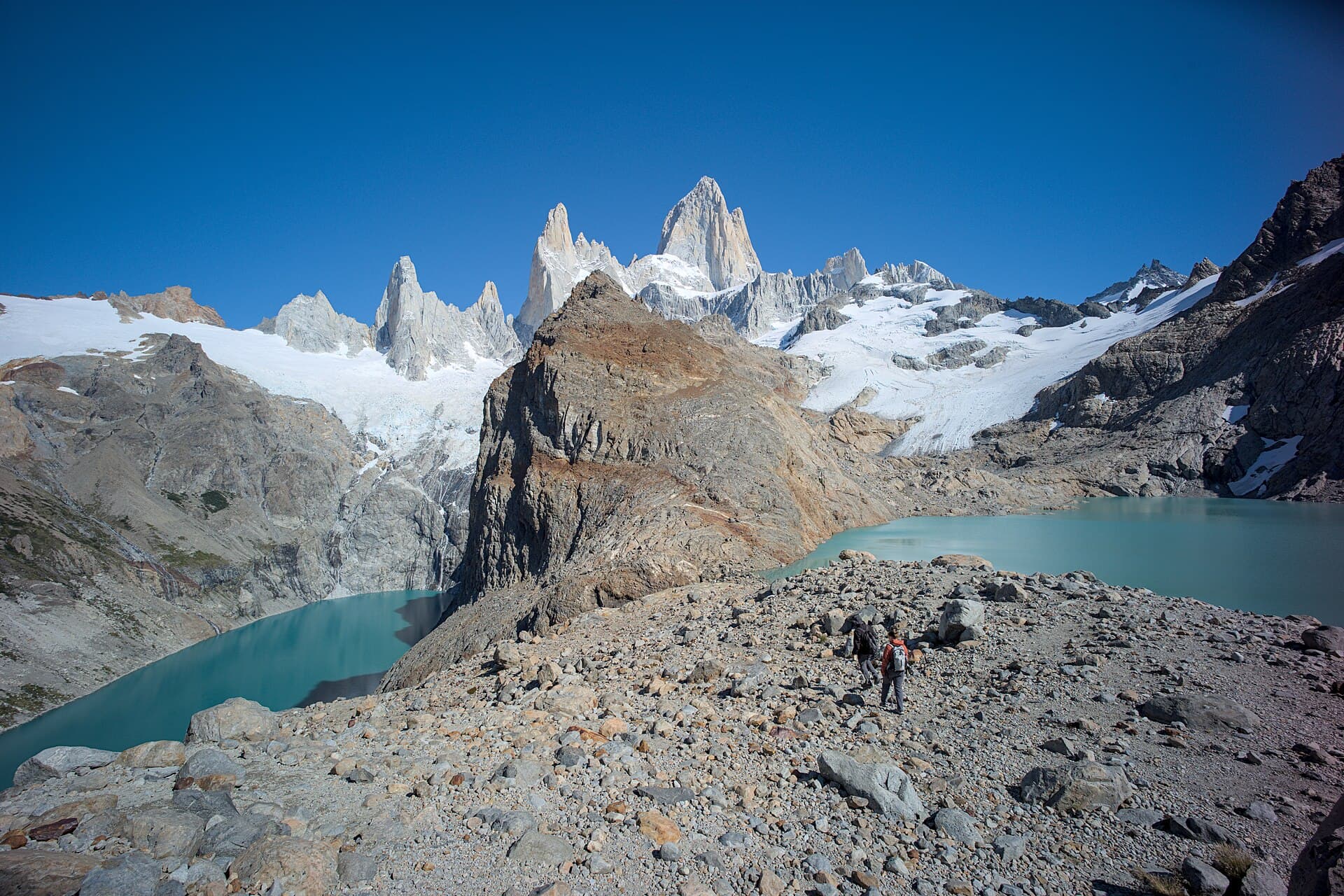
A quiet walk through Lenga forest, under history that isn't.
Going Argentina → Chile vs. Chile → Argentina
The two directions are not symmetric.
Argentina → Chile (the more common direction for trekkers finishing in El Chaltén):
- You're going from a well-connected Argentine town (daily buses, flights from El Calafate) to a remote Chilean village at the end of a partially gravel Carretera Austral.
- Onward from Villa O'Higgins means 1,200+ km of driving or bussing up the Carretera to Coyhaique, Puerto Montt, or onward to Santiago.
- You lose time on a cancellation, not a destination. If Hielo Sur is down, you wait at Candelario Mancilla.
Chile → Argentina (the inbound leg for Carretera Austral drivers):
- You're finishing a long road trip and entering a well-serviced part of Argentina. Rescue options abound on the Argentine side — El Chaltén has daily shuttles to El Calafate, and El Calafate has daily flights to Buenos Aires.
- You lose a planned town on a cancellation, not your whole itinerary. If the Argentine ferry is down, you sleep at Candelario Mancilla and start a day later.
Practical asymmetry: the north-to-south direction is harder to recover from. The south-to-north direction has redundancy built in once you reach Argentina. If you have a scheduled flight to protect, build your schedule around the crossing into Argentina, not out of it.
When this crossing is the right choice
It makes sense if:
- You're travelling the Carretera Austral end-to-end and this crossing is a structural part of the itinerary rather than a side quest.
- You have at least five flexible days between leaving El Chaltén and your next fixed commitment.
- You are willing to treat Hielo Sur cancellation as a feature of the trip, not a ruined trip.
- You're a climber or repeat Patagonia visitor doing the crossing because it's the fragile one, not despite it.
Consider skipping it if:
- You have a flight out of El Calafate or Santiago in under four days.
- You are a first-time Patagonia traveler who has not yet done Laguna de los Tres, Laguna Torre, or the Huemul Circuit. The valley day hikes are the correct first visit; the border crossing is the correct second one.
- Your itinerary depends on being in Santiago or Buenos Aires on a specific date. The correct alternative is to fly El Calafate → Santiago via Buenos Aires, which takes a day, is weather-proof, and costs less in stress than a five-day crossing with cancellation risk.
First-principles: is this crossing worth it?
It depends on what you're going to Patagonia for.
If you are going to Patagonia to see Fitz Roy and Cerro Torre, this crossing is irrelevant. The massifs are visible from town and the day hikes deliver the goods. You can leave El Chaltén by bus back to El Calafate, fly out, and never think about Villa O'Higgins.
If you are going to Patagonia to move through it — to feel, in your own schedule, that the Carretera Austral is a road with an actual end, and that Argentina and Chile are separated by a glacial lake in the middle of a continental ice field rather than by a passport booth — the crossing is the point. It is the only overland way to do this in southern Patagonia, and the entire point of doing it is precisely that it is fragile, remote, and seasonally constrained.
Neither reason is wrong. The wrong reason is the one the travel press keeps selling: "end of road" as a destination you can pencil onto a tight itinerary. This crossing does not reward tight itineraries. It rewards schedule slack and good weather days, which is exactly what it has always rewarded, and exactly what the "end of road" framing skips past every time.
Ask at Centro Ceferino Fonzo when you arrive in El Chaltén. The rangers track the current season's operator status and will tell you plainly whether the crossing is worth building the rest of your trip around this week, or whether it is not.
11 Sources
- travelwiththesmile.comTravel With the Smile — Villa O'Higgins border crossing guide — operator chain, sequence detail, historical cancellation context.
- exploradoreslagodeldesierto.comExploradores del Lago del Desierto — Argentine ferry operator — Argentine ferry booking, schedule, pricing.
- robinsoncrusoe.comRobinson Crusoe — Villa O'Higgins excursions — Chilean operator bundle, pricing, seasonal schedule.
- en.climate-data.orgclimate-data.org — El Chaltén — monthly wind averages relevant to Hielo Sur cancellation risk.
- wanderlog.comWanderlog — El Chaltén November weather and March weather — shoulder-month weather context.
- Lacoste, Pablo. "La disputa por Laguna del Desierto y el Tratado de Paz y Amistad de 1984." Estudios Internacionales (Universidad de Chile) vol. 36, no. 142 (2003). Via SciELO Chile — historical sovereignty context.
- Sentencia del Tribunal Arbitral Internacional, Laguna del Desierto, 21 October 1994. Archived by Cancillería Argentina; published in Revista Española de Derecho Internacional vol. XLVII (1995) — 1994 arbitration award.
- memoriachilena.gob.clMemoria Chilena — Hernán Merino Correa (Biblioteca Nacional de Chile) — 1965 border incident.
- whc.unesco.orgUNESCO WHC — Los Glaciares National Park (inscription 145) — UNESCO status and park boundaries relevant to the Argentine side of the crossing.
- argentina.gob.arAPN — Parque Nacional Los Glaciares — APN institutional status, ranger information network.
- en.wikivoyage.orgWikivoyage — Villa O'Higgins — informal tracking of operator schedule changes and 2024–2026 status notes.