The monopoly
Nepal owns altitude. Eight of the world's fourteen 8,000-meter peaks sit inside its borders. No other country competes on that axis.
Indonesia owns fire. 130 active volcanoes span an archipelago of 17,000 islands along the Ring of Fire — the highest density of active volcanism anywhere on Earth. The country has produced two of the five largest eruptions in recorded history: Tambora in 1815 (VEI-7, 92,000 dead, a global "year without a summer") and Krakatoa in 1883 (VEI-6, 36,417 dead, the loudest sound in recorded history at 310 dB).
These are not the same kind of mountain experience. Nepal's challenge is altitude — thin air, slow acclimatization, the ceiling of human physiology. Indonesia's challenge is geology — active lava, pyroclastic flows, eruptions measured in weeks not centuries, and a permit system fragmented across provinces with no central authority.
English-language trekking guides treat them as interchangeable entries on a "best treks" list. They are not.
What you actually have access to
Seven peaks define Indonesia's trekking and expedition landscape. They span four islands, three time zones, and a price range from $20 village fees to $30,000 expedition packages.
| Peak | Elevation | Island | Status (April 2026) | Type |
|---|---|---|---|---|
| Rinjani | 3,726m | Lombok | Open — 400/day quota | Multi-day trek |
| Kerinci | 3,805m | Sumatra | Open | Multi-day trek |
| Semeru | 3,676m | Java | Restricted — Ranu Kumbolo only, no summit | Active eruption |
| Agung | 3,031m | Bali | Open (reopened April 25) | Guided day climb |
| Bromo | 2,329m | Java | Open (ceremony closures) | Sunrise tourism |
| Carstensz Pyramid | 4,884m | Papua | Open — expedition only | Technical climb, Seven Summits |
| Tambora | 2,850m | Sumbawa | Open | Remote trek |
One of these is a $200 trek. One is a $30,000 expedition. Most English-language guides describe them as if they're on the same spectrum. They are not even in the same category of travel.
Continue reading The Real Cost of Climbing Indonesia in 2026 →
Rinjani — the flagship that's cheaper than you think (and more expensive than operators say)
Mount Rinjani is the marquee Indonesian trek: a 3,726-meter active volcano on Lombok with a turquoise crater lake (Segara Anak) inside the caldera. Three routes climb it — Senaru (north, the classic), Sembalun (east, more open terrain), and Torean (west, less trafficked). Most trekkers do a 3-day/2-night summit + lake circuit combining Sembalun up and Senaru down.
Operators quote IDR 3,200,000–5,200,000 ($195–$325) for the standard package. That number is real but misleading — it covers the guide, porters, food, tent, and park permits. It does not cover the flight to Lombok, the hotel before and after, travel insurance, or gear you don't own. The all-in cost for a foreign trekker flying from Bali is closer to $960–$1,600 depending on comfort level.
Guides are mandatory since 2018. The ratio changes to 1:4 in 2026 — one guide per four trekkers. The daily quota is 400 people, split 240 through operators and 160 individual bookings via the e-Rinjani platform. The park closes January through March for the monsoon and reopened April 1, 2026.
There is no luxury Rinjani. Every overnight on the mountain is in tents. The "VVIP" packages some operators market ($400–$600) add better tents, a private chef, and hotel nights in Lombok — but the mountain experience is still sleeping on volcanic gravel at 2,600 meters with a tarp overhead. If you want a lodge-based volcano experience, Rinjani is not it. This is a gap in the market, not a failure of the mountain.
Carstensz Pyramid — the $30,000 question
Puncak Jaya (4,884m), marketed internationally as Carstensz Pyramid, is the highest peak in Oceania and the only one of the Seven Summits that requires technical rock climbing (YDS 5.8–5.9, fixed ropes, a Tyrolean traverse over a 30-meter gap).
It is also, paradoxically, both the lowest and the most expensive of the Seven Summits. Not because the climbing is hard — experienced rock climbers call the technical sections moderate. The cost comes from logistics, politics, and a gold mine.
The Grasberg Mine, operated by Freeport McMoRan (majority-owned by the Indonesian government since 2018), is the largest gold mine on Earth. It sits 4 kilometers from the summit. The mine has displaced over 100,000 hectares of indigenous Amungme and Kamoro land and transformed the approach to the mountain into a militarized zone.
To climb Carstensz in 2026, you need permits from at least six agencies: BAIS (military intelligence), TNI (armed forces), the Ministry of Foreign Affairs, Freeport, local tribal leaders, and the national park. You need an armed military escort. And since a September 2025 mudslide blocked the mine road — the only overland route — you need a helicopter from Timika to base camp at 4,100 meters.
Operators charge $8,700 (local, minimum 4 climbers) to $29,950 (Alpenglow Expeditions, Adrian Ballinger personally guiding). The spread reflects the same guide, the same permits, the same helicopter — the difference is the international operator's overhead, marketing, insurance, and the comfort of a Western-staffed expedition versus navigating Papua's bureaucracy independently.
The expedition was closed from 2019 to 2024 due to armed conflict between the Indonesian military and the Free Papua Movement (OPM). It reopened in late 2024. The security situation remains fluid — a pilot was shot in February 2026 in a separate OPM incident. Operators emphasize that the climbing area itself has remained safe, but the geopolitical context is not something the glossy expedition brochures foreground.
One more thing: Carstensz Pyramid's equatorial glaciers — once covering the summit area — have lost 99% of their surface area since 1850. Glaciologists project they will vanish entirely by approximately 2030. You are looking at the last equatorial glaciers on Earth.
Semeru — the one they're still marketing as open
Multiple English-language trekking guides describe Semeru (3,676m, Java's highest peak) as a multi-day trek to the summit crater. As of April 2026, this is dangerous misinformation.
Semeru has been in continuous eruption since June 2017. The PVMBG (Indonesia's volcanological agency) maintains it at Alert Level IV — the highest level. In April 2026 alone, pyroclastic flows reached 4.5 km from the summit, warning sirens were activated, and ash plumes rose 2,500 meters above the crater daily.
The national park reopened limited access on April 24, 2026 — but only to Ranu Kumbolo lake (2,400m), a campsite roughly 10 kilometers and 1,300 vertical meters below the summit. The summit, the crater, and the upper mountain remain inside a 5-kilometer exclusion zone.
If a guide offers you a Semeru summit trek in 2026, they are offering you a walk into an active exclusion zone on a volcano that produces weekly pyroclastic flows. The correct answer is no.
The sacred layer
What makes Indonesia's volcanoes genuinely different from every other mountain range on jtreks is not the geology — it's the cultural overlay.
Rinjani hosts annual Mulang Pekelem ceremonies at Segara Anak crater lake, where Sasak and Balinese Hindu communities offer gold, clothing, and livestock to the lake's spirit. The ceremonies predate tourism by centuries.
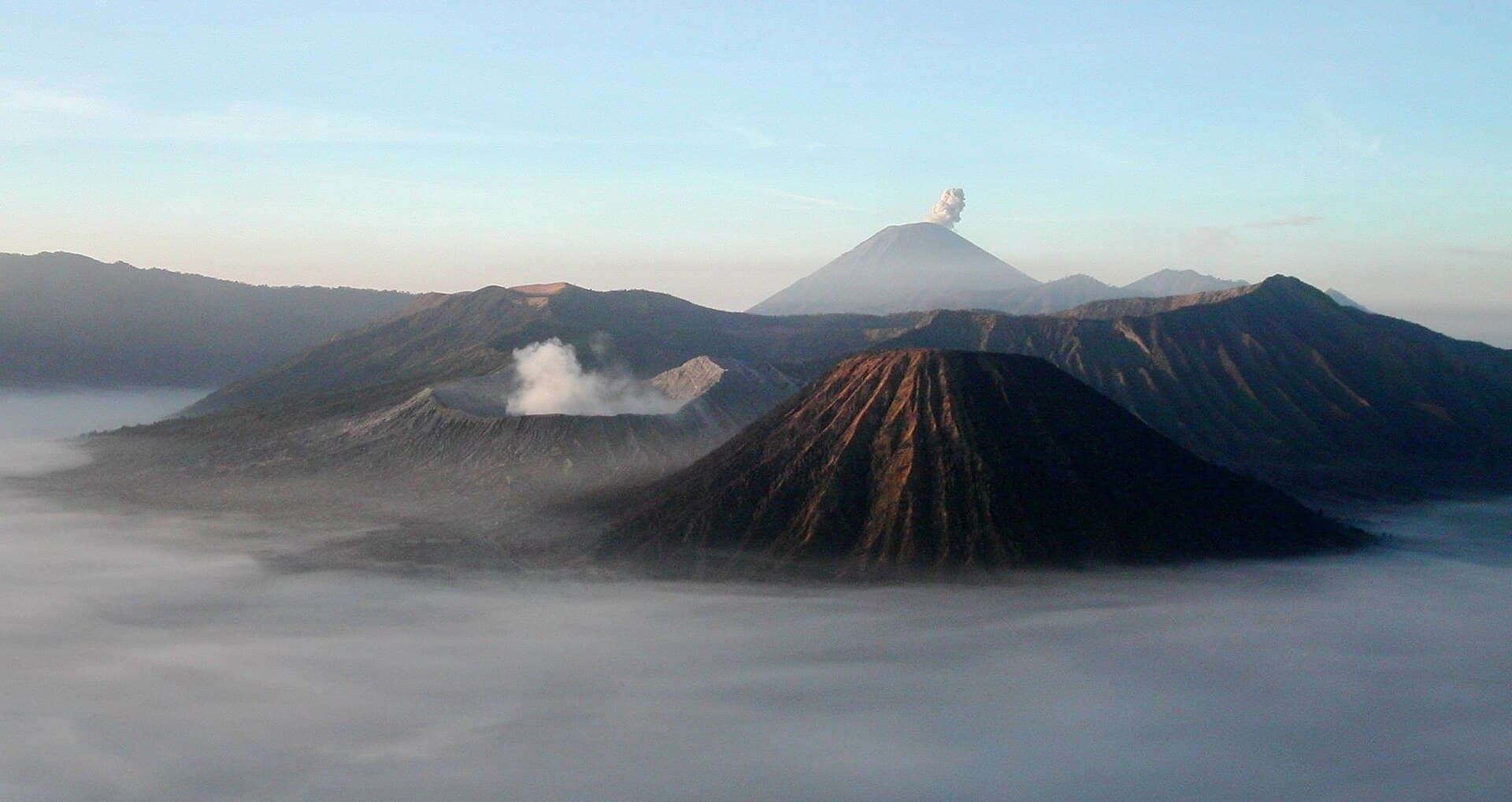
Bromo sits inside the Tengger Caldera, home to the Tenggerese — a Hindu minority of roughly 600,000 who have maintained their faith through five centuries of Islamization. Their annual Yadnya Kasada ceremony involves throwing offerings into Bromo's active crater. The crater closes to tourists during the ceremony (next: May 30–June 2, 2026).
Agung is the holiest mountain in Bali — the axis of the Balinese Hindu cosmos. It closed for 28 days in March–April 2026 for the Karya Ida Bhatara Turun Kabeh ceremonies at Besakih Temple. This is not a safety closure. This is a mountain that closes because the Balinese say so.
In Nepal, mountains are sacred but tourism operates around the sacred calendar without interruption. In Indonesia, the sacred calendar interrupts tourism. If you're planning a trip around Agung, Bromo, or Rinjani, the ceremonial schedule is not a footnote — it's a hard constraint.
The guide gap
Indonesia has no IFMGA (International Federation of Mountain Guides Associations) member body. There is no standardized mountain guide certification equivalent to France's ENSA, Nepal's NATHM, or Argentina's AAGM.
Rinjani guides are registered through the national park authority. Carstensz guides are employed by expedition operators. Bromo guides are freelance. There is no unified standard, no public registry, and no way for a foreign trekker to verify a guide's qualifications independently.
This does not mean Indonesian guides are incompetent — many Rinjani guides have done the mountain hundreds of times. It means the quality assurance mechanism is the operator's reputation, not a professional credential. For Rinjani at $200–$400, the risk is proportional. For Carstensz at $25,000, the absence of credential verification is worth understanding.
The permit fragmentation
Nepal has the Department of Immigration issuing TIMS cards and the Department of National Parks issuing entry permits. Two agencies, one system, applied nationally.
Indonesia has no equivalent centralized system. Each national park has its own authority, its own booking platform, its own fee structure, and its own rules about guides, quotas, and camping. Rinjani uses e-Rinjani. Bromo-Tengger-Semeru uses the TNBTS system. Kerinci uses the local forestry office. Carstensz requires military intelligence clearance.
For a trekker planning a multi-volcano trip across islands, this means booking through 3–5 separate systems in Indonesian, paying in different formats (some online, some cash-only at the gate), and navigating rules that vary by park. It is not difficult — it is fragmented in a way that makes planning slower than it needs to be.
Who this is for
Indonesia's volcanoes are for three types of trekker:
The multi-day trekker who wants Rinjani — a 3-day crater-lake circuit on an active volcano with a mandatory guide, tent-based camping, and a total cost under $1,600. This is the core audience and the most accessible entry point.
The Seven Summits chaser who needs Carstensz — a $10,000–$30,000 expedition with helicopter access, military escorts, technical rock climbing, and the geopolitical complexity of Papua. This is high-ticket by necessity, not by luxury.
The volcanic tourist who wants Bromo's sunrise, Ijen's blue fire, and Agung's sacred weight without multi-day commitments. This is day-trip and short-circuit territory with a wide price range ($50–$500 depending on whether you hire a driver or join a group).
What Indonesia does not have — yet — is a luxury multi-summit circuit. Nobody packages Rinjani + Agung + Bromo/Ijen into a single curated experience with premium accommodation, photography services, and cultural programming at the $2,000–$5,000 price point that high-net-worth trekkers would pay. The infrastructure exists. The product does not.
That gap is an opportunity.
7 Sources
- magma.esdm.go.idMAGMA Indonesia — PVMBG (Ministry of Energy and Mineral Resources)
- volcano.si.eduSmithsonian Global Volcanism Program — Semeru
- tc.copernicus.orgIbel, Mölg & Sommer (2025), The Cryosphere — Puncak Jaya glaciers close to extinction
- rinjaninationalpark.idBalai Taman Nasional Gunung Rinjani (official TNGR / e-Rinjani)
- bromotenggersemeru.orgBalai Besar Taman Nasional Bromo Tengger Semeru (official TNBTS)
- en.tempo.coTempo — Mount Semeru Eruption Sends 4.5km of Pyroclastic Flow (April 2026)
- indonesia.travelIndonesia Tourism Board — Yadnya Kasada ceremony at Mount Bromo