
Three volcanoes, two islands, one honest look
The Bromo-Agung-Ijen circuit is the most accessible volcanic tourism experience in Indonesia. No multi-day camping. No expedition permits. No military escorts. You can do all three in five days with a driver and a modest budget, or stretch it to eight days with rest days and better accommodation.
Most English-language guides describe each volcano in isolation — a Bromo sunrise page here, an Agung trek post there, an Ijen blue fire listicle somewhere else. In practice, the three are almost always combined into a single East Java and Bali itinerary, and the logistics of connecting them are the part nobody writes clearly about.
This article covers what each experience actually looks like on the ground, what the ceremonial calendar means for your planning, and what it costs when you stop quoting operator brochure prices.
Bromo — the sunrise that 700 people watch together
Mount Bromo (2,329m) is an active stratovolcano inside the Tengger Caldera in East Java. The caldera is a vast sand plain — the Tengger Sand Sea, 5,250 hectares at roughly 2,100 meters — from which Bromo and several other cones rise. The landscape is genuinely extraordinary: a volcanic plain the size of a small city, rimmed by the caldera walls, with smoking cones rising from grey sand under equatorial light.
The experience as sold is "spiritual sunrise above the clouds." Here is what actually happens.
4 AM at Penanjakan
You wake at 2:30 or 3:00 AM in your hotel in Cemoro Lawang or Tosari. You get into a jeep — one of dozens, sometimes hundreds, queuing on narrow mountain roads. You drive to the Penanjakan 1 viewpoint (2,770m) and join a crowd that, at peak season (July-August), reaches 600-700 people. Selfie sticks are the dominant visual element. Vendors sell instant coffee from thermoses. Drones buzz overhead despite regulations. The contemplative experience the marketing promises does not exist at Penanjakan 1 during high season.
The sunrise, when the clouds cooperate, is spectacular — Bromo's crater smoking in the foreground, Semeru's cone behind it, the caldera walls catching the first light. The problem is not the view. It is the distribution of people watching it.
The alternative: Penanjakan 2 (Seruni Point) has been renovated and draws fewer visitors. King Kong Hill is another viewpoint that most tour operators skip. Visiting on a weekday during dry season (April-June, September-October) rather than the July-August peak reduces the crowd substantially. The caldera is the same caldera at 6 AM on a Tuesday as it is at 5 AM on a Saturday in August — the difference is how many jeeps are parked next to yours.
The crater walk
After sunrise, you descend to the Sand Sea and cross the caldera floor — by jeep, then on foot or horseback — to Bromo's crater. The approach is via a paved staircase (250 steps). Horse-rental touts line the path every 50 meters. The crater rim viewpoint is a concrete platform with a railing.
The crater itself smokes continuously. The scale is impressive — the inner crater is roughly 800 meters across. But the infrastructure is designed for volume tourism, not for solitude.
The thing the tours don't mention
When tourists arrive at 4 AM for the "Instagram sunrise" at Bromo, they are standing in a landscape that has been a living Hindu ceremonial space for over 500 years.
The Tenggerese people are a sub-ethnic group of roughly 600,000 Javanese who have remained Hindu since the Majapahit era (13th-16th centuries) — the only Javanese group to maintain the faith through five centuries of Islamization. They live in the villages on the caldera rim: Cemoro Lawang, Tosari, Wonokitri.
Their central festival is the Yadnya Kasada. For approximately one month, the Tenggerese conduct ceremonies at Pura Luhur Poten — the Hindu temple at the base of Mount Bromo, on the Sand Sea floor. On the 14th day, they climb to the crater rim and throw offerings into the active crater: rice, fruit, vegetables, flowers, livestock. The next ceremony runs May 30 through approximately June 2, 2026.
During Kasada, Bromo's crater area closes to general tourism. This is not a safety closure. It is a religious observance by a living community that predates every jeep, every hotel, and every Instagram account in the valley. Most English-language guides mention Kasada as a "cultural highlight you can watch." The Tenggerese did not design their spiritual practice to be watched. Plan around the closure dates, not through them.
What it costs
| Item | Budget | Mid-range | Notes |
|---|---|---|---|
| TNBTS park entrance (foreign) | IDR 255,000 (~$15) | IDR 255,000 (~$15) | Same weekday/weekend since Nov 2024 |
| Bromo Tourist Area ticket | IDR 35,000 (~$2) | IDR 35,000 (~$2) | |
| Jeep (sunrise + crater, shared) | IDR 250,000 (~$15) | — | Per person, shared with 5-6 others |
| Jeep (sunrise + crater, private) | — | IDR 600,000-800,000 (~$35-47) | Per jeep, fits 4-6 |
| Accommodation (Cemoro Lawang) | IDR 250,000 (~$15) | IDR 850,000 (~$50) | Homestay vs. mid-range hotel |
| Accommodation (Plataran Bromo) | — | IDR 3,400,000+ (~$200+) | The luxury option — spa, pool, caldera views |
| Day trip from Surabaya (all-in) | IDR 680,000 (~$40) | IDR 1,700,000+ (~$100+) | Transport + entrance + guide |
Sources: Bromo-Tour entrance fees; Backpack Moments.
The total Bromo experience costs $40-250 depending on whether you're doing a shared day trip from Surabaya or spending a night at Plataran Bromo. Bromo has something most Indonesian volcanoes don't: genuine luxury accommodation within striking distance of the crater. ARTOTEL Cabin Bromo offers 30 design-forward cabins overlooking the park.
Continue reading Indonesia's volcanoes — the fire monopoly Nepal doesn't have →
Agung — the mountain that closes when the gods say so
Mount Agung (3,031m) is the highest point on Bali and the holiest mountain in Balinese Hindu cosmology. Pura Besakih — the "Mother Temple" — sits on its slopes. The mountain is not just sacred in an abstract, guidebook-copy sense. It is the axis of the Balinese universe. Balinese orientation is literally directional toward Agung: kaja (mountainward, toward Agung) is the sacred direction; kelod (seaward, away) is the profane direction. Every temple on the island is oriented toward this mountain.
The 28-day closure
From March 28 to April 24, 2026, Agung was closed to all trekking for the Karya Ida Bhatara Turun Kabeh ceremonies at Besakih Temple. This is a recurring closure, not a one-time event. The dates shift with the Balinese calendar.
This matters for planning because the closure is not announced years in advance the way a national park season is. It is set according to ceremonial requirements. English-language guides that list Agung as "open April-October" without noting the ceremonial calendar are giving you incomplete information.
The trek
Agung is not a multi-day trek. It is a single overnight push:
- Start: Midnight or 1 AM from Pasar Agung temple (southeast approach) or Pura Besakih (north approach, longer)
- Summit: 4-6 AM, before clouds roll in
- Return: Back at trailhead by late morning
- Total time: 6-10 hours round trip depending on route
- No camping. There are no shelters on the mountain.
The Pasar Agung route is shorter and steeper. The Besakih route is longer, more gradual, and offers the full crater rim. Both require a guide — mandatory since January 2025. Tourists caught without a guide have been detained and deported.
The summit is above the clouds on clear mornings. On overcast mornings, you climb through wet fog and see nothing. The mountain makes no promises.
The 2017-2019 eruptions
If you're wondering whether Agung is safe: the most recent eruption cycle ran from November 2017 through June 2019. Over 100,000 people were evacuated in 2017. The eruptions closed Bali's airport for multiple days, cancelled 450+ flights, stranded 75,000 passengers, and reduced Bali tourism by approximately 30%.
Agung is currently at Alert Level I (Normal). The PVMBG has maintained this level since at least 2023. The volcanic risk is low but not zero — the mountain erupted 53 years of quiet before 2017, which means "quiet" and "inactive" are different words.
What it costs
| Item | Cost | Notes |
|---|---|---|
| Guide (mandatory) | IDR 500,000-1,000,000 (~$30-60) | Sunrise trek, includes transport to trailhead |
| Full package (guide + transport from hotel) | IDR 1,000,000-2,500,000 (~$60-150) | Depends on group size, hotel location |
| Pre-trek accommodation | Your existing Bali hotel | No separate accommodation needed |
Agung is the cheapest of the three volcanoes to experience — $60-150 all-in from your Bali hotel.
Ijen — the blue fire and the miners
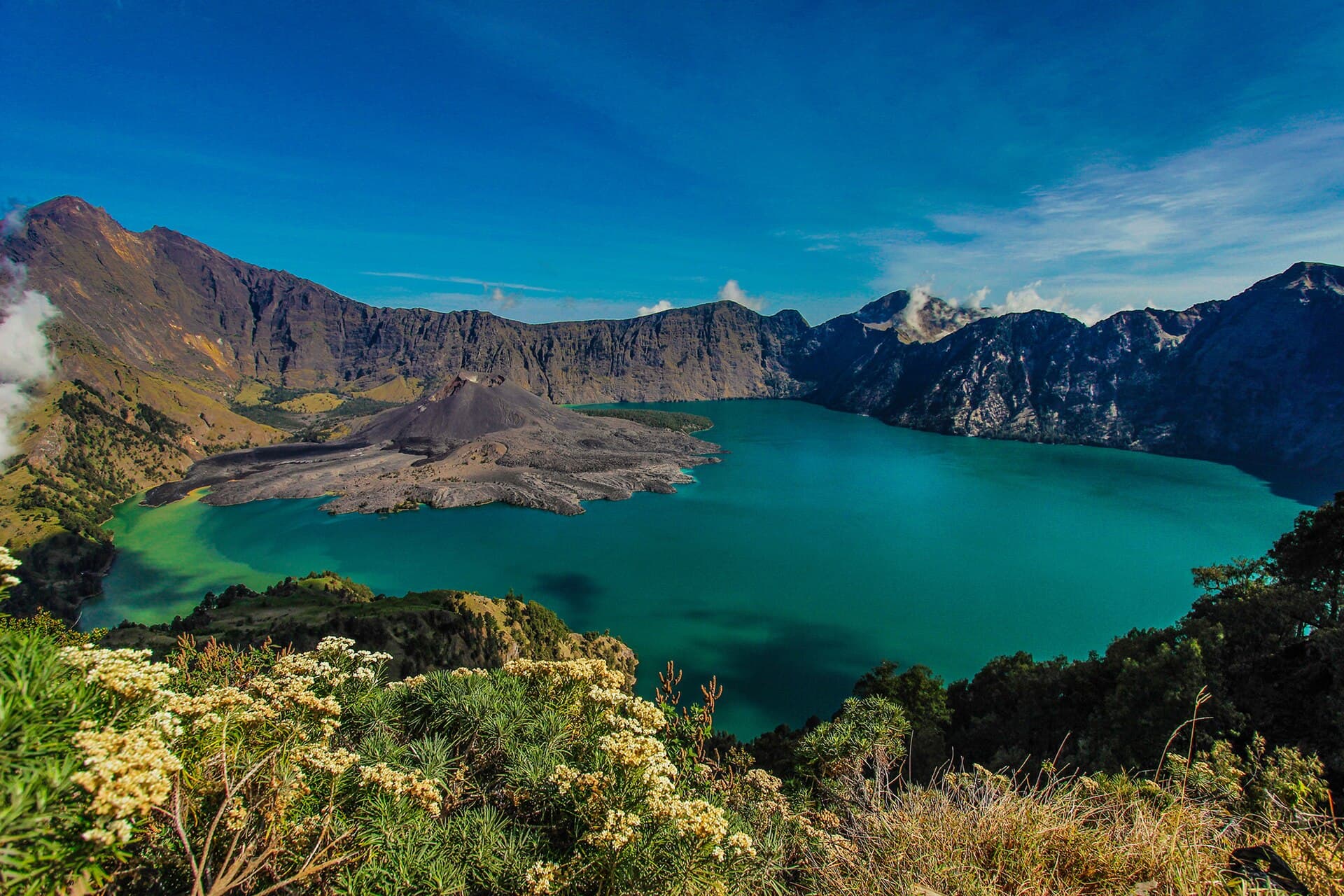
Kawah Ijen is a volcanic crater in East Java that produces two things no other accessible volcano on Earth can match: the largest blue fire phenomenon on the planet, and the world's most acidic crater lake.
The blue fire is not lava. It is sulfuric gases — escaping from fumaroles at temperatures above 600 degrees Celsius — igniting on contact with air. The flames burn up to five meters high and are only visible in darkness, which is why the trek starts at 1 AM.
The crater lake — pale turquoise, one kilometer wide — has a pH of approximately 0.5. For context: battery acid has a pH of approximately 1. The lake is among the most acidic bodies of water on Earth. You will smell it before you see it.
The human story
Ijen's blue fire is the headline. The sulfur miners are the deeper story.
Sulfur miners work inside the crater — inside the toxic gas zone — extracting blocks of solidified sulfur from the fumaroles. They carry the sulfur in bamboo baskets balanced on shoulder poles. Each load weighs 70-90 kg. They make two trips per day: down into the crater, load the baskets, carry them up and out of the crater (a climb of roughly 200 vertical meters on a steep, loose-gravel trail), then down the mountain to the weighing station.
For this, they earn approximately IDR 200,000 per day (~$12-13).
Gas masks are mandatory for tourists entering the crater. Many miners work without them. The sulfur dioxide concentration inside the crater exceeds safety thresholds for prolonged exposure. The health consequences — respiratory damage, reduced life expectancy — are documented but not addressed. The miners do this work because the alternatives available to them pay less.
This is not something to feel righteous about. It is something to know. If you trek Ijen and photograph the blue fire, you will also see men carrying loads that most trekkers could not lift, through gas that you are wearing a mask to filter, for wages that would not cover your hotel room. The appropriate response is not guilt tourism. It is informed attention.
The trek
- Start: 1 AM from Paltuding (the parking area), approximately 45 minutes by road from Banyuwangi
- Distance: 3 km to the crater rim, then descent into the crater for blue fire viewing
- Duration: 4-5 hours round trip
- Difficulty: Moderate — the trail is well-maintained but steep in sections. The crater descent requires care on loose gravel.
- Blue fire window: Only visible before dawn. Once the sun rises, the flames are invisible.
- Gas risk: Real. Carry a gas mask (rental available at trailhead, IDR 50,000). If wind shifts push sulfur dioxide directly at you inside the crater, leave immediately.
The crater lake is visible from the rim in daylight and is worth seeing independently of the blue fire — the color, the scale, and the acidic mist rising from the surface are unlike anything else in the region.
What it costs
| Item | Cost | Notes |
|---|---|---|
| Park entrance (foreign) | IDR 100,000-150,000 (~$6-9) | Varies by day |
| Guide (recommended, not mandatory) | IDR 300,000-500,000 (~$18-30) | Helpful for crater navigation in darkness |
| Gas mask rental | IDR 50,000 (~$3) | Non-negotiable for crater descent |
| Transport from Banyuwangi | IDR 200,000-400,000 (~$12-24) | Return trip, private hire |
| Tour package (Banyuwangi base, all-in) | IDR 500,000-1,500,000 (~$30-90) | Including transport, entrance, guide |
Ijen is the cheapest of the three: $30-90 all-in from Banyuwangi.
The circuit: how to connect all three
The three volcanoes sit across East Java and Bali. The logistics are not complicated, but they require choosing a direction and understanding the transit times.
Option A — Surabaya start, Bali finish (recommended)
This is the natural east-to-west flow, ending with Bali accommodation and an international departure.
| Day | Experience | Overnight |
|---|---|---|
| 1 | Fly into Surabaya. Drive to Bromo area (3-4 hours). Rest. | Cemoro Lawang or Tosari |
| 2 | Bromo sunrise (4 AM). Crater visit. Drive to Ijen area (5-6 hours via Probolinggo-Banyuwangi). | Banyuwangi area |
| 3 | Ijen blue fire trek (1 AM). Return by morning. Ferry to Bali (1 hour Ketapang-Gilimanuk). Drive to Bali base (3-4 hours to Ubud/Kuta area, or 1.5 hours to East Bali). | Bali |
| 4 | Rest day. | Bali |
| 5 | Agung sunrise trek (midnight departure, return by late morning). | Bali |
Total transit: Surabaya to Bali overland via the Ketapang-Gilimanuk ferry crossing. This is the common backpacker route and the way most multi-volcano tours operate.
The hard part: Days 2-3 involve two consecutive 1 AM wake-ups (Bromo sunrise, then Ijen blue fire). This is physically manageable but sleep-depriving. Adding a rest day between Bromo and Ijen makes the circuit six days instead of five and is worth it if you can spare the time.
Option B — Bali start, Surabaya finish
Reverse the flow. Agung first, then ferry to Java, Ijen, drive to Bromo, fly out of Surabaya. This works logistically but puts Agung — the shortest and simplest experience — at the start rather than saving it as a final stop.
Option C — Day-trip Bromo + Ijen, skip Agung
If you are based in East Java and don't plan to cross to Bali, a Bromo-Ijen combination is a standalone 2-3 day trip from Surabaya. Multiple operators package this as a standard product. Agung requires being on Bali and adds the ferry crossing.
What to know about the ferry
The Ketapang (Java) to Gilimanuk (Bali) ferry runs 24 hours a day, roughly every 30 minutes. Crossing time is approximately 1 hour. Cost: IDR 8,000-46,000 ($0.50-$3) depending on vehicle. It is a functional, unglamorous crossing on a roll-on/roll-off ferry. Book nothing in advance — you simply queue and board.
The full circuit cost
Budget (solo traveler, shared transport, basic accommodation)
| Item | Cost (IDR) | Cost (USD) |
|---|---|---|
| Bromo (entrance + shared jeep + homestay) | 540,000 | ~$32 |
| Ijen (entrance + guide + gas mask + transport) | 650,000 | ~$38 |
| Agung (guide package from Bali) | 1,000,000 | ~$60 |
| Transport Surabaya-Bromo | 150,000 | ~$9 |
| Transport Bromo-Banyuwangi | 250,000 | ~$15 |
| Transport Banyuwangi-Bali (ferry + Bali side) | 200,000 | ~$12 |
| Accommodation (4 nights basic) | 1,000,000 | ~$60 |
| Food (5 days) | 750,000 | ~$44 |
| Total | ~4,540,000 | ~$270 |
Mid-range (private driver, mid-range hotels)
| Item | Cost (IDR) | Cost (USD) |
|---|---|---|
| Bromo (entrance + private jeep + mid hotel) | 1,200,000 | ~$71 |
| Ijen (package tour + mid hotel Banyuwangi) | 1,500,000 | ~$88 |
| Agung (full-service guide package) | 2,000,000 | ~$118 |
| Private driver Surabaya-Bromo-Ijen-ferry (3 days) | 3,000,000 | ~$176 |
| Accommodation (4 nights mid-range) | 3,400,000 | ~$200 |
| Food (5 days) | 1,250,000 | ~$74 |
| Total | ~12,350,000 | ~$727 |
Premium (luxury accommodation, private everything)
| Item | Cost (IDR) | Cost (USD) |
|---|---|---|
| Bromo (Plataran Bromo + private tour) | 5,500,000 | ~$324 |
| Ijen (private guide + premium transport) | 2,500,000 | ~$147 |
| Agung (premium guide package) | 3,000,000 | ~$176 |
| Private driver + vehicle (5 days) | 5,000,000 | ~$294 |
| Accommodation (2 nights luxury Java + 2 nights luxury Bali) | 10,000,000 | ~$588 |
| Food (5 days) | 2,500,000 | ~$147 |
| Total | ~28,500,000 | ~$1,676 |
These numbers exclude international flights, domestic flights (Surabaya), Bali tourist tax (IDR 150,000), and travel insurance. The circuit itself — ground transport, entrance fees, guides, accommodation, and food — costs $270-1,700.
Best months
| Month | Conditions | Crowds | Notes |
|---|---|---|---|
| April | Dry season starting. Some rain possible. | Low-moderate | Good balance of weather and crowd levels |
| May | Dry. Stable weather. | Moderate | Kasada ceremony at Bromo (May 30-June 2, 2026) — plan around it |
| June | Dry. Clear skies. | Moderate-high | European summer holidays begin |
| July-August | Driest, clearest. | High | Peak season. Bromo sunrise: 600+ people. Book Agung guides early. |
| September | Dry. Excellent conditions. | Moderate | Best single month — dry weather, reduced crowds |
| October | Transitional. Occasional rain starts. | Low-moderate | Last reliable dry month |
| November-March | Wet season. | Low | Ijen accessible year-round but slippery. Bromo fog/rain common. Agung may have ceremonial closures. |
September is the best month for the circuit. Dry, clear, crowds thinned after the August peak, no major ceremony closures. April and October are strong alternatives.
The Kasada constraint: The Yadnya Kasada ceremony closes Bromo's crater area for several days. In 2026, this falls around May 30 through June 2. Dates shift annually with the Javanese Hindu calendar. If your trip coincides with Kasada, either adjust your schedule or plan to observe respectfully from outside the ceremony zone.
The Agung constraint: Ceremonial closures are announced based on the Balinese Hindu calendar and can last weeks. The March 28 - April 24, 2026 closure was 28 days. Check with local guides or Bali Holiday Secrets for updated ceremonial schedules before booking.
What has changed recently
"Bromo is a spiritual experience." Bromo is a mass-tourism product at peak season and a genuinely impressive geological formation at all times. The spiritual dimension is real — the Tenggerese ceremonies are a living religious tradition — but the 4 AM jeep convoy to Penanjakan 1 is not a spiritual experience. It is a logistics operation. The underlying landscape earns every superlative. The access model does not.
"Ijen blue fire tour — magical night hike!" The blue fire is real and extraordinary. The trek to see it involves walking down a steep, loose-gravel path into a volcanic crater filled with toxic gas, past miners carrying twice their body weight in sulfur for less than $15 a day. "Magical" is a word that obscures what is actually happening.
"Do Bromo and Ijen in one day." Technically possible. You do the Ijen blue fire trek at 1 AM, return by 7 AM, drive 5-6 hours to Bromo, arrive in the afternoon, then wake at 3 AM the next day for Bromo sunrise. Some operators sell this as an "efficiency" play. In practice, it means two nights of 3 hours of sleep separated by 6 hours in a car. It is possible in the way that many bad ideas are possible.
"Agung is open year-round." Agung closes for Hindu ceremonies on dates that are not fixed to the Gregorian calendar. It also closed for volcanic eruptions from 2017 to 2019. "Open year-round" is true in the same way that "I'm always available" is true — with significant and unpredictable exceptions.
Day trip vs. multi-day comparison
| Approach | What you get | What you miss |
|---|---|---|
| Day trip each (3 separate day trips) | Maximum flexibility. Sleep in comfortable hotels. No camping gear needed. | No sense of geographic connection between the volcanoes. More time in cars. |
| 5-day circuit (Option A above) | The natural flow. See all three with transit days built in. | Two consecutive pre-dawn starts are tiring. The Bromo-to-Ijen drive is long. |
| 6-7 day circuit (with rest days) | Best balance. Rest day after Bromo, rest day in Bali before Agung. | Costs more in accommodation and food. |
| 8+ day circuit (adding Semeru/Rinjani) | The complete volcanic experience. | Semeru is restricted to Ranu Kumbolo (no summit). Rinjani adds 3-4 days and a flight to Lombok. Different category of trip. |
The recommendation: the 5-day circuit is the standard product. The 6-7 day version with rest days is the better experience. The day-trip approach works if you're already based in Surabaya or Bali and want to add volcanoes without committing to a circuit.
The thing to understand
Indonesia's volcanic tourism circuit is not a wilderness trek. It is not an expedition. It is a series of encounters with active geological forces that happen to be wrapped in one of the densest cultural and spiritual landscapes on Earth.
The Tenggerese have thrown offerings into Bromo's crater for 500 years. Sulfur miners have carried impossible loads out of Ijen's crater for generations. The Balinese have oriented their entire civilization toward Agung's summit.
You can see the blue fire and photograph the sunrise and climb to the crater rim of the holiest mountain on Bali. The volcanoes allow it. The question is whether you understand what you are standing in front of, or whether you treat it as content.
The volcanoes will be there after the Instagram accounts are gone. The miners will still be carrying sulfur. The Tenggerese will still be making offerings. What you bring to these places is your own problem.
7 Sources
- bromotenggersemeru.orgBalai Besar TN Bromo Tengger Semeru — official park authority site
- pmc.ncbi.nlm.nih.govSyahbana et al., 'The 2017–19 activity at Mount Agung,' Scientific Reports (2019)
- geology.comGeology.com — Kawah Ijen: blue flames and the world's largest acidic lake
- pmc.ncbi.nlm.nih.gov'Toxic natural pollution at Ijen crater volcano,' Toxicology Reports (2025)
- indonesia.travelIndonesia Travel (official tourism board) — Yadnya Kasada at Mount Bromo
- lovebali.baliprov.go.idLove Bali — official Bali Provincial Government foreign-tourist levy portal
- antaranews.comANTARA (national news agency) — ASDP Ketapang–Gilimanuk ferry tariff