The mountain
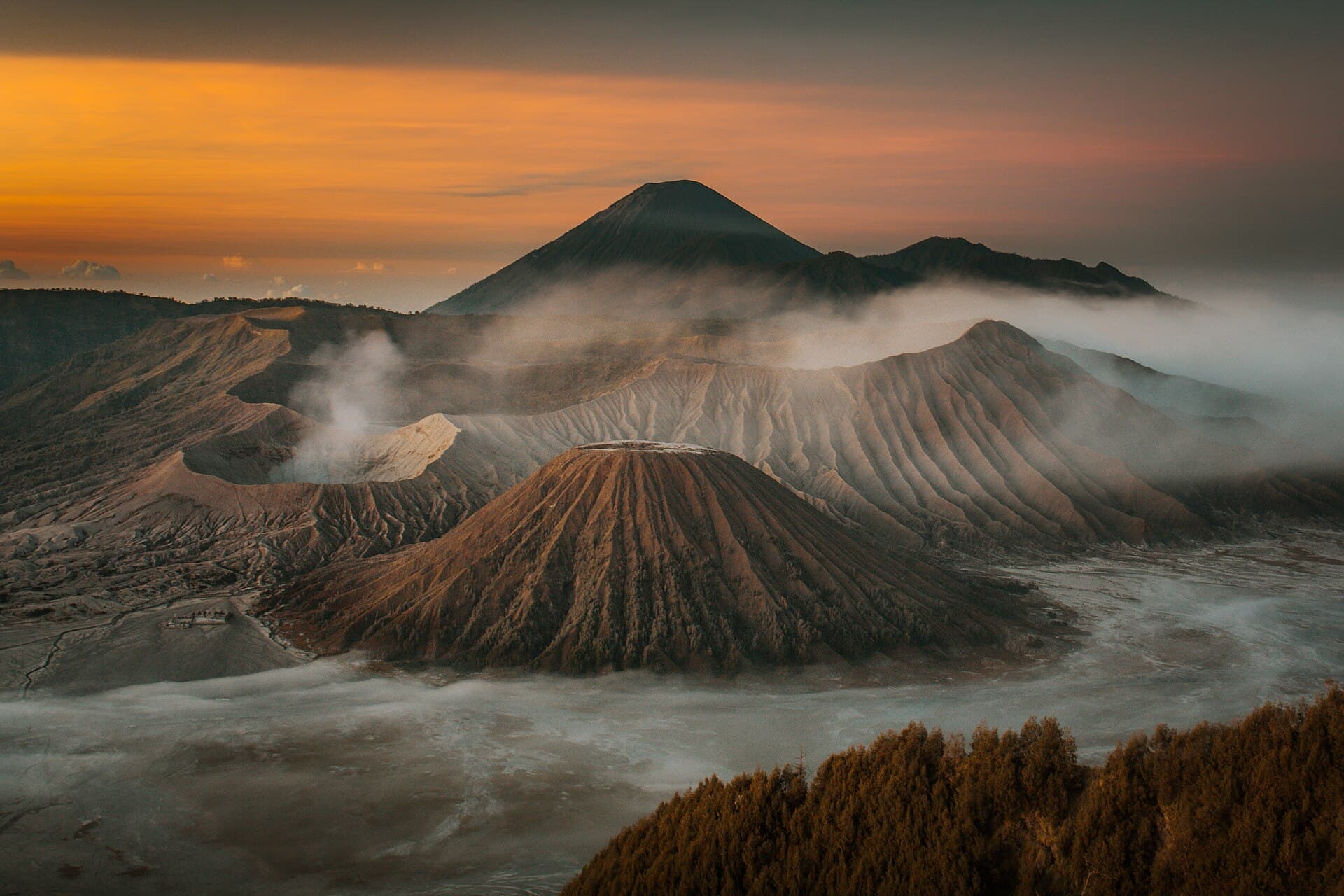
Mount Rinjani is a 3,726-meter active stratovolcano on Lombok, the island directly east of Bali. Inside its caldera sits Segara Anak — a turquoise crater lake at 2,004 meters elevation, roughly 11 square kilometers in area and 230 meters deep. The name means "child of the sea" in the Sasak language. Natural hot springs line the lakeshore at Aik Kalak. A younger volcanic cone, Gunung Baru Jari, rises from the lake itself — evidence that Rinjani is still geologically active, though its last significant eruption was in 2010 (VEI 2). PVMBG maintains it at Alert Level I (normal) as of April 2026.
Rinjani holds UNESCO Global Geopark status (designated 2018) and is sacred to both the Sasak people and Balinese Hindus. Annual Mulang Pekelem ceremonies bring offerings of gold, cloth, and livestock to Segara Anak. The mountain is not a backdrop — it is a living spiritual site. Trekking regulations reflect this. Closures for religious ceremonies are enforced, and behavior rules around the crater lake are taken seriously.
Wikipedia -- Mount Rinjani; Green Rinjani -- Rinjani Info; History of Mount Rinjani -- Green Rinjani
Three routes
Sembalun — the summit route
Starts at Sembalun Village (1,156m). Open savanna, exposed terrain, minimal shade. The trail crosses the "Seven Hills" and passes Bukit Penyesalan — "Regret Hill" in Indonesian, named for the moment most trekkers reconsider their decisions. Reaches Plawangan Sembalun (the Sembalun Crater Rim) at approximately 2,639 meters. This is the staging camp for the summit push.
The summit attempt starts around 2:00 AM. The final 1,087 vertical meters to the 3,726-meter peak involve loose scree, steep switchbacks, and volcanic gravel that slides underfoot. Sunrise from the summit — if the weather cooperates — puts the entire caldera, Segara Anak, Gunung Baru Jari, and the Senaru rim into view with Bali's Agung and Sumbawa's Tambora on the horizon.
This is the most direct path to the summit and the most popular route for summit-focused treks.
Senaru — the jungle route
Starts at Senaru Village (601m). Dense tropical rainforest for the first several hours, transitioning to montane scrub above 2,000 meters. More elevation gain than Sembalun (2,040m vs. 1,483m to the crater rim), but better shade and a more gradual approach. Reaches the Senaru Crater Rim at 2,641 meters — one of Lombok's best viewpoints.
The Senaru route does not offer a direct summit approach. To summit from Senaru, trekkers descend into the caldera, cross to the lake, then climb back up to the Sembalun rim before the summit push. This adds a full day. The Senaru route is better suited for crater rim treks (2D1N) or lake-focused itineraries (3D2N without summit).
Torean — the scenic exit
Starts or ends at Torean Village (585m). Descends through cliff faces, waterfalls, and river valleys on the western flank. Typically used as an exit route from Segara Anak rather than an ascent — though it is now classified as an official entry route as well.
The Torean descent is physically demanding in a different way than climbing: steep, slippery terrain through narrow river canyons. It is less trafficked than Senaru or Sembalun and offers the most dramatic waterfall scenery on the mountain.
Green Rinjani -- Rinjani Trekking Route; Green Rinjani -- Trekking Itinerary 2026
Continue reading Indonesia's volcanoes — the fire monopoly Nepal doesn't have →
Stage-by-stage: the popular combinations
3D2N Sembalun to Torean — Summit + Lake + Scenic Exit
Day 1: Sembalun Village (1,156m) to Sembalun Crater Rim (2,639m). 7-8 hours trekking. Open grassland, exposed sun, steady climb through the Seven Hills. Camp at Plawangan Sembalun.
Day 2: Summit push at 2:00 AM. Sembalun Crater Rim to Summit (3,726m) — 3-4 hours up through loose volcanic scree. Sunrise at the top. Descend back to the rim, then drop 600 meters into the caldera to Segara Anak lake (2,004m). Soak in the Aik Kalak hot springs. Camp lakeside. This is the longest day — 10-12 hours of movement.
Day 3: Lake to Torean Village (585m). Descend through waterfalls, cliff paths, and river valleys. 5-6 hours. Transport arranged from Torean back to Senaru or the airport.
4D3N Sembalun to Senaru — The Full Circuit
Day 1: Sembalun Village to Sembalun Crater Rim. Same as above.
Day 2: Summit push, descent to lake. Same as above.
Day 3: Rest day at the lake. Hot springs, explore Gunung Baru Jari crater cone. Afternoon ascent to Senaru Crater Rim (2,641m). Camp there. This day is why the 4-day version exists — it gives the body a partial recovery before the second rim climb.
Day 4: Senaru Crater Rim down to Senaru Village (601m). 6-7 hours through dense forest. The descent is steep and hard on knees.
2D1N Senaru Crater Rim — The Budget Option
Day 1: Senaru Village to Senaru Crater Rim (2,641m). 7-8 hours through forest. Camp at the rim.
Day 2: Sunrise at the rim with views of the caldera and lake. Descend to Senaru. 4-5 hours.
No summit. No lake. The cheapest package — approximately $160-$185 per person depending on group size. A reasonable option for trekkers who want the crater view without the summit commitment.
3D2N Hot Springs + Lake via Senaru — No Summit
Day 1: Senaru Village to Senaru Crater Rim.
Day 2: Descend into the caldera to Segara Anak. Hot springs at Aik Kalak. Camp lakeside.
Day 3: Ascend back to Senaru Crater Rim and descend to Senaru Village.
This avoids the summit entirely and focuses on the lake and hot springs. A legitimate alternative for trekkers who prefer the caldera experience over the peak.
The e-Rinjani permit system
All Rinjani treks are booked through e-Rinjani, the digital booking system operated by BTNGR (Balai Taman Nasional Gunung Rinjani). This has been the sole legal permitting channel since 2019. There is no walk-up booking. There is no paying at the gate. Any guide telling trekkers to "just show up" is either lying or describing a system that ended seven years ago.
Daily quota: 400 trekkers
The mountain allows 400 trekkers per day across all three routes. The split: 240 permits reserved for licensed trekking operators (this is where foreign visitors book), and 160 permits for individual/local bookings via the e-Rinjani app.
During peak season (July-August), popular routes sell out. The e-Rinjani system auto-closes when the quota fills. Off-peak (April-June, September-October), availability is rarely a problem.
Season
Open April 1 through December 31. Closed January 1 through March 31 for the rainy season and ecosystem recovery. The e-Rinjani system reopened for 2026 bookings on March 6, 2026.
Pricing (2026)
Foreign visitor entrance fee: IDR 250,000 per day (approximately $15/day at the April 2026 rate of ~17,000 IDR/USD). This pricing took effect November 3, 2025, when Rinjani was reclassified as a Class 1/Class 2 conservation area under Ministry of Environment and Forestry regulations (Permen LHK No.17/2025). The old rate of IDR 150,000 that still appears on most English-language blogs is no longer correct.
Green Rinjani -- e-Rinjani Booking Guide; Green Rinjani -- Trekking Rules 2026; Rinjani Trekking Planner -- Entrance Fees 2026
Mandatory guides and the 1:4 ratio
Foreign trekkers have been required to book through a PB-PJWA licensed Trekking Organizer since the post-earthquake safety overhaul in 2018. Independent trekking by foreign nationals is not permitted — the e-Rinjani system blocks solo permit applications from non-Indonesian passport holders.
The guide-to-trekker ratio was previously 1:6. From January 2026, the ratio tightened to 1:4 — one guide per four foreign trekkers. The porter ratio is 1:2 (one porter per two trekkers), with a load limit of 25 kg per porter.
There is no IFMGA (International Federation of Mountain Guides Associations) member body in Indonesia. Rinjani guides are certified through the national park authority, not through an international mountaineering credential. This does not mean they are unqualified — many have done the mountain hundreds of times. It means the quality assurance mechanism is the operator's reputation, not a transferable professional license.
Hike On Rinjani -- Without a Guide; Rinjani Trekking Planner -- Guide Requirements
Crater rim vs. summit vs. lake — choosing the right trek
This distinction matters. They default to recommending the summit without explaining that Rinjani offers three genuinely different experiences, each with its own fitness requirement and reward.
Crater rim only (2D1N)
Fitness: Moderate. A fit person with no trekking experience can do this. The trail is steep but the elevation gain (2,040m from Senaru) is spread over 7-8 hours.
Reward: The crater rim view — looking down into the caldera at Segara Anak and Gunung Baru Jari — is the single most photographed vantage point on the mountain. Many trekkers who summit report that the rim view was more impressive than the summit view.
Cost: $160-$185/person.
Summit (3D2N or 4D3N)
Fitness: Hard. The summit push — 1,087 vertical meters of loose scree starting at 2:00 AM — is the crux. Altitude sickness affects unprepared trekkers above 3,000 meters. Previous multi-day trekking experience is strongly recommended.
Reward: Standing on the highest point in Lombok at sunrise, with the entire caldera below and Bali, Sumbawa, and the Gili Islands visible on clear mornings.
Cost: $225-$395/person depending on route combination, group size, and operator.
Lake + hot springs (3D2N)
Fitness: Moderate-hard. The descent into the caldera and the climb back out are demanding, but there is no high-altitude scree scramble.
Reward: Swimming in a volcanic crater lake at 2,000 meters, soaking in natural hot springs at the base of an active volcanic cone. This is the experience that has no equivalent on any other mountain in Southeast Asia.
Cost: $195-$280/person.
What $225 actually buys
The entry-level trek price that operators quote — typically $215-$235 for a 3D2N summit trek with a group of 4-6 people — is a real number. It covers:
- Licensed guide (included)
- Porters for group gear, food, and cooking equipment (included)
- All meals on the mountain — breakfast, lunch, dinner, snacks (included)
- Tent, sleeping bag, and mat (included)
- Park entrance permits via e-Rinjani (included)
- Transport from Senaru/Sembalun to the trailhead (included)
What it does not cover is everything needed to reach the trailhead and return home. The all-in cost for a foreign trekker is substantially higher.
All-in cost breakdown (2026)
| Item | Budget | Mid-Range | Premium |
|---|---|---|---|
| International flight (to Bali/Lombok) | $600 | $1,000 | $1,800+ |
| Domestic flight (Bali to Lombok, 25 min) | $40 | $60 | $100 |
| Lombok accommodation (2 nights pre/post) | $30 | $120 | $500 |
| Trek package (guide + porters + food + gear + permit) | $215 | $305 | $450+ |
| Park entrance fee | $15 | $15 | $15 |
| Mandatory insurance (2026) | $18 | $18 | $0 (own policy) |
| Extra porter (personal gear) | $0 | $25/day | $50/day |
| Tips (guide + porter team) | $10 | $25 | $60 |
| Transport (airport to Senaru/Sembalun, 2.5-3 hrs) | $15 | $40 | $80 |
| Gear rental (sleeping bag, jacket at trailhead) | $20 | $0 (included) | $0 (included) |
| Total | $963 | $1,608 | $3,053+ |
The trek package is 15-25% of total spend. The flight is the largest single cost. Operators quoting "$225 for the Rinjani trek" are accurate for the mountain portion and misleading about the trip.
RinjaniTrekAdventure -- Cost; Green Rinjani -- Trekking Prices 2026; Rinjani Dawn Adventures -- Prices 2026
Insurance tiers (2026)
Starting in 2026, insurance is mandatory for all Rinjani trekkers. There are two tiers:
Basic coverage is included in the e-Rinjani permit fee. It covers standard trekking accidents and ground evacuation.
Premium Trekking Insurance is new for 2026. It covers helicopter evacuation — relevant because Rinjani's terrain makes helicopter landings extremely difficult. Cost: approximately IDR 290,000 (~$18). If a trekker's personal travel insurance does not explicitly cover air evacuation from altitude, the Premium tier is compulsory.
This matters because standard travel insurance frequently excludes trekking above 3,000-4,000 meters. Verify altitude coverage limits before assuming existing policies apply. Rinjani's summit is 3,726 meters — above many standard policy ceilings.
Helicopter evacuation on Rinjani is rare but not theoretical. In 2025, a Dutch hiker was airlifted after a fall on the Sembalun route, and a Brazilian woman was located via thermal drone after falling into a ravine in what Basarnas (Indonesia's SAR agency) described as "one of the most difficult mountain rescues in Indonesia's history" — three helicopters were deployed.
Hiking Rinjani -- Insurance Regulation; Rinjani Dawn Adventures -- Emergency Guide 2026
The porter reality
Rinjani porter wages run IDR 250,000-400,000 per day ($15-$25). On a 3-day trek, a porter earns IDR 900,000-1,200,000 ($55-$75). In peak season (June-September), a porter working 10 treks per month can earn roughly 4x the provincial minimum wage for West Nusa Tenggara. In the rainy season (January-March), when Rinjani is closed, income drops to zero.
The official load limit is 25 kg per porter. Operators routinely push 30-40 kg. There is no formal porter cooperative or certification program equivalent to Nepal's Porter Progress or Kilimanjaro's KPAP. Individual operators self-regulate.
Operators like Authentic Rinjani and Green Rinjani advertise above-standard wages, provide gear to porters, and run zero-waste programs where porters are paid a premium for carrying trash left by other groups. This is operator-level branding, not systemic certification. There is no independent body verifying compliance.
Tipping guidance: IDR 100,000-200,000 ($6-$12) per trekker per day for the combined guide and porter team. On a 3-day trek with a 2-person group, tipping IDR 300,000-600,000 total ($18-$37) is considered fair. This can represent 30-50% of a porter's base pay. It matters.
Authentic Rinjani -- Trekking Info 2025; Hiking Mount Rinjani -- Porter Info
Post-earthquake trail status
The M6.4 earthquake on July 29, 2018 caused major trail damage, triggered landslides, and required the evacuation of approximately 690 climbers from the mountain. One person died from rockfall. The earthquake triggered an indefinite closure, trail reconstruction, and the subsequent implementation of mandatory guides and the e-Rinjani permit system.
In mid-2025, two consecutive hiking accidents on July 17 on the Sembalun Crater Rim to Lake descent route — a Dutch hiker airlifted and a Swiss tourist with a leg fracture — triggered another temporary closure for trail maintenance and safety upgrades. The route fully reopened August 11, 2025.
As of April 2026, all three routes (Sembalun, Senaru, Torean) are open and operational. Trail conditions are good by Indonesian standards — maintained, marked, and staffed by BTNGR rangers. This is not Nepal's Annapurna Circuit with teahouses and stone staircases. The trails are volcanic gravel, exposed roots, and scree. Trekking poles are not optional.
Best months
| Period | Conditions | Crowds |
|---|---|---|
| April-May | Early dry season. Occasional afternoon rain. Trails can be muddy. | Low. Best availability on e-Rinjani. |
| June | Dry. Clear skies most mornings. | Moderate. Rising. |
| July-August | Driest, clearest. Coldest nights at altitude. | Peak. Sembalun route sells out. Book 2-4 weeks ahead. |
| September | Dry, clear, slightly warmer than July-August. | Moderate. The best single month for the balance of weather and crowd. |
| October | Transitional. Afternoon cloud buildup increasing. | Low-moderate. |
| November-December | Increasing rain. November still trekable. December wet. | Low. |
| January-March | Closed. Rainy season. Ecosystem recovery. No permits issued. | N/A. |
August delivers the best weather. September delivers the best experience — nearly identical conditions with significantly fewer people on the mountain.
Mighty Travels -- Indonesia Hiking Month-by-Month; Green Rinjani -- Trekking Season 2026
Gear
Rinjani is a tropical volcano, not an alpine peak. The gear list reflects this — lighter than Kilimanjaro, heavier than a Southeast Asian day hike.
Provided by operators (standard packages): Tent, sleeping bag, sleeping mat, cooking equipment, meals. Verify sleeping bag temperature rating with the operator — crater rim temperatures drop to 5-10 degrees Celsius at night (July-August), and some budget operators provide bags rated only to 15 degrees.
Bring or rent:
- Trekking boots. Mandatory. The volcanic gravel and scree on the summit push will destroy trail runners. Ankle support matters on the crater rim descent.
- Trekking poles. Not optional. The Sembalun descent and the scree slopes eat knees without them.
- Headlamp. For the 2:00 AM summit push.
- Rain jacket. Even in dry season, cloud cover at the crater rim can produce drizzle.
- Warm layers. Fleece or lightweight down jacket. Nights at 2,600-3,700 meters in the tropics are cold — not Himalayan cold, but cold enough that trekkers in cotton regret it.
- Sun protection. Sembalun's open savanna is fully exposed. Sunburn at 2,000+ meters tropical altitude is fast and severe.
- Water purification. Operators provide water, but tablets or a filter are backup insurance.
- Personal first aid. Blister kit, basic painkillers, anti-diarrheal. The nearest hospital is in Mataram, 2-3 hours from either trailhead.
Gear rental is available at both trailheads (Senaru and Sembalun) — sleeping bags, jackets, and trekking poles at approximately IDR 50,000-100,000 ($3-$6) per item per day. Quality varies. Bringing core items is preferable.
Getting there
International flight: Fly to Lombok International Airport (LOP) directly from Singapore, Kuala Lumpur, or Perth. Or fly to Bali (DPS) — the larger hub — and connect to Lombok on a 25-minute domestic flight (AirAsia, Lion Air, Wings Air, from $40 one-way).
Airport to trailhead: Senaru and Sembalun villages are 2.5-3 hours from Lombok airport by car. Roads are paved but winding through the mountain interior. Shared transport runs $15; private car $40-$80. Most trek operators arrange transfers as part of the package.
Cash: ATMs exist in Mataram but are unreliable in Senaru and Sembalun. There are no ATMs at either trailhead. Trek operators accept bank transfer pre-payment or cash on arrival. Withdraw IDR in Mataram before heading north. No cards, no QRIS, no digital payments in the trekking villages.
Visa: Indonesia's e-VOA (Electronic Visa on Arrival) covers trekking under tourism purposes. IDR 500,000 (~$35), single entry, 30 days, extendable once. Apply at evisa.imigrasi.go.id at least 48 hours before departure.
LMBK Surf House -- Getting to Lombok 2026; Sundays Lombok -- Currency guide
What has changed recently
A search for "rinjani trek" in April 2026 returns guides with the following errors. These are not edge cases — they appear in the top 10 English-language results.
| Claim in guides | 2026 reality |
|---|---|
| "Entrance fee is IDR 150,000" | IDR 250,000/day since November 2025 |
| "No insurance required" | Premium Insurance (IDR 290,000) mandatory since 2026, or proof of equivalent personal policy |
| "You can trek independently" | Foreign nationals must book through licensed operators; solo permits blocked on e-Rinjani |
| "Book at the gate on arrival" | Online booking via e-Rinjani required minimum 2 days in advance; 400/day quota enforced |
| "Guide ratio is 1:6" | Changed to 1:4 from January 2026 |
Every one of these errors creates a problem at the trailhead — wrong cash amount, no insurance, no permit, or a group too large for its guide allocation. The information ecosystem around Rinjani is 1-3 years behind the regulatory reality. Verify directly on the e-Rinjani platform or through a licensed operator before traveling.
Green Rinjani -- Trekking Rules 2026; Rinjani Dawn Adventures -- Prices 2026
The luxury gap
There is no luxury Rinjani product. Every night on the mountain is in a tent. The closest thing to a premium experience is Green Rinjani's Deluxe Service — a Hillman Turtle four-season tent, 8 cm thick mattresses, a private toilet tent, and a menu that includes rendang, satay, and fruit platters instead of instant noodles. The price premium is $100-$200 over standard. It is still camping on volcanic gravel.
The nearest quality accommodation is Rinjani Lodge in Senaru — 13 rooms, two infinity pools, Rinjani views, approximately $80-$150/night. The Lombok Lodge offers a boutique Rinjani Adventure Retreat from $1,468 per couple, but the resort itself is not near the trailhead.
The V.V.I.P. packages some operators advertise are marketing language for "private group with extra porters." The mountain experience does not fundamentally change. There is no Kilimanjaro-style glamping operation, no crater-rim lodge, no permanent shelter above the trailhead. This is a product gap, not a deficiency of the mountain — and it means the $200 trekker and the $600 trekker are sleeping on the same volcano, eating under the same tarp, and looking at the same sunrise.
Decision framework
| Question | Answer |
|---|---|
| How fit do I need to be? | Crater rim: moderate fitness, no prior trekking required. Summit: previous multi-day trek experience recommended. The 2 AM summit push on scree is the hardest 4 hours. |
| How far in advance to book? | July-August: 2-4 weeks minimum. April-June, September: 1 week is usually sufficient. |
| Solo trekker? | Must book through an operator regardless. Group packages are cheaper per person. Solo surcharge adds $50-$150. |
| Bali or Lombok base? | Lombok. The 25-minute flight from Bali costs $40-$100 and adds a day. Arriving directly to Lombok saves time and money. |
| Which operator? | Licensed through PB-PJWA. Green Rinjani, Rinjani Dawn Adventures, Authentic Rinjani, and Rinjani Trekking Planner all have 2026-current pricing and responsive booking systems. |
| Summit or lake? | If fitness allows, do both — the 3D2N Sembalun-Torean or 4D3N Sembalun-Senaru circuits include both summit and lake. Choosing only one: the lake and hot springs are the experience unique to Rinjani. Other mountains have summits. Few have a swimmable crater lake with volcanic hot springs at 2,000 meters. |
Research date: April 2026. All prices, permit rules, and trail statuses verified against operator websites and BTNGR regulations as of this date. Volcanic alert levels should be checked at magma.esdm.go.id before travel. Exchange rate used: 1 USD = ~17,000 IDR.
6 Sources
- unesco.orgUNESCO — Rinjani-Lombok UNESCO Global Geopark
- rinjaninationalpark.idBalai Taman Nasional Gunung Rinjani (BTNGR) — official national park site
- rinjaninationalpark.idBTNGR — Rinjani climbing ticket class and tariff increase (2025)
- magma.esdm.go.idMAGMA Indonesia (PVMBG) — official volcano alert-level platform
- english.news.cnXinhua — Rinjani closes Pelawangan Sembalun trail to Segara Anak (July 2025)
- en.antaranews.comANTARA News — Rinjani National Park closes Pelawangan–Segara Anak trail (2025)